NOTE BY NORSE: HUFF (Homeless United for Friendship & Freedom) has noted and denounced the discriminatory creation and enforcement of the No Smoking ordinance in parks with what appears to be an objective far Continue reading
Category Archives: Bathrobespierre’s Broadsides Radio Show
Who’s Watching Us in Santa Cruz?
NOTES BY NORSE:


Deputy Chief Steve Clark presented his usual smarmy defense of this system, noting the upsurge in car thefts. I was the only one questioning this agenda item when it came up at City Council two days ago with Clark and Chief Vogel standing by to push it through.
They needn’t have bothered. No Council member sought to require any anti-surveillance protections, clarification of which records were retained, etc. One can understand the crypto-fascist majority of Bryant, Terrazas, and Mathews supporting this. Or the unapologetically fascist Robinson and Comstock.
But the psuedo-progressives Posner and Lane following along? Well, ask yourselves what police expansions these two have ever opposed?
Community members should demand to know what kind of records are currently being kept on innocent people by the SCPD and what surveillance devices are currently being funded and/or accessed by police agencies. Just demanding public records as to where the surveillance cameras are placed could be helpful.
If anyone has information about where Santa Cruz surveillance cameras are placed, please pass it on to HUFF.
Santa Cruz Police to Add Cameras That Can Track Every Driver in the City
Some think the system which monitors every license plate on a road could be a ‘1984’-like invasion of privacy.
Posted by Brad Kava (Editor) , September 11, 2013 at 04:20 AM
With little debate or discussion, the Santa Cruz City Council Tuesday approved the purchase of $38,000 of cameras that can photograph and keep indefinitely the license plates of every car entering or leaving the city.
Called Automated License Plate Readers, the technology has been controversial in other cities, with freedom advocates claiming it is a step toward a 1984 surveillance system. The ones proposed by local police are mobile and can be kept in an officer’s car and set up when needed. They can read thousands of license plates per minute.
The money comes from a federal grant to help local agencies buy equipment. Police across the country have used them for cameras and other paramilitary equipment. The sheriff’s department will share in the funds.
Santa Cruz Deputy Chief Steve Clark told the council the technology would greatly help in retrieving stolen cars, and could have helped in a number of unsolved cases, such as the disappearance of antique dealer Deanna Brooks, who went missing 13 months ago and has never been found.
He said it could have possibly helped in the shooting of a UCSC student who survived a gunshot wound to the head at a bus station last year and has remained unsolved.
The city will purchase eight mobile units that can track traffic at major entry points, Clark said. Milpitas has used similar technology.
At issue in some cities is the question of how the technology can be used. The American Civil Liberties Union has issued a 26,000 page report on the monitoring, calling it an invasion of privacy and raising poignant questions, none of which were asked by the city council.
For example, do police have a right to monitor and keep information on drivers not suspected of a crime? Are the records public, and if so, could a citizen subpoena them, for example, in a divorce case to check on a cheating spouse? Can an insurance company get ahold of them to determine who was driving a car or how well they were driving?
Under what restrictions would the police use the information and for how long would they keep it?
The ACLU says of the “ALRP” technology on its homepage:
“The documents paint a startling picture of a technology deployed with too few rules that is becoming a tool for mass routine location tracking and surveillance. License plate readers can serve a legitimate law enforcement purpose when they alert police to the location of a car associated with a criminal investigation. But such instances account for a tiny fraction of license plate scans, and too many police departments are storing millions of records about innocent drivers.”
A report by the International Chiefs of Police Association listed some concerns about personal liberties and the readers:
“Recording driving habits could implicate First Amendment concerns. Specifically, LPR systems have the ability to record vehicles’ attendance at locations or events that, although lawful and public, may be considered private. For example, mobile LPR units could read and collect the license plate numbers of vehicles parked at addiction counseling meetings, doctors’ offices, health clinics, or even staging areas for political protests.”
Civil rights groups sued the Los Angeles Police Department over use of the cameras.
For further comment go to: http://santacruz.patch.com/
Fighting Back Against City Council’s “Crowd and Crush Street Vendors and Performers Ordinances”
https://www.indybay.org/newsitems/2013/09/09/18742960.php?show_comments=1#18743107
by HUFF (posted by Norse)
Wednesday Sep 11th, 2013 11:24 PM
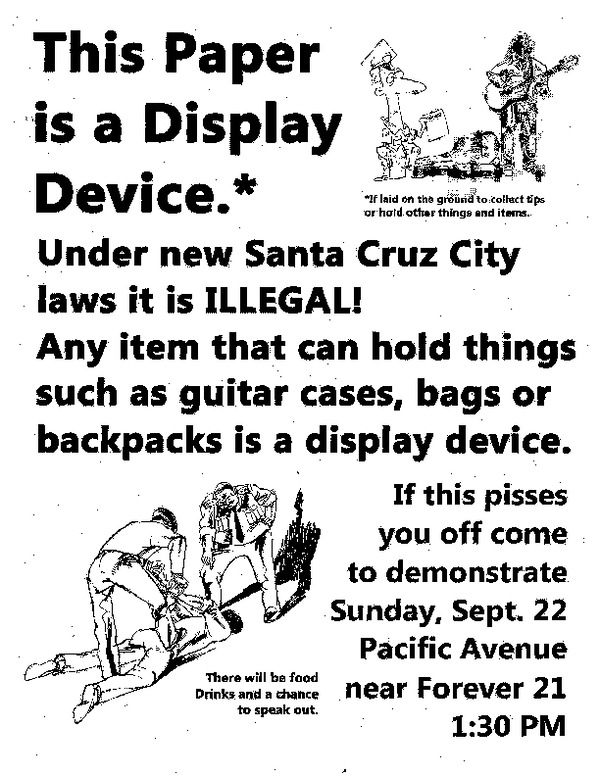
HUFF voted to call a protest with food, possibly music, and speakers on Sunday September 22nd at 1:30 PM in front of Forever 21 near Soquel and Pacific Avenues in anticipation of the final vote on the ordinances the afternoon of September 24th at City Hall.
A preliminary organizational meeting will be held Saturday September 14th at 5 PM on the steps of the main post office after the Food Not Bombs meal.
We encourage folks to pass the word to street performers, street vendors, homeless people being targeted by police, rangers, and security thugs, as well as political activists–all of whom will be severely impacted by these downtown ordinances that reduce tabling, sparechanging, vending, and performing space by 4/5.
RECENT REPORTS OF POLICE AND MERCHANT HARASSMENT AND DISCRIMINATION
Reports are coming in of mass harassment at the Red Church driving away sleepers on Tuesday morning and of mass ticketing of sleepers up near the railroad tracks a few days earlier. Travelers newly arrived are getting camping tickets, but not being informed that such tickets are subject to dismissal if the victim gets on the waiting list of the Homeless (Lack of ) Services Center. Trespass tickets are being used as a substitute for camping tickets in order to avoid the mandatory dismissal required by MC 6.36.055.
The downtown Coffee Roasting Company, according to its staff, is now refusing service to homeless people with large backpacks. Brent Adams reports that a family of three (mother, father, and child) bought coffee last night, and then were told to leave after the father brought in a laptop computer. If you are a regular customer or simply concerned about this kind of hateful attitude, please speak to the management and let them now how you feel. Also please post any more recent accounts of such repulsive behavior.
Sean Deluge created the flyer.
Shafting Non-Shoppers: Expanding the Destructive Downtown Ordinances
https://www.indybay.org/
Shafting Non-Shoppers: Expanding the Destructive Downtown Ordinances
by Robert Norse ( rnorse3 [at] hotmail.com )
Monday Sep 9th, 2013 11:33 AM
Monday Sep 9th, 2013 11:33 AM
In a disguised attack on the entire non-commercial street scene, tomorrow’s afternoon City Council meeting will rubberstamp restricting Continue reading
Keith McHenry on the Santa Cruz Eleven
Santa Cruz Eleven, the Lessons of Food Not Bombs and The Broader Austerity Crisis
by Keith McHenry (posted by Norse)
Sunday Sep 8th, 2013 2:13 AM
Sunday Sep 8th, 2013 2:13 AM
Keith McHenry has visited Santa Cruz numerous times to support the Santa Cruz Eleven (four of whom are still charged with phony felonies). Their “crime” was to report on, witness, and be supportive of a Continue reading
Fresno Fires on the Homeless…Again
NOTES BY NORSE: The kind of photographic and journalistic documentation of Santa Cruz’s calculated cruel crackdown on homeless camps is much needed—-and we can learn much from Fresno–where homeless activists have pressed successful lawsuits, provided the trash and waste disposal that the city refuses to provide to existing homeless encampments, and publicized abuses so regularly that the City is forced to respond with the kind of caution (though not really care) that is entirely foreign to Santa Cruz sweeps.
Still no word from Councilmember Posner on the $15,000 bill for a lone portapotty being set up “as an experiment” near the San Lorenzo River at night (the only 24-hour shitter in town apparently). As I continually insist, the money could be far more effectively spent on opening existing bathrooms in San Lorenzo Park and at the Soquel and Front St. parking structure. What say you, Posner?
No word either from City Attorney Barisone on the right of artists to put sales tags (i.e. visible prices) on their work on Pacific Ave. even though the clear White vs. City of Sparks decision forced Barisone to allow Rightsfinder Robin to do just that several years ago. (For the decision go to www.huffsantacruz.org and look under “Recent Legal Decisions” on the main page.
HUFF meets tomorrow (9-4) at 10 AM at the Sub Rosa if folks wish to discuss and act on these issues.
 The author, Jessie Speer (center), with Ray Polk (left) and Larry Collins (right) at the H street homeless encampment, which the City of Fresno plans to bulldoze on Sept. 9.
 The City of Fresno destroyed Yellow Feather’s shelter and confiscated her property. She now sleeps on the sidewalk near the Poverello House.
Still no word from Councilmember Posner on the $15,000 bill for a lone portapotty being set up “as an experiment” near the San Lorenzo River at night (the only 24-hour shitter in town apparently). As I continually insist, the money could be far more effectively spent on opening existing bathrooms in San Lorenzo Park and at the Soquel and Front St. parking structure. What say you, Posner?
No word either from City Attorney Barisone on the right of artists to put sales tags (i.e. visible prices) on their work on Pacific Ave. even though the clear White vs. City of Sparks decision forced Barisone to allow Rightsfinder Robin to do just that several years ago. (For the decision go to www.huffsantacruz.org and look under “Recent Legal Decisions” on the main page.
HUFF meets tomorrow (9-4) at 10 AM at the Sub Rosa if folks wish to discuss and act on these issues.
The City of Fresno Declares War on the Poor
By Jessie Speer
The author, Jessie Speer (center), with Ray Polk (left) and Larry Collins (right) at the H street homeless encampment, which the City of Fresno plans to bulldoze on Sept. 9.
Imagine a young woman. Close your eyes and see her in front of you—her hopeful gaze, her restless hands. Now imagine one morning she can’t get out of bed. The doctor says it’s brain chemistry, but her family can’t afford the treatment she needs.
There is no shelter space, so she ends up living in an encampment on the banks of a canal near downtown Fresno. One day the city announces it will bulldoze her tent, destroying everything she has.
This is not a nightmare. This is the real story of a young woman I met this summer while conducting interviews for a master’s thesis on Fresno homelessness with Syracuse University. Her name was Peaches, and she had freckles and curly hair. We sat outside her tent as she told me about her working-class upbringing, her bipolar disorder and her struggle with homelessness. (“Peaches” is a pseudonym, as the author protects the identity of all participants who wish to remain anonymous.)
Several weeks later, the city announced its plan to bulldoze three major tent cities in downtown Fresno. It will not provide residents with alternative shelter. When I asked Police Chief Jerry Dyer what will happen when the homeless resettle in other neighborhoods, he said the police will remove every camp in the city and continue doing so as long as necessary. I wondered what would happen to Peaches.
Fresno has the third highest rate of homelessness in the nation, and in 2011 it was the second most impoverished city. I came here to research how the local government was handling these high rates of homelessness and poverty. Over a two-month period, I interviewed more than two dozen politicians, shelter operators, community advocates and homeless people. I also attended community meetings and press conferences and read hundreds of pages of documents.
The more I learned, the more apparent it became that the city’s policy is to effectively drive the homeless out of Fresno. Politicians want to please business owners and see homelessness as a hindrance to downtown revitalization. Shelter operators claim that the homeless camps around their facilities have caused a decline in the use of services by other clients. In interviews, both groups consistently described all people without homes as criminal and deviant. The executive director of one of Fresno’s largest shelters told me that the homeless were “worse than infidels.”
I decided to write this article because I know firsthand that the homeless are not deviants. They are not separate and distinct from the rest of us. Like Peaches, the homeless are the mothers, fathers, grandmothers and cousins of the working poor in this community. Many homeless people work hard recycling or doing odd jobs all day long. Many people give away their last pair of clean socks to their neighbor or share their food with the community. And at no point during the hours I spent by myself at the camps did I feel threatened or unsafe.
At their latest press conference, city officials repeatedly referred to a recent string of violent crimes as the underlying reason behind the city’s new policy. Yet several insiders informed me that the plan to destroy the camps predated these crimes. And when I asked Chief Dyer how many of these violent crimes were committed by homeless people, he admitted only one perpetrator was homeless. Should more than 3,000 unsheltered citizens be driven out of the city because of the actions of one person?
The City of Fresno destroyed Yellow Feather’s shelter and confiscated her property. She now sleeps on the sidewalk near the Poverello House.
Imagine a massive flood hits north Fresno and hundreds of middle-class homes are destroyed. Of those affected, some don’t have anywhere to stay and begin living in tents to survive. Would you expect the community to come forward and help them, or should the community destroy their tents and drive them out of the city? I’m sure most Fresno politicians wouldn’t hesitate to help middle-class families get back on their feet. We would never think to blame middle-class flood victims for their tragic circumstances. But a pervasive and historic ideology says that poor people are somehow less deserving of kindness.
Aristotle wrote that wealth is a prerequisite for goodness. Milton Friedman, one of the fathers of American neoliberalism, argued that the poor are the losers of the capitalist system. In this way, poverty becomes justified, and society is no longer responsible.
But these luminaries forget that one’s lot is usually the luck of the draw, not a personal achievement. You are born with money, or you are born without it. And when you are born without money, you cannot afford disaster. Being laid off, missing a rent check, being arrested, getting sick, losing a loved one, surviving violence, getting hooked on drugs—every person I talked with who is living on the streets suffered from one or more of these problems.
The middle class and the wealthy have problems too. The difference is that their families will step in to pay for rent, quality healthcare, rehab or a lawyer. But for those already struggling with poverty, any blow can easily lead to homelessness. And once someone is living on the streets, it becomes harder and harder to bounce back, as physical health declines, depression sets in and drugs become a means of escape and self-medication.
As a society, we have several choices. We can help each other, we can do nothing or we can chase our poorest citizens out of town. For years, Fresno chose the second option and did nothing to house the majority of its homeless population who lived in sprawling downtown encampments. But when these camps began to receive negative press, the city started a campaign of destruction.
Over the course of a two-year period beginning in 2005, the city bulldozed at least 50 camps. During the raids, bulldozers came at odd hours and crushed all structures. Several residents lost their animals. On one occasion, a man crawled out of his tent moments after an activist prevented it from being bulldozed.
On another occasion, a Fresno police officer pushed a woman’s shopping cart into an irrigation canal of rushing water. The woman lived on a breathing machine due to severe asthma and had to attempt to replace her identification, birth certificate and medical records in order to requalify for disability.
The city destroyed another woman’s wheelchair, which left her sleeping outdoors without shelter or blankets. As a result, she slipped into a coma for two weeks. When city officials tried to destroy her tent on a second occasion, police threatened to Taser her husband if he intervened. The city’s policies resulted in hundreds of similar tragedies—tragedies that happened to real people, not the vague apparition Fresno politicians tend to dismiss as “the criminal homeless.”
In the wake of a lawsuit filed against the city in 2006, the sweeps slowed and tent city residents enjoyed a temporary reprieve. But the sweeps happened again in 2011, and again civil rights lawyers filed suit. Fresno officials I spoke with unanimously claimed that the lawsuits prevented them from doing anything about homelessness, when in fact the lawsuits only prevented them from unconstitutionally destroying people’s property.
As a corollary to this brutal and expensive policy, any attempts to create shelter options for the homeless have been seriously flawed and underfunded. In 2006, only 2% of the city’s homeless population was sheltered, and no new temporary shelters have been constructed since then. Currently, one of Fresno’s only emergency shelters is operating at less than 10% capacity because its executive director ousted anyone who uses a cellphone, who doesn’t pray and repent to Jesus on a daily basis, or who has any source of income. As one homeless man told me, this shelter is “worse than prison.” And many Fresno shelters have similarly draconian rules.
Meanwhile, attempts at securing permanent housing for the homeless in Fresno have been plagued by corruption. In 2010, when the city received an $11 million federal grant for permanent housing for the homeless, the money was given to a private developer to construct a small housing facility. The chair of the board that allocated the money also happened to be the CEO of the company that constructed the building. This facility now stands as the exemplary model for future housing for the homeless.
Thus, homelessness has become an industry in which various developers, shelters and service providers vie for government money. These problems can and should be addressed. But the city is so focused on driving the homeless out of town that the time and resources needed to do so are sorely lacking.
During my time here, I faced the real, everyday humanity of the people who are living on the streets of Fresno, and I can no longer remain impartial to the city’s policies. The way Fresno handles homelessness is not only rooted in an inhumane ideology, it is also irrational. This city has tried this tactic before in 2005 and 2011, and in both instances it failed. Homelessness is still a persistent problem. It’s time for a new tactic.
*****
Jessie Speer is pursuing a master’s degree in geography at Syracuse University. Contact her at jlspeer@syr.edu.
Rev. Dr. Chris Breedlove of College Community Congregational spoke at the press conference organized by homeless advocates
Coalition Organized in Opposition to Razing of Homeless Encampments
By Community Alliance Staff
About 30 members and supporters of the Fresno Coalition for Humane and Affordable Housing Policies held a press conference on Aug. 26 on the corner of Santa Clara and G streets to announce their opposition to the city’s planned demolition and to launch a petition drive asking the city to halt the razing of the camps and address the issue of homelessness in a humane and effective manner. The Coalition’s petition has been uploaded to a Web site created by the group at www.helpfresnoshomeless.org/.
“Our group believes that demolishing homeless encampments is inhumane,” said Coalition member Mary Ellen Carter at the press conference. “The city’s plan to offer alternative housing to the people who live in the encampments is woefully inadequate.
“Few people in the encampments will be able to receive housing vouchers before the scheduled demolitions. The city’s plan is not a long-term plan at all; its lack of compassion is disturbing, and it is a public shame to our city. We can do better than this.”
The city’s first day of the demolition went ahead as scheduled. Crews bagged and boxed homeless people’s property, taking it to a storage location where they say it will be available for retrieval for the next 90 days. Then the bulldozers moved in destroying couches, shelters and anything else left behind. Although the city workers store tents, they plowed through wooden shelters and put the remains into the back of waiting garbage trucks.
Later in the day, I talked to Yellow Feather a homeless woman who lived on F Street near Ventura, who was upset because the receipt she received for her property did not tell her where it was stored and it was issued by the Solid Waste department of the City of Fresno. Yellow Feather objected to her property being taken by Solid Waste, saying “my belongings are not garbage. And why can’t they tell me where my property is located at?”
A group of homeless men who attempted to get away from the demolition of their shelters were stopped on the other side of the street by Caltrans workers who told them they could not bring their shopping carts onto Caltrans land. In a minute, they were joined by a California Highway Patrol officer who provided additional urgency to the Caltrans workers’ demand to leave their vacant lot.
The homeless have no place to sleep that is safe and legal. Although city representatives are telling them that they will not stop them from sleeping on the sidewalk at night, some women like Yellow Feather wonder out loud how this new city policy is supposed to help them.
“Big Top” Bob Panhandles the Public in Santa Cruz!
NOTES BY NORSE:
Lee’s shortage of funds is not surprising and seems to be of his own making.
His office has already received a rare sanction for stalling and failing to deliver evidence in the Santa Cruz Eleven case. Lee is appealing the $500 fine iimposed by Judge Burdick last January at a cost of thousands of dollars in a 49-page brief.
At a recent court hearing, Burdick urged him to spare the taxpayers the tens if not hundreds of thousands of dollars that a 2-3 week long felony trial for the remaining four of the SC-11 would cost the taxpayers.
The Santa Cruz Eleven were a publicity stunt by Lee in his “Shut Down Occupy Santa Cruz” prosecutions of 2012. He targeted peaceful protesters & falsely blamed them for vandalism at the (still)vacant Wells Fargo-lased bank structure at 75 River St. With no evidence–instead using subsequently discredited “conspiracy” charges and now a tortured “aid-and-abet” theory based on the act that the four were supposedly in the bank, even if they couldn’t have been shown to do anything else.
Since there’s no evidence that any of the remaining four individuals still being hounded actually vandalized anything, this costly trial (now postposted until March 2014) needs to be dropped, obviously, in favor of real public safety concerns.
See https://www.indybay.org/
Santa Cruz reactionaries, however, have been successful in diverting attention from the pile-up of real violent crimes that remain unaddressed. Instead they have focused on their own special scapegoat agenda to spotlight political protesters and homeless survival campers (raising the old Drug War red herrings with “needlemania”).
This kind of toxic hysteria now has official cover with Mayor Bryant’s “Citizens Task Force on Public Safety” which gathers “testimony” from like-minded bigots every other Wednesday to confirm its obsession with “enabling the homeless menace”.
Lee apparently feels he can do no wrong (even when a judge rules otherwise). He also seems to think the Board of Supervisors and the taxpayers will roll over every time he screams “crime!”.
Time to spend money addressing real crime instead of backing the bigoted agenda of those who want to criminalize the poor or inflate their own political profile.
This kind of pernicious panhandling is far more deadly and far more expensive than the sparechanging that shocks the merchants and rouses Take Back Santa Cruz to self-righteous fury.
Santa Cruz County’s top prosecutor declares emergency personnel need
By Calvin Men
Santa Cruz Sentinel
Posted: 08/30/2013 06:26:05 PM PDT
SANTA CRUZ — In response to an unusually high number of serious violent crimes set for trial within the next two months, Santa Cruz County District Attorney Bob Lee declared a personnel emergency for his office Friday.
In a letter to County Administrative Officer Susan Mauriello, Lee notified her of the need to add attorneys to his staff because of the abundance of serious criminal cases headed to trial.
At least eight homicide trials are slated for September and October, an unprecedented number that is expected to put a strain on his staff, Lee said.
“Unfortunately, it’s just not stopping and it’s going to reach that conclusion where it’s thin ice,” Lee said in an interview. “If we take more steps without additional support, a case may fall through. Our ability to be successful, to get justice and hold people accountable would be compromised.”
By considering an emergency measure allowed under civil service rules, Lee is permitted to hire extra personnel without approval from the county Board of Supervisors for a period of 60 days — long enough to cover the upcoming trials, Lee said.
After 60 days, Lee will have to defer to the board for approving the extra personnel.
He said funding for the extra attorneys will likely come out of the county’s general fund. But he couldn’t say how many more attorneys will be hired, though there is already a list of candidates.
Each homicide case requires two attorneys dedicated to that case only, making them unavailable for other cases, Lee said.
His office has 33 budgeted positions but many of the attorneys would be largely unavailable because of the eight homicide trials, which include a gang-related homicide of a 14-year-old boy in 2011 and a 2009 murder of a homeless man on the river levee, both in Watsonville. There are also five sexual assault and attempted murder cases during the next two months.
Lee said the high rate of jury trials is due largely to suspects deciding not to settle cases.
After the 60-day period, Lee said he isn’t sure what will happen with extra personnel. He is expected to meet with the board to discuss future budgetary matters in January.
Follow Sentinel reporter Calvin Men at Twitter.com/calvinmenatwork
MORE COMMENTS AT http://www.santacruzsentinel.
Another Status Hearing for the Final 4 of the Santa Cruz Eleven
NOTE BY NORSE: This hearing is largely for scheduling purposes, though the five attorneys will be there (four for the defense and one from Bob Lee’s office). Two of the defendants who face 4 years in prison Continue reading
Raleigh, N.C. Bans Church Group From Serving Free Breakfast
NOTES BY NORSE: Food Not Bombs [FNB], unlike Hollowell’s Love Wins Ministry, has repeatedly ignored “disperse the homeless”-motivated attacks on its free food meals in Santa Cruz, San Francisco, Orlando, and many other cities in the past. Currently FNB is under attack in Portland, Seattle, Detroit, and Boulder. (Seehttp://www.foodnotbombs.net/fnb_resists.html ).
In Santa Cruz, food serving has generally been driven out of the Pacific Avenue area either to the ghetto-area of the Homeless (Lack of) Services Center [HLOSC], or to San Lorenzo Park. Funding for ID checks at the HLOSC as well as a $100,000 security gate appropriation (by city and county paranoid-enablers) was passed recently.
Santa Cruz Food Not Bombs still feeds each Saturday in front of the Main Post office on the sidewalk. Go to their facebook page to offer support–they need carrot choppers, soup-servers, and postermakers!
Keith McHenry, FNB co-founder, will be calling in to the stream of Free Radio Santa Cruz at during the Thursday evening show (6-8 PM) and again for a longer interview Sunday sometime between 9:30 AM and 1 PM) at http://tunein.com/radio/FRSC-s47254/ . Call in with questions at 831-427-3772 or 832-469-3119.
Free Radio Santa Cruz still desperately needs a transmitter site in Santa Cruz. If you know anyone with a tall tree or second story house, please contact them at www.freakradio.org .
Standing up with the hungry
Posted: Monday, August 26, 2013 12:36 am | Updated: 12:38 am, Mon Aug 26, 2013.
Protesters gathered Sunday evening at Moore Square in response to a series of cease and desist requests targeted at groups distributing food to the homeless.
The latest cease and desist request was enforced Saturday morning when the Raleigh Police department, in accordance with a city ordinance, forbade Hugh “The Reverend” Hollowell and his Love Wins Ministry from distributing coffee and breakfast to area homeless people.
“It seemed less like ‘get the people out of the park’ and more like ‘how do we punish homeless people,” Hollowell said.
According to Hollowell his group had handed out breakfast on Saturdays and Sundays for 6 years before the cease and desist request on August 24th.
Raleigh Mayor Nancy McFarlane attended the event to reassure protesters and charitable organizations that no arrests will be made for handing out food at Moore Square.
According to McFarlane at least 32 different groups distribute food at Moore Square. She also said that more homeless people might have their needs met if these groups were more evenly distributed across the city.
“We’ve gotten to where there are so many people coming and and bringing food and wanting to help that it is almost sometimes overwhelming,” McFarlane said.
City officials provided little information as to why police recently enforced the ordinance after years of interaction between organizations and homeless people, though McFarlane and City Councilman Russ Stephenson both cited an overabundance of groups donating and haphazardly dropping off food as reason for reform.
Donald Zepp, leader of Humans Beans Together and former professor of entomology at Cornell Univeristy, said that the police disallowing the distribution of food “came as a complete surprise considering we had police officers previously coming over to us to say ‘thank you for being here’ and ‘we appreciate what you are doing here.’”
Zepp also said he familiarized himself with the city ordinance that prohibits the distribution of food and it could theoretically be applied to extent that “if you’re here with your family and you feed your kid a sandwich, you’re breaking the ordinance.”
Hollowell expressed a surprise similar to that of Zepp, stating that “When a man with a gun tells you that you’re not permitted to do something, what do you do?”
“We are not the mayor’s enemies, we are not the City of Raleigh’s enemies,” Hollowell said. He mentioned that during a conversation with Mayor McFarlane she expressed her own surprise toward the incident and assured him that Love Wins would not be arrested if it returned the following Saturday.
Jes Cronmiller of Food Not Bombs, a political organization that frequently distributes food in Moore Square, noted that the number of people picking up food on Sunday afternoon was below normal. Many of her regulars had forgone acquiring food out of a fear of being ticketed or arrested by the police.
The sentiment of many of the protesters in attendance was that the police overextended their reach and used an obscure ordinance to remove homeless citizens from the park.
According to McFarlane, lawmakers and public safety officials will meet this week to address the future of food distribution in Moore Square and across the city. In the meantime, Love Wins, Food Not Bombs and Human Beans Together plan to conduct their food-giving schedules as normally as they are allowed.
Legal Eagles Gather to Defend Palo Alto Vehicle Dwellers
NOTE BY NORSE: I’m passing on some of the e-mail I received today. I had Aram James–former public defender in Palo Alto and now a strong advocate for homeless rights–on my Sunday radio show discuss next Continue reading