Thoughts on Escalating Police Violence in Santa Cruz

VIEW THE VIDEO AT http://www.youtube.com/watch?v=1Tyj3yxwy-o.

> Date: Fri, 26 Apr 2013 06:02:51 -0700
> Subject: The Artificial Creation of Crime and For What?
> From: dbruceloisel@gmail.com
> To:
>
> The Artificial Creation of Crime and For What?
>
> April 25, 2013
>
> http://www.youtube.com/watch?v=1Tyj3yxwy-o
>
> The Artificial Creation of Crime and For What?
>
>
>
> Yesterday I watched the Youtube video of a drunk homeless man being
> accosted by law enforcement I couldn’t help wonder what other options
> could have been employed by the persons responsible for public safety
> (homeless persons are included under the definition of the “public”).
> Let’s explore the options: the police could have walked by, smiled and
> kept moving. This would be my favorite. They could have questioned the
> duo, and then moved on, realizing they were drunk and minding their
> own business and harmless – number two on my list. They could have
> arrested them and when they got belligerent, “tasered” them, saving
> the one guy from a potential brain damaging blow to the head from a
> cement collision and resolving the situation – not the best option
> but better than a hospital stay. Apparently this dangerous situation
> called for backup and a physical confrontation.
>
>
>
> According the Santa Cruz police department there were 3 homicides, 33
> rapes, 83 robberies, 313 aggravated assaults, 527 burglaries, 2792
> acts of larceny, 264 auto thefts and 21 acts of arson. That makes 11
> of these types of crime per day. So I am just wondering if police time
> could be better spent on these types of crimes. Sitting on a bench
> drunk didn’t make the list for 2012 but there will be at least one
> offence for 2013. The good news is the Santa Cruz police department
> has launched Twitter and Facebook Pages and has a Mobile App for
> iPhone and Droid!
>
>
>
>
>
>
>
> Back to the dynamic duo. So let me get this straight, there are two
> guys on a bench, drunk, but doing a whole lot of nothing, and not
> really in any condition to walk, let alone able to creating mayhem. So
> pretty much the sum total of their transgression is akin to speeding
> or jay walking – it appears to me these two guys were totally
> harmless…so, here’s the result, the police initiate a confrontation,
> then the situation escalates, the two become belligerent (they weren’t
> belligerent before the cops arrived, begging the question what’s the
> catalyst?). This results in a booking, hospital visit, jail time for
> one, costing the tax payers tens of thousands of dollars, issuing
> nuisance citations that will never be paid, generating arrest warrants
> (again costing more money), the officers will get paid 1.5 their pay
> for overtime and retire at 45 with a healthcare benefits and a
> generous pension…and the City of Santa Cruz gets sued into oblivion
> (again) by a smart young attorney …not to mention the guy got his
> face bashed in and potential brain damage and pain…and for what? Who
> wins here? The man was belligerent. Who gives a shit? My kids are
> belligerent and so are my employees. So what? Adults handle these
> situations with common sense. The new buzz issue these days is
> bullying, but this is worse than bullying, it’s brutality. The
> standard justification for acts like this is how hard the job of the
> police is – as if this justifies assault? Being a doctor is a hard
> job. Working in the fields is a hard job. Having a hard job doesn’t
> justify being an ass hole. This is crime creation, not law
> enforcement. And they could have just walked by.
>
> Posted by D. B. Loisel.NORSE’S NOTES:

Nicely put, Doug.

I wouldn’t suggest tasering,  which can also be lethal and tends to be misused as curbside punishment for less-than-swift-compliance.   But rather calling for a few more cops to help  move the guy into the squad car.

The new strategy seems to be to use fear and punishment if people don’t fully cooperate,  seems like.

I’m normally not a fan of megacopping on Pacific Avenue–I’ve seen half a dozen instances of it in two weeks around things like “leaning against the railing of the fence near the New Leaf Market”  (an incident involving Brent Adams and Officer Ahlers), 4 squad cars blocking traffic on the street while a fifth parks across the street (near community TV) to handle one drunk on the sidewalk who’s already handcuffed (and may have also been slammed down–I got their late and his face was bleeding).   Actually both these and a third happened on the same day–I witnessed the first, got a first hand account of the second, and a more distant account of the third–I think it was Friday April 5th.

Maybe there’s a “message” police are trying to send out to drunks similar to the message their vigilante cousins are sending out to homeless people:  “get out of town or get hurt”.   Just wonderin’.

Finally, the cops also often use this “drunk in public” charge to haul people in, seize their property, and sequester it for days–notably homeless people and their backpacks and blankets, when folks simply have an open container or are mildly buzzed and “have the wrong attitude”.  They are then held in a cell for a few hours and released in the cold wee hours without charges.

It looked like Richard Hardy–the name of the man assaulted by Officer Vasquez–was perhaps too drunk to take care of himself–the actual definition of drunk in public, rather than the police misusage above.  So perhaps he had justification, but what really tells is the subsequent behavior of the cops (“Are you all right, Richard?”) where they attempt to whitewash their brutality for the watching videocamera and the cover-up of the matter by the SCPD (not aware that Vasquez has been relieved of duty pending investigation).  Also with the Copley decision of a decade ago, there’s no public revelation of any disciplinary consequences unless someone leaks it.

Hardy, by the way, was reportedly released from Dominican yesterday, but I’m not sure if that’s because they’re cheap, or because he’s truly recovered.

The aggravated anti-homeless climate in Santa Cruz (I got another report yesterday of 4 guys jumping a man named Gabriel as he headed for Cabrillo College–which you  may have heard on the radio–report to be posted soon) is ramping up and solidifying this long-time police corruption.

I’m hoping to begin creating a video on-line library of such local incidents and turn them into a well-edited video that demonstrates both police brutality locally and the abusive anti-homeless laws to pass on the public in another of my (often seemingly ineffectual) Calls to Conscience.

Thanks for your analysis.

R


From: rnorse3@hotmail.com
To: compassionman@hotmail.com
Subject: RE: [huffsantacruz] Thoughts on Escalating Police Violence & in Santa Cruz
Date: Fri, 26 Apr 2013 21:05:28 -0700

Unless we’re talking some new laws, jaywalking doesn’t mean not crossing at a crosswalk, but crossing in a block between two stop lights or obstructing traffic.  Were you doing either?   What’s the ordinance they cited?


From: compassionman@hotmail.com
To: rnorse3@hotmail.com
Subject: RE: [huffsantacruz] Thoughts on Escalating Police Violence & in Santa Cruz
Date: Fri, 26 Apr 2013 10:33:21 -0700

11pm officers winston and “coffy”?.. in front of new leaf as they were scaring off drunken street performers.

I crossed a vacant well lit street to pass by them.  He recognized me from afar and said, “SIR!!  COME HERE NOW!!”
….. and asked me to produce my ID.   it was because i had crossed the street outside of the cross walk.

they both indicated that they knew about the police violence video.


From: rnorse3@hotmail.com
To: compassionman@hotmail.com
Subject: RE: [huffsantacruz] Thoughts on Escalating Police Violence & in Santa Cruz
Date: Fri, 26 Apr 2013 10:23:35 -0700

Thanks, Brent.  When and were did this happen–if you remember?  Any video or further commentary?  Number of officers involved, for instance.  Time of day, etc.  As well as the ultimate consequences (did the ticket show up in court?).


From: compassionman@hotmail.com
To: rnorse3@hotmail.com
Subject: RE: [huffsantacruz] Thoughts on Escalating Police Violence & in Santa Cruz
Date: Fri, 26 Apr 2013 10:21:05 -0700

i was given a ticket for Jay walking and officer Coffy tried to give me a ticket for an unregistered bike untilWinston told him that they don’t do that anymore because its illegal.

Weakened Homeless Bill of Rights Passes Assembly Committee

NOTE BY NORSE:   Not having seen the revised bill, I can’t tell how badly the bill has been weakened.  It seems there are still some useful provisions left in it.  Contact the Santa Cruz City Council at citycouncil@cityofsantacruz.com to demand they support and strengthen it.  Not to mention dumping the raft of anti-homeless laws they already have on the books (See “Deadly Downtown Ordinances–Updated” at http://www.indybay.org/newsitems/2010/08/29/18657087.php ).

Capitol Alert

The latest on California politics and government

homeless.JPG

An amended version of a bill that would extend new protections to California’s homeless population cleared the Assembly Judiciary Committee on Tuesday morning.

Assemblyman Tom Ammiano, D-San Francisco, framed Assembly Bill 5 as an attempt to create a statewide baseline of homeless civil rights, citing a proliferation of municipal ordinances cracking down on behavior like lying or sleeping on the sidewalk as examples of the “criminalization of poor people.”

“Today numerous laws infringe on poor peoples’ ability to exist in public space, to acquire housing, employment and basic services and to equal protection under the laws,” Ammiano said at a Tuesday morning hearing.

Ammiano’s legislation faced a backlash from critics who said the bill would sanction behavior like urinating in public while exposing businesses to new litigation, undercutting the will of voters who had passed local ordinances and handcuffing city-level efforts to deal with homelessness. The California Chamber of Commerce included AB 5 on its annual list of “job killers” because it imposes “costly and unreasonable mandates on employers.”

The amendments addressed those concerns, Ammiano and supporters of the bill argued. A widely derided provision establishing “the right to engage in life sustaining activities” including “urinating” was deleted. Another amendment jettisoned language prohibiting discrimination by business establishments.

But those changes were not enough to allay the concerns of critics like the League of California Cities, which argued that the bill still imposes onerous new requirements. Lobbyist Kirstin Kolpitcke pointed to a provision requiring governments to compile statistics on arrests and citations for offenses like loitering or obstructing sidewalks.

The bill would also bar local law enforcement from applying laws governing things like eating, sitting or panhandling in public places unless the county has satisfied a set of requirements that include a relatively low unemployment rate, a short wait for public housing and readily available public assistance.

“The city does not control the county’s numbers or what they do or do not provide,” Kolpitcke said.
Concerns also remain about the cost of the bill, which requires the State Department of Public Health to fund health and hygiene centers. At the committee hearing on Tuesday, even lawmakers who voted to move the bill underscored those qualms — committee chair Bob Wieckowski, D-Fremont, predicted a “lively discussion” when the bill goes before the Appropriations Committee.

“While I can certainly appreciate the goal and the aspiration, we all know we simply don’t have the money to be able to provide that,” Assemblyman Al Muratsuchi, D-Torrance, said of the proposed hygiene centers.

Even should that provision be stripped from the bill, it would leave the core of the legislation intact — what Jennifer Friedenbach of the San Francisco-based Coalition on Homelessness described as “making sure homeless people have a fundamental right to rest” without facing harassment.
“That does not overturn local laws,” Friedenbach told the Bee.

PHOTO CREDIT: Advocates for the homeless rally outside the State Capitol building on Tuesday The Sacramento Bee/Jeremy B. White

Read more here: http://blogs.sacbee.com/capitolalertlatest/2013/04/updated-homeless-bill-of-rights-passes-committee.html#storylink=cpy

2 held after shooting downtown Fresno homeless with paintballs

NOTE BY NORSE:  The “call in a criminal sleeper” campaign encouraged by the SCPD and, I suspect, by Take Back Santa Cruz, could easily escalate to this kind of Trollbuster Violence, as it did in the past.   When homeless people are casually associated with theft, discarded needles, feces-and-urine, trash, and burglaries, open season on poor people becomes not just okay but valued.  The recent Arm the Homeless campaign (see http://www.indybay.org/newsitems/2013/04/15/18735243.php ) was a response.

2 held after shooting downtown Fresno homeless with paintballs

By Diana Aguilera – The Fresno Bee
Monday, Apr. 22, 2013 | 11:19 PM Modified Mon, Apr 22, 2013 09:54 PM

Two teenagers were arrested in downtown Fresno Monday after shooting several homeless people with a paintball gun, costing one man the sight in one eye, police said.

Officers went to the area of Fresno and F streets, where two suspects inside a vehicle shot a homeless man with a paintball gun. The two suspects drove in an alley, shot the man and then fled the area, police said.

Shortly after that, the two teenagers shot another homeless man with the paintball gun near Ventura and H streets.

Police located the vehicle at Broadway and San Benito avenues and later arrested a 17-year-old juvenile from Fresno and an 18-year-old man from Bakersfield.

Police learned the pair had shot paintballs two days earlier at a homeless man and woman at Ventura and H streets. According to police, the man was struck in the eye by a paintball, resulting in loss of sight in one eye. The woman reported being struck in the chest.

The two teens were arrested on suspicion of assault with a deadly weapon and conspiracy. Police said they could face mayhem charges, as well.

Check fresnobee.com for breaking news

Two From Monterey County

NOTES BY NORSE:  [See below]

Monterey City Council to look at homeless problem

440 homeless people are in Monterey, says a 2011 census
By LARRY PARSONS   Herald Staff Writer
Updated:   04/22/2013 11:31:16 PM PDT

Amid increased public outcry about the city’s homeless population, the Monterey City Council will hold an evening study session Wednesday on the subject.

A 13-page council report prepared for the session says a 2011 census counted 440 homeless people in Monterey. It cautions that homelessness, unlawful behavior and activities affecting health and safety “are not one in the same and cannot be addressed with the same tools and strategies.”

The council session comes in advance of a first-time, Peninsula-wide “Hungry and Homeless in Paradise” conference to be held May 18 at Monterey Peninsula College.

The council report breaks down different groups of homeless people, looks at different ways of addressing the complex issue, notes what the city already is doing, and says public complaints about transients are on the rise.

“Most causes of homelessness are outside the the control of government agencies,” the report says. “There are no easy answers or solutions, only good intentions, inadequate resources and growing frustrations.”

The homeless population comprises the “truly homeless” who have suffered severe economic setbacks, persons with substance-abuse, mental-health or other traumatic problems, and growing numbers of young “travelers” living nomadic lifestyles, the report says.

The city itself — with its moderate climate, seasonal visitors with disposable income and beaches, parks and greenbelts — are “reasons for the area’s attractiveness


for people experiencing homelessness.”

City officials receive complaints “on a daily basis” from residents, tourists and the business community about the growing numbers of homeless, the report says.

“They report seeing homeless persons sprawled on the sidewalks, urinating in public and acting intimidating,” the report says. Areas particularly impacted are downtown, Roberts Lake and the Garden Road, the report says.

In response, the city has created a temporary three-member police team to maintain a presence in the areas most affected. But city officials also have received complaints from the public about “criminalizing poverty” and targeting the homeless, the report says.

The city has ordinances against aggressive panhandling, loitering, littering, consuming alcohol in public, trespassing and other “health and safety” issues, the report says.

But other measures — overnight parking prohibitions in certain areas, expanded no-smoking laws and making it a crime to sit or lie on sidewalks or other public spaces — likely will be brought to the council, the report says.

This year, the city allocated $123,060 in community development grant money to 13 agencies serving the homeless. That’s 50percent below last year’s funding level because of the elimination of local redevelopment agencies, the report says.

The report lists about two dozen suggestions received by city officials to respond to homelessness. They range from increasing city contributions to business groups for security to licensing panhandlers.

NOTES BY NORSE:

“Most causes of homelessness are outside the the control of government agencies,” the report says. “There are no easy answers or solutions, only good intentions, inadequate resources and growing frustrations.”
Actually, the government has lots of control. Consider the police and judicial amputation of basic legal and human rights that homeless people suffer as a class, such as sleeping bans, bogus “public safety” curfews in public spaces, twenty-first century vagrancy laws (which were actually declared unconstitutional 30 years ago in the Lawson case). These are directly a result of local government action– responding to the agenda of their police department, developers, right-wing bigots, or a reactionary merchant association.
Instead of low-income campgrounds, bathroom facilities, and the obvious amenities of civilization which should be publicly available, there’s the “scare ’em out of town or lock ’em up mentality”. Today in Sacramento Assemblyman Tom Ammiano’s AB 5—the California Homeless Bill of Rights—comes up for an initial Judiary Committee vote. See http://wraphome.org/?p=2953&option=com_wordpress&Itemid=119 .
“In response, the city has created a temporary three-member police team to maintain a presence in the areas most affected.” A brilliant response to the “urination problem”. I guess public bathrooms are out. Exactly how many 24-hour bathrooms are there in Monterey, and where are they located?

Salinas restaurateur admits beating homeless man, will get nine years

Will get 9 years in prison for attack with bat

By JULIA REYNOLDS   Herald Staff Writer
Posted:   04/22/2013 09:02:19 PM PDT
Updated:   04/22/2013 11:11:11 PM PDT
Click photo to enlarge

Robert DeLeon Entered no contest plea after new witness to attack came forward

In a stunning mid-trial turnabout, a Salinas restaurant owner accused of beating a homeless man with a metal bat admitted to assault charges early Monday that will mean nine years in prison.

Halfway through a jury trial that included costly expert witnesses rendering opposing opinions, Robert DeLeon, 43, entered a no-contest plea to charges of assault with a deadly weapon and causing great bodily injury leading to a coma in an attack on Ramon Anderson in October.

DeLeon is co-owner of XL Grindhouse on Main Street near the National Steinbeck Center. Prosecutors said he admitted he inflicted injury that caused Ramon Anderson, 55, to “suffer brain injury resulting in a coma.”

An additional charge of attempted murder was dropped as part of the plea agreement.

The sudden change in the trial’s course came about in a matter of hours on Friday.

Prosecutor Steve Somers said Salinas police Det. Arlene Currier received a message Friday from someone suggesting she speak with a possible new witness in the case.

It was the same day DeLeon testified that he never beat Anderson with a bat, something his attorney has contended since the trial began one week ago.

DeLeon admitted a fight took place, but said he only used fists in self-defense.

Currier had no phone number for the new witness, Somers said Monday, but was told where she could find him. She did so, and obtained a recorded interview that told a very different story, one that matched versions given


by another witness and Anderson.

Anderson testified early in the trial that he suffers from schizophrenia and was sleeping behind the restaurant when a customer called police and he was asked to leave the premises. He said he did, but was later walking on the sidewalk in front of the establishment when DeLeon came outside and attacked him.

The new witness, a regular customer of the XL Grindhouse, told Currier that he was “sitting in the restaurant,” Somers said. “He saw the defendant hit (Anderson) with a bat three times in the head.”
During the fight, Somers said, “DeLeon lost control of the bat but continued to attack Mr. Anderson, punching him and stomping on his head as Anderson lay on the sidewalk in a fetal position.”

He said the witness told Currier that DeLeon came back inside the restaurant carrying the bat, then looked at the witness and angrily told him to be quiet.

Two days later, Anderson was flown to a trauma center and underwent surgery to relieve swelling in his brain, followed by weeks in hospitals and convalescent homes.

With another week of trial looming on Friday, Somers said he quickly sent the recording to DeLeon’s attorney Brian Worthington.

Before the night was over, a plea deal was forged, Somers said.

Somers said this was only the second time he has struck a deal halfway through a jury trial.

He said the witness told Currier he never came forward because he thought investigators already had enough evidence.

Worthington on Monday said he didn’t want to discuss witness allegations that are not in evidence, and said he stands by DeLeon’s testimony about not using a bat.

“He’s been consistent with that,” Worthington said. He said corroborating testimony by forensic pathologist Dr. Joseph Cohen about Anderson’s injuries “more than showed that wasn’t the case.”

He said DeLeon did admit in the plea deal to using a bat because the sentence would have been the same whatever weapon was used, and it was more important to get the attempted murder charge off the plate.
“It was a reasonable compromise,” Worthington said. “What really made us move forward with a plea was the (acknowledgement) that Mr. DeLeon had absolutely no intent to kill.”

Somers had another take. Somers felt it met the legal definition of attempted murder, “But it was a tough charge to prove.”

Overall, he said, the plea deal was “an appropriate result.”

DeLeon was facing 15 years in prison, Worthington said, but the deal now stipulates the nine-year sentence. State law requires that DeLeon serve at least 85 percent of the term, and the conviction will count as a strike under California’s three-strikes law.

He is scheduled to be sentenced June 21.

His brother James DeLeon was also originally charged in the assault. He was later sentenced to felony

probation after he admitted to being an accessory after the fact when he lied to police officers about the beating.

It is unclear what will happen to the XL Grindhouse’s beer and wine license, which state records show is held by a company run by both brothers.

California law says convicted felons cannot own liquor licenses unless they are deemed “rehabilitated” through a lengthy court procedure.

Julia Reynolds can be reached at 648-1187 or jreynolds@montereyherald.com

NOTES BY NORSE:
Perhaps De Leon can start a chapter of Take Back Monterey in jail and link up with the militant Take Back Santa Cruz [TBSC] organization up North.

Anti-homeless hysteria generated by TBSC has resulted in the closing down of the only Needle Exchange program located in the city. They’ve amped up “Reefer Madness” and stopped a 2nd medical marijuana facility from opening [See http://www.santacruzsentinel.com/localnews/ci_23059432/santa-cruz-planners-consider-medical-marijuana-grow].

TBSC is pushing for more punitive police response, and recently sent a mob to pressure a local judge (successfully) into keeping an innocent man in jail (Ken Maffei) with the false charge that he stole flowers from a police memorial. See http://www.santacruzsentinel.com/localnews/ci_22843345/charges-dismissed-against-man-accused-stealing-flowers-from .

Today the Santa Cruz City Council is considering an anti-homeless curfew on Cowell’s Beach–the first beach “forbidden zone at night” ever–after a Drug Warrior gang of hysterical residents mobbed City Council and prompted it to vote behind closed doors to shut down the only Needle Exchange in town.

State-wide Coalition Converges on the Capitol 4/22 and 4/23 for Homeless Bill of Rights hearing

NOTE BY NORSE:  Santa Cruz really needs some constitutional counteraction against its own Downtown Ordinances.  For a toxic selection of these nasty ordinances see “Deadly Downtown Ordinances–Updated” at http://www.indybay.org/newsitems/2010/08/29/18657087.php.

As homeless people are increasingly caught up in a bogus “Public Security” crackdown involving private security thugs harassing the homeless around city hall, the library, the levee, and in the Pogonip, documenting these abuses with video and audio–and posting the accounts becomes increasingly important.  A good place to post is www.indybay.org/santacruz .  Plus you-tube, of course.

A reminder to HUFF members and other interested folks that Keith McHenry, co-founder of Food Not Bombs, will be returning to Santa Cruz on Saturday to give a workshop/forum on the California Homeless Bill of Rights, creating a Homes Not Jails locally,  and other activist civil rights issues impacting those outside.  See http://www.indybay.org/uploads/2013/04/15/arm_the_homeless.pdf .


Date: Thu, 18 Apr 2013 08:59:35 -0700
From: shoc_1@yahoo.com
Subject: State-wide Coalition Converges on the Capitol 4/22 and 4/23 for Homeless Bill of Rights hearing
To: shoc_1@yahoo.com
CC: pboden@wraphome.org

State-wide Coalition converges on the Capitol on April 22 and 23 before Homeless Bill of Rights Hearing
 
Homeless communities, grassroots organizations, and advocates across the state join together to ensure the passage of the Homeless Person’s Bill of Rights and Fairness Act (AB 5) 
 
CONTACT:                                                   
Paula Lomazzi, SHOC Director
shoc_1@yahoo.com                                         
916.862.8649                                                    
EVENTS:
Rally – North Steps of Capitol, April 22, 2:30 – 6 PM
Press Conference – North Steps Capitol, April 23, 7:30 or 8:15 AM

APRIL 12, 2013—Momentum for the Homeless Person’s Bill of Rights and Fairness Act is building steadily, with critical revisions to the proposed bill now complete and Judiciary Committee hearings scheduled for April 23rd.  Hundreds of homeless rights activists from across California will rally in Sacramento on April 22nd
Assembly Bill 5 was introduced by Assemblymember Tom Ammiano (D-San Francisco). “This bill,” he says, “is really about basic justice. People who are Homeless not only have to struggle with life on the street, they often have the indignity of being treated like criminals because they have nowhere to eat, sit, or sleep except in public. My bill is not about privilege. It’s about making sure they are treated equally before the law. I’m proud to be standing with, and for, anyone seeking justice.”
In a Western Regional Advocacy Project (WRAP) survey of 1,267 homeless people, 81% of participants reported that they were harassed by police for sleeping. In addition, 78% reported experiencing police harassment for sitting. Six hundred of these respondents were in California. Tickets for “status offenses” like sleeping or sitting often result in the arrest and imprisonment of homeless people.
With shelters filled to capacity and thousands of people on waiting lists for housing around the state, homeless people have no choice but to sleep, rest and eat in public places. Paula Lomazzi from Sacramento Homeless Organizing Committee said, “These are basic rights that allow all people to stay alive—things most of us get to take for granted, but which remain a daily challenge for many of the poorest members of our communities.”
“Laws that segregate, that make criminals of people based on their status rather than their behavior, or that prohibit certain people’s right to be in public spaces are not just sad relics from the past, ” says Paul Boden, Organizing Director of the Western Regional Advocacy Project (WRAP). “The California Homeless Bill of Rights is a response that will protect homeless people from discrimination and ensure their right to exist. This is not about special rights – this is about equal rights.”

Last year, Rhode Island became the first state to pass a statewide homeless people’s bill of rights. Building on the community organizing that led to this success, social justice organizations around the country have been working on bills that aim to protect the rights of homeless people. While the states of Vermont, Oregon, Connecticut and Missouri have already had bills introduced, California’s Bill – co-sponsored by the Western Regional Advocacy Project, Western Center on Law and Poverty, JERICHO: A Voice for Justice, and the East Bay Community law Center – is the first bill since Rhode Island’s to be heard in the state legislature. Judith Larson of Jericho said, “This is the essence of what Jericho was

Sacramento Homeless Organizing Committee
P.O. Box 952, Sacramento, CA 95812
Phone and Fax: (916)442-2156
www.sacshoc.org
 – http://homeward.wikispaces.com

Sleeping During the Day–Now a Crime in Santa Cruz?

http://www.indybay.org/newsitems/2013/04/16/18735297.php

ALERT: Two Arrested For “Being” in the Pogonip
by Robert Norse
Tuesday Apr 16th, 2013 5:07 PM

I received the following information by phone a few minutes ago. The charges against the two arrested were not clear, though they may be something like “camping” (i.e. survival sleeping during the day–which is not illegal).

I just received a preliminary report from two of six people who were accosted by authorities in the Pogonip about an hour or two ago. Two others in the group–Freedom of Occupy Santa Cruz and Andrew–were arrested for failing to leave (the charge was unclear). Since it was during the day, the Pogonip was open. One of those I spoke with, Baba, told me that when he asked what their crime was and why they were being told to leave, one of the three officers (a ranger, a SCPD officer, and a sheriff) told him “what if a family with some children came down and saw you here?”

Baba noted that he first found this offensive with the implication that they were “unsightly” because of their appearance (youthful traveling alternative culture folks). Then on reflection he was even more deeply troubled because the officer’s comments implied that the area was open to families but not to “his kind”.

Baba noted that the officers did not confiscate any property, gave them time to move their stuff (including two dogs), and told them they could “go to some other city”. It was still not clear what Freedom and Andrew were arrested for, but I hope to learn more soon.

Freedom had widely announced her interest in convening a meeting to deal with safe and secure sleeping space for the 100 people denied shelter when the Winter Armory Shelter had its last night on April 14th-15th.

The weekly HUFF meeting, as described at http://www.indybay.org/newsitems/2013/04/15/18735243.php tomorrow at 10 AM will discuss the situation. All are invited.

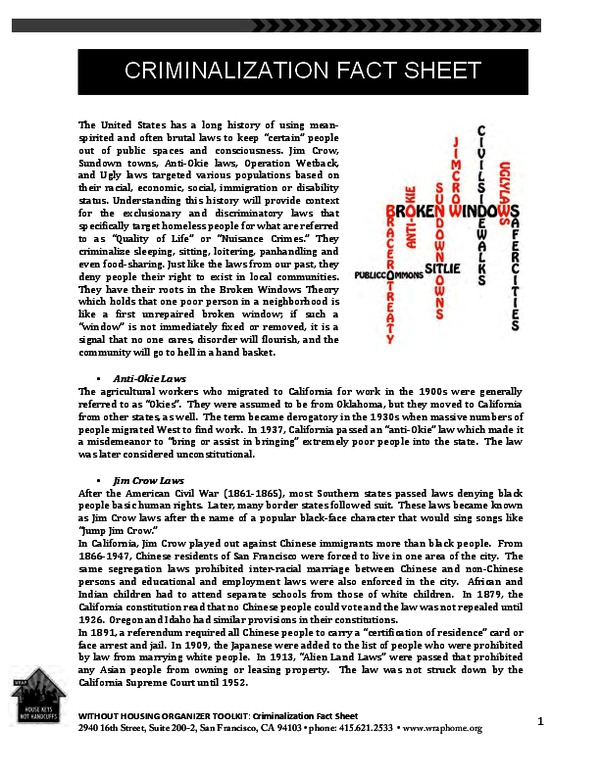
I’m attaching a history of criminalization of the homeless from WRAP (Western Regional Advocacy Project), a group of West Coast organizations fighting for the civil rights of those outside.

Nevada’s Therapy of Choice: Patient Dumping?

NOTE BY NORSE:   A  favorite Santa Cruz homeless-hostile comment by those who want to restrict the highly-limited homeless services available, intensify anti-homeless laws, and “crackdown” on homeless survival camps is that other cities in the country bus their homeless to Santa Cruz because of its “wonderfully permissible” and “enabling” policies.   In the two dozen years I’ve been an activist here, interviewing several thousand  homeless people since 1988, I’ve never had a homeless person volunteer that information about themselves.  If anyone has had that experience, please e-mail me at rnorse3@hotmail.com .

Nevada buses hundreds of mentally ill patients to cities around country

By Cynthia Hubert, Phillip Reese and Jim Sanders
chubert@sacbee.com
Published: Sunday, Apr. 14, 2013 – 12:00 am | Page 1A
Last Modified: Sunday, Apr. 14, 2013 – 7:58 am
Over the past five years, Nevada’s primary state psychiatric hospital has put hundreds of mentally ill patients on Greyhound buses and sent them to cities and towns across America.

Since July 2008, Rawson-Neal Psychiatric Hospital in Las Vegas has transported more than 1,500 patients to other cities via Greyhound bus, sending at least one person to every state in the continental United States, according to a Bee review of bus receipts kept by Nevada’s mental health division.

About a third of those patients were dispatched to California, including more than 200 to Los Angeles County, about 70 to San Diego County and 19 to the city of Sacramento.

In recent years, as Nevada has slashed funding for mental health services, the number of mentally ill patients being bused out of southern Nevada has steadily risen, growing 66 percent from 2009 to 2012.

During that same period, the hospital has dispersed those patients to an ever-increasing number of states.

By last year, Rawson-Neal bused out patients at a pace of well over one per day, shipping nearly 400 patients to a total of 176 cities and 45 states across the nation.

Nevada’s approach to dispatching mentally ill patients has come under scrutiny since one of its clients turned up suicidal and confused at a Sacramento homeless services complex. James Flavy Coy Brown, who is 48 and suffers from a variety of mood disorders including schizophrenia, was discharged in February from Rawson-Neal to a Greyhound bus for Sacramento, a place he had never visited and where he knew no one.

The hospital sent him on the 15-hour bus ride without making arrangements for his treatment or housing in California; he arrived in Sacramento out of medication and without identification or access to his Social Security payments. He wound up in the UC Davis Medical Center’s emergency room, where he lingered for three days until social workers were able to find him temporary housing.

Nevada mental health officials have acknowledged making mistakes in Brown’s case, but have made no apologies for their policy of busing patients out of state. Las Vegas is an international destination and patients who become ill while in the city have a right to return home if they desire, the state’s health officer, Dr. Tracey Green, told Nevada lawmakers during a hearing last month.

She and others insist that the vast majority of patients they are discharging to the Main Street bus station are mentally stable and have family members, treatment programs or both waiting for them at the end of their rides.

That was not true in Brown’s case. His papers from Southern Nevada Adult Mental Health Services read: “Discharge to Greyhound bus station by taxi with 3 day supply of medication” and provided a vague suggestion for further treatment: “Follow up with medical doctor in California.” Brown said staff at Rawson-Neal advised him to call 911 when he arrived in Sacramento.

Nevada Health and Human Services Director Michael Willden told lawmakers last month that while health officials “blew it” in their handling of Brown, an internal investigation found no pattern of misconduct.

But an investigation by the Nevada State Health Division documented several other instances from a small sampling of cases in February in which the state hospital violated written rules for safely discharging mentally ill patients.

Other apparent violations surfaced during The Bee’s investigation.

At least two patients from the Nevada system arrived in San Francisco during the past year “without a plan, without a relative,” said Jo Robinson, director of that city’s Behavioral Health Services department.

“We’re fine with taking people if they call and we make arrangements and make sure that everything is OK for the individual,” Robinson said. “But a bus ticket with no contact, no clinic receptor, anything, it’s really not appropriate.”

Robinson said she viewed the practice as “patient dumping,” and has reported it to federal authorities. “It’s offensive to me that they would show this lack of care for a client,” she said.

Practice called risky

Nevada mental health officials did not respond to repeated requests for phone interviews for this story, nor would they address a list of emailed questions about the origins of the busing policy and the safety protocols in place.

Southern Nevada Adult Mental Health Services, the agency that oversees Rawson-Neal, maintains detailed written policies for transporting patients “to their home communities,” with the stated goal of providing more appropriate care by the most economical means possible.

The policy includes a special section on “Travel Nourishment Protocol,” specifying the number of bottles of Ensure nutritional supplement the patient should receive for the bus trip – essentially six per day.

Staff members are supposed to fill out a “Client Transportation Request” form, which includes questions about whether the patient is willing to go, whether housing or shelter has been verified, and the cost of the trip.

The written policy calls for staff to confirm that a patient has housing or shelter available “and a support system to meet client at destination.” They are to provide information about “mental health services available in the home community.”

Interviews with health officials in California and numerous other states indicate Nevada’s practices are unusual. None of the 10 state mental health agencies contacted by The Bee said that placing a psychiatric patient on a bus without support would be permissible. And none recalled being contacted by Rawson-Neal to make arrangements for a patient coming from Nevada.

In California, where most public mental health treatment is overseen at the county level, agencies contacted by The Bee said they rarely bus patients and that Nevada’s practices seem out of step with the standard of care.

Several described the practice as risky, even if patients have someone waiting for them at the end of their journeys.

“Putting someone whose mental illness makes them unable to care for themselves alone on a bus for a long period of time could be absolutely disastrous,” said Dorian Kittrell, executive director of the Sacramento County Mental Health Treatment Center.

Patients could suffer relapses during their trips and potentially harm themselves or other people, said Kittrell and others. They could become lost to the streets or commit crimes that land them in jail.

“The risk is just too great,” said Dr. Marye Thomas, chief of behavioral health for Alameda County.
Southern Nevada Adult Mental Health Services has had an ongoing contract with Greyhound since July 2009, said bus company spokesman Timothy Stokes.

Stokes said he was unaware of any serious incidents involving mentally ill patients from Nevada. He said Greyhound has contracts with “a number” of hospitals around the country, but declined to identify them.

“We take it on good faith that the organization is going to make certain that patients are not a risk to themselves or others,” he said.

Still, officials in several of California’s largest counties said they rarely, if ever, bus patients out of state.
“We don’t do it, we never will do it, and we haven’t done it in recent memory, meaning at least 20 years,” said David Wert, public information officer for San Bernardino County. Rawson-Neal has bused more than 40 patients to that county since July 2008.

Los Angeles County officials said they have not bused a single patient out of state during the past year, and when they have done so in the past they have supplied chaperones. In the past five years, L.A. County has received 213 people from the Nevada hospital, according to The Bee’s review, more than any place in the country.

Likewise, in Riverside County, sending patients out of state “happens very infrequently upon request of the family,” said Jerry Wengerd, head of the county’s Department of Mental Health. “A staff member accompanies the client and it is usually by air.” Nevada bused 20 patients to Riverside in the period reviewed.

Sacramento County bought bus tickets for five patients during the past year, Kittrell said. In all cases, he said, facility staff confirmed before patients departed that a family member or friend would meet them at their destinations, and provided referrals for treatment.

Organizations that advocate for mentally ill people said Nevada’s busing numbers seem unjustifiably high.
DJ Jaffe, executive director of Mental Illness Policy Org., a nonprofit think tank, said his group often hears anecdotally about patients being “dumped” from one county to another.

“Discharging severely mentally ill patients inappropriately is policy in this country,” Jaffe said. “But getting rid of them altogether by busing them out of state is, I think, rare. I am shocked by these figures. It seems to be almost routine in Nevada.”

After California, Arizona has received the most patients by bus from Nevada, at more than 100 over the five years.

But Cory Nelson, acting deputy director for the Arizona Department of Health, cautioned against drawing conclusions about Nevada’s practices based solely on number of bus tickets issued. In many cases, Nelson said, relatives could have agreed to house patients or made treatment arrangements before the clients left Las Vegas.

In rare cases, Nelson said, a hospital can find itself in a Catch-22 situation when a patient no longer needs to be in a hospital but refuses to cooperate with a discharge plan. “It kind of leaves a hospital in a tough situation,” he said.

Still, the sheer number of patients bused from the Nevada hospital “does seem pretty high,” he said.

‘A tsunami situation’

Several people interviewed said the numbers might be explained in part by the unusual nature of Las Vegas.

“As the whole country no doubt knows, Vegas is a pretty unique place,” said Dr. Lorin Scher, an emergency room psychiatrist with UC Davis Health System.

The city’s entertainment and casino culture draws people from all over the world, Scher noted, including the mentally ill.

“Many bipolar patients impulsively fly across the country to Vegas during their manic phases and go on gambling binges,” he said. “Vegas probably attracts more wandering schizophrenic people” who are attracted to the warm weather, lights and action, he added.

“I am by no means defending their practices,” he said. “It certainly gives cause for concern. But it’s one possible explanation.”

Stuart Ghertner, former director of Southern Nevada Adult Mental Health Services, cited other possible reasons.

He said Rawson-Neal has been under siege for years because of state budget cuts, a steady increase in poor people needing mental health services in the Las Vegas area and a revolving door of administrators.
He noted the city had a disproportionate number of people displaced by the housing and mortgage meltdown of a few years ago.

“The casino boom was over, people were losing their jobs and their homes. They were stressed and they wound up in a mental health crisis,” Ghertner said.

Between 2009 and 2012, Nevada slashed spending on mental health services by 28 percent to address budget deficits, according to data collected by the National Alliance on Mental Illness. Even before those cuts, Nevada fell well below the national average in spending on mental health services: In 2009, it spent $64 per capita on such services compared with a national average of about $123, according to the study.

“You’re looking at a tsunami situation,” said Ghertner, a psychologist who resigned last year after five years as agency director. “There is more pressure to turn patients over faster, and fewer programs (in which) to place them. Perhaps busing them became the easier solution.”

It also is cheaper, he noted. Southern Nevada Adult Mental Health Services spent a total of $205,000 putting patients on Greyhound buses during the past five years, according to The Bee analysis. The state hospital admits about 4,000 patients a year to its inpatient unit, and inpatient care runs around $500 per day per client, Ghertner said.

He said he was aware during his tenure that Rawson-Neal was busing patients out of state but that he thought the practice was rare.

At the time, “I had 800 employees and a $106 million budget,” he said. Ghertner regularly reviewed numbers pertaining to admissions, length of stay and other issues at the hospital, but patient busing was never on his radar, he said.

“I’m embarrassed to say that this practice was going on to this degree under my leadership,” he said. “I had no idea. It just never came up.”

Ghertner said the state mental hospital has been under stress since it opened in 2006, turning over five hospital directors since that time. That instability has taken a toll, he said.

“This busing issue is a symptom that reflects that the care there is not quality care,” he said. “Things clearly are being missed.”

Willden, Nevada’s Health and Human Services director, said during last month’s legislative hearing that policies have been tightened and disciplinary actions taken to ensure that patients are discharged only after the hospital confirms care and treatment at their planned destinations. The hospital administrator, Chelsea Szklany, now must approve all bus discharges ordered by medical staff, he said.

“Southern Nevada Adult Mental Health Services is committed to providing quality mental health services to its patients,” said spokeswoman Mary Woods in an emailed statement.

But investigations continue into the agency’s practices.

Rawson-Neal could lose vital federal funding pending an ongoing probe by the federal Center for Medicare and Medicaid Services. California state Senate President Pro Tem Darrell Steinberg has written a letter expressing outrage to U.S. Secretary of Health and Human Services Kathleen Sebelius.

The hospital’s discharge practices also have prompted a call for action by a member of the U.S. Commission on Civil Rights. Commissioner David Kladney called for a broad investigation by Nevada’s governor and Legislature.

“As a Nevadan, I am ashamed that my state is failing in its duty toward the neediest residents,” Kladney said. Nevada, he said, appears to be “simply hoping that other states will shoulder the responsibility.”


Call The Bee’s Cynthia Hubert, (916) 321-1082. Follow her on Twitter @cynthia_hubert. Bee researcher Pete Basofin contributed to this report.


For more links and comments: http://www.sacbee.com/2013/04/14/5340078/nevada-buses-hundreds-of-mentally.html#.UWuvi8Wb-cQ.facebook#storylink=cpy

A 25-Year-Old Lawsuit and the Persistence of Homelessness Advocates

NOTE BY NORSE:   Fresno activists are at work looking for locally federally owned property.  A decade or more ago, the city made a listing of its unused properties as possible homeless campgrounds, shelter, or housing under pressure from homeless advocates here.   Time to dust off the local list and join with other advocates to look into the federal prospects as well.

Oh, and in the meantime,  for those outside: postpone sleeping at night and stay out of public spaces during the day.   Santa Cruz’s new investigatory commission on “public safety” as another of the “blame the homeless and their enablers” measures by the NIMBY crowd formed last night by “Enough is Enough” Mayor Hillary Bryant has no homeless people or advocates among its 20 members.


    Written by Ruth McCambridge
Created on Wednesday, 10 April 2013 13:48
April 7, 2013; Source: The Washington Post
NPQ has written repeatedly over the years that it is one thing to pass a law, but an entirely different and more lengthy process to enforce implementation. In this case, after 25 years of fighting, advocates have finally garnered a court ruling to have a federal law properly implemented.
Title V of the McKinney-Vento Act, passed in 1987, requires federal agencies to list unused, surplus, or underutilized properties in the Federal Register, and to reach out to homeless services providers, giving them a 60-day right of first refusal on leasing or buying the sites. Since then, almost 500 properties have been obtained by groups serving the homeless.
But on March 21, 2013, in response to a lawsuit filed by the National Law Center for Homelessness and Poverty, Judge Royce Lamberth of the U.S. District Court for the District of Columbia found that many government agencies have not been complying with the law. That ruling mandates that the General Services Administration and the Department of Housing and Urban Development must take more steps to ensure that agencies comply.
“We’re very hopeful this order will result in potentially thousands of properties that have never been made available to homeless services providers to be screened for suitability and be made available,” said Tristia Bauman, an attorney with the Center. “We expect we’re going to be able to more closely monitor whether the government is complying, and have access to buildings that were unbeknownst to us before.”
According to this article, the agencies named in the original suit were the Department of Veterans Affairs, Defense Department, Department of Housing and Urban Development, the GSA, and D.C.’s Department of Health and Human Services. A permanent injunction issued in 1993 ordered the government to implement the law and preserved the right for the issue to again be brought to court if agencies did not comply. Attorneys for the government have tried to get that order lifted, but to no avail.
In the March opinion, Lamberth noted a large difference between the count on unused federal properties (28,000 between 2005 and 2011) reported through the Title V process and on properties labeled by the Office of Management and Budget as surplus (69,000 excess, unused ,and underused) federal properties.
The National Law Center for Homelessness and Poverty, one of the groups that filed the original lawsuit in 1988, has long advocated for better administration of Title V. Without constant monitoring and pressure, this law would fade into disuse, wasting the original advocacy effort. NPQ has written similarly about the Mental Health Parity and Addiction Act.—Ruth McCambridge

Santa Cruz Human Rights abuse news compilation at North Bay Uprising Site

North Bay Uprising compiles Santa Cruz homeless civil rights updates.   Tip of the hat to the NBU folks!


Date: Wed, 10 Apr 2013 00:15:11 -0700
Subject: Santa Cruz Human Rights abuse news compilations
From: northbayuprising@gmail.com
To: rnorse3@hotmail.com

Thank you for taking the time (and the energy) to provide us with information about the abuse in Santa Cruz. Your Notes by Norse are insightful and give context.

I have separate compilations for the attacks against those without homes, and against political activists:

[http://northbayuprising.blogspot.com/2013/01/santa-cruz-attacking-houseless-people.html]

[http://northbayuprising.blogspot.com/2013/01/santa-cruz-11-with-linda-lemaster-ed.html]


Tune in every Thursday, 3 to 6pm, at www.ozcatradio.com, transmitting live in Vallejo at 89.5fm KZCT.
Northbay Uprising radio is a showcase featuring a wide variety of soul-driven music across many genres, interviews with independent musicians, producers of “do it yourself” media, and information about bay area concerts and cultural events, including a news digests for the San Pablo bay area, reporting on the ecology, community localization, civil rights movements, and more, with interviews of the people in the news. http://northbayuprising.blogspot.com