Horrendous Report of a Homeless Man Set on Fire in East L.A.

NOTE BY NORSE:   Jennafer Yellowhorse is the former editor of the homeless newspaper Making Change in Santa Monica/Venice.  Some Santa Cruz homeless people report an upsurge in violence.  There are repeated reports of theft involved.  One man reported to me he was hit over the head while talking to another guy in a wheelchair, ending up in the hospital, all is stuff stolen.  He noted he was epileptic, and had been similarly robbed during another incident some time before.  Police and deputies contributed to the obscenity by destroying his campsite and gear while he was in the hospital, he further reported.’
Many homeless people have found reports to the police are useless.

While chatchat and sunnyside advertising is being pushed for the Sanctuary Camp and the “Justify the Anti-Homeless Hysteria” Task Force on Public Safety is continuing its “Make Santa Cruz More Unwelcome to the Poor” agenda, the abusive attacks–both official and vigilante continue against the Santa Cruz homeless.   Those who make it to the Sanctuary Camp Public Forum on Thursday  (7 PM at 415 Walnut St at Santa Cruz High School) and Mayor Bryant’s Task Farce meeting 6-9 PM on Wednesday (10-9 at the Branciforte School Cafeteria at 315 Poplar St) should be raising these far more immediate real public safety and human dignity issues.

When a “Hospitality” worker verbally assaulted an activist Sunday at the Funday Frolics protest and the head of the Hospitality crew refused to release her name, Officer Albert refused to take a Citizen’s Arrest.  I will be posting an account of this shortly on www.indybay.org/santacruz.


OUTRAGEOUS

Last Sunday, September 29th around 9PM a homeless man was set on fire in front of Eagle Rock library

While conducting our monthly outreach yesterday Pauline, a RRH [Recycled Resources for the Homeles] volunteer and RN, ran into John at the Eagle Rock library. What she discovered was horrifying. I followed up with John and worked with him today. Though he is strong, he is hurt by all this. It is unimaginable.

Last Sunday, John, a homeless Iraqi veteran and an Eagle Rock native was asleep in his wheelchair in front of the Eagle Rock library when men approached from behind him. He didn’t know who they were and was unable to react in time as he was doused in some type of flammable liquid and set on fire. He was able to get out of his chair and fell to the ground, removing his clothing as it burned. He had layers of clothing on and a leather jacket that assisted him in fighting the flames however his back was left badly burned. The fire was so strong that the vinyl seat in his wheelchair completely melted and his belongings are all a loss.

When I met with him today he told me when he heard the men and felt the liquid being thrown on him he didn’t understand what was going on. He informed me that before the men, at least three, ran from the scene they stood and laughed at him as he fought off the flames. He didn’t understand why, nor do I. He described the men as around 18-25 with shaved heads. Today after encouraging John, he agreed to file a police report. What I do not understand is that someone called 911 reporting the incident however when fire and paramedics arrived and put the fire out they did not notify LAPD. No crime was reported and therefore this incident went unnoticed.

John is a survivor. He saw 8 years of combat defending our country, survived 4 gun shot wounds and his leg remains badly damaged from a bomb that exploded near his humvee. He is strong. After we filed the report today with NELA PD, I explored why he didn’t file a report. ‘People don’t care, it doesn’t matter, I don’t understand people and why they do what they do I. I was sleeping in my wheelchair when they tried to kill me. They laughed, who does that? I wasn’t doing anything to anyone’. I wonder the same thing. There are several chronically homeless individuals living in Eagle Rock and they are our neighbors. This was a hate crime. If you have information about this incident you are encouraged to call NELA PD.

-Rebecca Prine

Director, Recycled Resources for the Homeless

Please repost or share this with anyone who may be able to help.
https://www.facebook.com/kkroger/posts/10151716344142005

Portland Homeless Struggle for Survival Space

NOTES BY NORSE:   Portland’s 2 year old Right 2 Dream Too homeless-run encampment in downtown Portland, established without benefit of permission and maintained since the Occupy movement, is now engaged in an interesting struggle to move too another site.   What’s important for Santa Cruz is the realization that the old adage “ask forgiveness, not permission”.  Power must precede permission–particularly dealing with entrenched interests and fears This is so whether such bigotry-in-power wears the protective Progressive camouflage of comforting pro-homeless rhetoric a la Don Lane & Micah Posner or the straightforward “cut off the enablement” cruelty of the Robinson-Comstock-Bryant majority.  Portland homeless activists and writers understand this quite clear in their neck of the woods.

Brent Adams’ Sanctuary Camp proposal is coming up for public discussion Thursday night 10-10 at 7 PM at Santa Cruz High School.  The idea of safe campgrounds (many of them, homeless-run, and voluntary) is an obvious one when the reality of affordable housing is simply flimflam at the moment.  People create them themselves whatever the depredations of The Clean Team, the sweeps of the SCPD, the prattlings of Rangers and Hosts, the brutality of Deputies, or the legal absurdities of the Sleeping Ban, PC 647e, & the curfews and closings.

Aside from Brent’s cyclothermic outbursts denouncing potential allies who have questions and disagreements–which occur with depressing regularity,  the real issue is the basic strategy of putting human survival and dignity on hold until he can get approval from the Gang of 7 at City Council.  This is exactly the opposite of how even the limitied campgrounds (including the historic Dignity Village of a decade ago) were established.  The whole strategy has also led Brent to repeated denunciations of activists who support protests (like myself) and even the homeless protesters themselves. 

Brent’s energy, skill, and creativity as an advertising man–organizing colorful and “safe” looking campaigns for Sanctuary Camp are impressive.  But portals, plastic tags, potlucks, and pretty flyers can’t substitute for the  actual creation of camps.  A good first step is to support those who have done so and are being treated like trash by the police.

Prior campaigns like Sherry Conable’s Coalition for a Safe Place to Sleep (1990). her New Brighton Beach plan of 1996, and Silva’s Safe Sleeping Zones (2000) failed because they depended strongly on support and permission from sympathetic Council members–who ran when the shit began to fly from the usual business and residental NIMBY’s.

It’s inspiring and instructive to remember Frederick Douglass’s timeless advice as he fought slavery 175 years ago: 

“Power concedes nothing without a demand. It never did and it never will. Find out just what any people will quietly submit to and you have found out the exact measure of injustice and wrong which will be imposed upon them, and these will continue till they are resisted with either words or blows, or both. The limits of tyrants are prescribed by the endurance of those whom they oppress…If there is no struggle, there is no progress.  Those who profess to favor freedom and deprecate agitation, are men who want crops without plowing up the ground, they want rain without thunder and lightening…It is not light that we need, but fire; it is not the gentle shower, but thunder.   We need the storm the whirlwind, and the earthquake.

“Dream” Move Challenged by Ugly Reality of Class Politics

September 30, 2013
DSC_2941a-1
Story and photos by Pete Shaw
The Portland City Council will be hearing testimony this Thursday, October 3, as it considers granting Right 2 Dream Too a permit to continue its work helping people without housing at a new location. The group is planning a move from West Burnside to NW Lovejoy Court and NW Station Way, under the ramp of the Broadway Bridge. At its Burnside home R2DToo has not only served as a rest area for people without housing, but has also proved a pivotal transition point in many people’s lives for nearly two years.
According to an R2DToo press release, the Dreamers have “as a community” approved the move that will provide “a roof over our heads (the off-ramp itself), a paved lot for wheelchair users, a quieter location, and of course, the economic relief provided by the cancellation of more than $20,000 in fines.”
At a press conference held on September 9, R2DToo and City Commissioner Amanda Fritz announced they had reached an agreement regarding R2DToo’s future. During the press conference, Fritz recognized the great success of R2DToo’s model, which includes 71 Dreamers finding new housing and 73 getting jobs, all without public funds.  The Bureau of Development Services further acknowledged R2DToo’s important role on September 26, when BDS Director Paul L. Scarlett confirmed that the zoning for R2DToo’s new home should be classified as a “Community Services use.”
However, other forces within the city are saying, “Not In My Backyard.” In particular, the NIMBY contingent includes the Portland Business Alliance (PBA)–which has opposed R2DToo from the moment it set up its rest area–and the Pearl District Neighborhood Association (PDNA). On September 12 the PDNA allocated $10,000 from its “rainy day fund” to take legal action against R2DToo’s move, and the PBA has come out against the relocation.
In an article in the Portland Business Journal, Real Estate Daily editor Wendy Culverwell noted “a coalition that includes Hoyt Street Realty, Williams & Dane Development Co. and Ziba Design” wants to blow up the deal between R2DToo and the City, and also wants “to stop being painted as wealthy developers unconcerned with homelessness.”
As part of the effort to show that concern, Culverwell wrote about how Hoyt Street Properties has an agreement with the city that “calls for it to set aside at least 30 percent of the 2,700 residential units it plans to build for low-income residents.”
This is a red herring. The people served by R2DToo are not low-income residents. They are people without housing and little to no income. The people who work at Hoyt Street Properties, as well as those with the PBA and other business interests, may well be compassionate individuals who care about those without housing. But as part of a company whose sole concern is making profit, their concern for people without housing is to get them as far away as they can from their business interests.
Later in the article, such truths come forth. Greg Close, president of a real estate consulting firm representing Ziba Design, said, according to Culverwell, that “the camp will chill property values, hinder leasing efforts by design firm Ziba and others and depress rents by as much as 15 to 25 percent.” Close also said property owners might sue to recover their losses. Another person from the business community expressed worries about how a “homeless camp across the street could in theory harm” the Marriott Hotel set to open in the Spring.

Right 2 Dream Too has lasted because it has been effective in organizing people who understand there is something fundamentally wrong with denying shelter to people without housing. For some, that understanding is based on something as beautifully simple as compassion for a fellow human. For others, it is a belief that the innate value of a person is always greater than the price placed on a piece of land. So far, it has been the coming together of a community of people who have proven more powerful than the money mustered by the likes of the PBA and the PDNA.
Wherever you may stand within that spectrum, come out to City Hall and let your voice be heard. For nearly two years, the Dreamers have been effectively treated as non-legal persons, and despite protestations to the contrary, the business community’s support for various permutations of sit-lie laws has shown its rhetoric regarding its concern for people without housing has been hollow for much longer than R2DToo’s existence.
This week marks a pivotal day for R2DToo and all people without housing, as well as for those who value people over profit. The PBA and the PDNA will be sure to have many representatives there. Where will you be?
Testimony will take place at City Hall–1221 SW 4th Avenue– on October 3 from 2 to 5:30 PM, with a second session beginning at 6 PM.
For more information see: https://www.facebook.com/events/240437666109730/?ref_newsfeed_story_type=regular.
– See more at: http://www.portlandoccupier.org/2013/09/30/dream-move-challenged-by-ugly-reality-of-class-politics/#sthash.mXwmeC7P.dpuf


Class Warfare, Compassion Emerge at R2DToo Hearing; Move Hangs in Balance

October 5, 2013

CLASSLESS AND CLASSIST
Story by Pete Shaw
Since Right 2 Dream Too (R2DToo) and the City of Portland came to an agreement in July to move the rest area for people without housing to a spot in the Pearl District, those opposed to the move have been trying to walk a tightrope. On the one hand the opposition is worried about falling rents, diminished property values, and safety and on the other they want to avoid the NIMBY label and being perceived as soulless creatures who do not care about the plight of those not so fortunate as themselves. But in case anyone thought the breast beating of the business community and the leaders of the Pearl District Neighborhood Association (PDNA) had some measure of authenticity to it, that misguided notion should have been put to rest at City Hall around 7:15 pm, on October 3rd.
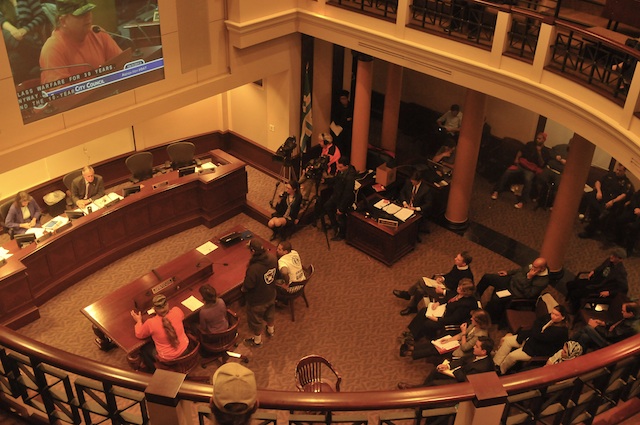
The 91st person to give testimony before the City Council regarding R2DToo’s move asked for a moment of silence in memory of people without housing who have recently died. Most people in the chamber rose and bowed their heads in respect. Approximately 12 people who had already testified against the move remained in their seats against the back wall. In that moment–when even a shred of common decency would have gone a long way–their farce was exposed.
On this October 3rd, during the course of over four hours of testimony, about 100 people spoke in favor of or in opposition to the move. The difference in the language between the two sides was striking.  The business and Pearl people spoke the language of fear, as well as the callously indifferent language of bottom lines and lost profit opportunities. They were cold and bloodless, expressing compassion only for themselves.
The first six speakers were from Station Place Tower, which stands near where R2DToo will move, and they all sounded the safety alarm, warning of the Mongrel Hordes at the gates. “How long before someone sneaks into a warm building or steals a purse?” “Now walking to the Amtrak or the Greyhound will be more daunting.”  “Those of us on limited income cannot afford to keep moving just so we can find a safe place to live.”
A few opponents tried out the human angle. One woman trotted out information about “pigeon guano” and its dangers, inclusive of CDC handouts for the commissioners regarding how to properly clean it. The fungi within the guano would be dangerous to the people of R2DToo, she said,  as it accumulates under the bridge. In what seemed an attempt to embarrass Commissioner Amanda Fritz and cast aspersions on her competence, the woman asked–since she was formerly a nurse–if Friz could properly pronounce the name of the fungi. The commissioner gracefully replied, “I was a psychiatric nurse.”
Some other people tried the health card, but the pigeon guano was about the last appeal opponents made on grounds that had a slight veneer of humanity. It was fascinating to witness people expressing so much interest in making sure bird crap is treated properly, but have no problem treating their fellow humans like shit. That point was hammered home by Tequilam, who has not had housing for almost two years, when he chastised opponents of R2DToo’s move. “For people to say they are worried about health concerns,” he said, “when you were walking over me, did you care then?  You should be goddamned ashamed of yourselves.”
Shame was hard to find, although it was on occasion placed upon the houseless and their supporters. One member of the business community said, “Their argument is one of class warfare, and I find it offensive.” He also said that calling R2DToo a “community service”–a term of importance to the city code, and one sanctioned by Paul Scarlett, director of BDS–is “intellectually dishonest at best and a bald faced lie at worst.”
Greg Close, president of a real estate firm representing Ziba Design, shared his pain as well. “You have created class warfare…you are making me feel great apprehension in speaking on behalf of my friends economically.” Close later told a story about a chiropractor friend who was going to lose her business if R2DToo moves in nearby. A person in the crowd noted it was no small irony that Close and the other opponents were actually creating business for chiropractors by trying to put their boots on the necks of the houseless, or as Close referred to them, “These people.”
Process and code were constantly called into question.  Patricia Gardner, President of the Pearl Neighborhood Associaiton noted that the purpose of the city code is to “create certainty and safety for everyone,” although she failed to elaborate on the certainty and safety in the lives of people who lack housing.  At one point developer Homer Williams looked like he was about to burst into tears because he might be unable to use money and its attendant influence to get his way. It may have been the only genuine moment of emotion by anyone opposed to R2DToo’s move.
Finally, there were the outright rude, even cruel. Nothing says hate like telling people their lives are not as valuable as parking spaces, a judgment offered up in both qualitative and quantitative terms. Despite all evidene to the contrary, R2DToo was also called “a failure” and it was implied that all the Dreamers are “ex-convicts and sex offenders”. One speaker compared R2DToo to a nuclear dump and then wandered down some dystopian alley in the Pearl where children, who “pick stuff off the sidewalks,” fall prey to an outbreak of hepatitis.

For the most part, Dreamers and their supporters stuck with more nurturing tones. They spoke of support and friendship, and not just among themselves. They also expressed a desire and willingness to share this with the very people who were trashing them. Melissa, who has recently found housing, showed off her six week old child, James; both are success stories. One woman who was assaulted twice while living on the street, expressed her gratitude for R2DToo. Many said the rest area saved their lives or preventing them from being raped. These and other similar testimonies were greeted with stone faces from opponents.
One Dreamer, who goes by the street name Dikweed, was not as charitable in his words, saying he was disturbed by the bigoted language that had associated him with toxic waste. “I deserve to have a place to sleep,” he said. “I don’t deserve to have rich white people tell me where to sleep.” Addressing the soft pedal bigotry of falling property values, he talked about how people in the Pearl District had a choice. They could keep treating people without housing as sub-human, or they could treat them as they would other neighbors. “It’s your hatred that drops values,” he told them. “If you hate then your property value goes down. And that’s called justice.”
The zoning confirmation required by City Council to seal the R2DToo move was postponed until October 16, in order–according to Mayor Hales–to seek an outcome that’s not a “zero sum game”. During his testimony, Homer Williams, who has made untold sums capitalizing on development in the Pearl, asked that he be given time to provide a solution. In his summation the Mayor expressed interest in finding out more about what Williams has in mind. Commissioner Fritz said that any discussions must include R2DToo, since they had the greatest understanding of their own needs.
During the evening a few R2DToo supporters looked forward to a day when this would not be a fight between “us and them.” That is a worthwhile sentiment, but it requires “them” to see “us” as people. If yesterday’s testimony in opposition to R2DToo’s move represents the feeling of the entire Pearl District and the business community, then that day is still far away.
– See more at: http://www.portlandoccupier.org/2013/10/05/class-warfare-compassion-emerge-at-r2dtoo-hearing-move-hangs-in-balance/#sthash.XOmluLjC.dpuf

Plans to relocate Portland’s tent city provokes mixed response

October 6, 2013 7:30PM ET
Proposal to move camp for the homeless into an upper-middle class district takes heat from all sides
TentCity
City chiefs plan to more the Right 2 Dream Too homeless camp in Portland, Ore.Don Ryan/AP Photo
Residents of one of Portland’s toniest areas are fighting plans to move a tent city to their neighborhood, but say social concern rather than financial motive is behind their objection.


Mayor Charlie Hales and city commissioners plan to decide Oct. 16 whether to relocate the camp to the Pearl District from its current home near Portland’s Chinatown. If approved, a coalition of property owners promises to sue to block the relocation of the 100-person camp.


But while those with a financial stake in the neighborhood have privately voiced concerns about diminishing property values and a potential spike in crime, Pearl District residents are choosing their words more carefully during the well-attended town hall hearings on the topic.


In a public debate that has engulfed Portland – a hotbed for social activism – criticisms of the city’s expedited process and concerns about the welfare of those willing to live in a parking lot under a bridge are eclipsing more self-interested grievances.


Tiffany Sweitzer, the president of Hoyt Street Properties, a realty and development firm has helped transform the Pearl District from a dying industrial area into a thriving residential neighborhood, said “throwing a bunch of people under a bridge” should not be the city’s solution to helping the estimated 2,000 residents who sleep outside each night.


“It’s embarrassing, because that is not how you would treat anybody,” she said.


The camp, known as Right 2 Dream Too, was established in October 2011 amidst the Occupy Portland movement in the lot of a former adult bookstore that had been empty for three years until the aggrieved owner allowed the homeless to lease the property – for $1 a year.


Every night since then, about 100 people have slept on prime downtown real estate – in tents shielded from passers-by with a barrier of colorful, old doors fashioned into an artsy makeshift wall.


Over that period of time, however, landowner Michael Wright racked up more than $20,000 in fines for operating a campsite without a permit. When he responded with a lawsuit, city Commissioner Amanda Fritz brokered a deal in which the fines would be waived, the lawsuit dropped and the homeless campers sent to the Pearl District. It all happened in a matter of weeks, angering homeowners and developers who say the city was so desperate to settle Wright’s lawsuit that it bypassed zoning laws.


Fritz, a former psychiatric nurse, acknowledged that the camp is not the ideal answer to homelessness. But she said there is not enough money to provide housing to all, and Right 2 Dream Too has provided a much safer alternative than the street.


“It’s been an option that’s been better than nothing,” she said.


Scores of people spoke for and against the proposal at a five-hour hearing on Thursday. Though a handful said their safety would be jeopardized, most Pearl District residents completely ignored quality-of-life and financial issues and repeatedly griped about the city conducting the deal in secret and delegitimized the zoning code.


Not everyone in the Pearl District is rich, they added, and the fight has been unfairly cast as the greedy against the homeless, or “us against them.”


“It’s a sad, confrontational, divisive atmosphere because communication was intentionally closed,” said Julie Young, a retired social worker who lives in the Pearl.


Besides condominiums and the low-income apartments for older residents, there are businesses nearby, including a Marriott that is scheduled to open next year. Those who have spoken to the potential financial impact of Right 2 Dream Too suggest hotel guests won’t want to stay near the camp and that it would impact on property prices.


Homeless camp residents, meanwhile, ask their prospective neighbors to give them a chance. Right 2 Dream Too has a stellar safety record, and supporters say the camp – they call it a rest area – has helped people get back on their feet and into permanent housing.


“We’re not there to bring property values down,” said Ibrahim Mubarak, the Right 2 Dream Too leader. “We’re there to get people from sleeping on your sidewalk. We’re there to stop people from sleeping in the doorways. We’re there to stop the drug dealing; we’re there to stop the drug use by our friends.”


Wire services


Class Warfare, Compassion Emerge at R2DToo Hearing; Move Hangs in Balance
October 5, 2013
photo by Paul

Photo by Paul
CLASSLESS AND CLASSIST
Story by Pete Shaw
Since Right 2 Dream Too (R2DToo) and the City of Portland came to an agreement in July to move the rest area for people without housing to a spot in the Pearl District, those opposed to the move have been trying to walk a tightrope. On the one hand the opposition is worried about falling rents, diminished property values, and safety and on the other they want to avoid the NIMBY label and being perceived as soulless creatures who do not care about the plight of those not so fortunate as themselves. But in case anyone thought the breast beating of the business community and the leaders of the Pearl District Neighborhood Association (PDNA) had some measure of authenticity to it, that misguided notion should have been put to rest at City Hall around 7:15 pm, on October 3rd.
The 91st person to give testimony before the City Council regarding R2DToo’s move asked for a moment of silence in memory of people without housing who have recently died. Most people in the chamber rose and bowed their heads in respect. Approximately 12 people who had already testified against the move remained in their seats against the back wall. In that moment–when even a shred of common decency would have gone a long way–their farce was exposed.
On this October 3rd, during the course of over four hours of testimony, about 100 people spoke in favor of or in opposition to the move. The difference in the language between the two sides was striking.  The business and Pearl people spoke the language of fear, as well as the callously indifferent language of bottom lines and lost profit opportunities. They were cold and bloodless, expressing compassion only for themselves.
The first six speakers were from Station Place Tower, which stands near where R2DToo will move, and they all sounded the safety alarm, warning of the Mongrel Hordes at the gates. “How long before someone sneaks into a warm building or steals a purse?” “Now walking to the Amtrak or the Greyhound will be more daunting.”  “Those of us on limited income cannot afford to keep moving just so we can find a safe place to live.”
A few opponents tried out the human angle. One woman trotted out information about “pigeon guano” and its dangers, inclusive of CDC handouts for the commissioners regarding how to properly clean it. The fungi within the guano would be dangerous to the people of R2DToo, she said,  as it accumulates under the bridge. In what seemed an attempt to embarrass Commissioner Amanda Fritz and cast aspersions on her competence, the woman asked–since she was formerly a nurse–if Friz could properly pronounce the name of the fungi. The commissioner gracefully replied, “I was a psychiatric nurse.”
Some other people tried the health card, but the pigeon guano was about the last appeal opponents made on grounds that had a slight veneer of humanity. It was fascinating to witness people expressing so much interest in making sure bird crap is treated properly, but have no problem treating their fellow humans like shit. That point was hammered home by Tequilam, who has not had housing for almost two years, when he chastised opponents of R2DToo’s move. “For people to say they are worried about health concerns,” he said, “when you were walking over me, did you care then?  You should be goddamned ashamed of yourselves.”
Shame was hard to find, although it was on occasion placed upon the houseless and their supporters. One member of the business community said, “Their argument is one of class warfare, and I find it offensive.” He also said that calling R2DToo a “community service”–a term of importance to the city code, and one sanctioned by Paul Scarlett, director of BDS–is “intellectually dishonest at best and a bald faced lie at worst.”
Greg Close, president of a real estate firm representing Ziba Design, shared his pain as well. “You have created class warfare…you are making me feel great apprehension in speaking on behalf of my friends economically.” Close later told a story about a chiropractor friend who was going to lose her business if R2DToo moves in nearby. A person in the crowd noted it was no small irony that Close and the other opponents were actually creating business for chiropractors by trying to put their boots on the necks of the houseless, or as Close referred to them, “These people.”

Process and code were constantly called into question.  Patricia Gardner, President of the Pearl Neighborhood Associaiton noted that the purpose of the city code is to “create certainty and safety for everyone,” although she failed to elaborate on the certainty and safety in the lives of people who lack housing.  At one point developer Homer Williams looked like he was about to burst into tears because he might be unable to use money and its attendant influence to get his way. It may have been the only genuine moment of emotion by anyone opposed to R2DToo’s move.

Finally, there were the outright rude, even cruel. Nothing says hate like telling people their lives are not as valuable as parking spaces, a judgment offered up in both qualitative and quantitative terms. Despite all evidene to the contrary, R2DToo was also called “a failure” and it was implied that all the Dreamers are “ex-convicts and sex offenders”. One speaker compared R2DToo to a nuclear dump and then wandered down some dystopian alley in the Pearl where children, who “pick stuff off the sidewalks,” fall prey to an outbreak of hepatitis.
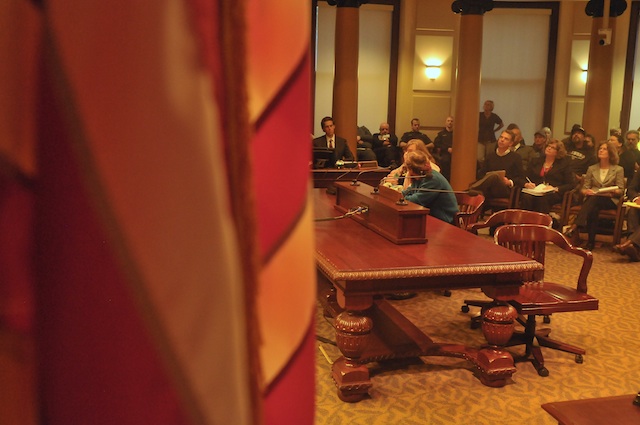
Photo by Pete

Photo by Pete
For the most part, Dreamers and their supporters stuck with more nurturing tones. They spoke of support and friendship, and not just among themselves. They also expressed a desire and willingness to share this with the very people who were trashing them. Melissa, who has recently found housing, showed off her six week old child, James; both are success stories. One woman who was assaulted twice while living on the street, expressed her gratitude for R2DToo. Many said the rest area saved their lives or preventing them from being raped. These and other similar testimonies were greeted with stone faces from opponents.
One Dreamer, who goes by the street name Dikweed, was not as charitable in his words, saying he was disturbed by the bigoted language that had associated him with toxic waste. “I deserve to have a place to sleep,” he said. “I don’t deserve to have rich white people tell me where to sleep.” Addressing the soft pedal bigotry of falling property values, he talked about how people in the Pearl District had a choice. They could keep treating people without housing as sub-human, or they could treat them as they would other neighbors. “It’s your hatred that drops values,” he told them. “If you hate then your property value goes down. And that’s called justice.”

The zoning confirmation required by City Council to seal the R2DToo move was postponed until October 16, in order–according to Mayor Hales–to seek an outcome that’s not a “zero sum game”. During his testimony, Homer Williams, who has made untold sums capitalizing on development in the Pearl, asked that he be given time to provide a solution. In his summation the Mayor expressed interest in finding out more about what Williams has in mind. Commissioner Fritz said that any discussions must include R2DToo, since they had the greatest understanding of their own needs.
During the evening a few R2DToo supporters looked forward to a day when this would not be a fight between “us and them.” That is a worthwhile sentiment, but it requires “them” to see “us” as people. If yesterday’s testimony in opposition to R2DToo’s move represents the feeling of the entire Pearl District and the business community, then that day is still far away.

– See more at: http://www.portlandoccupier.org/2013/10/05/class-warfare-compassion-emerge-at-r2dtoo-hearing-move-hangs-in-balance/#sthash.XOmluLjC.dpuf

Right 2 Dream Too

http://streetroots.org/node/21


Statement:
What happens when a group of 50 homeless people get together and create a safe place to call home? The verdict is still out.


In a time when Street Roots can’t buy a positive story about homeless and housing policy, and local and national leaders continue to communicate bad news on the budget front, Right 2 Dream Too is breaking the mold by providing a refuge for people on the streets.


We could talk about the state and federal governments’ lack of support for housing and human services. We could concentrate on the hypocricies of the city and other groups who stand on the sidelines, shoulders shrugged. We could call out any number of neighborhood and business groups who patronize Right 2 Dream Too as well intentioned, but fall back on the argument that it’s not the solution, and request that the group be removed from the neighborhood.  But none of this gets us anywhere, and has all been said before.


The reality is, Right 2 Dream Too is doing the right thing.


By refusing to make a simple and appropriate gesture — waiving the fines in this case — the city is passively, but with calculated intention, closing down


Right 2 Dream Too. Neither code violations nor a bitter history between the city and the property owners should stand in the way of people seeking a safe and warm place to sleep.


Right 2 Dream Too isn’t going anywhere. People who have lost everything have nothing to lose. Imposing fines is short-sighted, and sweeping the camp and jailing people isn’t an option. So what’s the play, City Hall? We’re all waiting to see.


It’s possible that Right 2 Dream Too, local government and social service providers can work together to help place people into housing. When Occupy Portland was swept, Mayor Adams and Commissioner Fish called on a number of social-service agencies to do targeted outreach. The city should offer the same kind of support for Right 2 Dream Too and be working actively to help the group satisfy code requirements or find another location.


Dignity Village still houses about 60 people on any given night. It is low-barrier and low-cost, and it has found a way, for better or worse, to succeed on its own. Right 2 Dream Too is building momentum. Many Portlanders support the groups efforts, just like they support Street Roots efforts to help foster an environment where homeless people can do for themselves.


There are many grassroots organizations and groups in this town that go under the radar day-in and day-out on a shoestring budget that help people experiencing poverty. Those groups are not recognized like many of the larger groups, or celebrated with ceremonies, but they serve a life-saving role in our city nonetheless.


Change is seldom easy. When Street Roots began, many businesses disapproved, some people in the city were disinterested or against it altogether. Others saw a good idea. Thirteen years later, we are still grassroots and have a positive effect of the City of Portland every day. There’s no reason to believe that Right 2 Dream Too can’t do the same.


In today’s economic landscape, solutions won’t always look like they used to, and they will challenge our community to think differently and work together. Solutions always do.


You can also “Making a dream a reality,” written by Street Roots in January.


Find out ways to support Right 2 Dream Too by going here.


Class Warfare, Compassion Emerge at R2DToo Hearing; Move Hangs in Balance

October 5, 2013
photo by Paul

Photo by Paul
CLASSLESS AND CLASSIST
Story by Pete Shaw
Since Right 2 Dream Too (R2DToo) and the City of Portland came to an agreement in July to move the rest area for people without housing to a spot in the Pearl District, those opposed to the move have been trying to walk a tightrope. On the one hand the opposition is worried about falling rents, diminished property values, and safety and on the other they want to avoid the NIMBY label and being perceived as soulless creatures who do not care about the plight of those not so fortunate as themselves. But in case anyone thought the breast beating of the business community and the leaders of the Pearl District Neighborhood Association (PDNA) had some measure of authenticity to it, that misguided notion should have been put to rest at City Hall around 7:15 pm, on October 3rd.
The 91st person to give testimony before the City Council regarding R2DToo’s move asked for a moment of silence in memory of people without housing who have recently died. Most people in the chamber rose and bowed their heads in respect. Approximately 12 people who had already testified against the move remained in their seats against the back wall. In that moment–when even a shred of common decency would have gone a long way–their farce was exposed.
On this October 3rd, during the course of over four hours of testimony, about 100 people spoke in favor of or in opposition to the move. The difference in the language between the two sides was striking.  The business and Pearl people spoke the language of fear, as well as the callously indifferent language of bottom lines and lost profit opportunities. They were cold and bloodless, expressing compassion only for themselves.
The first six speakers were from Station Place Tower, which stands near where R2DToo will move, and they all sounded the safety alarm, warning of the Mongrel Hordes at the gates. “How long before someone sneaks into a warm building or steals a purse?” “Now walking to the Amtrak or the Greyhound will be more daunting.”  “Those of us on limited income cannot afford to keep moving just so we can find a safe place to live.”
A few opponents tried out the human angle. One woman trotted out information about “pigeon guano” and its dangers, inclusive of CDC handouts for the commissioners regarding how to properly clean it. The fungi within the guano would be dangerous to the people of R2DToo, she said,  as it accumulates under the bridge. In what seemed an attempt to embarrass Commissioner Amanda Fritz and cast aspersions on her competence, the woman asked–since she was formerly a nurse–if Friz could properly pronounce the name of the fungi. The commissioner gracefully replied, “I was a psychiatric nurse.”
Some other people tried the health card, but the pigeon guano was about the last appeal opponents made on grounds that had a slight veneer of humanity. It was fascinating to witness people expressing so much interest in making sure bird crap is treated properly, but have no problem treating their fellow humans like shit. That point was hammered home by Tequilam, who has not had housing for almost two years, when he chastised opponents of R2DToo’s move. “For people to say they are worried about health concerns,” he said, “when you were walking over me, did you care then?  You should be goddamned ashamed of yourselves.”
Shame was hard to find, although it was on occasion placed upon the houseless and their supporters. One member of the business community said, “Their argument is one of class warfare, and I find it offensive.” He also said that calling R2DToo a “community service”–a term of importance to the city code, and one sanctioned by Paul Scarlett, director of BDS–is “intellectually dishonest at best and a bald faced lie at worst.”
Greg Close, president of a real estate firm representing Ziba Design, shared his pain as well. “You have created class warfare…you are making me feel great apprehension in speaking on behalf of my friends economically.” Close later told a story about a chiropractor friend who was going to lose her business if R2DToo moves in nearby. A person in the crowd noted it was no small irony that Close and the other opponents were actually creating business for chiropractors by trying to put their boots on the necks of the houseless, or as Close referred to them, “These people.”

Process and code were constantly called into question.  Patricia Gardner, President of the Pearl Neighborhood Associaiton noted that the purpose of the city code is to “create certainty and safety for everyone,” although she failed to elaborate on the certainty and safety in the lives of people who lack housing.  At one point developer Homer Williams looked like he was about to burst into tears because he might be unable to use money and its attendant influence to get his way. It may have been the only genuine moment of emotion by anyone opposed to R2DToo’s move.

Finally, there were the outright rude, even cruel. Nothing says hate like telling people their lives are not as valuable as parking spaces, a judgment offered up in both qualitative and quantitative terms. Despite all evidene to the contrary, R2DToo was also called “a failure” and it was implied that all the Dreamers are “ex-convicts and sex offenders”. One speaker compared R2DToo to a nuclear dump and then wandered down some dystopian alley in the Pearl where children, who “pick stuff off the sidewalks,” fall prey to an outbreak of hepatitis.
Photo by Pete

Photo by Pete
For the most part, Dreamers and their supporters stuck with more nurturing tones. They spoke of support and friendship, and not just among themselves. They also expressed a desire and willingness to share this with the very people who were trashing them. Melissa, who has recently found housing, showed off her six week old child, James; both are success stories. One woman who was assaulted twice while living on the street, expressed her gratitude for R2DToo. Many said the rest area saved their lives or preventing them from being raped. These and other similar testimonies were greeted with stone faces from opponents.
One Dreamer, who goes by the street name Dikweed, was not as charitable in his words, saying he was disturbed by the bigoted language that had associated him with toxic waste. “I deserve to have a place to sleep,” he said. “I don’t deserve to have rich white people tell me where to sleep.” Addressing the soft pedal bigotry of falling property values, he talked about how people in the Pearl District had a choice. They could keep treating people without housing as sub-human, or they could treat them as they would other neighbors. “It’s your hatred that drops values,” he told them. “If you hate then your property value goes down. And that’s called justice.”

The zoning confirmation required by City Council to seal the R2DToo move was postponed until October 16, in order–according to Mayor Hales–to seek an outcome that’s not a “zero sum game”. During his testimony, Homer Williams, who has made untold sums capitalizing on development in the Pearl, asked that he be given time to provide a solution. In his summation the Mayor expressed interest in finding out more about what Williams has in mind. Commissioner Fritz said that any discussions must include R2DToo, since they had the greatest understanding of their own needs.
During the evening a few R2DToo supporters looked forward to a day when this would not be a fight between “us and them.” That is a worthwhile sentiment, but it requires “them” to see “us” as people. If yesterday’s testimony in opposition to R2DToo’s move represents the feeling of the entire Pearl District and the business community, then that day is still far away.

– See more at: http://www.portlandoccupier.org/2013/10/05/class-warfare-compassion-emerge-at-r2dtoo-hearing-move-hangs-in-balance/#sthash.XOmluLjC.dpuf


Making a dream reality: Right 2 Dream Too’s success flies in the face of skeptics

by Street Roots | 5 Jan 2012
Making a dream reality: Right 2 Dream Too’s success flies in the face of skeptics
“A rendering of Right 2 Dream Too created by a local architecture firm”alt
by Joanne Zuhl, staff writer (Photos by Israel Bayer)


It was supposed to be about the city’s new plan to allow limited car camping for people experiencing homelessness. But testimony at Wednesday’s City Council meeting became an extended appeal for another camping option, one that’s been, almost unanimously, highly successful for nearly three months.
During more than an hour of testimony, a series of people — many homeless — testified in defense of Right 2 Dream Too, a structured camp at the corner of Fourth Avenue and Burnside that is home to about 70 people experiencing homelessness.


The group has a year lease for the property, tacit support from leaders in the neighborhood and no problems with law enforcement. It has a board of directors, regular meetings and is pursuing its own nonprofit status. It has received financial support from the community and has its own portable toilet.
“People who stay at the camp work the security and hospitality shift”]alt  Overhead view of Right 2 Dream Too


It is also under the city’s screws for code violations.


On Dec. 20, Right 2 Dream Too filed a request with the city to waive penalties against its camp while it works to address code violations issued by the Bureau of Development Services (BDS).


The group was cited in November for establishing an unpermitted recreational park-campground and for having a fence greater than six feet in height, also without a permit.


The document is as much a statement on the condition of homelessness in Portland today as it is an argument against the pending penalties, which could amount to nearly $600 a month.


“We’re trying to cooperate to the extent that we can,” says Michael Moore, one of the site’s organizers. “The director of planning has the ability to (waive penalties) in special circumstances and we’re making the case that these circumstances warrant these considerations.”


In its appeal, the group says it believes the code being applied is overbroad, and that their site isn’t a “recreational” camp at all, but a facility for sheltering people who are homeless. The group says it is willing to work with the city to begin the permitting process on bringing the fence under code or finding a variance.


Unlike other tent cities of years past, Right 2 Dream Too has signed a one-year lease with the owners of the property. In addition to donations, it received support from it’s parent group, Right 2 Survive, which recently received a $6,000 grant for general operations from McKenzie River Gathering.


“The extent and severity of the economic crisis that has led to a severe shortage of affordable housing and shelter space warrants consideration for a hardship waiver while we undertake this process,” the group wrote in its appeal to the city. “We have achieved more than many of us expected in terms of the impact we are having on the lives of Portland’s most disadvantaged and disenfranchised residents, those whom BDS’s mission to ‘maintain safe and livable neighborhoods’ is failing. We ask that the bureau work with us to help extend this mission to all of Portland’s residents.”


Ross Caron, public information officer with the Bureau of Development Services, said the group missed the deadline to file its request for the waiver, and the property owners will be fined $614 as of Jan. 1 for noncompliance. After three months, that figure doubles. Caron said he could not speculate on what the department’s response will be to the organization’s appeal, which can then follow with another series in the appeal process.


Beyond the bureaucracy, however, the camp has gotten good reviews as an orderly and safe operation, even if some people would like to see it moved from its high-profile site downtown.
“A man reads an overnight camp log kept by the group”alt
“Tent tags are hung in an orderly fashion. When campers leave or return, they flip their assisgned tent number to indicate whether they are home.”alt
“I’ve heard far more positive feedback than negative feedback,” said Michael Boyer, crime prevention program coordinator for the Old Town/Chinatown neighborhood. “I think from a humanity standpoint, people want to see something more stable and livable than tents on the streets.”
From the beginning, the camp has set strict rules prohibiting drugs, alcohol and violence.


At City Council Wednesday, Trilliam Shannon with Right 2 Survive, testified that a camp like this should be replicated, not destroyed. “You have the ability to work with BDS to suspend code violations,” she said. “We need to stop criminalizing people who are exercising their right to survive.”


“A man who stays at Right 2 Dream Too walks away defeated in a suit after learning he did not get the job he had interviewed for.”alt


“A poem”alt


Read SR editorial on Right 2 Dream Too.
Court Decisions Uphold the Right to Beg in Flagstaff, AZ

NOTE BY NORSE:

Santa Cruz “homeless get out of sight, get out of town” groups and their fans at City Council  have recently used phony Public Health & Safety pretests to make Santa Cruz a “less welcoming city” for poor, unconventional, and homeless travelers as well as long-time residents.  These have included Take Back Santa Cruz’s “positive loitering” events, pressuring convenience stores to remove payphones, & spending city and county money on a $100,000 + security gate at the Homeless (Lack of) Services Center.

The City’s slimey solution to cracking down on panhandling, once it was ruled constitutional in California by a federal judge in the early 90’s in the Blair decision, was to use “time, place, and manner” restrictions.   The only valid justification for limiting peaceful beggins is if it becomes truly threatening or obstructive of pedestrian (or vehicular) traffic.  Santa Cruz’s “Aggressive Solicitation” ordinance (MC 9.10  See http://www.codepublishing.com/CA/SantaCruz/) is misnamed to cover its real intent–to give police selective enforcement tools to run off any sparechanger they consider unsavory, or to harry that person from place to place.  Panhandling, even silently with a sign, is forbidden entirely at night, on 95% of the downtown sidewalks and on 100$ of sidewalks elsewhere where there are any buildings.  It is akin to creating “protest pens” far from where public officials actually appear (something Santa Cruz officials have also done by establishing curfews around City Hall,  County Building, and the Court Buildings–this by decree rather than legislative vote after public debate).

Recently a disabled woman in a wheelchair (Glenda) was harassed on the sidewalk out near Kosko’s where she had a perfect right to be–even though abiding by the letter of the panhandling prohibitions–with deputies and SCPD thugs colluding to remove her at the request of some anonymous bigot.   This followed threats up at a sidewalk near Safeway on the Westside, even though Glenda reported being in a legal place, okayed previously by police authorities–where police responded to a “get out of town” TBSC-type by falsely demanding she move on, though she was legal right where she was.  The examples of repression are becoming more flagrant & more numerous.  Check my twice-weekly radio show archives at http://www.huffsantacruz.org/brb-descriptions.html for many many instances and specific stories.

The Santa Cruz ordinances have never been taken to court in their entireity.  The only section that was taken to court was thrown out a decade ago as unconstitutional (See “Powdering The Crooked Nose of The City’s Anti-Homeless Panhandling Law ”  at https://www.indybay.org/newsitems/2006/06/19/18281363.php).  Santa Cruz awaits a new generation of citizen legal activists who will take on the abusive law and others that criminalize for the homeless what ordinary housed citizens take for granted (far too complacently considering NDAA, Guantanamo, NSA, and Patriot Act abuses that have become standard in the last decade).

Flagstaff, Arizona, to halt its crackdown on panhandling

The Flagstaff City Council agrees to settle a lawsuit that claimed an Arizona law against panhandling and the city’s aggressive enforcement of it were unconstitutional.

Flagstaff panhandling lawFlagstaff Police Cpl. Mike Rodriguez issues a citation to a homeless man who gave his name as James. The man was cited for camping within the city limits. (Josh Biggs / Arizona Daily Sun)
By Cindy CarcamoSeptember 24, 2013, 10:33 p.m.

FLAGSTAFF, Ariz. — An Arizona city that led the nation in its aggressive stance on panhandling reversed course Tuesday night, setting in motion the apparent demise of a century-old state law that criminalized begging.

The Flagstaff City Council voted to settle a lawsuit launched this summer by the American Civil Liberties Union of Arizona on behalf of a 77-year-old woman who had been arrested after asking an undercover police officer for bus fare. The ACLU argued that the state law and Flagstaff’s enforcement of it were unconstitutional.
The council agreed and voted unanimously to stop enforcing the statute, promising that city officials would no longer interfere with a person peacefully begging in public spaces. But the council left the door open to imposing other restrictions.
The ACLU lawsuit challenged a policy Flagstaff adopted six years ago to remove people from downtown areas by jailing them early in the day on suspicion of loitering to beg. The city had invoked an Arizona statute that makes it a crime to beg in public spaces.
Flagstaff police had arrested an estimated 135 people on suspicion of loitering to beg during one year. In some cases, those people were jailed, said Mik Jordahl, a Flagstaff attorney who is serving as ACLU co-counsel in the lawsuit.
A spokeswoman for state Atty. Gen. Tom Horne said Monday he would not contest the ACLU’s effort to have a federal judge declare the law unconstitutional.
The Flagstaff situation mirrors a national trend of localities and states enforcing or creating laws to deter panhandling and control the movements of the homeless, said Heather Maria Johnson, civil rights director at the National Law Center on Homelessness & Poverty, based in Washington.
Some states have passed similar statutes against begging. Others have invoked old laws, but Flagstaff’s efforts were an example of extreme enforcement, Johnson said.
Courts across the country have ruled that laws against aggressive panhandling and harassment are constitutional. But they’ve also ruled that peaceful begging is protected by the Constitution and cannot be outlawed by states or municipalities.
In March, after the ACLU sued Colorado Springs, Colo., the city scrapped nearly every aspect of an anti-panhandling law it had passed four months earlier.
An anti-panhandling law in American Fork, Utah, met a similar fate after a homeless man filed suit. He had been cited several times for holding a sign on public sidewalks. The city agreed to pay him $750 in damages and more than $5,300 in attorney fees and court costs.
Salt Lake City officials took notice and stopped enforcing a statute that made it illegal to sit, stand or loiter on or near a roadway in order to solicit a ride, money, employment or other business. A federal judge later ruled that law unconstitutional.
Jordahl, the ACLU attorney, lauded the outcome in Flagstaff.
“We are pleased that the hundreds of desperately poor persons arrested under this unconstitutional law in the last several years will no longer face arrest and jailing for simply exercising their right to free speech in a peaceful manner,” he said in a statement.
Flagstaff Police Chief Kevin Treadway said the city had opted to enforce the statute in response to hundreds of residents’ complaints about people loitering or begging for money.
“In our city, this is really a prevalent issue,” Treadway said. “We have citizens contacting us on a regular basis who are intimidated.”
Flagstaff is a tourist hub, with shops, restaurants and university students. The city is also a gateway to the Grand Canyon, with several highways intersecting in town.
Tensions tend to peak during hot months, when the homeless population swells with transients who come to the mountain community to escape the sweltering desert heat.
Treadway said city officials were in the process of developing a new ordinance. This time, he said, it would target aggressive panhandlers.
cindy.carcamo@latimes.com

MORE COMMENTS AT:  http://www.latimes.com/nation/la-na-ff-flagstaff-homeless-20130925,0,6561745.story

‘Begging is not a crime,’ ACLU says in suit against Flagstaff

By Cindy CarcamoJune 26, 2013, 6:30 a.m.


TUCSON — The American Civil Liberties Union of Arizona filed suit Tuesday against the city of Flagstaff, accusing municipal leaders of unconstitutionally driving beggars off the streets and criminalizing peaceful panhandling in public places.

“Begging is not a crime,” Arizona ACLU Legal Director Dan Pochoda said in a statement. “To appease local business interests, Flagstaff has sacrificed the fundamental rights of individuals and is throwing people in jail for simply for asking for a dollar or two for food.”

The complaint challenges a policy adopted by the city six years ago to remove people from downtown areas by jailing them early in the day on suspicion of “loitering to beg.” City officials have used a state statute that makes it a crime to beg in all public spaces.

Flagstaff police made 135 such arrests from June 2012 to May 2013, according to the ACLU.

Flagstaff Police Chief Police Kevin Treadway did not return a call for comment.
City Atty. Michelle D’Andrea said Flagstaff officials could not comment until they had reviewed the lawsuit and drafted a response.

“The city typically does not comment on pending litigation and will file a response to the lawsuit in a timely manner,” D’Andrea said in a statement.

The three plaintiffs named in the suit include Marlene Baldwin, a 77-year-old Hopi woman who ACLU officials said is disabled and losing her eyesight. She was arrested in February on suspicion of loitering to beg after asking an undercover police officer if he could spare $1.25 for bus fare, according to the complaint.

Mik Jordahl, a Flagstaff attorney who is serving as co-counsel in the lawsuit, said that although laws against aggressive panhandling and harassing solicitations have been found to be constitutional, states and cities cannot legally outlaw peaceful begging.

“When the most downtrodden among us are arrested and punished for the peaceful content of their speech, then none of our free speech rights are guaranteed,” Jordahl said.

MORE COMMENTS AT http://www.latimes.com/news/nation/nationnow/la-na-nn-ff-aclu-lawsuit-flagstaff-panhandlers-20130625,0,652527.story

HOMELESS DEPORTATION MASQUERADING AS “SMART COMPASSION”:

Even in Beverly Hills, helping homeless is a struggle

There are fewer homeless people in Beverly Hills than on skid row, but they too are entrenched street dwellers. Helping them takes persistence.

By Steve LopezAugust 20, 2013, 7:24 p.m.


Amy lives near a man named Bond, just down the street from Jennifer in a terrific neighborhood in the heart of Beverly Hills, where lollipop palm trees sway in celebration of high-living. But it’s been years since Amy, Bond or Jennifer had a home other than a park bench or a clearing in the manicured shrubbery.

Beverly Hills doesn’t have many homeless people — roughly 30, give or take. But the ones it does have are stubbornly inclined to stay right where they are, living in their own minds and on their own terms, practically in the shadow of multimillion-dollar mansions.
Why?

“It’s safe,” said Jim Latta, the city’s human services administrator, who knows every one of the city’s homeless people by name. People living on the streets don’t have to watch their backs the way they would on skid row or in Venice.
Kevin Conner, an outreach worker, offered another explanation as well.

“The residents of Beverly Hills give to the homeless,” Conner said.

Amy backed him up on that. She lives on a bench in the park that runs along Santa Monica Boulevard, and when I asked how she gets by, she pointed to the nearby church.

“I stand against that wall during Sunday Mass,” said Amy, a senior citizen. When Mass lets out, parishioners — lifted by the spirit — reach into their pockets. Amy said she makes enough to hop on a bus and go to the Farmer’s Market at 3rd and Fairfax, where she does her shopping.

But Conner said that only makes his job harder.

“If a parishioner gives her everything she needs, she doesn’t need me,” he said. Which is why he hands donors a card that says, “Positive Change, Not Spare Change,” and, “Please give to a charity, not a panhandler.”

It’s not as if City Hall doesn’t get complaints about homeless people from merchants and residents. But most of the gripes are about panhandlers, many of whom don’t live in Beverly Hills but drift in to tap locals and tourists.

The city banned so-called aggressive panhandling. But five years ago, it hired Step Up On Second, a Santa Monica nonprofit, to help look after homeless people and try to steer them into services. Only four people have been permanently housed in that effort, but many others have been cared for at least temporarily at People Assisting the Homeless, a Hollywood nonprofit that provides six beds nightly for Beverly Hills’ street dwellers.

That might make it sound as though the goal is to push the homeless beyond the borders of Beverly Hills, and I’m not holding my breath waiting for the city to open a Step Up On Rodeo. But after a day of making the rounds with Latta and the Step Up outreach team — Conner and his partner Annie Boyd — it looked to me as though the goal is to make regular contact with a very sick population, earn some trust and jump on any opportunity to offer life-changing help.

Latta said that when he speaks to local groups about his work, he points out that his subjects are a little harder to help than Nick Nolte‘s lovable vagabond character in the movie “Down and Out in Beverly Hills.” That chap ends up sleeping with the maid of a rich, dysfunctional family and enjoying the city’s fine dining. Latta’s people, meanwhile — like many entrenched street dwellers in any community — are fighting severe mental illness and barely hanging on. Some of them tip a bottle to ward off waves of despair, only to sink further into the depths.

Latta, a career mental health and social worker, keeps a photo of a guy named Al in his office. Al was a steady, benign presence near the Gap store on North Beverly. Though he didn’t ask for money, passersby gave him enough to survive despite mental and physical illness, and he resisted efforts by the outreach team to get him treated and housed. By night, he lived behind a dumpster in an alley with the blessing of a merchant, until he became so physically ill that he finally agreed to go to a hospital. A few days after being admitted, he was dead.

“Many want help but struggle to make a change,” Latta wrote in a letter to the editor at the time of Al’s death. “It took more than two years for our gentleman to decide whether to stay with his miserable but known world or try the alternatives provided by the outreach team.”

When we met up with Amy, who is very sick physically and otherwise, Latta was wrestling with memories of Al and wondering whether — if Amy continues to refuse help — the humane option might be an involuntary commitment.

A few blocks away, we met with a man who finally accepted housing recently, only to land back on the streets. “If I can get the church to come up with the money, I’m going to come by and see if I can take you to an apartment,” Latta told the man, who nodded in approval.

Beverly Jermyn, an L.A. resident, told me that this kind of persistence paid off in the case of her brother. John Jermyn, who was homeless for 30 years and would often dance his days away on Robertson Boulevard, moved into an apartment at Step Up On Vine in April.

“He had no hope of getting off the street until this wonderful outreach team worked with him,” Beverly Jermyn said.

John Jermyn, who played minor league baseball in the Dodgers‘ farm system 40 years ago, sleeps in his Hollywood apartment by night but still can’t resist Beverly Hills by day. I met him at Will Rogers Memorial Park on Sunset, where he said he couldn’t talk long because he had lots of dancing to do.
I asked what it was like to live indoors after so many years under the stars.
“It has its benefits,” he said, and then he was lost in motion.
steve.lopez@latimes.com

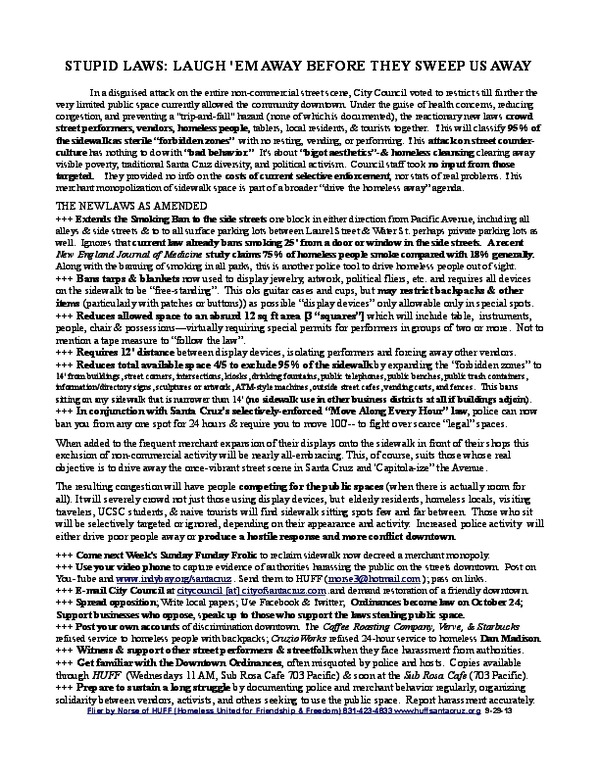
Santa Cruz Task Farce Rides Again–Wednesday 10-2 SCPD Community Room

https://www.indybay.org/newsitems/2013/10/01/18744150.php

View other events for the week of 10/ 2/2013

Title: Public Hysteria Gang “Targets” Other Gangs
START DATE: Wednesday October 02
TIME: 6:00 PM – 9:00 PM
Location Details:
Community Room of the Santa Cruz Police Department at Center and Laurel Streets.
Event Type: Meeting
Contact Name Susan O’Hara (posted by Norse)
Email Address sohara [at] cityofsantacruz.com
Phone Number 831-420-5013
Address 809 Center St., Santa Cruz, CA
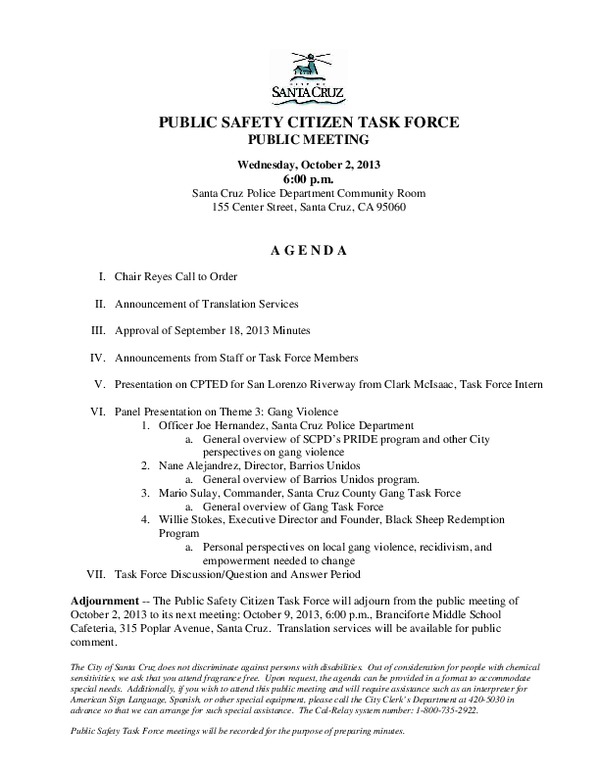
The Mayor’s handpicked “scapegoat the homeless” Task Force will be meeting Wednesday, October 2 in its familiar meeting place–the Community Room of the Santa Cruz Police Department.

The audience, as usual, will be gagged (i.e. refused any public comment period and rudely advised to shut up if they dare to raise a question or react to the ongoing show).

The topic will be Gangs–without, of course, any representation from current gang members on police abuse, background on gangs from the gang member’s point of view, and/or suggestions for real solutions rather than throwing more money at police or forming local vigilante Take Back Santa Cruz style counter-gangs..

Prior agendas, staff reports, minutes, and audio of this City-funded Circus can be found at http://www.cityofsantacruz.com/index.aspx?page=1924 where the agenda and staff report for the meeting tomorrow can be found.

The next meeting will be held at Branciforte Middle School on October 9 (see below) and will actually allow the public to speak before resuming “no comment” sessions in a weekly schedule throughout October. This is as distinguished from its bi-weekly schedule previously.

The staff person being paid to do research, record, and organize these meetings is Susie O’Hara, who actually gave me her direct city contact phone after the city offices would not (it’s 420-5013). She can be reached by e-mail at sohara [at] cityofsantacruz.com .

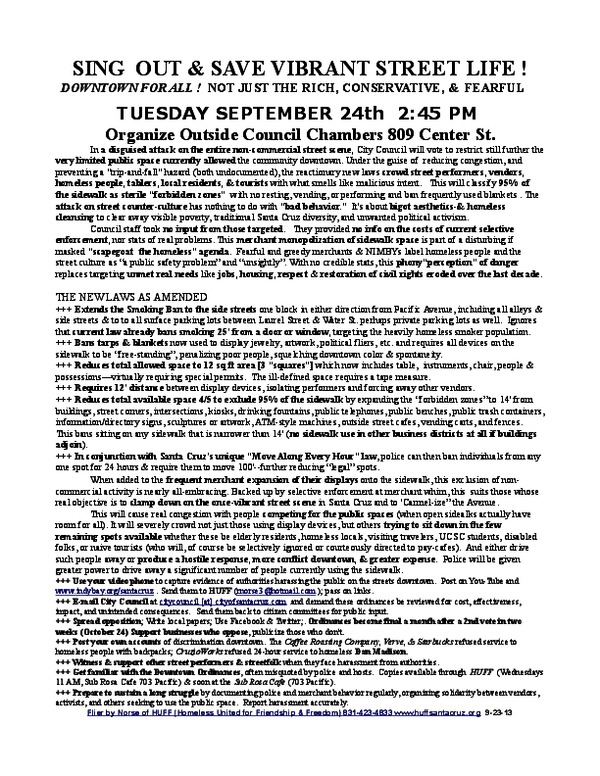
I suggest those who go bring placards silently indicating their opinions (“Stop Scapegoating Street People”) or even a more versatile sign like a double-sided one with ‘half-truth” on one side and “total bullshit” on the other. Signs referencing the new Downtown Ordinance outrage against street culture would also be welcome.

More discussion on the issue at the HUFF meeting tomorrow 11 AM 10-2 at the Sub Rosa Cafe 703 Pacific Ave.

For ease of reference, I include the agenda as PDF.

For some prior indybay articles on the Task Farce and its members see

“Mayor’s Public Safety Task Force Member is “fine with junkies dying”” at http://www.indybay.org/newsitems/2013/07/25/18740407.php

“Strongly Biased Public Safety Survey” at http://www.indybay.org/newsitems/2013/06/10/18738231.php. and

“Mayor’s Stacked and Packed “Public Safety Task Force” meets” at http://www.indybay.org/newsitems/2013/05/28/18737491.php

To be clear, this post is by Robert Norse in its entirety–the information was in part supplied by city staffer Susan O’Hara, whose opinions are not necessarily represented by this article.

Correcting the Record on Analicia Cube’s Take Back Santa Cruz

https://www.indybay.org/newsitems/2013/09/30/18744094.php

Missing from the S.C. Weekly Puff Piece on Take Back Santa Cruz Co-Founder Analicia Cube
by Robert Norse ( rnorse3 [at] hotmail.com )
Monday Sep 30th, 2013 2:11 PM

The Santa Cruz Weekly published a lengthy chitchat boosting the public image of Take Back Santa Cruz’s public face Analicia Cube. Hopeful as I’ve been for Georgiana Perry’s writing, this one has a sweet stench to it and prompted me to write an extensive reply in the on-line comments section. Though it’s not exhaustive, it summarizes some of the major concerns I have about Analicia’s group and those who cater to it and its mythologies. At http://www.santacruz.com/news/2013/09/24/take_back_santa_cruz_leader_pulls_no_punches , there are 35 comments as of this writing, most of them praising Cube, but a number are worth reading. I reprint mine for indybay readers and invite them to share their thoughts.

Analicia Cube is a high-spirited,strong-voiced, effective activist whose TBSC agenda and actions menace poor and homeless people in Santa Cruz and empower the darkest elements of our community.

Missing from G. Perry’s article are some key accomplishments of her Take Back Santa Cruz and allied or infiltrated groups, now grown in power with their leaders in significant government positions.

TBSC accomplishments: They and their needle-rattling allies have closed down the only Needle Exchange in Santa Cruz—doing so without public hearings or evidence of any real problems at the Barson St. site. They have stopped a second marijuana club from opening in the Harvey West in another medieval anti-mariuana move. They’ mobbed a court to keep the innocent Ken Maffei in jail for three weeks (the guy who brought his own flowers to the SCPD memorial and was then falsely accused of stealing posies).

They raised the temperature of anti-homeless sentiment, serving as a forum for those who want to defund the very limited homeless shelter services that currently exist. Their clean-up’s for years have not advised their participants to respect homeless campsites (the only shelter Santa Cruz’s 1500-2000 homeless have).

They have spread the hateful and false broadside that sleeping and camping are crimes (something currently being entrenched in the Public Safety Citizens Task Farce). This has resulted in harassment and assault against homeless people, as documented in the famous (but frequently suppressed) video of Clean Team activists bullying a homeless camper (See http://www.indybay.org/newsitems/2013/05/15/18736901.php ).

They have colluded with and encouraged the most reactionary and dangerous higher-up’s in the SCPD (such as Deputy Chief Steve Clark—notorious for his ceaseless attacks on activists, homeless people, and “liberalism” in Santa Cruz).

Additionally they have driven previously sympathetic critics who disagree with their obsessive and futile Drug War posture from their website. T.J. Magallanes, the founder of The Clean Team website, has repeatedly noted that TBSC activists kidnapped his site and their hostility made his presence in town uncomfortable. (See http://www.indybay.org/newsitems/2013/05/22/18737249.php )

Those who come out for medical rather than police solutions to social problems created by the illegal status of methedrine, cocaine, heroin, and other drugs are reportedly removed from their website and discussions. The futile enforcement of these laws, of course, funds police departments nationwide and gives politicians a boogeyman to intimidate and co-opt politicians. The toll in ruined lives and wasted money is immense here—yet that is one of their main “law and order” selling points.

What’s really depressing is how these clear issues are ignored not only in Perry’s article but in the mainstream media generally. In response liberals like Lane, Posner, and Pleich surf this sick tide and buy into the Public Safety mythology in order to ride the wave of groundless hysteria that Cube’s group and related ones have created.

THE FULL ARTICLE AND FOLLOWING COMMENTS CAN BE FOUND AT http://www.santacruz.com/news/2013/09/24/take_back_santa_cruz_leader_pulls_no_punches  .  The article is also the cover story for the current Santa Cruz Weekly.

The Latest Street Menace–Chess

NOTES BY NORSE:  The suppression of sidewalk chess in San Francisco is a mirror example of what is being done in Santa Cruz–removal by edict of public assembly on the sidewalks though the behavior is innocent (indeed positive), traditional, and serves not only “homeless” people but the community as well.  The only people complaining (and its not clear whether any real presentation of complaints versus commendations has been made) are some merchants.
Ditto with Santa Cruz.   Performers, vendors, artists, political tablers–indeed anyone who wants to sit down on the broad Santa Cruz sidewalks (and don’t even  mention anyone who wants to peaceful, even silently sparechange)–already face an absurdly contracted space, high fines for sitting outside the designated areas, and huge fines for doing so (not to mention the threat of ail for repeated offenses).   The aggressors here are the same group of self-entitled gentrification maestros and economically-anxious merchants who are attempting to sanitize business districts throughout the country.
Liberal on the outside, homeless-ophobic and streetlife-hostile underneath, places like New Leaf Market, Coffee Roasting Company, Verve–to mention only a few–are banning backpacks and homeless-looking people inside and (in New Leaf’s case) supporting their removal even from the public sidewalks outside.  Streetlife is considered to be a “draw” or–in the current crypto-fascist language–“an enabling” or “welcoming” aspect to the sidewalk and so needs to be either regimented or removed entirely.  Ironically this “clean up” campaign threatens the vibrancy and color that actually draws tourists to the overpriced Pacific Avenue with its skyrocketing rents & knickknack shops.
Simply wailing the business blues isn’t enough in Santa Cruz (and SF), so merchants, cops, cranky conservatives, and paranoid residents hook up to generate the mythical “Public Safety” menace.  In Santa Cruz this takes the virulent and retrograde Drug War shape with politically resurgent groups like Take Back Santa Cruz, the Green Team, and the new Needle-Free Zone fear-mongers beating the drums for attacks on anyone who looks homeless (See https://www.indybay.org/newsitems/2013/09/29/18744023.php ).  Deny them services; deny them space; criminalize them with absurd laws, and then use that criminal status to drive them away.
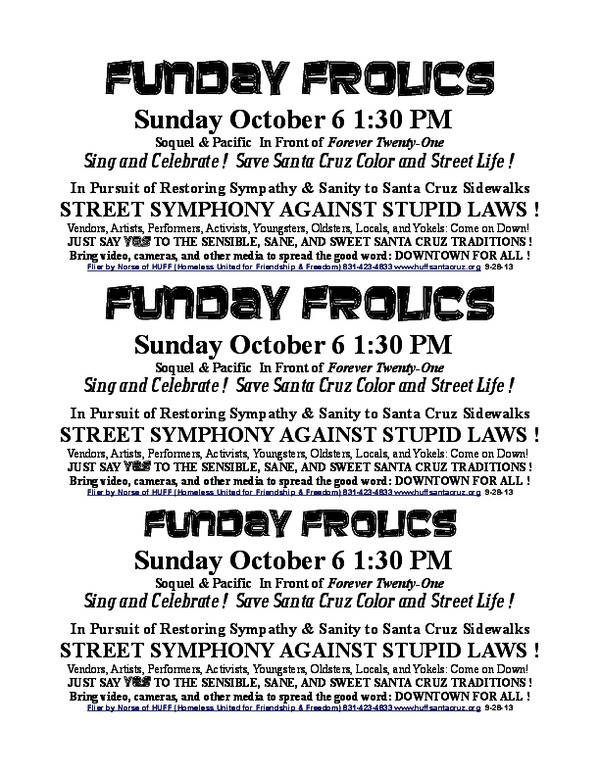
In Santa Cruz it will also become difficult if not impossible to play chess on the sidewalk without a permit.  Try and do it in 12 square feet and see.   Protests continue against these spirit-suppressing laws next Sunday (See https://www.indybay.org/uploads/2013/09/29/festival_of_fun_flyer__for_10-6.pdf and related articles at www.indybay.org/santacruz ).

SFPD Shuts Down Sidewalk Chess Games

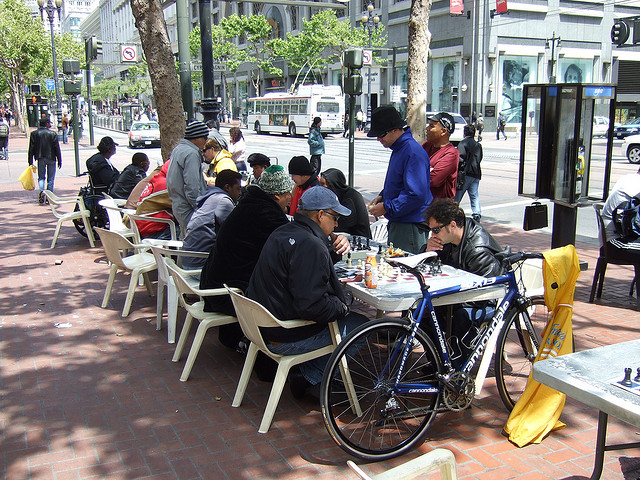
sf-sidewalk-chess.jpg
Photo: goosmurf/Flickr
Well, this is a pathetic development in the War on Fun: The SFPD has confiscated all the game tables, chairs, and chess boards that have been used for at least three decades for sidewalk chess games on Market Street near Fifth. The claim is that “illegal activity” has spiked in the last six months, but this kind of sounds like bullshit given that we used to live in this neighborhood, and the entire five-block radius around those chess games has basically never not been a hotbed of illegal activity.
Says police Capt. Michael Redmond to the Chron, “It’s turned into a big public nuisance. I think maybe it’s a disguise for some other things that are going on.”
Oh, for god’s sake. It’s just a bunch of elderly, mostly homeless dudes playing chess!! Whatever else is going on around them, or whatever pills they may be taking on their non-chess-playing time, has little or nothing to do with the fact that they’re all just out their passing the time in a perfectly peaceful way, sacrificing pawns and taking bishops and rooks and shit!!
Sidebar: We gather that women passing by the daily games were frequently subjected to harassment, but that is another matter.
Our guess is that the row of chess-playing dudes runs counter to the image that the upcoming new tenants across the street, in what will become Market Street Place, the vertical mall formerly called CityPlace. And even though that is only barely under construction and not near opening, they want to get a head start on spiffing things up for the neighboring businesses that will reap the benefits of the retail gentrification to come.
They have their work cut out for them on Sixth Street. Baby steps.

Endgame: S.F. police shut down sidewalk chess

Neal J. Riley Updated 11:32 pm, Tuesday, September 17, 2013
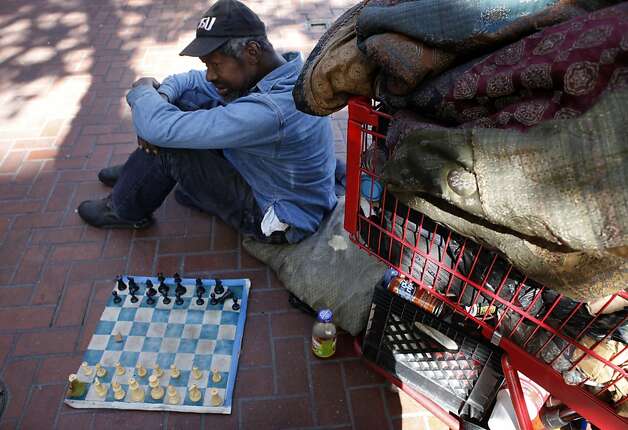
      Marvin Boykins, sitting on Market Street between Fifth and Sixth, is the last sign of street chess in downtown San Francisco. Boykins, 57, learned to play chess when he was 7 years old. Photo: Lacy Atkins, The Chronicle


Street chess, that institution of young, old, rich and poor mentally duking it out over a checkered board in the open air, thrives downtown in nearly every big city of America – except, now, San Francisco.

For more than 30 years, chess games have been a staple near Fifth and Market streets, but earlier this month, the San Francisco Police Department confiscated the playing equipment, chairs and tables from where dozens of people, mostly homeless, would gather every day to play.
Police said that regular chess players weren’t the problem but that the area had become a hotbed for illegal gambling and drug use.
“It’s turned into a big public nuisance,” said Capt. Michael Redmond, contending that complaints from nearby businesses and arrests for sale and possession of narcotics have increased over the past six months. “I think maybe it’s a disguise for some other things that are going on.”
On Tuesday afternoon, the only sign of street chess was at the feet of Marvin Boykins, 57. Across from his latex chessboard, a friend moved chess pieces at the command of a smartphone computer game set at the grandmaster level, which Boykins refused to listen to after it warned him that he’d made a bad move.
“I’ve been playing since I was 7 or 8 years old,” said Boykins, who has been playing at the spot for decades. “Chess is a true San Francisco tradition.”
His friend, Hector Torres Jr., said chess saved him from a gambling addiction when he moved to San Francisco from Las Vegas more than 20 years ago. He said the chess games are a discrimination-free zone that has welcomed everyone including San Francisco Giants players, millionaires and people who have been in prison for decades.
“They’re being mean for no reason,” Torres Jr., 42, said about the police. “To me, it’s a scapegoat.”

Decades of history

Pinpointing exactly how the games began on Mid-Market is difficult, but what is clear is that they have been a fixture since at least the early 1980s.
The people supplying the tables, and the rules for play, changed periodically, but the basic premise was always the same: A steady core of chess devotees, many of them homeless, sat at the tables all day, and pretty much anyone who wanted to play could take a seat.
Sometimes the winner won $1, other times it was just a straight fee to play. At one time in the early 2000s the players who ran the tables charged 50 cents for three games. Boykins charges $2 for people to rent one of his boards.
The tables were sometimes supplied by avid players with homes and sometimes by homeless people – one penniless man in the mid-2000s dragged them there every morning from his storage place south of Market Street.
San Francisco resident Vivian Imperiale, walking down Market Street on Tuesday, said she saw police officers telling chess players a few weeks ago to get rid of their equipment.

Businesses relieved

“I was walking out here and I was thinking ‘how charming,’ although I think there’s money involved – it’s probably not all squeaky clean,” she said. “It seemed innocent.”
But employees at several nearby businesses said they were relieved the tables are gone.
“It’s an excuse for illegal activity – period,” said Dimitri Madrid, manager at Beauty Supply and Hair Salon, which has sent four letters to Mayor Ed Lee complaining about drug and alcohol use, violence and barbecuing that has taken place by the tables.
Now that the tables and crowds are gone, Madrid says he no longer sees people walking by with their purses clutched tightly in their arms, or just crossing to the other side of the street.
“It’s like night and day,” he said. “Sales have been up.”
At CeX, an electronic entertainment exchange, people have come in and asked where the chess went, said Ryan K., a store manager who didn’t want to give his last name.
“Since it’s been gone, it’s been a lot quieter,” he said, adding that he thought that was an improvement.

Not the last move

Ryan said police had reached out to businesses, asking if the chess tables were creating problems. He said drug use was commonplace and customers were calling to say they weren’t coming back to the store.
“They said, ‘We didn’t want to come here because it’s too dangerous,’ ” Ryan said.
Jennifer Friedenbach, executive director of the Coalition on Homelessness, said the police were wrong to take chess away.
“Having activities for folks to do is a positive thing,” she said. “We have elderly people who are very isolated, and this is a great way for them to be out in the community.”
Redmond said the players’ property will eventually be released back to them and he hopes to work out a plan for chess in the future – but that may involve persuading a business to pay for a permit so games can be played on the sidewalk.
“I’m optimistic that something is going to work out,” Boykins said.
Neal J. Riley is a San Francisco Chronicle staff writer. E-mail: nriley@sfchronicle.com Twitter @realdealneal

Protests Continue Against New Laws to Sweep Away Street Performers in Santa Cruz

https://www.indybay.org/newsitems/2013/09/29/18744041.php

Festival of Fun Draws More Police Surveillance
by Robert Norse ( rnorse3 [at] hotmail.com )
Sunday Sep 29th, 2013 8:13 PM

An hour and a half protest against the latest turn of the screw choking off street performers, artists, vendors, and tablers drew singers, poets, chalkers, a cop, and even a long-winded critic. Activists have put out a flyer announcing a second protest next Sunday October 6th.

Saturday night some of us came together for the first street protest in front of Forever Twenty-One last night since the passage of the Downtown Ordinances on September 24th. Activists bravenly chalking their outrage on the sidewalk and informed passersby of the new shrunken space street performers will be allowed.

For those who know the downtown, that will be three of the 2′ X 2′ squares on Pacific Avenue within which a performer (or tabler or vendor or artist) will be expected to confine instrument, body, chair, table, and accompanists). Since this is clearly impossible in many cases, it will mean that to be legal you need to get a special permit.

To do this requires 3 days to a week notice, is reportedly free, but may only be permissibble in a few spots downtown (though it wasn’t clear from my conversations with the Parks and Rec Department last week whether the special permits were limited to that area). Obviously arriving to play spontaneously (if you wish to have a guitar case or other “display device” out–will be a thing of the past. Unless folks ignore this law and continue their traditional practices.l Having any “amplified sound” whatsoever supposedly now requires going through the SCPD and takes 2 weeks, or such was the info from P and R.

The new rules also require 12′ distances between those those busqueing, tabling, displaying artwork, or vending on the sidewalk as well as none of this activity at all within 14′ of any building, any change-dispersing machine, any fence, any bench, any drinking fountain, any public telephone, any public bench, any public trash can, any information or directory sign, any sculpture, any “no panhandler” meters, any vending cart, any sidewalk cafe, any street corner, any intersection, or any kiosk. Sitting or sparechanging is also restricted to those tiny patches of ground. Any cup, cap, or guitar case is defined as a “display device”.

The Saturday night protest focused on the absurdities of the new laws as well as older ones that ban bouncing or throwing a ball downtown, hackeysacking, using a squirt gun, or chalking on the sidewalk with erasable chalk. Sports fans brought a basketball and a small football. Bubble-blowing–which is permitted–was also provided as a legal interlude. Hopscotch enthusiasts brought sidewalk chalk. A “Box of Crime” was displayed and offered to the police as a form of “crime control”.

Office Headley arrived with camera to stand with arms folded taking occasional snapshots of those giving out flyers of the chalkked sidewalk delineating the small “permitted” zones that go into effect on October 24th. When asked if he were there on complaint or to give out citations, he smiled broadly and said nothing. Such picture taking has been used in the past to later cite peaceful activists like Wes Modes who was dragged into a full-blown trial for walking in the parade along with hundreds and hundreds on New Year’s Eve 2010 (See http://www.indybay.org/newsitems/2010/12/17/18666919.php ).

On my radio show today, I played some of the audio of the protest, which included poetic performance by Lyrical Eye (Isaac Collins), speeches by Becky Johnson, and others, and spirited conversations with surprised locals, baffled tourists, and irate critics (though fewer of those). Most passed by swiftly en route to their Saturday evening activities.

I did get wind of larger protests being planned by more “respectable” folks–and some of these may be discussed at the next HUFF meeting (Wednesday 11 AM Sub Rosa Cafe 703 Pacific Ave.).

I was impressed with the determination to restore First Amendment rights downtown–some activists began to chalk, though the area was under surveillance and they might later well be subject to fines of hundreds of dollars. Others sat on the sidewalk in “illegal” locations.

Another Sunday “Funday Frolics” protest has been announced for next Sunday afternoon.

§

by Robert Norse Sunday Sep 29th, 2013 8:13 PM

Anaheim Moves Against Its Homeless Community

NOTES BY NORSE:   Both Anaheim and Santa Cruz are ramping up their assaults on the homeless, without specifying what they’re doing (why acknowledge unconstitutional and cruel behavior?) or masking it under other labels.  In Santa Cruz it’s “public safety”, “the needle menace”, and “the perception of danger”; in Anaheim, they’re calling it “blight”, “increasing police tools”, etc.

The latest Santa Cruz City Council’s anti-homeless expansion of Smoking, Vending, Tabling, Performing, Art Display, Sparechanging, and Sitting Bans downtown are similarly camouflaged and rationalized as “congestion”, “clarity”, and “clean and tidy” aesthetic concerns.    Today at Santa Cruz City Council at 2:45 PM supporters of a Downtown for All will be gathering to share food, experience, ideas and speak to the Community during the Council meeting (the Council itself isn’t listening) in the brief televised period.  That’s at 809 Center St. across from the Main Library and Civic Auditorium.  Bring instruments and friends.

Another “more respectable” effort is being made by activists supporting a Santa Cruz Sanctuary Camp to the County Board of Supervisors–calling for a small tightly controlled “drug free” Camping Area.  9 AM at 701 Ocean St. on the 5th Floor of the Board of Supervisors.   The supporters led by Brent Adams will be presented a business plan and may have recently gotten the support of Paul Lee, a local author and philanthropist who tried himself unsuccessfully to set up an Eco-Village a decade ago and a Community House a decade before that.  In the 80’s Lee supported activist Calamity Jane Imler’s hunger strikes against the Sleeping Ban, police abuse, and the call for a cold-and-rainy-night Shelter.  Adams has been a target of political repression in the aftermath of the Occupy Movement as one of the Santa Cruz Eleven–when hundreds occupied a vacant Wells Fargo-leased bank at 75 River St.

The Anaheim ordinance’s definition of “camping” (Yuppie-speak for “survival sleeping”) is “Residing in or using any Public Area for living accommodation or lodging purposes with one’s personal property or while storing one’s personal property;  and/or constructing, maintaining, occupying, or inhabiting or using camping facilities and/or constructing, using or maintaining camping paraphernalia.  For the purposes of this section “camping” shall not include merely sleeping outside in a park or the use of a blanket, towel, or mat in a park during the time the park is open to the public.”

Santa Cruz activists have long agitated against Santa Cruz’s Sleeping and Blanket Bans, which defines and criminalizes camping as sleeping after 11 PM at night outside on any public property, on much private property, or in a vehicle, even if legally parked on public property.   It has its own “abandoned property” rule, and in today’s City Council vote will finalize a severe shrinkage of space where homeless people (and to be “fair” this affects any one and everyone) can place their possessions if trying to display art, engage in political activity involving a table, vend anything, or perform music.  This is a social sickness that is spreading everywhere.

The City’s gentrification adovocates are countering traditional toleration and compassion in the community (though not in the police, City Council, or City Manager’s office), right-wing NIMBY’s with the Downtown Association, Santa Cruz Neighbors, Take Back Santa Cruz, and other reactionary groups propaganda and agitation.  These exclusionary Upper Class warriors are making much of the Drug War and a xenophobic “outsiders flooding our community”.  They can be seen in full frightening bloom at the Mayor’s Public Safety Task Force.  The group meets every Wednesday in October usually at the police department’s Community Room on Laurel and Center streets.  The public is generally allowed to watch but not to comment.

Anaheim City Council Now Declaring War on Homeless

By Gabriel San Roman Mon., Sep. 23 2013 at 2:31 PM
lapalmapark_tent.jpg
Josue Rivas
Homeless tent

A week after activist Stephen Baxter held a ‘sleep-in’ protest in downtown Fullerton over the city’s war on the homeless, Anaheim will try to one-up them with a punitive ordinance of its own. The city municipal code already forbids staying in a public park between the hours of 10:30 p.m. and 5 a.m., which has the homeless laying their head elsewhere for the night–but that’s not enough for councilwoman Kris Murray and her crew!

On Tuesday, council members will decide on a proposal aimed at banning camping and storage of personal property on public property at any time.
In a staff report submitted by Director of Community Services Terry Lowe, the ordinance is framed as one that will “serve as a tool in the City’s effort to promote and support safe, clean and accessible neighborhoods and eliminate blight.” Never once are the homeless referenced directly, but it couldn’t be clearer who the intended target is.

If Anaheim’s city council should approve the crackdown–and it almost assuredly will–no homeless person can use a tent for living purposes at any hour in public areas including parks, alleys, parking lots, or any other publicly owned property. Nor could they store personal belongings such as the tents themselves, sleeping bags, bedrolls, cooking equipment, books, money and appliances in addition to other possessions in such spaces.

Public parks are the most visible places where the city’s homeless population set up tents during the day. Since the eviction of a sizable homeless encampment in Fullerton by the shuttered Hunt Library earlier this year, many of those displaced turned up on the east lawn of La Palma Park in Anaheim.

lapalmapark_homeless.jpg
Josue Rivas / OC Weekly
La Palma Park in Anaheim

The belongings of the homeless would be subject to 90-day impounds so long as they are given “proper notice.” Anaheim police can immediately confiscate possessions if they are left after hours at the park or deemed to be contraband, a threat to public health and safety or evidence of crime. Retrieval is allowed when the Chief of Police finds proof of ownership to be “satisfactory.”
If that’s not the case, the city stands poised to make money off of the confiscations, whether through depositing unclaimed money into the general fund or holding auctions.

Enforcement of the ordinance entails fines for infractions. The first violation would cost $100. A second violation within a year is punishable up to $200 with every subsequent infraction in that time span costing $500.

“I would categorize this ordinance as part of the larger ‘criminalization of homelessness’ that many communities fall back on when they choose to be less creative with their problem solving,” says Jennifer Lee-Anderson, Co-Chair of the Anaheim Poverty Task Force and policy planning consultant on homelessness. “The $100 to $500 fines that are noted in the proposed ordinance are part of the reason that many chronically homeless are simply cycled through the criminal justice system repeatedly.”

Near La Palma Park, the city is just weeks into a newly opened storage area and outreach center. The homeless can take advantage of Conex boxes set up to leave their personal belongings during the day. The city-owned parking lot by Glover Stadium is close to where people continue to set up tents. In a heavy-handed way, the ordinance could encourage more homeless to participate in the pilot program but is also a cause for concern and clarification. “There’s no language that exempts the storage area,” adds Lee-Anderson expressing disappointment that she learned about this proposal from the Weekly and not city staff. There is also the issue of other public areas in Anaheim far beyond La Palma Park where homeless persons stay.

For the past six years, Jim Carter has taken students at Servite High School, where he works, to serve meals at La Palma Park every Thursday. “I understand where the city comes from. I understand where the police come from,” says Carter, also a member of the Anaheim Poverty Task Force that has drafted a 15 point plan to address homelessness. “I don’t think [the ordinance] is a good thing. Unless it comes with a long-range plan to help these people move out of this situation, it’s just going to add stress to them. Where are the homeless going to go?”

“What would have been nice is if the city adopted the 15 point plan in full,” Carter mentions, emphasizing the key recommendation of establishing a multi-service center. “If the city is not willing to find a location where we can put a shelter, it’s never going to change.”


Follow Gabriel San Román on Twitter @dpalabraz


Follow OC Weekly on Twitter@ocweekly or on Facebook!

FURTHER COMMENTS AT http://blogs.ocweekly.com/navelgazing/2013/09/anaheim_homeless.php

TEXT OF THE ORDINANCE AT http://www.anaheim.net/docs_agend/questys_pub/MG41822/AS41861/AS41864/AI44292/DO44294/DO_44294.pdf

STAFF REPORT AT http://www.anaheim.net/docs_agend/questys_pub/MG41822/AS41861/AS41864/AI44292/DO44293/DO_44293.pdf

HOMELESS ENCAMPMENT EVICTION STORY AT:  http://blogs.ocweekly.com/navelgazing/2013/06/hunt_library_fullerton.php

YET ANOTHER “NO SHELTER, NO RELIEF” 15-POINT PLAN TO “END HOMELESSNESS” BY FUNDING POVERTY PIMPS:  http://www.anaheimptf.org/plan .

Demonstrations Against the Santa Cruz Sidewalk Snatchers Continue Tuesday 3:45 PM

Title: Last Change to Stop the Sidewalk Snatchers
START DATE: Tuesday September 24
TIME: 2:45 PM – 3:45 PM
Location Details:
809 Center Council Chambers at City Hall across from the main library and the Civic Auditorium
Event Type: Protest
Contact Name Robert Norse
Email Address rnorse3 [at] hotmail.com
Phone Number 831-423-4833
Address 309 Cedar PMB #14B Santa Cruz, CA 95060
SUCCESSFUL PROTEST ON SUNDAY
After a rousing demonstration downtown on Sunday (see http://www.facebook.com/events/483912138373592/?context=create) Downtown for All activists will gather to oppose the Bryant-Robinson City Council’s steamroller seizure of the sidewalk beginning at 3 PM.

Neither the Santa Cruz Sentinel (though a reporter was there) nor indybay.org/santacruz chose to cover the protest.

Councilmember Micah Posner put in appearance as the protest was dispersing. I’ll hope to post my own impressions later today.

TUESDAY PROTEST WILL PROVIDE FOOD
Meet earlier and share some hot tasty soup, a strong dose of common sense and citizen outrage, and organizing for future action outside Council chambers.

A special tip of the hat to India Joze’s Jumbogumbo Joe Schultz for providing tasty vegan soup at both the Sunday and Tuesday protests.

THE LAWS
The new Shrink-Sidewalk-Space law changes are described at http://www.indybay.org/newsitems/2013/09/09/18742960.php?show_comments=1#18743583 though the latest clarifications are included in the attached flyer.

The text of the proposed ordinances is at http://sire.cityofsantacruz.com/sirepub/cache/2/mgx3p145ppgk5z45tcxxok45/379504109232013080657617.PDF (the extended Smoking Ban) and;

http://sire.cityofsantacruz.com/sirepub/cache/2/mgx3p145ppgk5z45tcxxok45/379504209232013080741906.PDF (the Ban on Street Performing, Street Art, Street Vending, Political Tabling, & Peaceful Sparechanging on 95% of the Pacific Avenue sidealks and entirely in other business districts where sidewalks are adjacent to buildings).

COUNCIL’S RUSH JOB
Neither of the ordinances were vetted before the public in a Council Committee or Commission–as is customary with such changes. Nor were stakeholders in the major groups impacted consulted.

They were proposed with only 72-hour notice 2 weeks ago and passed by City Council 5-2 without only 2 minutes public input allowed per person (instead of the 3 minutes customary in a Public Hearing on a law change). There was no estimate of the amount of city money and police time already being spent enforcing these “don’t sit next to a building”-style ordinances

THE USUAL SUSPECTS
They are being pushed by some merchants in the DTA to sanitize the sidewalks and lure more shoppers in the belief that less vibrant street life is a bigger draw. The pretexts are “congestion”, “trip and fall hazard”, and “upgrading the tacky look”.

The ordinances also seem to be part of a continuing campaign to make Santa Cruz an “unwelcome” area for homeless people, hippies, and poor people generally.

Since it seems unlikely that the Council will disobey its Downtown Association, Santa Cruz Neighbors, and Take Back Santa Cruz masters, this meeting will also be an organizing opportunity to plan the next phase of the resistance.

More protests like Sunday’s street demonstration and the spontaneous Saturday Chalk-In (see http://www.flickr.com/photos/97198640@N08/ http://sfbay.craigslist.org/scz/eve/4078506873.html ) are a likely outcome of this kind of special interest repressive legislation. To challenge the surrender of traditional Santa Cruz street vitality to the prim Victorian standards of the New Puritans.


READ THE TEXT OF THE FLYER AT
https://www.indybay.org/newsitems/2013/09/23/18743666.php 

SAVE VIBRANT STREET LIFE DOWNTOWN !

(Text of flyer for Sept. 22, 2013, protest of latest anti-homeless legislation by City Council.)

(Flyer in pdf format at bottom)

SAVE VIBRANT STREET LIFE DOWNTOWN !
PROTEST, CHOW-DOWN, AND SPEAKOUT !
SUNDAY SEPTEMBER 22nd 1:30 PM
on Pacific Avenue in front of Forever Twenty-One
SING BACK AT CITY COUNCIL
TUESDAY SEPTEMBER 24th 3 PM
Council Chambers 809 Center St.
In a disguised attack on the entire non-commercial street scene, City Council will vote to restrict still further
the very limited public space currently allowed the community downtown. Under the guise of health concerns,
reducing congestion, and preventing a “trip-and-fall” hazard (none of which is documented), the reactionary new laws
crowd street performers, vendors, homeless people, tablers, local residents, & tourists together. This will classify
95% of the sidewalk as sterile “forbidden zones” with no resting, vending, or performing. This attack on street
counter-culture has nothing to do with “bad behavior.” It’s about “bigot aesthetics”-& homeless cleansing
clearing away visible poverty, traditional Santa Cruz diversity, and political activism. Council staff took no input
from those targeted. They provided no info on the costs of current selective enforcement, nor stats of real
problems. This merchant monopolization of sidewalk space is part of a broader “drive the homeless away” agenda.
THE NEW LAWS AS AMENDED
+++ Extends the Smoking Ban to the side streets one block in either direction from Pacific Avenue, including all
alleys & side streets & to to all surface parking lots between Laurel Street & Water St. perhaps private parking lots as
well. Ignores that current law already bans smoking 25′ from a door or window in the side streets.
+++ Bans tarps & blankets now used to display jewelry, artwork, political fliers, etc. and requires all devices
on the sidewalk to be “free-standing”. This okays guitar cases and cups, but arguably makes backpacks and
anything placed perpendicular to the sidewalk “display devices” requiring a 12′ distance from the next “device”.
+++ Reduces total allowed space to 12 sq ft area [3 “squares”] which now includes table, instruments, chair,
people & possessions—virtually requiring special permits. The ill-defined space requires a tape measure.
+++ Requires 12′ distance between display devices, isolating performers and forcing away other vendors.
+++ Reduces total available space 4/5 to exclude 95% of the sidewalk by expanding the “forbidden zones” to
14′ from buildings, street corners, intersections, kiosks, drinking fountains, public telephones, public benches, public trash containers,
information/directory signs, sculptures or artwork, ATM-style machines, outside street cafes, vending carts, and fences. This bans
sitting on any sidewalk that is narrower than 14′ (no sidewalk use in other business districts at all if buildings adjoin).
+++ In conjunction with Santa Cruz’s unique “Move Along Every Hour” law, police can then ban
individuals from any one spot for 24 hours & require them to move 100′–further reducing “legal” spots.
When added to the frequent merchant expansion of their displays onto the sidewalk in front of their shops this
exclusion of non-commercial activity will be nearly all-embracing. This, of course, suits those whose real
objective is to drive away the once-vibrant street scene in Santa Cruz and ‘Capitola-ize” the Avenue.
The resulting congestion will have people competing for the public spaces (when there is actually room for
all). It will severely crowd not just those using display devices, but others trying to sit down in the few
remaining spots available whether these be elderly residents, homeless locals, visiting travelers, UCSC
students, or naive tourists (who will, of course be selectively ignored or courteously directed to pay-cafes). And
either drive such people away or produce a hostile response and more conflict downtown. Police will be
given greater power to drive away a significant number of people currently using the sidewalk.
Flier by Norse of HUFF (Homeless United for Friendship & Freedom) 831-423-4833 www.huffsantacruz.org 9-22-13
DOWNTOWN FOR ALL ! NOT JUST THE RICH, CONSERVATIVE, & FEARFUL
+++ Use your video phone to capture evidence of authorities harassing the public on the streets downtown. Post on
You-Tube and www.indybay.org/santacruz . Send them to HUFF (rnorse3@hotmail.com ); pass on links.
+++ E-mail City Council at citycouncil [at] cityofsantacruz.com .and demand these ordinances be reviewed for cost,
effectiveness, impact, and unintended consequences. Send them back to citizen committees for public input.
+++ Spread opposition; Write local papers; Use Facebook & Twitter;. Ordinances become final a month after a
2nd vote in two weeks (October 24) Support businesses who oppose, publicize those who don’t.
+++ Post your own accounts of discrimination downtown. The Coffee Roasting Company, Verve, & Starbucks
refused service to homeless people with backpacks; CruzioWorks refused 24-hour service to homeless Dan Madison.
+++ Come to City Council 3 PM September 24th to oppose the 2nd Vote on these laws!
+++ Witness & support other street performers & streetfolk when they face harassment from authorities.
+++ Get familiar with the Downtown Ordinances, often misquoted by police and hosts. Copies available
through HUFF (Wednesdays 11 AM, Sub Rosa Cafe 703 Pacific) & soon at the Sub Rosa Cafe (703 Pacific).
+++ Prepare to sustain a long struggle by documenting police and merchant behavior regularly, organizing
solidarity between vendors, activists, and others seeking to use the public space. Report harassment accurately.
Flier by Norse of HUFF (Homeless United for Friendship & Freedom) 831-423-4833 www.huffsantacruz.org 9-19-13
DOWNTOWN FOR ALL ! NOT JUST THE RICH, CONSERVATIVE, & FEARFUL
+++ Use your video phone to capture evidence of authorities harassing the public on the streets downtown. Post on
You-Tube and www.indybay.org/santacruz . Send them to HUFF (rnorse3@hotmail.com ); pass on links.
+++ E-mail City Council at citycouncil [at] cityofsantacruz.com .and demand these ordinances be reviewed for cost,
effectiveness, impact, and unintended consequences. Send them back to citizen committees for public input.
+++ Spread opposition; Write local papers; Use Facebook & Twitter;. Ordinances become final a month after a
2nd vote in two weeks (October 24) Support businesses who oppose, publicize those who don’t.
+++ Post your own accounts of discrimination downtown. The Coffee Roasting Company, Verve, & Starbucks
refused service to homeless people with backpacks; CruzioWorks refused 24-hour service to homeless Dan Madison.
+++ Come to City Council 3 PM September 24th to oppose the 2nd Vote on these laws!
+++ Witness & support other street performers & streetfolk when they face harassment from authorities.
+++ Get familiar with the Downtown Ordinances, often misquoted by police and hosts. Copies available
through HUFF (Wednesdays 11 AM, Sub Rosa Cafe 703 Pacific) & soon at the Sub Rosa Cafe (703 Pacific).
+++ Prepare to sustain a long struggle by documenting police and merchant behavior regularly, organizing
solidarity between vendors, activists, and others seeking to use the public space. Report harassment accurately.
Flier by Norse of HUFF (Homeless United for Friendship & Freedom) 831-423-4833 www.huffsantacruz.org 9-19-13
DOWNTOWN FOR ALL ! NOT JUST THE RICH, CONSERVATIVE, & FEARFUL
+++ Use your video phone to capture evidence of authorities harassing the public on the streets downtown. Post on
You-Tube and www.indybay.org/santacruz . Send them to HUFF (rnorse3@hotmail.com ); pass on links.
+++ E-mail City Council at citycouncil [at] cityofsantacruz.com .and demand these ordinances be reviewed for cost,
effectiveness, impact, and unintended consequences. Send them back to citizen committees for public input.
+++ Spread opposition; Write local papers; Use Facebook & Twitter;. Ordinances become final a month after a
2nd vote in two weeks (October 24) Support businesses who oppose, publicize those who don’t.
+++ Post your own accounts of discrimination downtown. The Coffee Roasting Company, Verve, & Starbucks
refused service to homeless people with backpacks; CruzioWorks refused 24-hour service to homeless Dan Madison.
+++ Come to City Council 3 PM September 24th to oppose the 2nd Vote on these laws!
+++ Witness & support other street performers & streetfolk when they face harassment from authorities.
+++ Get familiar with the Downtown Ordinances, often misquoted by police and hosts. Copies available
through HUFF (Wednesdays 11 AM, Sub Rosa Cafe 703 Pacific) & soon at the Sub Rosa Cafe (703 Pacific).
+++ Prepare to sustain a long struggle by documenting police and merchant behavior regularly, organizing
solidarity between vendors, activists, and others seeking to use the public space. Report harassment accurately.
Flier by Norse of HUFF (Homeless United for Friendship & Freedom) 831-423-4833 www.huffsantacruz.org 9-19-13

Flyer in pdf – Flyer for 9-14, revised 9-22.pdf