Merced Mercycrushers Move on Homeless Camp

NOTES BY NORSE:   In Santa Cruz HUFF began turning in damage claim forms demanding $2500 from city sleepbusters.  The first claim forms were presented to the City Clerk’s office during the protest Tuesday night against the SCPD’s  rescue-n-riot Bearcat Armored Personnel Vehicle.   The restitution is demanded for each instance where a ranger or police officer has wakened a homeless person and demanded they leave–invariably without giving them a legal place to go and often with a $157 citation. Bring your sleeping and camping tickets to the Food Not Bombs tables on Saturday and Sunday at 4 PM near the main Post Office in downtown Santa Cruz.
      We don’t know how Small Claims Court “judges” will treat these lawsuits, but at least homeless folks and their advocates will get a chance to face their abusers.
       However, the attacks on homeless survival encampments in Santa Cruz are not likely to stop.  The hyperpolicing of parks and other greenbelt areas continues with no increase in shelter, no warming centers opened, and no acknowledgment of the misery and injustice caused by these sweeps.
       The new “Stay-Away” law in the parks and other large swaths of Santa Cruz goes into effect on February 12th or thereabouts.  Read about these new “Homeless–Disappear or Go to Jail” laws at https://www.indybay.org/newsitems/2015/01/09/18766602.php    Specifically, the text of the monstrously expanded Stay-Away law is at https://www.indybay.org/uploads/2015/01/09/final_law.pdf and the older City Hours of Operation and abusive “Disorderly Conduct” laws are at  https://www.indybay.org/uploads/2015/01/09/p_and_r_codes_shorter.pdf.  

Merced Homeless Threatened

by Mike Rhodes ( mikerhodes [at] comcast.net )

Sunday Jan 25th, 2015 4:37 PM

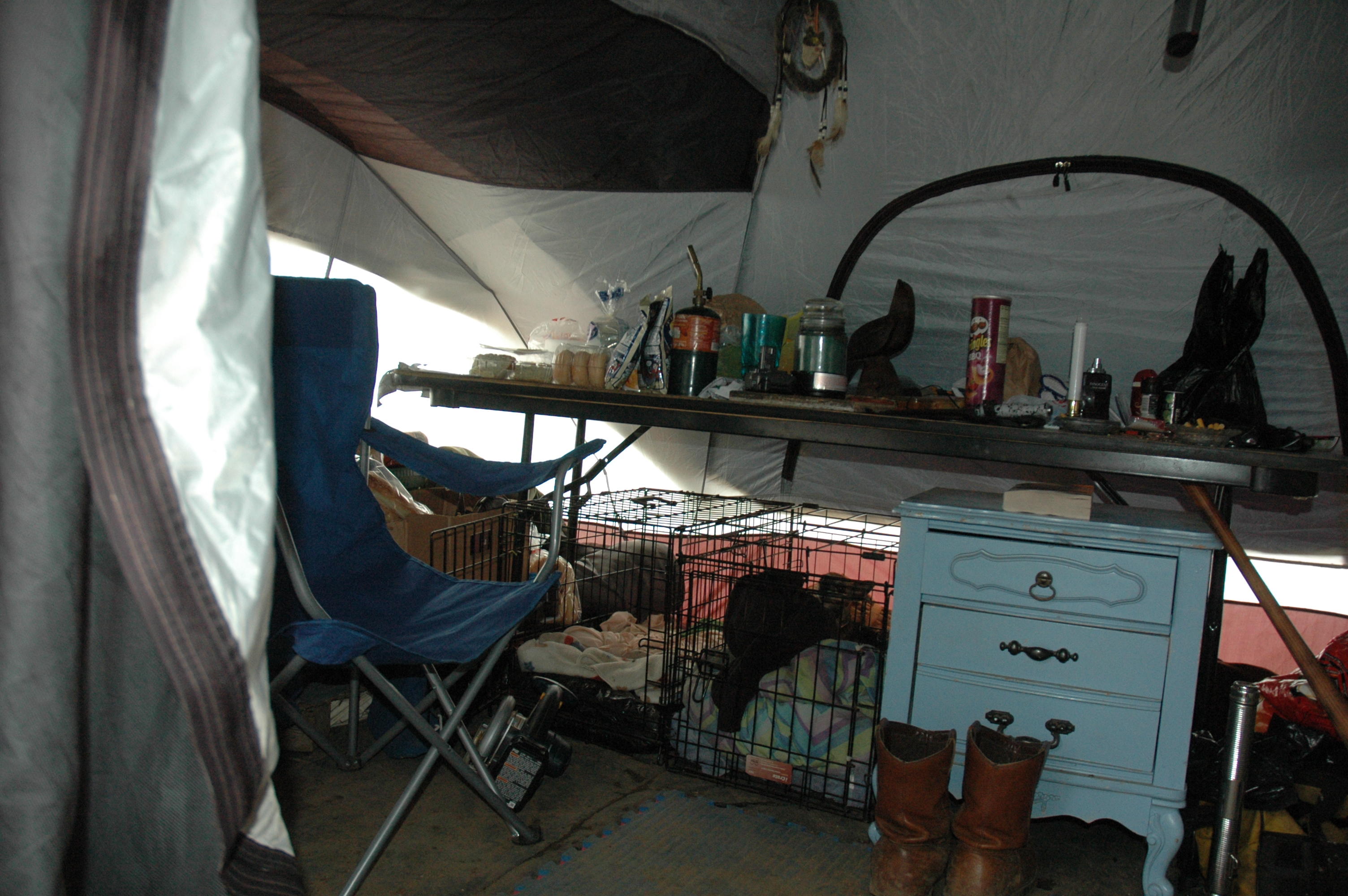
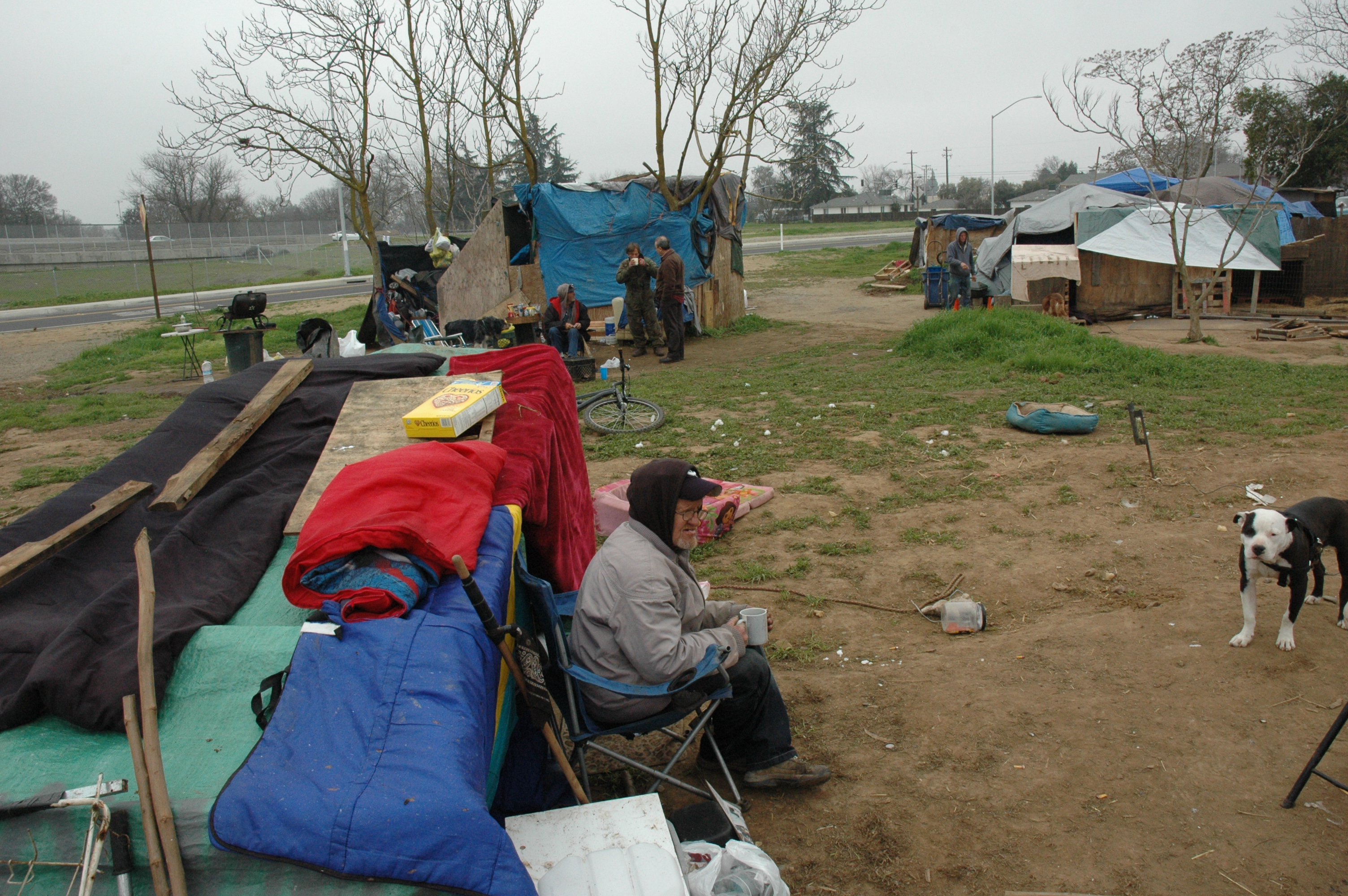
Caltrans says this homeless encampment is on public (State of California) land. If these homeless people can’t live here (on the people’s land), where can they live?

A group of 25 (+ or -) homeless people living in an encampment near highway 140 and Baker street in Merced are being threatened with eviction by Caltrans. Notices were posted on Friday, January 23 for the Monday, January 26 at 8 a.m. eviction. The notice posted by Caltrans says that “all personal property and camp debris is to be removed by the time and date noted below.” The notice continues “any personal property left at this site after this time will be considered abandoned.”

The residents in the encampment, some of whom have lived there for over a year, don’t have any place to go. There are no safe and legal camp sites for the homeless in Merced. Several of the residents are elderly and some are sick and unable to move their property, even if there was some place to take it.

Marilyn showed me inside her shelter today and it is obvious that she is not going to have her property moved by tomorrow morning. The notice does say that “any personal property not disposed of will be stored for ninety (90) days.”

Supporters of the homeless will be at the encampment on Monday morning to video the Caltrans operation and make sure that homeless people’s rights are not violated.

She is unable to move her property to another location.

§Some of the homeless shelters are very well maintained

by Mike Rhodes Sunday Jan 25th, 2015 4:37 PM

§This is a view of a couple of the shelters in the camp

by Mike Rhodes Sunday Jan 25th, 2015 4:37 PM

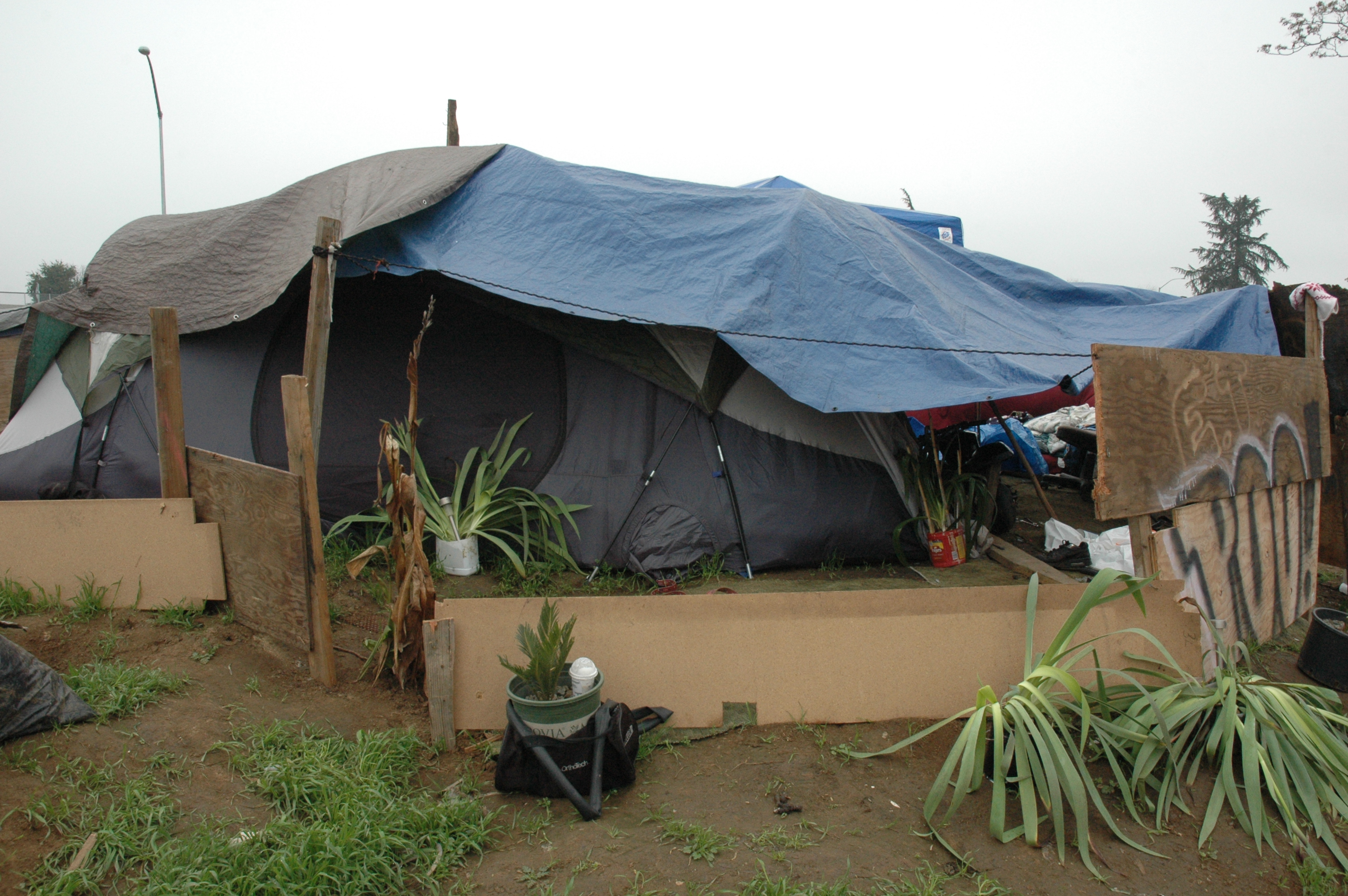
§Some Shelters had some landscaping

by Mike Rhodes Sunday Jan 25th, 2015 4:37 PM

http://fresnoalliance.com/wordpress/?p=1313

Caltrans clears Merced homeless camp

By Thaddeus Miller
tmiller@mercedsunstar.com

01/26/2015 9:54 AM

01/26/2015 6:16 PM

The California Department of Transportation on Thursday posted notices at an encampment near Kelly Avenue and Highway 140 on the east side of Merced ordering the homeless illegally camping there to leave before crews clear the area Monday.

The notice went up on the same day that volunteers assisted the county’s Continuum of Care in counting the homeless in Merced County, a count required by the Department of Housing and Urban Development.

Though the official numbers from the count aren’t expected to be released until next month, the Continuum of Care member heading the tally said there are more homeless people in the county than last year at the same time.

Those living in encampment near the Bradley Overhead, an overpass maintained by Caltrans, said Thursday they may have been able to find other shelter if they’d been given more notice.

Gail Henslee, a 60-year-old woman who’s lived in the encampment for two months, said a few days is not long enough to move. “We have nowhere to go, and they don’t care,” she said.

The notice says the area will be cleared because of illegal camping and dumping. Homeless advocates estimate that 25 people call the encampment home.

Henslee said she’s called a lawyer to study her options, but in the meantime admits she won’t have any choice but to leave before the camp is cleared out beginning at 8 a.m. Monday. She said she didn’t know about the plans to clear the camp until a Caltrans employee warned her earlier this week.

Entering a local shelter, such as the one D Street, is not an option for her, she said, because staff there would not allow her to bring her 11-year-old dog.

Being forced from one place to another is nothing new, said Brent Shirley, who has lived in a makeshift structure near the overpass for about six months. “There’s no closure for all of this – none,” the 52-year-old said. “It’s just a vicious cycle we’re all living in.”

A handful of tents and makeshift shelters make up the encampment, which can be seen by drivers who travel the highway to and from Yosemite National Park.

Caltrans spokeswoman Angela DaPrato said the California Highway Patrol will assist in the removal early next week, when crews will throw out anything left behind. Those in the encampment can identify possessions they plan to come back for, according to the posted notice, and Caltrans will store the items for up to 90 days.

Representatives from the Merced County Human Services Department were on hand Thursday to speak with those living near the overhead after the notices were posted.

Renee Davenport, who headed up the tally for Continuum of Care, said she appreciated that Caltrans held off from destroying the camp until after the count. She said several people in the camp are elderly or suffer from medical conditions that keep them from working.

Davenport said she is doubtful that many of them would get housing relatively soon, because the system does not work quickly.

Moving them from the encampment is not a long-term solution, she said. “They’re just going to go somewhere else in the street.”

The encampment has been there for about two years, Davenport said. It started to receive extra attention after the $41.2 million Bradley Overhead project was completed in November.

There were 768 homeless people in Merced County, including 21 children, based on the 2014 Homeless Count and Survey.
Davenport said this year’s count found more homeless people, but she declined to report the exact numbers. Urban Initiatives, the nonprofit that oversees Continuum, said it expects to be able to report the numbers in February.

Volunteers will continue with a homeless survey Friday. The questionnaire is an attempt to better track the demographics of the homeless, with questions designed to find out how many of them are men, women, children, veterans, HIV positive, mentally ill and so on.

Those leaving the camp will have to find a place to stay other than the warming shelter that’s been used during the past couple of winters. The Merced County Rescue Mission said this month that it was not planning to open the shelter, which is essentially a tarp tent filled with beds and space heaters.

Also this week, during a regular meeting, the Merced City Council instructed city staff members to look at the cost of opening a public building or taking over control of the city’s warming shelter. About $7,200 in Department of Housing and Urban Development money during the past two years has gone toward the purchase of the tent and the equipment inside, as well as paid the utility costs, according to the city’s Housing Department.

City staff members said a report could be ready in the coming weeks.

FOR PHOTOS, VIDEO, AND COMMENTS, GO TO
http://www.mercedsunstar.com/news/local/article8160516.html#/tabPane=tabs-b0710947-1-1

Caltrans clears Merced homeless camp

By Thaddeus Miller
tmiller@mercedsunstar.com

01/26/2015 9:54 AM

01/26/2015 6:16 PM

MERCED

Plans to clear a homeless encampment came to fruition Monday morning, as Caltrans workers used heavy machinery to begin clearing the camp near Highway 140, where an estimated 25 people lived in tents and makeshift buildings.

The work started shortly after 8 a.m. in the mud and grass field near where Kelly Avenue meets the Bradley Overhead. Caltrans posted notices on Friday that ordered the homeless to leave the area by Monday morning.

California Highway Patrol officers, who were on hand to provide security, said the people in the camp peacefully complied with the notice. One man who lived in the camp was taken away by an ambulance after he complained of chest pains.

Many of the residents of the camp were still packing up when the crews arrived. Steve Mentz, 51, hurried to secure his dogs and try to save as much of his structure as possible.

As he left the camp, he said he didn’t know where he would spend the night, as he’s been run off before. “They’re making it where there’s nowhere to go,” he said.

A resident of the camp for about eight months, Mentz said he’s legally blind and hoping to get disability benefits soon. He was aware of the looming destruction of the camp, he said, but didn’t have anywhere else to go because the shelters in town don’t allow pets.

Renee Davenport, a member of the Merced County Continuum of Care, said many of those living in the encampment have stories similar to Mentz’s. She said some have drug problems or suffer from mental illness, but several of those living in the camp are elderly or disabled and can’t work.

She said the breaking up of the camp highlights what she sees as a lack of services for homeless people in Merced and the county. “To do this in the middle of the winter – and there’s no warming shelter – there’s no excuse,” she said.

Davenport was in the camp Monday morning helping people pack up.

People who left the camp would have to find alternate housing from the warming shelter that Merced County Rescue Mission opted not to open this year. About $7,200 in Department of Housing and Urban Development money during the past two years has gone toward the purchase of the tent and the equipment inside, as well as paid the utility costs, according to Merced’s Housing Department.

Merced City Manager John Bramble said his staff is still looking into the cost and feasibility of opening a public building or taking over control of the warming shelter tent.

That same day, U.S. Housing and Urban Development Secretary Julian Castro announced groups that work with the homeless throughout the central San Joaquin Valley received about $10 million to help those without shelter. Merced County’s Continuum got seven grants worth $579,193.

Back in Merced, Caltrans crews took down some of the makeshift structures in the camp by hand, folding up tarps and bagging trash. The buildings made with wooden pallets snapped and splintered as they were knocked over by heavy machinery. Some of the homeless got help moving from friends with cars, while others pulled their belongings on a cart behind a bicycle.

A handful of people arrived to the camp with signs saying the homeless there were being “persecuted.”

According to the last year’s homeless count by the Merced County Continuum of Care, there are 476 homeless people in Merced. Continuum conducted the 2015 count this month, but has not reported the numbers yet.

Caltrans agreed to store possessions for up to 90 days for those who lived in the camp. Anything else left behind was destined for the dump.

Angela DaPrato, a spokeswoman for Caltrans, said the department had been planning to clear the camp for a few months but waited until after the holidays and last week’s homeless count to go through with the plans.

She said the cleanup would continue Tuesday and crews were not certain how many more days it would take. “They didn’t anticipate how much work it would be,” she said.

FOR PHOTOS AND COMMENTS, go to http://www.mercedsunstar.com/news/local/article8160516.html#/tabPane=tabs-b0710947-1-1


__._,_.___

Continue reading

Sanctuary Camp in Santa Cruz Discussion

Activist Brent Adams has proposed a Sanctuary Camp in Santa Cruz, which is being discussed at https://www.indybay.org/santacruz/  with a specific thread at https://www.indybay.org/newsitems/2013/10/10/18744678.php    I reprint my comments from

https://www.indybay.org/newsitems/2013/10/10/18744678.php?show_comments=1#18745233

by Robert Norse
Tuesday Oct 22nd, 2013 8:54 AM

Some valuable information is contained in this business plan. Yhose who are working on the Sanctuary Camp proposal need to be commended for their determination and energy in the face of a hijacked and hostile political climate. I’ve given the plan a reading, but it needs more careful analysis. Brent’s style of presentation, his repeated hostility to some of us who haven’t jumped on the bandwagon (alternating with New Age hugs), and his direct attacks on me personally and protesters generally has made objectivity difficult.

They also need to be aware that many concerned with the rights of homeless people–some homeless and some housed–have “concentration camp” and other concerns with the model.

Fresno activists have been funding homeless-created encampments with trash pick-up’s, portapotties, fresh water, and other services since they won A $2.3 million lawsuit in 2007 (because city authorities, like Santa Cruz’s SCPD and Rangers) were stealing and destroying homeless property.

There’s extensive history on this homeless civil rights struggle at http://fresnoalliance.com/wordpress/?p=1313 . (Scroll to bottom for the most recent story)

More recent encampment coverage:

http://www.indybay.org/newsitems/2013/10/10/18744664.php (Grain Silo Homeless Encampment Posted for Demolition)
http://www.indybay.org/newsitems/2013/10/09/18744608.php (City of Fresno Finds New Ways to Harass the Homeless)

While Fresno activists have tried repeatedly to appeal to the city to be reasonable, recognize how cost productive it would be to stop harassing homeless encampments and/or supply services to them (or perhaps establish Sanctuary type campsites), authorities have repeatedly hoarded or ignored funding specifically intended for homeless relief and continued its campaign of harassment.

The relief that Fresno activists were able to give was through documentary videoing, lawsuits, and then direct services as described above.

Ed Frey and Occupy Santa Cruz supplied toilet facilities here in Santa Cruz when the City would not. In both cases PeaceCamp2010 and the Occupy Santa Cruz San Lorenzo campground were destroyed by authorities (not by internal problems).

Direct support to campsites currently in existence is another avenue to consider here in Santa Cruz, while Sanctuary seekers struggle to persuade right-wing staff, frightened liberals, and an apathetic community to allow a very limited Sanctuary campground.

Another informative document from Fresno is this documentation of The Cost of Destruction in Fresno: http://helpfresnoshomeless.org/ . The business plan references local costs generally, but getting such documentation more specifically is important.

While it feels endless and overwhelming, it’s important to support homeless folks–their rights, their property, their dignity now as it is seized from them, legislated away by law, and snarled away by a rightwing riptide undertow. If they choose to protest, it’s wrong to ignore or–worse–denounce them as “alienating the community.”

It seems both cruel and delusional to suggest they wait for the toxic political establishment to be persuaded that a sanctuary camp is a good idea as they shiver in the shadows through the winter, facing an ever nastier set of “recommendations” from Bryant’s Citizens Task Force on Public Safety. See http://www.cityofsantacruz.com/Modules/ShowDocument.aspx?documentid=34557 (meeting again 6 PM 10-23 in the Tony Hill Community Room of the Civic Auditorium).

There’s also the concern that pushing a plan for a select number of homeless to be allowed a special sanitized segregated area where they will not be allowed the rights that anyone indoors takes for granted (drinking alcohol for instance) is both paternalistic and unrealistic. It also goes against the wisdom of the Housing First model which seeks to provide the most basic housing before imposing sobriety.

No one doubts the need for campgrounds. But we must support those who are struggling now. Not turn aside and censor our efforts and websites in the hope of teasing out a smile on Pamela Comstock’s face. Waiting for Don Lane to find a backbone and other progressives scuttling to find protective cover from the phony Public Safety scare is self-defeating. (See, however, http://santacruz.patch.com/groups/don-lanes-blog/p/why-are-they-here-or-is-it-why-are-we-here for Lane’s defense of social services to the Task Force, as he remains silent–as he has for decades–on the vital need for safe places to sleep)

Eugene Activists Force City to Act on Homeless Sanctuary Camps

NOTES BY NORSE:  Eugene pioneered the Safe Parking/Camping Zones, in part because of pressure from homeless activists there two decades ago and recently from SLEEPS (Safe Legally Entitled Emergency Places to Sleep) as well as an active leftist and anarchist community.
Meanwhile Santa Cruz drops deeper into paranoia and anti-homeless hysteria with the Take Back Santa Cruz-inspired Needle-Free Zone homeless-aphobiacs.  The repression contagion has spread—now street performers, vendors, artists, and political activists are under attack downtown.
New laws go into effect in Santa Cruz October 24th that will limit performance spaces to a 12′ square area and make traditional assembly and political activity illegal on 95% of the downtown sidewalks.  These laws follow earlier ones that make it illegal to hold up peace signs on city medians (to outlaw panhandling there) and empower park officials to issue 1-day stay away orders prior to trial for “crimes in the park” like “trespass after dark” “smoking” and “sleeping after 11 PM”.   An expansion of the Smoking Ban downtown targets homeless people (in a recent New England Journal of Medicine study, 17% of the general population smoke as distinguished from 75% of the homeless population).
Instead of opening existing bathrooms for 24-hour use, authorities are setting up a fenced off segregated portapotty as well as funding a $100 “Security” gate and fence around the Homeless (Lack of) Services Center.  Activist Brent Adams has put forward a Sanctuary Camp plan disdained by the City Council majority.   Instead Mayor Hillary Bryant’s  band of bumbusters is backing  a “Citizens Public Safety Task Force” which defines homeless survival activity like sleeping outside, camping in parks, and urinating and defecating in the woods as “criminal behavior”.
Though the City has announced multi-million dollar surplus in their budget this year, none of it will be going to fund campgrounds or restrooms or showers for the most needy.  Eugene soars on, while Santa Cruz descends into a darker period.

Eugene Government

City OKs homeless camps

If the first 15-person site works out, others could be added on lots approved by the City Council


Legal camping advocate Alley Valkyrie speaks to the Eugene City Council in support of a proposal to create legal camping sites in Eugene on Monday, September 23, 2013. (Chris Pietsch/The Register-Guard)


By Edward Russo

The Register-Guard

Published: 12:00 a.m., Sept. 24


A proposal that could allow Eugene to establish small homeless camps on yet-to-be-­chosen sites was approved by the City Council on Monday night.


Councilors voted 6-2 to pass an ordinance recommended by City Manager Jon Ruiz that would allow the council to authorize more than one volunteer-­run homeless camp of up to 15 people apiece — if the first camp works well.

Councilor Claire Syrett — who represents a ward that includes the Whiteaker, River Road and Santa Clara areas — said the proposal, which would allow camps to operate until next March, is not a cure for homelessness in Eugene.

But the camps will be better for some of the “hundreds of people” who have been sleeping for years in city parks and other public land, she said.


“It won’t fix all of the problems,” Syrett said. “It won’t fill all of the need, but it’s better than the status quo.”

Joining Syrett in voting for the proposal were councilors Alan Zelenka, Betty Taylor, George Brown, Chris Pryor and Greg Evans. Voting against were Councilors George Poling and Mike Clark.


Under the proposal, volunteers or nonprofit groups would manage the camps, and they would provide garbage service and portable toilets at no cost to the city. The council would control the number and location of camps, with the expectation that there would be little or no other costs to the city.


Potential sites could be located on city-owned parcels in commercial or industrial areas, or those offered by religious institutions, nonprofit groups or a business located on commercial or industrial-zoned property.


Until Monday, the council had been considering a proposal introduced by Zelenka to let the council authorize a single “rest stop” or overnight camp for up to 15 homeless people.


Under that proposal, the first camp would have been tried for 90 days to see how well it worked before other sites could be started. The proposal also would have required campers to pack up their belongings and leave the site each day.


But the concept was criticized at previous council meetings by homeless people and activists. Critics said a single site isn’t enough for the many homeless people in Eugene, and that requiring homeless people to pack up their belongings each day is impractical.


Ruiz, the city manager, on Friday made changes to a draft ordinance that could allow the establishment of more than one camp in the near future. He also added flexibility to the ordinance so that, depending on the site, campers wouldn’t necessarily have to pack up their belongings and leave each day.


Poling said he objected to the rest stop proposal being changed so that homeless people could stay on a site all day and night.


“That is no longer a rest stop,” he said. “That is a campground.”


Poling also faulted the proposal because the city would not be helping people to get out of homelessness.

“All we are doing is warehousing them and not working with them to end their homelessness,” he said.

Instead of establishing camps, Clark favored having the city act as a referral service to connect homeless people with property owners who would be willing to let homeless people camp on their property.


The camps proposed by Ruiz would be managed by “hosts” and the areas would be run according to site agreements between the site operators and the city. The camps could be terminated if the agreements are violated.


Previously, when city officials had begun working on the homeless camp idea at the direction of the council, they compiled a list of 19 possible sites that included undeveloped parkland in residential areas. That raised so much concern by nearby residents that the council eliminated potential sites in residential areas or those located close to a school.


On Monday night, several homeless advocates thanked Ruiz for developing his proposal.


Michael Carrigan, of the Community Alliance of Lane County, said people who want to help the homeless “are excited about this proposal and are ready to roll up their sleeves to make this work.”


Alley Valkyrie, a south Eugene resident who has been helping the homeless advocacy group known as SLEEPS, said she was “really stunned” by the city manager’s proposal.


“It’s a huge step in the right direction,” she said.


Valkyrie suggested that a camp be allowed on city land under the Ferry Street Bridge, where several campers have pitched tents. Another camp has been set up on city land at Broadway and Hilyard Street, which Valkyrie said is an excellent site.


The Rev. Dan Bryant, president of Opportunity Village Eugene, a newly formed housing area for homeless on Garfield Street, urged the council to approve the ordinance to get as many of the camps “up and running as quickly as possible, and we will work with you to help make that happen.”


You are here: Home / 2013 / May / 08 / CITY COUNCIL UNANIMOUSLY INSTRUCTS STAFF TO MOVE FORWARD WITH SLEEPING ORDINANCE

CITY COUNCIL UNANIMOUSLY INSTRUCTS STAFF TO MOVE FORWARD WITH SLEEPING ORDINANCE

4.25.2013 Eugene, OR The Eugene City Council, which had dawdled unmercifully in coming to the table to discuss Safe Legally Entitled Emergency Places to SLEEP for those who are unhoused, arrived at the April 22 Council Work Session table with unprecedented determination to take immediate and purposeful action.  The Councilors were brought to the table by Councilor Greg Evan’s leadership in calling for an official Council Work Session. Councilor Evans called the session following ongoing testimony from both housed and unhoused people affiliated with SLEEPS, CALC, Occupy, Interfaith Occupy, CLDC, Nightengale, ACT and other groups, stating that the testimony led him to believe that Eugene’s current policies were, at best, “counterintuitive”.
In a surprisingly bold move, in the early minutes of the session, Councilor Alan Zelenka made a motion to authorize city staff to draft an ordinance to designate temporary safe and legal place to sleep from 9PM to 7AM on non-park, city owned land.  The motion passed unanimously, with Councilor George Poling absent.  The Council also directed staff to call a special Work Session on the first date at which all Councilors can be present to review and approve an ordinance.  Once approved, a Public Hearing will be held and the newly authorized “Rest Areas” can become a proud part of Eugene’s dramatically changing policies addressing issues surrounding those who are unhoused.  The Council backed up their voiced support of finding creative, financially feasible and effective new solutions with a clear sense of enthusiasm and commitment….and action.  At the next Session the Council will also seek to approve some of the four options proposed by city staff, most involving relationships between the city, religious, not for profit and private land owners.  The Council indicated agreement that a whole continuum of small, partial and temporary solutions are needed to meet the emergency needs and buy time to find longer term answers.
The Rest Areas, as proposed by Councilor Zelenka, will be on several selected, specially designated, city owned non-park land parcels.  They will offer a safe place to sleep from 9PM to 7AM, toilet access, garbage collection and lockers so that individuals can secure their items during the day, facilitating their ability to find work, housing, keep health appointments and conduct other personal business.
A major benefit of the Rest Areas is that they will draw people who now sleep downtown or in public parks away from those areas and into areas that are especially designed to meet the basic safety and sanitation needs of those who sleep in the areas.  Insufficient bathrooms, especially at night, has been a major health hazard to all citizens in Eugene’s downtown and public parks and the new Rest Stops will improve the public health of all citizens.  It establishes a new, more realistic and businesslike approach that will better meet the needs of the downtown and parks as well as the needs of those who need a place to sleep.  The City’s long term failure to address the problem has put those needs unnecessarily in conflict.
Another major business benefit is that the Rest Areas should save a great deal of the current $300,000 per year the Eugene city government is spending to clean up deserted camps, often vacated as individuals flee under police orders.  It will be far cheaper to take this preventive approach:  placing toilets and garbage/recycling resources in the Rest Areas so that people can clean up after themselves.  Not only has the City’s previous approach been a poor choice from a business perspectivie, it has posed health hazards for all and failed to meet the goal of chasing the unhoused out of Eugene.
Activists who have long been trying to persuade the Council to provide better solutions than in the past were impressed with the Mayor and Council’s obvious determination to do something substantive and to do it now.  “It took a long time to encourage them to actually TALK about this really gnarly problem….but once they decided to take it on, they took it on with gusto.  It us up to the rest of us, both housed and unhoused, to be certain that we give the Council the support they deserve for having the courage to admit that what we’re doing isn’t working and to start proving out better solutions”, said one activist.


Eugene council OKs small homeless camps operated by nonprofit groups outside neighborhoods

THE ASSOCIATED PRESS
September 24, 2013 – 4:36 pm EDT

EUGENE, Oregon — The Eugene City Council has given the go-ahead for homeless camps for no more than 15 people each on land owned by the city, churches or nonprofit groups in commercial or industrial areas.


The sites haven’t been designated. Activists have been demonstrating for months in favor of allowing homeless people to camp on city property.


The Council’s action Monday expands the proposal it had been considering, which would have been limited to one camp. Campers would have had to pack up their belongings and leave every day.
Instead, more than one camp will be allowed if the first one works, and some camps could allow residents to remain during the day.


City Manager Jon Ruiz said they would be managed by “hosts” and run according to site agreements between the site operators and the city.


Volunteers or nonprofit groups would provide garbage service and portable toilets at no cost to the city.


The Council would control the number and location of camps, with the expectation that there would be little or no other costs to the city.


The camps could be terminated if the agreements are violated, Ruiz said.


Alley Valkyrie, a south Eugene resident who has been speaking for the homeless advocacy group known as SLEEPS, said she was stunned.


“It’s a huge step in the right direction,” she said.


Demonstrations for homeless camps have been marked by arrests in recent months and a legal dispute over a free speech area outside the county courthouse.

Eugene Homeless Camp Broken Up In Free Speech Plaza

AP | Sept. 05, 2013 7:56 a.m. | Eugene, Oregon

Share
1
AP

A three-week-old camp-in protest at the Wayne Morse Free Speech Plaza in downtown Eugene was broken up Wednesday after Lane County commissioners enacted an emergency closure of the plaza.


The Eugene Register-Guard reports the Board of Commissioners voted 4-1 on the emergency closure. Protesters were given until Wednesday afternoon to clear out the camp. Four individuals later refused to leave and were cited for trespassing by Eugene police.


Officials say the closure will be used to clean all of the areas and work on further restrictions.


The group behind the makeshift campsite, Safe Legally Entitled Emergency Places to Sleep, or SLEEPS, is protesting the lack of legal camping areas for homeless people in Eugene.
___
Information from: The Register-Guard, http://www.registerguard.com

Homeless camps dot Central Oregon

In this Sept. 5, 2013 photo, Mike Miller, of Bend, Ore., poses for a photo at a transient campsite, where he once spent several nights at during a year of living and camping outside. “This is survival for some people. I know it was for me,” Miller said. (AP Photo/The Bulletin, Joe Kline)

BEND, Ore. (AP) — Mike Miller had hit bottom.

Roughly eight years ago, he and a brother from San Jose, Calif., moved to a house in Bend for work. About two years later, Miller lost his job and took up drinking. His brother left for Nevada, and Miller was left alone.

Before he knew it, he was scouting secluded places to put up a tent to replace his lost home.

“I didn’t want to camp out,” Miller said. “It’s a part of my life I didn’t think I would go through. But, the things I was doing and the choices I made brought me here.”

Usually unseen or overlooked, homeless camps around Bend provide a temporary home for scores of homeless people. The camps may appear, be vacated and be re-established in a matter of days, according to Miller and others who’ve worked with or policed the homeless. Or they may quietly persist for months. They range from one person in one tent to several people in upward of 10 tents, according to Bend Police spokesman Lt. Chris Carney.

Nearly 2,200 people are experiencing homelessness in Central Oregon, according to the annual point-in-time count conducted in January by the Homeless Leadership Coalition. Of those 2,200 people, Miller feels most are down on their luck, just as he was.

But he knows that’s not everybody. Some choose to live that way, he said. “I was never threatened. But I know it does happen out there. I had one guy who watched my back as I watched his. It’s about surviving.”

Carney said the department deals with homeless camps all around Bend. For example, at least six camps lie within a five-mile radius of The Bethlehem Inn, a homeless shelter on U.S. Highway 97 in north Bend, according to managing director Chris Clouart. Most campers keep to themselves and hide from view, but sometimes events propel them into the forefront of public attention.

Saturday, Bend Police reported an attempted rape at a transient camp on Northeast Fourth Street. An alleged witness at the camp, Don Wichmann, performed a rare act and reported the incident to police. As a result, Jacob Schoenborn was held in Deschutes County jail on suspicion of first-degree rape, fourth-degree assault and two counts of first-degree sexual abuse.

“Most of the time, these people are camping because they want to be left alone,” said Carney. “Getting them to report incidents is always a tough thing to do.”

Crimes at these camps are not infrequent, Carney said. But they aren’t everything the camps are about. A fire in July that charred 4 acres in east Bend started with a homeless campfire. Two people — a mother and daughter — were cited in that incident. In addition, Carney said, stabbings and a shooting have occurred at homeless camps around the city within the past five years.

“It’s difficult to distinguish between the types of people who are out there,” he said. “Most of the people in these camps are people down on their luck — they can’t afford housing or something. But there are the others who choose that lifestyle and can sometimes cause problems.”

Residential camping in city limits is illegal, according to Bend affordable housing manager Jim Long. His department attempts to work with local nonprofits and businesses to find affordable housing for those whose income was diminished or demolished after the recession.

“Most people are one or two paychecks from tragedy anyway,” Long said. “If there’s 100 homeless people, there are 100 different stories. I don’t have rose-colored glasses — they aren’t all saints. But they aren’t all evil, either.”

He said the city attempts to move homeless camps as humanely as possible. Before calling the police, Long said, he would call the Central Oregon Veterans Organization or the Deschutes County Mental Health division in order to give the affected homeless a warning. If COVO and Deschutes County are unsuccessful, the police are called in.

“As a police department, we just go in there and tell them they have to camp outside of the city,” Carney said. “They typically pick up and move to a new spot. It’s about all we can do; we don’t have the time or resources to go out and force these people to move.”

Clouart said community calls to clean up homeless camps are routine following violent incidents like the one Saturday.

“It won’t solve anything,” Clouart said. “You’re just moving them from one place to another. To fix it, we need to become a society and a culture that doesn’t judge these people.”

Organizations around Bend attempt to keep judgment out of rehabilitation. The Shepherd’s House, a homeless men’s support shelter, offers a bed, food and shelter to applicants who are clean and sober. In emergency situations, it offers the same services to men for seven days. For those who need camping supplies, the shelter may provide them as well.

The Bethlehem Inn is open to men and women, offering the same “get back on your feet” services. COVO started a homeless outreach program, donating camping and survival supplies to ex-military men in need. “Feed the Hungry” hosts a breakfast and lunch at Bend’s Community Center every Sunday, and the center is getting ready to hand out survival gear to the “Keep Them Warm” program again.

Miller said he got so comfortable with camping that he was able to fashion a shower in his tent so he didn’t have to interact with people at camp showers. He said he notices others have taken up residence at the sites where he once camped.

“Some people just stay in that mindset of camping,” he said. “Some don’t want to stop doing that. I just realized that life wasn’t for me, and I was ready for a change.”

Miller, now 27 months free of alcohol, has lived at The Shepherd’s House for almost a year. He’s getting ready to move to Portland soon for an internship with a religious homeless-assistance organization and hopes to go to school later for addiction studies. Miller said he hopes to use his future education to help others in his former position, paying forward the help he received.

But no matter what, he won’t forget his time in the tent.

“You just learn how to blend in,” he said. “In fact, at one point, you get comfortable blending in. Once you get that comfortable, you don’t have a desire to stop blending in. And, by then, you’ve run out of options to get out.”

___

Information from: The Bulletin, http://www.bendbulletin.com

Copyright 2013 The Associated Press

Fresno Homeless Evictions Loom…on Valentine’s Day

http://www.indybay.org/newsitems/2013/02/11/18731822.php

Fresno has no Heart – Will Evict the Homeless on Valentines Day
by Mike Rhodes ( editor [at] fresnoalliance.com )
Monday Feb 11th, 2013 5:43 PM

The photo below shows the north end of the Monterey and E street homeless encampment.

An eviction of a significant number of homeless people at a downtown encampment will probably take place on Thursday, February 14. According to residents of the homeless encampment, located near Monterey and E street, they were told by the owner of the property they are living on that they have until Thursday to “move on.” The owner was accompanied by several officers from the Fresno Police Department and a truck & crew from the Fire Department.

One homeless man told me this afternoon (Monday, February 11) that the owner of the property said he would be bulldozing the vacant lot on Thursday and everything would be destroyed. “He told me to get the fuck out of here,” he shared with me as he sorted through recycled items sitting in several shopping carts on the property. When I asked if he was sure it was the owner, he said “well, he had the police with him, so it looked pretty convincing to me.”

Unlike other evictions by the City of Fresno, there are no signs posted to notify the residents of the demolition that is to come. Julie (not her real name), said someone had posted an eviction notice about a month ago, but those were torn down within an hour or two. The owner told her that he did not have to post notices because it is his property.

There was an eviction that took place in the spring of 2012 at another homeless encampment, behind the grain silos near Palm and H street, that was similar. This was private property, the owner made numerous attempts to force the homeless to move, and eventually put a fence around the property to force the eviction. Many of the homeless people from that encampment moved about 200 feet south and occupied a different vacant lot. They have not been threatened with eviction again, as far as I know.

Most of the residents at the Monterey and E street homeless encampment who are being threatened with eviction said they were planning on moving, but I was told that not everyone would pack up and move. I was told that it is only the north end of the encampment that has been threatened with eviction. The dividing line is Monterey street. Everything north of Monterey street will likely be destroyed on Thursday. Everything south of Monterey street is said to be safe from the demolition.

Can the owner of a vacant lot take and immediately destroy homeless peoples property? Did the City of Fresno threaten the owner with legal action if he did not move against the homeless? Will FPD officers participate in the demolition or arrest anyone if they resist? Observers are needed starting early Thursday morning. If you can help, meet at the encampment starting at 7 a.m. on Thursday. Bring your video or still camera to document what takes place. If you can’t come until later, let me know so we can coordinate having someone there all day.

Demolitions of homeless encampments in October and November of 2011 resulted in over 30 lawsuits against the City of Fresno claiming that the city violated homeless peoples legal rights by taking and immediately destroying their property. Those cases are working their way through the court. Without this litigation it is likely that the city would have been more aggressive in their attacks on the homeless. A new strategy of forcing property owners to evict the homeless may be emerging as City Hall seeks to avoid additional lawsuits.

###

Mike Rhodes is the editor of the Community Alliance newspaper. He can be reached by email at editor [at] fresnoalliance.com .

§Another view of the norht end of the encampment

by Mike Rhodes Monday Feb 11th, 2013 5:43 PM


§This shows the entire area impacted by the evictions

by Mike Rhodes Monday Feb 11th, 2013 5:43 PM


§Typical Shelter in the Area

by Mike Rhodes Monday Feb 11th, 2013 5:43 PM


§This is the center of the homeless encampment looking north

by Mike Rhodes Monday Feb 11th, 2013 5:43 PM

Destruction of Local Homeless Survival Camps in Felton: Another Disgraceful Episode

Norse’s Notes:  Instead of ordering that the campsites be cleaned up, the real motivation of the vigilantes and sheriffs seems to be to drive away any and all homeless survival campers.
Too bad no one documented the three truckloads of “trash” with video.  When that was done in Fresno, the City lost a two million dollar lawsuit, and actually had to start at least giving token acknowledgment of state law regarding seized property.
More to the point would be establishing emergency campgrounds for folks who need to be outdoors (95% of whom have no legal shelter).  Even more addressing the underlying conditions that create this crisis.
If folks were serious about clean-up’s, the county would provide portapotties, dumpsters, trashbags, and legalization of clean camps.  If they were serious about ending unsafe needle disposal, they’d take local initiatives to end the insane Drug Prohibition war and at the very least expand (rather than contract) harm-reduction programs like needle exchange.
While it’s always encouraging to see community members getting together to clean-up areas that the city and county decline to address, that must not involve scapegoating a whole class of people.  T.J. Magallanes, who created The Clean Team website, has said and written this repeatedly.  But “Take Back Santa Cruz” type hardliners prefer to use the homeless as a political football here and blame them as a means of attacking a power structure (that deserves to be attacked, incidentally).
Screaming about “tolerance for drugs” and “illegal” homeless camps (when virtually all survival camping is illegal) is just blind bigotry and the kind of desperation that ensues when folks fail to identify the real enemies who run the show.
The KSBW news brief on this suggests the sweeps are “controversial” only in that they “aren’t effective” and folks seem to keep coming back.  Sort of reminds me of the homeless = vermin approach, used to describe insurgents, terrorists, 1930’s Jews, etc.  Dehumanizing people is a nice way of covering your fascist ass.
It’s also a pity that the “service providers” in the area didn’t speak out against this destruction of homeless survival camps.  Maintaining the illusion that there are shelter alternatives when there are not.  The sheriffs don’t even pretend there are.  And won’t be even if the pretty-pretty 180-180 program gets fully funded.
There are thousands of homeless in the county.  Is the plan to drive them all out into the rain and make them internal refugees?
I wrote more in the comments that follow this article, which is primarily window-dressing for the sheriffs and demonization of the campers, though as of yet those comments haven’t appeared (other than one brief sentence).  See http://www.santacruzsentinel.com/rss/ci_22545061?source=rss for more comments and to make your own.  Or comment on this article on the HUFF blog at http://huffsantacruz.org/wordpress/ .

Three truckloads of trash hauled from Felton campsites

By Stephen Baxter

Santa Cruz Sentinel

Posted:   02/07/2013 07:05:45 PM PST


FELTON — Three deputies and four Santa Cruz County Jail inmates hauled out three truckloads of trash from illegal campsites near Zayante Creek and the San Lorenzo River on Thursday.

Responding to some residents’ complaints and a pile of garbage and human waste at the Graham Hill Road Bridge over the San Lorenzo River, deputies posted notices to vacate the campsites in January.
Since then, much of the debris was removed or swept down the river with last month’s rain, sheriff’s Sgt. John Habermehl said.
Thursday, they hauled out dirty clothing, alcohol bottles, bicycle parts and a broken kayak, among other items.
“It’s not so much that somebody decided to pitch a tent,” Habermehl said. “We try to address the criminal behavior — the illegal dumping, the drug and alcohol issues, and the waste in our rivers.”
He added that the cleanups are a matter of maintenance rather than a long-term solution: “If we don’t do something about what’s out there, it’s just going to get worse.”
The action follows similar Sheriff’s Office sweeps near Highway 9 in September and by Santa Cruz police during the fall and summer of 2012.
No one was cited and no syringes or other drug paraphernalia were found on Thursday, deputies said. The inmates who participated volunteered from the Rountree Detention Center, a medium-security facility.

At a second cleanup site under the Conference Drive Bridge at Zayante Creek, deputies were


surprised to find a relatively clean area with several trash bags left by campers.

Light rain fell on the crew as it loaded food wrappers and dirty clothing into a Santa Cruz County flatbed pickup and a truck loaned by the Mount Hermon Christian Conference Center.

Don Cox, a homeless 53-year-old Air Force veteran, watched the crew work in the rain. He said he camped in the Felton area for years and noticed new people who came from Santa Cruz because of recent cleanups in that city.

“A bunch of them who’ve come down here are drug addicts and thieves,” Cox said.

Having been a mechanic and tow truck driver, he said he is trying to attend job-training classes at Cabrillo College and find a place to live with his veteran benefits.

“It’s not like I’ve chosen to be out here and be a bum,” he said. “I’m too old to be on the streets.”

“They’re really kind of picking on us,” he said of Thursday’s cleanup.

Another woman, Amanda Livingston, 22, saw the deputies and inmates work under the Graham Hill Bridge.

She said one of the men went to Santa Cruz to collect a check Thursday morning, so she scrambled to round up his gear and a bag of prescription drugs before it was removed.

“I’ve been telling him that they’re going to clear the camp,” she said. “He didn’t believe me.”

Originally from Michigan, Livingston said the bridge offered her some shelter during the rain storms earlier in the winter. She and others cooked, drank and tried to stay dry, she said.

Above the bridge, some employees at nearby businesses said they appreciated the cleanup.

“I think it’s definitely necessary but it’s pretty lame that it has to be done in the first place,” said 21-year-old Adam Pomianowski, who works at Budget Truck Rental at 6440 Graham Hill Road. “This is a river running through our little town. I’m glad someone’s paying attention.”

MORE COMMENTS at:  http://www.santacruzsentinel.com/rss/ci_22545061?source=rss

Tent City Time in Santa Cruz? Salnas says Yes.

Humble Surroundings: Cory Meek (left) and girlfriend Rita Acosta stand outside 
of Soledad Street’s Tent City on Christmas Day.

Humble Surroundings: Cory Meek (left) and girlfriend Rita Acosta stand outside of Soledad Street’s Tent City on Christmas Day. Arvin Temkar

Stable Shelter

Salinas homeless build a rules-driven tent community on Soledad Street.

Arvin Temkar

Thursday, January 3, 2013

It’s Christmas on Soledad Street. “Festive” isn’t a word normally associated with this part of Salinas, where crates and tarps substitute for homes, and worn buildings hover stonily over drug deals and fights. And yet, even in this refuge of the desperate or addicted, there is evidence of holiday cheer.
Marking the entrance of Tent City is a Christmas tree, adorned with red and gold ornaments and battery-operated lights. Barely taller than the tents themselves, the tree is a point of pride for the residents who live here.
Tent City, also known as Tents by the Gardens, is a collection of about 20 tents and 30 or so people occupying a corner of an otherwise empty lot. Next to the lot is a garden, maintained by CSU Monterey Bay students involved in the university’s service learning program.
Residents are careful to distinguish their living area from the other illicit encampments that have mushroomed around Soledad Street’s Dorothy’s Kitchen, a gathering point for the city’s homeless. Tent City is a community.
Further into the encampment, more signs of Christmas. A few bright stockings hang above the doorway of a spacious gray tent, and inside, over a cabinet, there’s a wall clock with a drawing of Santa and his sleigh. A pillowcase on the mattress that was found in a nearby dumpster says, “Merry Christmas.”
“Christmas is my favorite holiday,” says Rita Acosta, who lives in the tent with her boyfriend and two dogs, Princess and Prince Charming. “Just because I’m here doesn’t mean I’m not going to celebrate.”
Acosta, 45, and her boyfriend, Cory Meek, are leaders in a movement to organize some of the homeless on this street. Their mission: To create a safe environment in which they won’t be bothered by the police or neighboring derelicts.
Tent City is about two months old. It was started after the last “sweep,” when police forcibly uprooted the clusters of tents that had sprung up on the street and its alleys.
But it’s also possibly part of a cycle: Tents and jerry-rigged homes crop up, and eventually degrade into dens of drug-use and filth. Someone calls the cops, the cops kick everyone out, but sooner or later people come back.
Tent City wants to break that cycle, at least for its own people. The residents – mostly couples, but also a few single women who want the protection of a group – think if they can prove that they’re responsible, the city and the cops will leave them alone, and maybe even help them out.
To ensure orderliness, residents must respect a few basic ground rules: no visitors after 10:00 pm; no drugs or fighting in or around tents; respect your neighbors; no harassing any tent neighbors or visitors; no clutter or garbage outside of tent area.
So far the rules seem to be working. The community has already kicked out a couple of residents who were using drugs, Acosta says. And, the lot is clean, compared to surrounding encampments. In front of Acosta’s tent is a small trash can, and there are other larger ones scattered about between tents.
Another major element is safety, which means no unwanted guests. Residents say they feel safe for the first time in a long while, knowing they’ve got others to watch out for them. It may seem strange, residents say, but petty thieves prey on the homeless too.
Professionals who work with the homeless on Soledad Street know little about the movement.
“I would really say that’s an emergent organic leadership that’s coming to the fore, more than anything we’ve instigated,” says Seth Pollack, director of CSUMB’s service learning program.
Acosta says residents got the idea after attending a meeting of the Salinas Downtown Community Board, a homeless advocacy council now working to get portable toilets for Soledad Street.
During the meeting there was talk of the Dignity Village, a city-recognized encampment in Portland, Ore. Acosta hopes Salinas will follow suit and partner with residents to create temporary shelters that will allow them to get on their feet without fear of getting caught up in another sweep.
She says not everyone on the streets is an addict – she was the victim of housing fraud, and lost her home and her job. Others in the community just want to be left alone, and not be mixed up with the roughhousers elsewhere on the street.
Dorothy’s Kitchen coordinator Rick Slone believes the effort could bring public empathy to the plight of the homeless – a step in the right direction. But he isn’t confident the plan will work, at least not before the next sweep. There are a number of issues with the lot Tent City occupies, not least of which is the toxic lead beneath the ground.
Residents say if they get swept away, they’ll just restart the encampment.
“I think it’s really cool everyone’s come together and banded together as a community,” says DJ Olf, 25, who says he’s been homeless in Salinas since February. “We all kind of look out for each other as family, which is a really rare thing among homeless people.”

http://www.montereycountyweekly.com/news/2013/jan/03/stable-shelter/