In latest Santa Cruz Street Performer Sweep Away, Permits Not Available

NOTES BY NORSE:   The attack on street performers, activists, and artists downtown to seems to me directly related to the ongoing sub-humanization of the homeless population through Drug War smears, “lazy bum” stereotypes, and “public safety”  scare stories.   Many of the street performers are themselves homeless or travelers.  There is a fundamental push to Carmel-ize Santa Cruz by right-wing groups which have always had this agenda (the Downtown Association, the SCPD, Santa Cruz Neighbors, etc.).  We need a broad coalition of artists, performers, unhoused folks, renters, workers, and bankster victims to fight back, or get picked off.

Shrinking Sidewalks and the Permit Fantasy

by Robert Norse
Saturday Nov 9th, 2013 7:12 PM

With the suffocating reduction of sidewalk art and performance space under the modified Downtown Ordinances that went into effect in Santa Cruz on October 24th, repression apologists are reassuring those facing a matrix of exclusion that all the need to do, if they want to play, table, display, or occupy more than 12 square feet (approx 3 1/2 X 3 1/2 feet) is to apply for a permit at the Parks and Recreation Department. This is camouflage and cover for a fundamental change in the downtown scene being orchestrated by those engaged in class and culture war to gentrify Pacific Avenue and use the myth of Poverty Crime and Clutter to tramplel Santa Cruz values & traditions of diversity & inclusion. Described below is what is actually offered in the “permit process”.

In fact performers, other than those singly cramming themselves into 12 square feet downtown are now technically illegal. Those you see down there are either unaware of this fact or being temporarily ignored by the police (perhaps while protest heat subsides).   However the new laws are as clear as they are devastating.  It signifies the legal end to street performing as Santa Cruz as has traditionally known it.


NOTES ON STREET PERFORMERS PERMITS
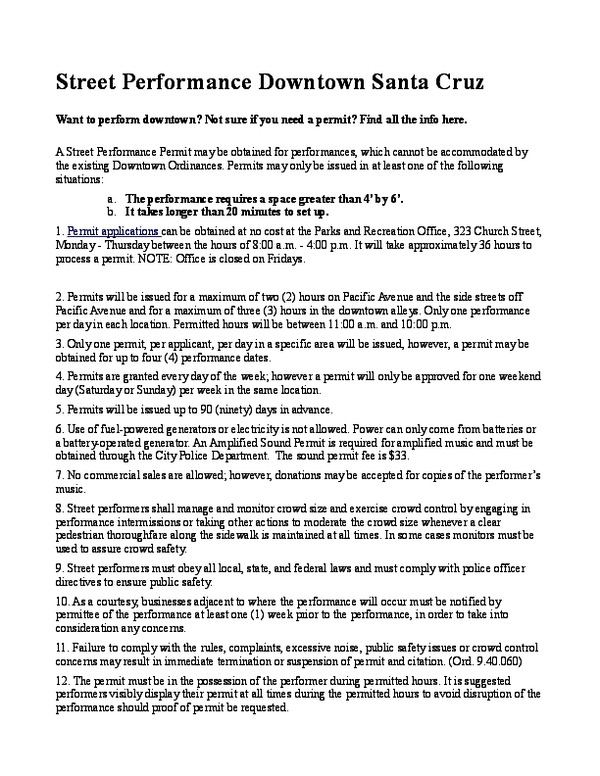
(These notes are based on the Parks & Recreation [P & R] office worker info on 11-7-13 as well as the City’s Street Performance Downtown Santa Cruz website. If anyone has new info or corrections, please contact me).PERMITS TO BE GRANTED IN ONLY 5 SPOTS DOWNTOWN
The only spots for which P & R will grant permits are
(1) Compass Rose area near the post office;
(2) Memorial Plaza near Jamba Juice;
(3) Pacific and Cooper;
(4) Pearl Alley;
(5) Scribner Statue area.

In other areas where performing for donation was traditional (say in front of New Leaf Market), it is simply banned with NO provision for any permit. This means from Laurel St. to Water St. there are a total of 4 spots to play with more than one performer, assuming the two aren’t in a carnal embrace and playing harmonicas (i.e. have instruments like guitars that require at least some space).

ADVANCE NOTICE COULD BE REQUIRED DAYS IN ADVANCE
Permits can be filed only Monday – Thursday 8 AM – 4 PM at the P & R Office at 323 Church St 36 hours in advance of performance. So, if you want to perform with a fellow guitarist on a Monday, you’d better have applied on Wednesday or Thursday of the prior week. P & R worker Betsy assured me that two people playing could easily fit into 12 square feet—the maximum allowable space without a permit for someone with an open guitar case, cup, or other “display device”.. She must have been quite the rage at college phone booth stuffing events.

REPRESSIVE TIME LIMITATIONS
Maximum time length allowed is 2 hours on Pacific and 3 hours in the alleys, one performance per day, and only between 11 AM- 10 PM. Additionally it’s not clear when these rules will be altered given the new ordinances (and new bleak mentality to enable performance “regulation” by police, hosts, security guards, city staff, & merchants). Only one event per weekend. And only in the five spots indicated. Otherwise you are expected to squeeze your instrument, effects, companions and hynee’s into 3 of those sidewalk squares.

When Betsy checked, no one had applied for (and been granted) a permit subsequent to October 24, though 2 groups had applied for events in November before that date and been granted permits. Actually though I’ve only heard second hand accounts of smoking tickets being issued and none of sitting or “display device in wrong place” or “taking up too much space” citations, the number of performers down there has looked tome to be markedly less and those who are there are newbies who often don’t know the rules. Today I saw two homeless people sprawled in “illegal” spots (but not blocking traffic, of course, just “illegal under the “merchant freeway” rules) and, I think, one performer–this was around 4 PM.

Though the permits are free, if you’re using a keyboard or any kind of “amplification” however minor, you’ve got to go through the SCPD and pay $33 with a much longer lead time. I’ve filed a Public Records Act request asking for specifics from them—which they’re supposed to respond to in the next 10 days.
I’ve also requested a list of the names and positions of the Hosts (the Hostile-aptaility squad) and the First Alarm thug patrols–no response yet.

PRICE TAGS ON YOUR OWN ARTWORK AND MUSIC IS CONSTITUTIONALLY PROTECTED (BUT CONVENIENTLY OMITTED IN THE CITY’S LITERATURE)
Contrary to what rule#7 at reads at the Street Performance Downtown Santa Cruz city website http://www.cityofsantacruz.com/index.aspx?page=1289 (“no commercial sales”), recent court decisions acknowledged by the City Attorney’s office allow you to both sell and price tag your own original work (if written, audio, or video)–though this is not explicitly acknowledged (and not respected by some police).

The published decision is Steven C. White v. City of Sparks. It can be found at http://caselaw.findlaw.com/us-9th-circuit/1300114.html . There’s a news story at http://www.firstamendmentcenter.org/no-license-needed-to-sell-art-in-parks-of-sparks-nev

The City’s Street Performer website has also not been updated to indicate that a permit is required for any space more than 2′ X 6′ (not 4′ X 6′ as it now reads).

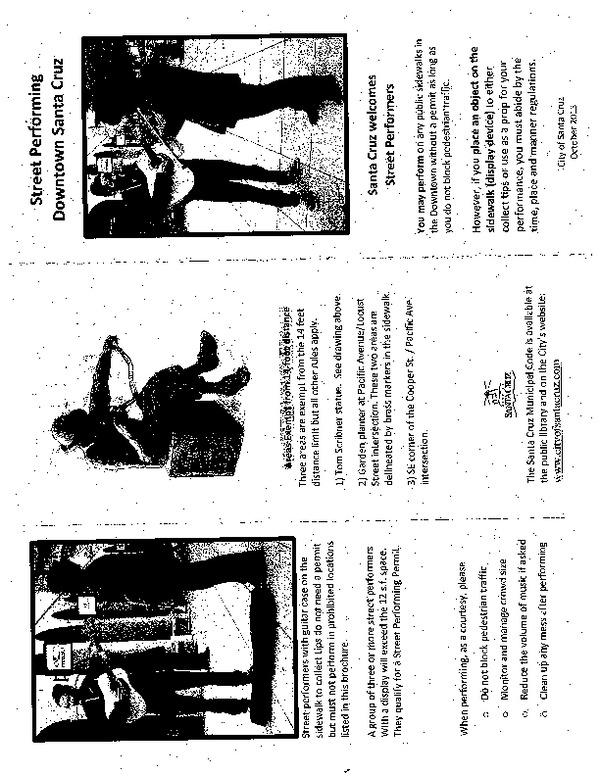
What you don’t read in the latest cheery Street Performing Downtown Santa Cruz hand-out being passed on by police and hosts (from their unmarked HQ at 607 Front St.) is the alarming (and absurd) clarification that the 12 square feet is only 3 “sidewalk squares”–difficult for one performer with an instrument and its case, impossible for more than one.

POSSIBLE ESCAPE HATCH?
MC 5.43.010 only limits “a display device for noncommercial use ON ANY PUBLIC SIDEWALK” [emphasis mine]– so if the device itself doesn’t sit on the sidewalk, but on you, it arguably isn’t covered by the ordinance. So one alternative for performers is to attach a cup to your clothing and have no display device at all. Perhaps add a small sign “City law forbids me to place this cup on the sidewalk.”

This has the additional benefit of arguably allowing you if you perform while standing to do it anywhere and everywhere and still get donations from those brave enough to approach. The 14′ setbacks only apply to sitting, display devices placement, (and panhandling—which is explicitly defined differently than performing for donation).

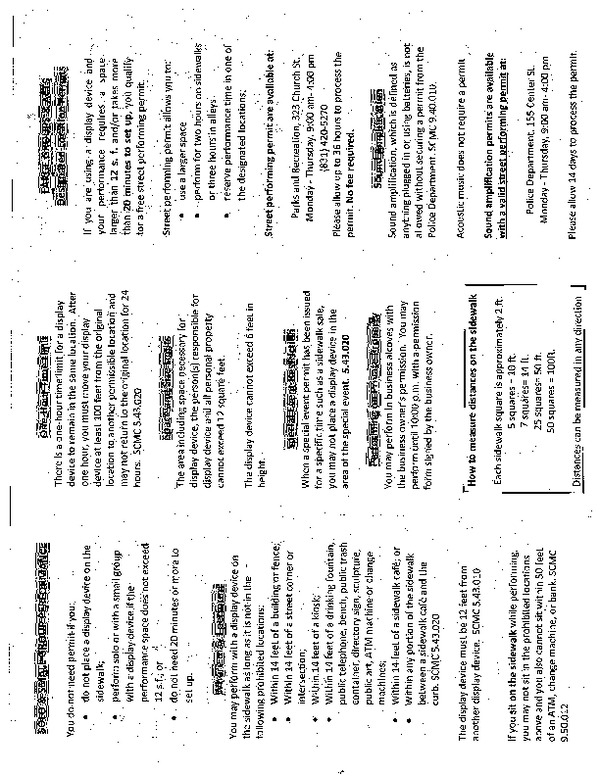
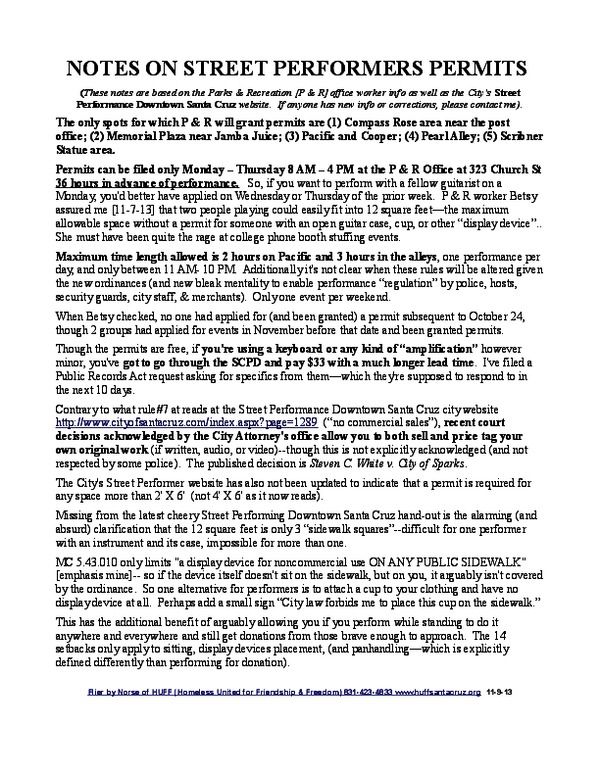
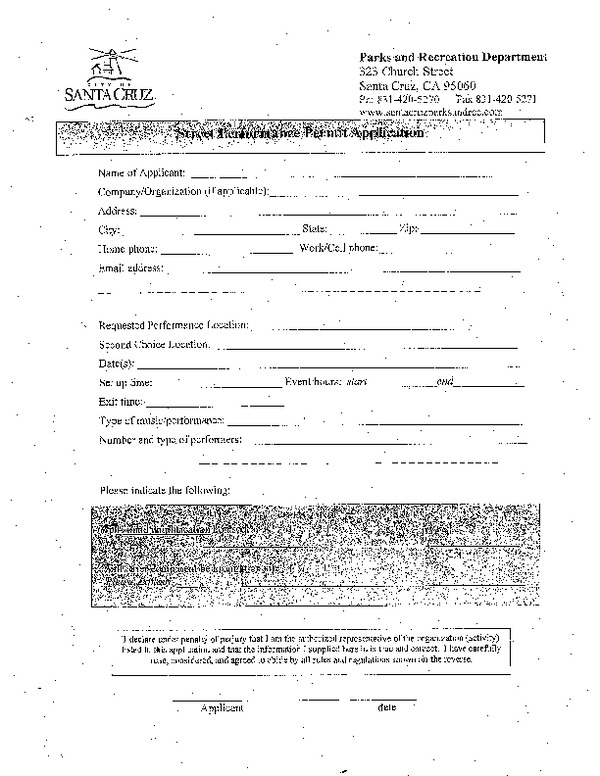
I include below copies of the Permit Application, the Permit “Rules” from the City website, the Santa Cruz Performers Guidelines flyer being pushed by the Hosts and cops, and a flier that outlines the information I’ve outlined above.

§

by Robert Norse Saturday Nov 9th, 2013 7:12 PM


§

by Robert Norse Saturday Nov 9th, 2013 7:12 PM


§

by Robert Norse Saturday Nov 9th, 2013 7:12 PM


§

by Robert Norse Saturday Nov 9th, 2013 7:12 PM


by City Staff (posted by Norse)

Saturday Nov 9th, 2013 7:16 PM


The site at http://www.cityofsantacruz.com/index.aspx?page=1289 has not been updated. So the sentence “The performance requires a space greater than 4 X 6 feet” has now been amended to read “greater than 2 X 6” or more accurately, 12 square feet.

Albany Homeless Driven to Nowhere

NOTES BY NORSE:  As here and elsewhere, an unholy coalition of gentrification gents, NIMBY’s, homeless-o-phobes, “public safety” flimflam hysterics, and (strangely) environmentalists are pushing or backing the deportation-to-nowhere of homeless folks, who haven’t created any notable problems (and certainly less than when they are dumped and dispersed).  In Santa Cruz, this takes the form of Clean-Up’s, a Public Safety Task Farce, a collection of tightening restrictions on the use of public spaces for everyone, & a neighborhood siege mentality targeting homeless survival camping as the Menace of the Month.

                   The first two stories are from the Berkeley Daily Planet, an on-line paper at www.berkeleydailyplanet.com .  The third an earlier one from the S.F. Chronicle.
Laying waste to the primitive hovels and tents of poor homeless people is billed in the mainscream newspapers as garbage disposal, drug dealer seizure, and public security enhancement. ( See http://www.santacruzsentinel.com/santacruz/ci_24168246/illegal-camp-cleanup-slated-carbonera-creek-property-santa  &  www.santacruzsentinel.com/copsandcourts/ci_24429612/deputies-clean-out-corralitos-creek-homeless-campsite  ).

The Sierra Club and the Albany Bulb

By Lydia Gans
Thursday October 24, 2013 – 08:17:00 PM
The backlash against the Sierra Club for joining with Citizens for East Shore Parks in lobbying to incorporate the Bulb into East Shore State Park is not surprising. The San Francisco Bay Chapter, in the May issue of their newspaper, the Yodeler, states the rationale for their action. It gives a very troubling image of the group. The story is titled “Changing the Albany Bulb – creating a bright spot on the East Bay Shoreline”. Apparently in order to “create a bright spot” the first step requires evicting the people who are camping there, people for whom the Bulb is their home. Why is this Sierra Club chapter participating in evicting people? The mission of the Sierra Club is the maintenance and protection of the environment for the enjoyment of the people. It does not mean only certain people, only the“right kind” of people.In going over some of the Bulb history, the Yodeler article says; “In the 1990’s people started camping illegally on the Bulb, and in 1999 the city and the Park District removed that camper population, but the land was again left unprotected …” From what, or from whom did the land need to be protected? From people who cared for it as their home, who planted trees, made trails, worked at mitigating rebar and concrete hazards on the site?

Protected from people who created works of art out of found materials, set up and operated a free lending library?

Over the years the police occasionally sent homeless people from the streets out to the Bulb but otherwise the city of Albany pretty much ignored the camp. Some churches and community organizations and local citizens who enjoyed the place regularly brought food and supplies to the campers. The Sierra Club never took an interest in them. Other than contract with Berkeley Food And Housing Project to provide “Outreach and Engagement” the city has done nothing for the campers. Albany has no homeless shelters and apparently little or no affordable housing – only one of the 60 or so campers has been housed.

One might ask the question, why now? Why do the Sierra Club and Citizens for East Shore Parks demand the Bulb incorporated into the Park at this time? The Bulb juts out from the shoreline and would not be an integral part of the Park nor would any section of the Bay trail go through the Bulb. With a few amenities such as toilets and running water and possibly some help in getting rid of the rebar and concrete it could continue to serve as a campground – at least until Albany can provide proper housing for homeless.

Albany Landfill Evictions Affect Berkeley

By Daniel J. McMullan III
Thursday October 24, 2013 – 08:28:00 PM
In 1999 I was asked by some of the then long time residents of the Albany landfill to come out to the bulb and advocate for those who were being evicted, some them after living there for over 10 years or more.At the time the City of Albany had no services whatsoever for the homeless and their only design, that became very clear by the end, was to dump their homeless problem on the City of Berkeley. The residents of the landfill then as they are today came from places all over the state and country.

I watched the City of Berkeley spend 100’s of thousands if not millions of dollars on the people they ejected from the landfill, most of whom eventually died on our streets. With the help of a non-profit they paid a nominal $13,000 they shifted their responsibility to their homeless to Berkeley.

Now they are in the process of doing it again. In the 14 years since the last big dump upon our City, Albany has done nothing. Still not a single penny has been spent on any program or plan to deal with its homeless.(Unless you want to count the very recent plan to put it’s responsibilities on the backs of the Berkeley taxpayer)

To keep the heat off themselves they permitted their homeless to occupy the landfill again but now they want to pull another people dump at our expense. Every item in their plan is the same except that this time instead of employing conservation corps members to tear out the foliage. They have employed goats. I like goats and to use these noble creatures to serve their hateful plan is very disturbing.

Albany has already hired a willing Berkeley non-profit to do their fakery. And the rest of their non-plan is rolling along. I ask the Mayor and City council to direct the City attorney to put a stop to this in and by any and all means available to us.

We have been hard at work with our own responsibilities,The Homeless Task Force, the revitalization of our SRO’s and creating movement in that system among many, many other things.) And now Albany wants to throw another 70+ people on our streets and into our programs and services?

Albany has one plan. One Action

Dump all its problem’s and expenses on us, on Berkeley.

Time to flip switch at Albany Bulb park, city says

Carolyn Jones
Published 5:21 pm, Monday, September 9, 2013
  • A view of the bay from inside the Castle, a piece of conceptual art that was built by an Albany Bulb resident. Photo: Sam Wolson, Special To The Chronicle
    A view of the bay from inside the Castle, a piece of conceptual art that was built by an Albany Bulb resident. Photo: Sam Wolson, Special To The Chronicle

For more Albany Bulb Art go to http://www.sfgate.com/bayarea/article/Time-to-flip-switch-at-Albany-Bulb-park-city-says-4800115.php

213
Albany’s version of People’s Park appears headed for a showdown next month when police begin rousting 60 to 70 homeless people who’ve taken up residence at a long-neglected shoreline park.The City Council recently voted to begin enforcing no-camping laws at the Albany Bulb, a 31-acre former landfill that juts into San Francisco Bay just north of Golden Gate Fields racetrack.

But some of the homeless, a few of whom have camped there for decades, pledge to resist any relocation efforts. Affordable housing in the Bay Area is scarce, far too expensive and potentially too far away or unsafe, they said.

In short, Albany is their home, and they want to stay there, they said.

“It’s frustrating, aggravating, scary,” said Katherine Cody, 60, who’s lived at the Bulb for about two years. “I’m comfortable here. I feel safe here. Rainy season is coming – I don’t know where I’ll go except the streets of Albany.”

The Bulb, named after its shape, is comprised of old concrete, rebar, dirt and other debris from the construction of East Bay highways. Since the landfill closed in 1984, it’s evolved into a somewhat more natural setting, with a beach and dense acacia, broom, eucalyptus and other plants.

Decades ago, artists began colonizing the Bulb as a sort of outdoor studio not unlike the old Emeryville mudflats, leaving anonymous works of all shapes, sizes and quality. Some works have endured and others have disintegrated over the years.

In the 1980s, homeless people also started moving in, taking advantage of the relative quiet and million-dollar bay views. Some have semipermanent homes, with generators, sturdy wooden walls and even multiple stories.

The Bulb is also a favorite among dog walkers, who enjoy the informal off-leash rules, beach and relatively wild environment. Some have noted it’s one of the only shoreline parks that’s not manicured or developed with paved paths.

Part of state park

In the mid-1980s, the Bulb became one of the original pieces of the Eastshore State Park, envisioned as a continuous strip of bayside greenery stretching from Oakland to Richmond and linked by the Bay Trail.

Most of the park is completed. But the Bulb remains as woolly as ever, due in part to complications with the Regional Water Quality Control Board over seepage.

Those issues are finally resolved, and last spring the city began moving ahead with plans to clean up the Bulb and turn it over to the East Bay Regional Park District and California State Parks to incorporate into the Eastshore State Park.

Relocating the homeless is an important part of that transition, said Robert Cheasty, a former Albany mayor who’s president of Citizens for East Shore Parks, a nonprofit.

“Thousands of people have worked for three or four decades to turn this area into a usable shoreline park,” he said. “We cannot break the faith of all these people just to allow a small group to essentially privatize public land.”

Helping the homeless

To ease the transition for the homeless, the city has spent $60,000 on a contract with Berkeley Food and Housing Project, a nonprofit, to help the Bulb campers find homes, counseling and other services.

The anticamping enforcement should have come months, if not years, ago, said City Councilwoman Peggy Thomsen.

“It’s a safety issue and a health issue, and we need an end point,” she said. “A lot of people are afraid to go out there. We need to worry about the safety not just of regular park users but the inhabitants as well.”

That’s little comfort to the homeless, who say they’re safer there than they would be at a shelter or at affordable housing in sketchy areas.

“Everyone’s stressed,” Cody said. “We don’t know where we’re going to go. It’s very discouraging.”


Hope and Positive Reporting: A Rare Commodity in the Media

NOTES BY NORSE:  The two stories below come as a welcome but unusual respite from the flood of anti-homeless propaganda, police vitriol, and drug war dirt used to smear those outside locally.  A long series of interesting and spirited comments unlike the usual troll detritus on the Sentinel website follows the article profiling the Felton homeless folks at  http://pressbanner.com/view/full_story/23916689/article-The-experience-of-the-homeless-in-Felton?instance=home_news_bullets#cb_post_comment_23916689   There you can read “Take Back Santa Cruz”–Felton-style bigots getting corrected by the homeless people they are smearing.  Quite provocative.  A little favorable publicity can go a long way.

Homeless turn overnight California bus route into ‘Hotel 22’

By Mark Emmons, San Jose Mercury News
http://www.santacruzsentinel.com/ci_24433523/homeless-turn-overnight-california-bus-route-into-hotel

Posted:   11/01/2013 07:43:43 AM PDT

People wait to board the No. 22 VTA bus at about 1:20 a.m. morning, October 25. (Nhat V. Meyer/Bay Area News Group)

ABOARD VTA BUS 22 — Sylvia Hernandez bundled up with extra clothing from her small pull cart and prepared to join the other dozen people trying to doze on the bumpy ride between East San Jose and Palo Alto, Calif. It’s still early, she said. Just wait.

“Later, it will completely be full of homeless people,” Hernandez said.

By midnight, the transformation from public bus into “Hotel 22”³ was well under way — and among the growing number of no-place-to-call-home riders was a father and his 10-year-old daughter.

“We don’t have a place to stay,” said the man, who wouldn’t give their names, but said they had spent nights this way for five months. “From early evening to morning, we’re on the bus.”

Line 22, the only bus route that runs 24 hours in the Santa Clara (Calif.) Valley Transportation Authority system, becomes an unofficial shelter each night, a mobile testament both to the resourcefulness of the region’s homeless and the agonizing challenge of finding shelter in pricey Silicon Valley.

Weary riders can start at the Eastridge Transit Center and travel for two-plus hours to the end point at the Palo Alto Transit Center. There, they wait for a return bus, and then maybe make the round trip again. Somehow, they manage to nod off despite the herky-jerky motion and lights coming on with each stop as an automated voice announces the location.

“The bus says to me that people are so desperate that they will ride it all night,” said Jenny Niklaus, the CEO of the nonprofit EHC LifeBuilders. “Think about it: We are in such a state of crisis that people are eager to ride a bus, and it’s been that way for years.”

One early morning last week, an older woman, who would identify herself only as Angel, said being a Hotel 22 rider comes down to simple survival skills.

“The bus,” she said, “is safety.”

The complex problem of homelessness is a hot-button issue in Silicon Valley at a time when the high-tech economy continues to fuel the expensive
home and rental markets — widening the divide between haves and have-nots.

A 2012 U.S. Department of Housing and Urban Development report highlighted how the South Bay has become a front line to the homeless quandary not only here in the Bay Area, but nationally as well. It found that San Jose and Santa Clara County had the nation’s highest percentage of unsheltered homeless as well as the third-highest number of chronically homeless.

Using data from another census, conducted in January, it was estimated that 19,063 people in the county would experience homelessness this year. The survey found that 27 percent of homeless said they had been turned away from an emergency shelter in the previous 30 days — usually because of a lack of beds.“There are 5,000 homeless on any given night, and we just don’t have enough housing for all of them,” said Ray Bramson, San Jose’s homelessness response team manager.

That explains Hotel 22.

The line is VTA’s longest and busiest route, ferrying about 20 percent of the system’s overall bus ridership. In the overnight hours, three buses make the meandering trip that runs from East San Jose, through downtown, onto the El Camino Real corridor into Santa Clara, Sunnyvale, Mountain View and finally Palo Alto — before heading back.

VTA officials make clear that homeless have just as much right to ride as anyone as long as they obey the rules such as no smoking, eating or drinking.

“We serve the public, and that includes anybody who has the need for transportation and has the ability to pay,” said Greta Helm, the VTA’s chief external affairs officer. “If people present a valid fare, there’s no reason to dispute them boarding.”

A one-way fare costs $2, but monthly passes can be purchased for $70, and VTA also has a program offering some free, quarterly transit passes to homeless and those in risk of losing their housing. So the Hotel 22 is a relative bargain in high-cost Silicon Valley.

As night stretched into early morning last week, late-shift workers and club-hoppers who mostly stared at their smartphones thinned out. They largely were replaced by people using the bus to catch some sleep rather than reach a destination. More were men than women, and the ages of all tended to skew older.

“This bus has all kinds of names, like Hotel 22 or some just call it ‘Life on the 22,’ ” said Tony Velgara, a bus operator. “These usually are nice people, but they’re just dealing with hard times. They’re just like anybody else.”

Hernandez, 52, sat near the front where she could stay close to her cart containing possessions. Hernandez said she has been homeless two years since losing her disability compensation, splitting nights between what she described as “benches” and Bay Area public transportation.

“People think it’s easy finding a place to stay, but in a bad economy, it’s very difficult to even get into a shelter,” Hernandez added. “And the winter shelters aren’t going to be opening for another month, and it’s going to begin to rain soon.”

When passengers disembarked in Palo Alto, they only had to wait a few minutes before climbing on a San Jose-bound bus. On this trip, the father slept sitting up in a back corner. His daughter was lying over three seats, covered in a blanket, a backpack serving as a pillow.

The father was uncomfortable revealing details about their lives. But he did say that he’s 40, has been unemployed and that he and his daughter, who is in fifth grade, are on a family shelter waiting list.

“She’s managing, much better than I ever expected,” the father said after waking her as the bus reached Eastridge at about 1:45 a.m. “I have no idea how she’s doing it. This is one of her best years so far in school.”

The girl, acting like a Hotel 22 veteran, had joined a large group of people gathering for another journey toward Palo Alto — a mixture of newcomers and those who had made the previous round trip.

“Daddy, the bus is coming!” she shouted in a voice both urgent and tired.

As it left the station, the Hotel 22 nearly was full.

“In the morning,” the father had said before boarding, “she’ll get on the bus for school.”

The experience of the homeless in Felton
Jeffrey Scofield, Rob Ropes, Jonney Hughes, and Linda Miller discuss their experiences living homeless in Felton. Joe Shreve/Press-Banner

Jeffrey Scofield, Rob Ropes, Jonney Hughes, and Linda Miller discuss their experiences living homeless in Felton. Joe Shreve/Press-Banner

The topic of homelessness in Felton is not exactly a new one, but in the past several months, it has become something of a hot topic as local community groups and organizations have made a priority of addressing the environmental and societal concerns associated with homelessness and homeless encampments.

In the wake of some extensive coverage of the efforts of the political and community organizations, a group of homeless agreed to meet with the Press-Banner on Tuesday, Oct. 8 to share their own experiences of being homeless in Felton.

“I never dreamed I’d be homeless,” said Jonney Hughes, a woman in her early fifties who described herself as being retired and on disability. “There’s all kinds of reasons people are out here.”

Hughes said that she found herself without a home in 2003, when she was suddenly widowed.

For the next five years, she said, she camped in many different places in the Santa Cruz Mountains and found herself accepted into what she described as a tight-knit family of fellow homeless people.

“They took care of me,” Hughes said. “You just don’t have any of the things you need to have, so everybody looks out for everybody.”

Hughes said that while she has lived in a fifth-wheel camper since 2008, she still maintains regular ties with her homeless friends.

“I still come here every day,” she said. “I love these people.”

Linda Miller, 54, originally hails from Virginia, but has lived in the Felton area for the past 9 years, living with her boyfriend, Rob Ropes, in his recreational vehicle — parking it wherever he can find a safe place.

Miller, a retired nursing assistant, said that she is currently on disability and found herself homeless 20 years ago in the wake of a messy divorce.

David Paul, an unemployed woodworker, has camped in the Felton wilderness since early August. He said he had been living with his brother — who has a home in the area — for several months after moving from Colorado in search of work.

While he has not been homeless in the area as long as the others, it is not his first time being homeless, either.

“I’ve done it before in Colorado,” he said. “I’ve gone through this before.”
 
‘One of these days, they could be right where we’re at.’
All of the homeless people interviewed said that they are all too aware of the spotlight cast on them, and negative reputation associated with them, in recent months.

Many said that they feel as though they are being unfairly assigned blame for issues raised by the community — such as littering, drug abuse, and aggressive panhandling.

Often, they said, issues arise when mentally ill people from local treatment facilities are mistaken for homeless people, or new — often younger — homeless people come to the area and do not understand the rules followed by the established homeless community.

“We try to police our own people,” Hughes said. “You’ve got a lot more younger (homeless), and it’s up to the older ones to teach the younger ones.”

Ropes said that most of the homeless in the area are just trying to eke out a living, and described the idea of drug abuse as “ludicrous.”

Ari Stines, a younger homeless man agreed.

“Most of the people who can afford drugs are in downtown (Santa Cruz),” he said.

Hughes said that, as far as littering goes, recycling is often the primary source of income for homeless people, and they “recycle everything they can get a hold of.”

Ropes, who has to frequently move his recreational vehicle due to lack of a legal place to park it, said he is often harassed — even when the RV was parked at an auto shop with a work order invoice attached to it.

“We don’t do drugs, we don’t panhandle, and we don’t beg,” Ropes said. “All I want to do is be left alone.”

While Paul acknowledged that a few bad apples occasionally appear, he said that most homeless people are just trying to make the most of a bad situation and the spotlight falls on the homeless because “you’re so much in the open here.”

“The people that are willing to help themselves aren’t the problem,” Paul said. “(The ones that aren’t), they just get to a point where they just go underground.”

Miller said that she was often upset by what she sees as a lack of communication and understanding between the homeless and the community.
“It really upsets me,” she said. “One of these days, they could be right where we’re at.”

‘I wish we could find a place’
The reality of the situation in Felton, Hughes said, is that with crackdowns on camping on private property, such as the closure of the Felton Meadow property by Mount Hermon, have concentrated the homeless into a few places.

“The bottom line is, where do they want the homeless to go?” she said.

Paul, who is a member of the Felton Reboot group working to clean up downtown Felton, said that he and other homeless were trying to get involved in dialogue with community members.

“Some of us are trying to do some outreach,” he said. “We’re trying to put our best foot forward.”

He said that the homeless needed to acknowledge the community’s concerns as much as vice versa.

“They have valid concerns,” Paul said. “You can’t discount people — otherwise, it’s just a wall between us.”

Ropes said that he, and others, have paid rent to down-on-their-luck homeowners who are willing to let homeless camp on their property, but that always comes with the fear of bringing a red tag down from the county.

“I paid $10,000 for this RV,” he said. “I have some money; I’d be happy to pay rent.”

Hughes, who herself lives in a fifth-wheel trailer, said that one day, she’d like to see a place set aside for homeless people to camp, and not put homeowners at risk by renting to homeless.

“We’re worried we’re going to get (the homeowners) in trouble,” Hughes said. “I wish I could find a place where homeless could go.”

Fresno: Where the Disappearing Blankets and Tents Went

NOTES BY NORSE:  Santa Cruz homeless activists have long demanded that Santa Cruz store rather than discard homeless property.   I have had conflicting accounts of whether this is done, but rarely of people being able to reclaim their property.  More recently a camper near “Nasty’s Camp”, the camp targeted by SCPD and sheriffs for seizure of their (legally grown) marijuana crop [http://www.santacruzsentinel.com/santacruz/ci_23880596/santa-cruz-police-clear-hundreds-pot-plants-trash?IADID=Search-www.santacruzsentinel.com-www.santacruzsentinel.com ]  reported all her property twice stolen and dumped by workers affiliated with the city though she wasn’t charged with anything.

Santa Cruz is a much smaller community than Fresno and reclaiming property should be easier.  Simply citing state law and the constitution clearly doesn’t do the trick if you don’t have the power of people on the street and perhaps attorneys behind you.  Still I encourage any Santa Cruz homeless person who’s had her property taken by police post their accounts of whether they were able to reclaim it or not.  Public exposure is much cheaper than trying to find legal help–though the possibility of Small Claims Court is still open.
Where Hope Goes to Die

These photos show where the City of Fresno is temporarily storing property taken from homeless people during the sweeps over the last two months.


The large blue tarps flap in the wind and catch your eye as you drive down south down H street, on your way to the center of downtown Fresno. Few people know that this small city of blue topped storage containers is where the City of Fresno, complying with a Federal court order, has brought the confiscated property of homeless people, as they fled the destruction of their humble shelters. Today, the police are confiscating shopping carts filled with homeless people’s property and adding those to the collection – even if the owner of the property just left their property in front of the Poverello House while they got a bite to eat.This confiscation of homeless peoples property started about 2 months ago with the demolitions of downtown Fresno homeless encampments. It continues today as the police and city workers round up homeless people’s property and lock it away behind a barbed wire fence, guarded 24 hours a day/7 days a week, with very little chance that it will be given back to its owners.

Even when homeless people are with their property, on the streets of Fresno, they are harassed by the police. In an incident that happened about a week ago, a group of homeless people were given “debris in road” citations. The “debris” was their blankets, food, and other items they need to survive.

There is little chance that homeless people who lost all of their belongings in these raids by the police and city workers will be able to re-claim their property, because there is no place in the city that is currently safe for them to keep it. Nobody can carry everything they need to survive with them all day/every day. Therefore, the “technical” compliance with the Federal court order is simply a cover for the city’s ongoing policy of taking and destroying homeless peoples property, endangering their health, and decreasing their overall quality of life.

For information about what homeless advocates are doing to respond to this crisis, see: http://www.helpfresnoshomeless.org/


§These Shopping Carts Were Taken From the Homeless

by Mike Rhodes Sunday Nov 3rd, 2013 5:31 PM


§Sign Identifying Who the Property was Taken From

by Mike Rhodes Sunday Nov 3rd, 2013 5:31 PM


Comments  (Hide Comments)

by Kit Williams

Sunday Nov 3rd, 2013 7:44 PM

The sergeant of the police task force charged with following the homeless to ensure that they do not resettle anywhere told me that the police were taking the shopping carts because the carts belonged to stores and would be returned to them, their rightful owners. Apparently this isn’t true, as the carts remain lined up beside the storage containers. Are store owners clamoring for the return of their property? I’ve read nothing that indicates they are.The receipt given to a homeless person whose property is confiscated says clearly (on the bottom of the form) that a photo of the property is placed on the reverse side of the form. I have yet to see a single photo of any property.

The idea that the City is complying with the court order is clearly a farce. At the end of ninety days, the property, if unclaimed, can be discarded by the City. If the City isn’t doing so, it’s undoubtedly because they don’t have the resources (the personpower) to do so, not because they are holding it out of the goodness of their hearts.

The idea that a homeless person is capable of reclaiming their property before the end of the ninety day period is likewise a farce, as this article states. Because they are homeless (and lack vehicles), they have no way to transport their belongings and no place to put them were they able to reclaim and transport them.

It is time for all of us to stand up to the City, to insist on both emergency and transitional housing, for safe and legal campgrounds, for some form of housing for those without shelter of any kind. Contact your City Council member now!

The temperatures are dropping into the 40s, into the range at which people can suffer from hypothermia. Can the City be held liable or found culpable in the deaths of any homeless people who have had the most basic of shelters torn from them? A possible question worth exploring ….

by paulal

Sunday Nov 3rd, 2013 9:27 PM

It looks like it would be impossible for a person to find their belonging in those big containers.

More “Public Safety” Snake-Oil Today at 6 PM at the CopShop

https://www.indybay.org/newsitems/2013/10/30/18745646.php

Title: Public Hysteria Task Farce Slimes On…
START DATE: Wednesday October 30
TIME: 6:00 PM – 9:00 PM
Location Details:
Santa Cruz Police Department’s Community Room at Laurel and Center Streets
Event Type: Vigil/Ritual
Contact Name Susan O’Hara (posted by Norse)
Email Address sohara [at] cityofsantacruz.com
Phone Number 831 420-4020
Address
FACILITATING STAFF FOR THIS INSTITUTIONAL HATE-CRIME GROUP
Susan O’Hara is the city’s staff person (your tax payer dollars at work) who–along with Scott Collins–has been feeding and tending the Task Farce beast.

It may seem unfair to blame these bureaucrats who are facilitating this official cover for reactionary demonization of the homeless (“it’s just my job; my family has to eat: etc.)

Still Susan and Scott Collins–not to mention the ever-amiable Fred Keeley–are the workhorses that keep this foul flock fed and watered (again on your taxpayer dime). as they excrete the foundation for a new level of costly, cruel, cowardly, and pointless attacks on the poor and the addicted.

The graphic representation at http://www.indybay.org/uploads/2013/10/23/10-23_poster.pdf still aptly conveys the underlying spirit of the TF.

SEASIDE COMPANY SOFTSOAPER SOFTENS THE STENCH
It’s being smoothly soft-pedaled by Seaside Company Snake Oil salesman Kris Reyes He is the Director of General Services and External Relations at the Santa Cruz Seaside Company. His softer packaging seems to have upset some of the more Tea Party-ish members last week.

Epitomized by Renee Golder, they’d like to see more explicit and outspoken medieval Drug War measures (such as a straight-forward ban on all needle exchange in the County).

In order to maintain credibility with those a tad nervous about jumping on the reactionary steam roller, Reyes would prefer to submerge us slowly in the water, so it can be quietly heated to a boil later. Let’s not appear “extreme”.

But the entire group is clear on supporting a retreat back into the worst Drug War paranoia of the last century by agreeing on the objective of banning needle exchange in Santa Cruz city, for instance.

CRAVEN COUNCIL HAS DUMPED BEST PRACTICES
This was already done by City Council when it shut down the only site in the City at Barson St. last January behind closed doors with no public discussion, expert input, or public vote.

The sound of former liberals scuttling for cover as misinformed and fearful bigots shook their cans of improperly discarded needles at city council and Bryant-Coonerty opportunist politicians licking their ambitious chops was deafening and infuriating.

The flier I distributed there last week at http://www.indybay.org/uploads/2013/10/23/10-23_flier.pdf still sums up the origins, impulse, goals, & toxic consequences of this surrender to homeless-aphobia hysteria.

MEETING TODAY
The repulsive juggernaut lurches on today–again without audience input–at the cop shop, though the public is welcome to go and watch this well-mannered train wreck.

Issues of real crime and real rehabilitation are not the focus of this group. But as with Sheriff Wowak and his successful propaganda to spend $25 million to upgrade and expand the local jail, the TF camouflages its real passion and prejudice with reassuring noises about youth truancy and drug-treatment.

Their real interest is creating a hostile climate for homeless people and the counter culture, designating them as a “public safety” threat.

FOLLOW THE FOLLY
Agenda and staff report (and subsequent audio) are at http://www.cityofsantacruz.com/index.aspx?page=1924 .

It’s a bit hard to follow recent audio since they are completing a line by line finalizing of their report.

Still, it beats relying on the complaint and complaissant Shanna (Banana-Brain) McCord who continues her career as SCPD swill-spreader.
See http://www.santacruzsentinel.com/santacruz/ci_24375964/santa-cruz-task-force-focuses-youth-program-treatment .

Real public safety, of course means addressing real problems instead of scapegoating street performers, homeless residents, and hippie travelers. But it makes a convenient diversion from confronting those with real wealth and power whose insatiable hunger gobbles up homes, jobs, and lives.

Homeless Encampments in Fresno–the Mainstream Media & the Advocate Response

Fresno Bee Editorial

October 24, 2013
http://www.fresnobee.com/2013/10/23/3568717/editorial-illegal-camps-are-cleared.html

EDITORIAL: Illegal camps are cleared, but Fresno homeless need shelter
City should set up temporary camp for those awaiting housing.
Evidence of the gaping hole in Fresno Mayor Ashley Swearengin’s plan to deal with rampant homelessness can be seen all over the city.
Homeless people are living behind businesses, along freeways and on the San Joaquin River bottom. Some are squatting in vacant homes and garages. During the day, they panhandle for cash and congregate near parking-lot recycling centers, where they turn in cans, bottles and cardboard for money.
The Swearengin administration is doing the right thing by clearing out the illegal homeless encampments downtown. These encampments were unsanitary and unsafe and created intolerable conditions for nearby residents and businesses.
The mayor’s goal of helping the homeless gain independence through “housing first” is also laudable. This strategy provides immediate housing to individuals for stability and then attempts to treat the causes that put them on the streets.
Swearengin deserves credit, too, for launching Fresno First Steps Home, which provides funding to nonprofits and agencies helping the homeless.
But there’s a fatal flaw in her homeless plan: housing is expensive and limited, and Fresno has an estimated 4,000 homeless. With the closing of the illegal encampments, most of them are left with nowhere to go but the street.
We recognize the city’s stressed finances. But skilled leadership can move mountains at bargain rates. The mayor should assemble a team of city staff, homeless advocates and community leaders to set up a temporary emergency camp.
The camp should have rules, toilets, wash areas and security. It must be fenced and located in an area without adjacent businesses and homes. Most of all, it should be temporary.
Long term, Fresno needs a permanent, dormitory-style place for homeless waiting to transition into housing.
San Antonio, Texas, for example, has the 37-acre Haven for Hope, a nonprofit facility that can house up to 1,500 men, women and children.
Haven for Hope’s greatest asset perhaps is its more than 80 federal, state and community partnerships.
It will require that kind of teamwork in Fresno to successfully address our homeless problem.


THE ADVOCATE RESPONSE


To: FresnoHomelessAdvocates@yahoogroups.com
From: MikeRhodes@comcast.net
Date: Thu, 24 Oct 2013 21:54:47 -0700
Subject: [FresnoHomelessAdvocates] Responding to The Fresno Bee editorial

The Fresno Bee printed an editorial (see below) about the homeless in this morning’s paper.  Several people have asked me what I thought about it.
What I liked about the Fresno Bee editorial was that it made a strong statement about the need to do something for the thousands of homeless people who are living on the streets right now.  The mayor’s narrative is that homeless encampments are bad and that she wants to put people into housing.  That is a nice and simple message that plays well in the media, but the problem is that there is a huge gap between destroying the encampments and when homeless people get a voucher and into an apartment.  This is something that I have been talking about for years.  While I find it hard to believe that the mayor thinks that you can destroy homeless peoples shelters and then VIOLA, they are all in housing, that is what she is saying.  The Bee just called her out on her faulty logic.  I get that she is trying to be “positive,” but there is such a huge disconnect between what she is saying and reality, people can’t help but notice.
Aside from The Bee’s acknowledgment that this GAP exists, I did not like the analysis or the solutions they offer.  For example, they wrote “The Swearengin administration is doing the right thing by clearing out the illegal homeless encampments downtown.”  I disagree.  The homeless encampment they destroyed yesterday was a calm place with a stable group of people who looked out for each other.  The owner of the land did not mind that the homeless were there, but was coerced into having them removed, rather than be fined by the City of Fresno for the clean up.  At least that is what the owner told the people who lived there.  The Grain Silo encampment was just a poor neighborhood that homeless people lived in because they could not afford to live somewhere else.  The camp provided protection from predators and there was always someone around to look after a neighbors property if a resident left for a while.  Without having neighbors you can trust, people are more vulnerable.  How is it better for a woman to live alone out in the open or under an oleander bush, without neighbors to protect her?  Homeless encampments provide protection and stability for people who find themselves in very difficult circumstances.
Also, having thousands of people displaced from the encampments in the downtown area is going to be a problem for the health and safety of everyone.  At least when people lived in these encampments we could provide them with portable toilets and trash bins.  That is no longer the case.  Where do you think all of that waste is going to end up now?
The Bee’s solution is to put homeless people into a big encampment that “must be fenced and located in an area without adjacent businesses and homes.”  Great!  First City Hall tells people that the homeless are criminals, they destroy their shelters, take their property and now they want to put them in a concentration camp in some remote location?  This has been done before and the outcome is not good.
The answer is decentralized safe and legal places for the homeless to live.  Homeless advocates wrote a proposal to do this in January 2012.  A copy of that proposal is also below.
Mike Rhodes
Editor
Community Alliance Newspaper
PO Box 5077
Fresno Ca 93755
(559) 978-4502 (cell)
editor@fresnoalliance.com
www.fresnoalliance.com
***

PROPOSAL FOR SAFE AND LEGAL HOMELESS ENCAMPMENTS IN FRESNO

The Need
The City of Fresno allowed homeless encampments to exist and grow for several years but in the past couple of months has cleared out all the major encampments in the city. This dislocation has resulted in thousands of homeless people in Fresno having no safe and legal place to live.
Existing shelters cannot house all of the homeless who are now sleeping on sidewalks and other locations not intended for human habitation. As temperatures dipped below freezing in late December, one woman died as she slept on the sidewalk outside of the Poverello House. Many others are sick with pneumonia and other illnesses related to their exposure to the cold weather.
The cost to city and county government, if we allow the situation to continue as it currently exists, will be enormous. The price of providing emergency medical care and hospitalization would be dramatically reduced if we redirected those dollars to provide the homeless with a safe and legal place to live.
Although the city’s goal of decent, affordable and permanent housing for everyone is a good goal, we all know that it cannot be achieved anytime soon. Therefore, there will be homeless people who do not make it into a shelter and have no place to sleep. It is with those people in mind, and there are currently thousands of them in the City of Fresno, that this proposal is intended to assist.
Safe and Legal Campsites
The fastest and easiest way to dramatically improve life for the homeless would be to allow them to construct shelters and provide them with basic public services. With shelters like tents, the homeless can get out of the rain and stay considerably warmer than if they have no protection from the rain, wind and cold.
These encampments will exist on public and private land. The City of Fresno could determine which property it owns that will be used for these encampments. The city will allow encampments to be developed, through a conditional use permit, for any owner of property who wanted to use his/her land for that purpose. The city will work with other state, federal or county governmental entities to facilitate the use of the land for encampments.
Initially, Phase I of this proposal seeks to allow the establishment of encampments at existing sites, with limited development of infrastructure. A longer-term project will see some infrastructure put into place to better serve the needs of the homeless residents.
These campsites will be self-governing and not overseen by any social service agency or government entity. The residents will be like any other group of people living in a small neighborhood. They will be provided with drinking water, portable toilets and trash pickup. Those services could be paid for by the city, county, community groups, churches, and/or individuals.
The individuals living in these safe and legal homeless encampments will be responsible for maintaining the campsite. No illegal activity will be permitted in the camp. If there are legal problems, they will be handled in the same way as they are in any other neighborhood in Fresno.
These campsites will be distributed throughout the city and consist of no more than 100 residents per encampment. The purpose of the multiple locations is an acknowledgment that homeless people live throughout the community, and the intention is to equitably distribute the encampments throughout the city as much as possible. The purpose of limiting each camp to 100 people or less is to avoid concentrating the homeless in one location and impacting any single area with a high density of homeless people.
Possible campsites include vacant lots, churches, parks and unused government property.
Phase I of this proposal will start immediately and utilize the areas where the homeless are already living. Phase I will allow the homeless to construct simple structures (tents and tarps) and live in them until something better is available. This will take away the stigma of living illegally and being told to “move on,” when there is nowhere better to move on to. This decriminalization of poverty is an important first step in allowing people to live with dignity and respect.
Phase I will provide every group of 10 or more homeless people living together with basic public services (drinking water, toilets, and trash service). Providing the homeless with these services will not only dramatically improve their lives but also clean up our. Having access to drinking water should be a service provided to every citizen of this community, whether rich or poor.
Phase II, which will take a couple of months to start, will seek new locations for the homeless encampments. These new locations will have improved infrastructure and might be associated with a church or a community group, or they could be independent and located on property owned by someone who allows the encampment on his/her property.
The range of shelters in Phase II might include tents, wooden buildings, modified tool sheds and other structures deemed appropriate by the residents. Although residents in the Phase II development might stay for a while, none of these encampments is intended to be permanent. The goal is to work with the residents, address any issues they have that are holding them back and get them into decent and affordable housing as soon as possible.
The primary goal of phase one and two of this project is to improve the lives of the homeless while saving taxpayers money and improving public safety.  By stabilizing and improving their lives, it will improve their chances of getting a job and/or getting the help they need from social service agencies. That assistance ranges from health services, mental health services, alcohol or drug addiction treatment, job training or getting a better education. Being in a stable location will help the homeless get the assistance they need.
A cost-benefit analysis of this proposal would show that it will save the taxpayers money. Our streets, businesses and residential neighborhoods will benefit by providing homeless people with basic public services. Homeless people will benefit by improved living conditions, better contact with social service agencies and ultimately getting into a house.
Phase III, We recognize that there is both an independent and resourceful spirit among homeless people. A portion of the population will never be served by traditional housing. Additionally, many homeless individuals posses underutilized construction skills or the capacity to learn those skills.
In Phase III we would like to identify location(s) suitable for the development of permanent self sustaining communities that are being designed by architect Arthur Dyson and the non-profit organization, Eco-Village. At an location agreeable to the residents and the jurisdictions, an Eco-Village will be planned for phased development. Residents that will work on the site will establish a temporary camp on site. Through sweat equity and volunteers labor the shared facilities (bathrooms, kitchen, community space, etc.) and individual dwellings will be built and occupied by the residents.
The work will be guided by tradesmen and trained professionals.
Alternatively, the City or County may determine an existing unused public facility that it desires to convert for use as shelter. Like with the Eco-Village, a temporary camp will be located on site and homeless individuals will work on the adaptation of the facility for shelter. In turn they will gain skills and earn equity in the final product.
Additional suggestions are to establish true 24/7 Emergency Shelter for up to 30 days, following acquiring federal funding for Emergency Shelter and Services.  Development of transitional housing for up to 2 years.  We also support a permanent housing development utilizing existing and foreclosed homes in Fresno and the new affordable housing being developed as part of Housing First.

Public Hysteria Task Farce’s Final Report Closer to Completion

Looking In On the Public Hysteria Task Farce

by Robert Norse
Wednesday Oct 23rd, 2013 11:15 PM

With hearings for the Mayor Bryant’s hand-picked “Task Force on Public Safety” happening weekly now with the aim of churning out a report in November, I stepped in to tonight’s meeting at the Civic (next week’s is supposed to be at the Police Station again–where most of their meetings have been held). I only stayed for an hour of the meeting. The audience was small and submissive. As ever, there was no provision for public comment, though there was informal (if insubstantial) chatter between Task Force members and some of the regular audience members. I include a poster I displaye for those arriving and a flier I gave out to the Task Force and to the audience.

Poster by a talented but anonymous homeless artist

§

by Robert Norse Wednesday Oct 23rd, 2013 11:15 PM

A narrow vote defeated an attempt to officially and openly ban needle exchange in the City. Of course that was already done when the City Council in closed session directed the City Attorney to threaten and close the Barson St. needle exchange last January. And so imperil the City’s health for the last 9 months.
Sentinel story is on-line at http://www.santacruzsentinel.com/santacruz/ci_24375964/santa-cruz-task-force-focuses-youth-program-treatment

Comment on this issue either at the Sentinel’s on-line story above or at the indy-media story: https://www.indybay.org/newsitems/2013/10/23/18745324.php .

Past Task Force agendas, staff reports, minutes, and audio are at http://www.cityofsantacruz.com/index.aspx?page=1924 .

Fresno’s Last Homeless Encampment Demolished–but not without resistance

NOTE BY NORSE:  A day before Santa Cruz’s Community Blanket Sit-in on Pacific Avenue (scheduled for 1-3 PM tomorrow in front of Forever Twenty-One on Pacific Ave–or whereever folks want to show on Pacific), Fresno activists engaged in active resistance to the Fresno homewrecker attack on the unhoused community ther   Below is a brief update by Mike Rhodes, who will be on the stream of Free Radio Santa Cruz tomorrow (10-24) at 6:34 p.m.  Tune in at http://tunein.com/radio/FRSC-s47254/.

                Unlike Santa Cruz activists (myself included) who have put little time into providing support and defense for existing encampments,  Fresno’s strong advocates put their bodies on the line to block bulldozers or so they report.  Admittedly they also have some legal muscle behind them and on-going lawsuits (by an ACLU that actually supports homeless civil rights unlike the Rotkin-Pleich ACLU of Santa Cruz), but we can still learn lessons from them.The Grain Silo/Canal Bank Homeless Encampment is Destroyed

by Mike Rhodes ( editor [at] fresnoalliance.com )
Wednesday Oct 23rd, 2013 10:21 PM

The City of Fresno continued their attacks on the homeless today by destroying the last encampment in the downtown area. The photo below shows one protester stopping a bulldozer as it tried to enter the encampment.


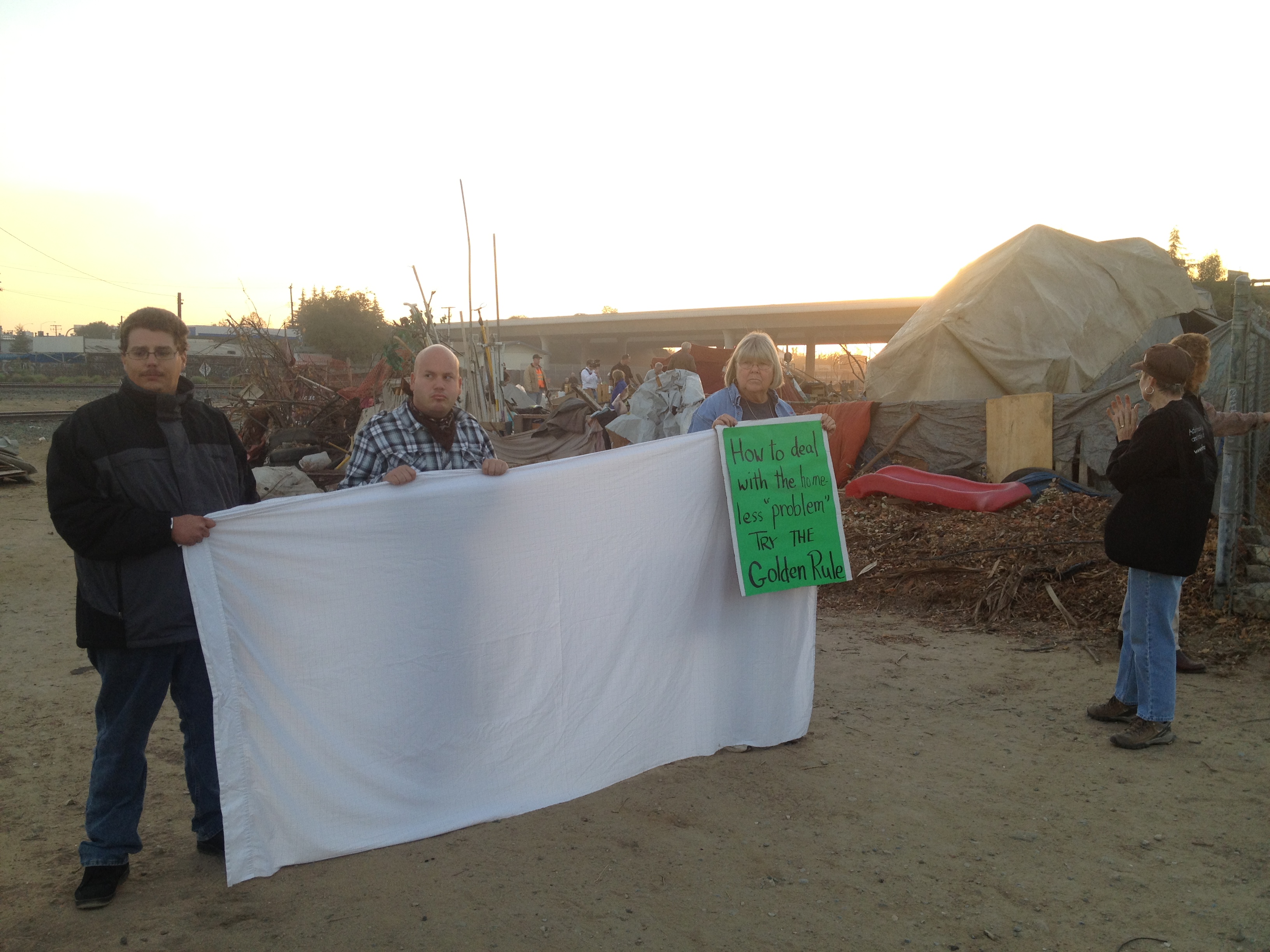
The City of Fresno destroyed the last remaining homeless encampment in the downtown area today. The assault on the Grain Silo/Canal Bank homeless encampment started at dawn and continued throughout the day. By 7:30 a.m. homeless advocates had blocked the two main roads into the encampment, preventing bulldozers and other city vehicles from entering.The city work crews shifted their strategy to focus on a handful of tents and other structures in a field on the other side of the railroad tracks. Bulldozers, garbage trucks, police and other support vehicles came down a dirt road on a canal bank to start the demolition. The handful of homeless people at that location were told to remove their property or it would be stored. The destruction of the structures at that location took several hours, while the homeless advocates maintained their vigil at the main encampment.

Eventually the city focused their attention on the much larger encampment and tried to bring in their bulldozers on a road that ran parallel to the railroad tracks on the south side of the camp. They were met by 10 – 15 homeless advocates who refused to allow the city vehicles to pass. After negotiations with Jim Betts, an attorney working for the City of Fresno, an agreement was reached to allow a U-Haul truck in to move some of the property.

As the homeless and their allies were loading the U-Haul a second bulldozer came down a road at the north end of the camp. One of the protesters jumped on the bulldozers claw and the city soon withdrew that vehicle.

The protesters, having gained time to help move the homeless, stepped back and two bulldozers and a garbage truck entered the encampment and started destroying what was left on the south end. It appeared that all of the homeless had moved out of that area and the property remaining had been stored.

I had to leave by mid afternoon, but it appeared that the city would have the entire encampment leveled by the end of the day. Several City of Fresno representatives told me that a fence would be put up on Thursday to keep anyone from re-establishing an encampment at that location.

Meanwhile, in other parts of town, homeless people are having their property confiscated if it is left unattended. I was also shown a citation one homeless person received yesterday that charged them with an infraction for leaving “debris in the road” which was, they say, their property. To see an earlier story about this new police tactic in Fresno, see: http://www.indybay.org/newsitems/2013/10/09/18744608.php

To see what groups working in support of the homeless will do next, see: http://www.helpfresnoshomeless.org/

§Protesters Arrived at Dawn

by Mike Rhodes Wednesday Oct 23rd, 2013 10:21 PM


§The City Started the Attack in an Unexpected Location

by Mike Rhodes Wednesday Oct 23rd, 2013 10:21 PM


§Bulldozer stopped by the Protesters

by Mike Rhodes Wednesday Oct 23rd, 2013 10:21 PM


§Negotiations take place with Jim Betts (Center)

by Mike Rhodes Wednesday Oct 23rd, 2013 10:21 PM


Betts is the attorney representing the City of Fresno

§A U-Haul Truck was used to help people move

by Mike Rhodes Wednesday Oct 23rd, 2013 10:21 PM


You can see the protesters stopping the city equipment, to the left of the U-Haul

§Loading property onto the U-Haul

by Mike Rhodes Wednesday Oct 23rd, 2013 10:21 PM


§Protesters Hold Their Ground

by Mike Rhodes Wednesday Oct 23rd, 2013 10:21 PM


§Destruction of the encampment

by Mike Rhodes Wednesday Oct 23rd, 2013 10:21 PM


§Some people moved their property across the RR tracks

by Mike Rhodes Wednesday Oct 23rd, 2013 10:21 PM


§One of the Signs Posted by the Homeless – to save their property

by Mike Rhodes Wednesday Oct 23rd, 2013 10:21 PM


§Cinnamon, one of the homeless residents, Called out for Help

by Mike Rhodes Wednesday Oct 23rd, 2013 10:21 PM


Sanctuary Camp in Santa Cruz Discussion

Activist Brent Adams has proposed a Sanctuary Camp in Santa Cruz, which is being discussed at https://www.indybay.org/santacruz/  with a specific thread at https://www.indybay.org/newsitems/2013/10/10/18744678.php    I reprint my comments from

https://www.indybay.org/newsitems/2013/10/10/18744678.php?show_comments=1#18745233

by Robert Norse
Tuesday Oct 22nd, 2013 8:54 AM

Some valuable information is contained in this business plan. Yhose who are working on the Sanctuary Camp proposal need to be commended for their determination and energy in the face of a hijacked and hostile political climate. I’ve given the plan a reading, but it needs more careful analysis. Brent’s style of presentation, his repeated hostility to some of us who haven’t jumped on the bandwagon (alternating with New Age hugs), and his direct attacks on me personally and protesters generally has made objectivity difficult.

They also need to be aware that many concerned with the rights of homeless people–some homeless and some housed–have “concentration camp” and other concerns with the model.

Fresno activists have been funding homeless-created encampments with trash pick-up’s, portapotties, fresh water, and other services since they won A $2.3 million lawsuit in 2007 (because city authorities, like Santa Cruz’s SCPD and Rangers) were stealing and destroying homeless property.

There’s extensive history on this homeless civil rights struggle at http://fresnoalliance.com/wordpress/?p=1313 . (Scroll to bottom for the most recent story)

More recent encampment coverage:

http://www.indybay.org/newsitems/2013/10/10/18744664.php (Grain Silo Homeless Encampment Posted for Demolition)
http://www.indybay.org/newsitems/2013/10/09/18744608.php (City of Fresno Finds New Ways to Harass the Homeless)

While Fresno activists have tried repeatedly to appeal to the city to be reasonable, recognize how cost productive it would be to stop harassing homeless encampments and/or supply services to them (or perhaps establish Sanctuary type campsites), authorities have repeatedly hoarded or ignored funding specifically intended for homeless relief and continued its campaign of harassment.

The relief that Fresno activists were able to give was through documentary videoing, lawsuits, and then direct services as described above.

Ed Frey and Occupy Santa Cruz supplied toilet facilities here in Santa Cruz when the City would not. In both cases PeaceCamp2010 and the Occupy Santa Cruz San Lorenzo campground were destroyed by authorities (not by internal problems).

Direct support to campsites currently in existence is another avenue to consider here in Santa Cruz, while Sanctuary seekers struggle to persuade right-wing staff, frightened liberals, and an apathetic community to allow a very limited Sanctuary campground.

Another informative document from Fresno is this documentation of The Cost of Destruction in Fresno: http://helpfresnoshomeless.org/ . The business plan references local costs generally, but getting such documentation more specifically is important.

While it feels endless and overwhelming, it’s important to support homeless folks–their rights, their property, their dignity now as it is seized from them, legislated away by law, and snarled away by a rightwing riptide undertow. If they choose to protest, it’s wrong to ignore or–worse–denounce them as “alienating the community.”

It seems both cruel and delusional to suggest they wait for the toxic political establishment to be persuaded that a sanctuary camp is a good idea as they shiver in the shadows through the winter, facing an ever nastier set of “recommendations” from Bryant’s Citizens Task Force on Public Safety. See http://www.cityofsantacruz.com/Modules/ShowDocument.aspx?documentid=34557 (meeting again 6 PM 10-23 in the Tony Hill Community Room of the Civic Auditorium).

There’s also the concern that pushing a plan for a select number of homeless to be allowed a special sanitized segregated area where they will not be allowed the rights that anyone indoors takes for granted (drinking alcohol for instance) is both paternalistic and unrealistic. It also goes against the wisdom of the Housing First model which seeks to provide the most basic housing before imposing sobriety.

No one doubts the need for campgrounds. But we must support those who are struggling now. Not turn aside and censor our efforts and websites in the hope of teasing out a smile on Pamela Comstock’s face. Waiting for Don Lane to find a backbone and other progressives scuttling to find protective cover from the phony Public Safety scare is self-defeating. (See, however, http://santacruz.patch.com/groups/don-lanes-blog/p/why-are-they-here-or-is-it-why-are-we-here for Lane’s defense of social services to the Task Force, as he remains silent–as he has for decades–on the vital need for safe places to sleep)

Blankets On Pacific Avenue for Justice 1 PM Thursday October 24th


https://www.indybay.org/newsitems/2013/10/22/18745224.php

Title: Community Blanket Sit-In
START DATE: Thursday October 24
TIME: 1:00 PM – 3:00 PM
Location Details:
On the sidewalk in front of Forever Twenty One on Pacific Avenue near Soquel in downtown Santa Cruz
Event Type: Protest
Contact Name Phil Posner
Email Address chatrabbi [at] aol.com
Phone Number 831-713-6730
Address
Join us October 24th – the day the Santa Cruz City Council’s new draconian downtown ordinance “restricting artists, musicians and Petitioners'” freedom of expression is to take effect. The Ordinance not only restricts display space, it even bans blankets on which artists may display their wares and maintains the rule that artists and musicians must move to a new location after one hour.

Bring a blanket and a piece of jewelry or a favorite musical instrument.

As Councilman Don Lane, who with Micah Posner voted against the ordinance, pointed out a 6-foot-long table, even a smaller card table with two chairs, or a three-member music combo would all “… violate the new standards.” Further, As Councilman Posner stated, these rules are “literally a curtailment of freedom of speech” and difficult to regulate (and enforce) without a measuring tape, T-square or other tools.”

If you agree that individuals seeking to share their sidewalk musical or artistic talents have the same right to freedom of expression as brick and mortar merchants join us in solidarity – in opposition to rules that are arbitrary and oppressive; whose intent seems to be an attempt to whip clean artistic, musical creativity and freedom of expression from our downtown streets.

Join our peaceful, non-violent protest.

Sincerely: Committee for Fairness & Equal Opportunity for Artisans and Musicians. 831-426-1319 and HUFF – Homeless United for Freedom & Friendship 831-423-4833