Santa Cruz Suffocation of Street Culture

NOTE by NORSE:  Apologies to those who received the first version of this addition to my indybay article at https://www.indybay.org/comment.php?top_id=18742960 .  This is a corrected and amended version of that e-mail.
Most of the following I e-mailed to City Council.

The question, of course, is whether the community is prepared to tolerate this crackdown on street performers, vendors, smokers, and homeless people downtown and what effective resistance strategies can be mounted.  Next Sunday’s 1:30 PM protest in front of Forever Twenty-One may provide some ideas.

There’ll be an additional gathering at City Council on the afternoon of the 24th when Council votes pn the 2nd reading.

I played some of the staff’s defense of the proposed amendments on my show–archived at http://www.radiolibre.org/brb/brb120915.mp3 (about 2 hours into the audio file).

In response to what I heard, I wrote the following–some of which has already been detailed in the main article:

CURRENT SMOKING BAN LAW IGNORED
An inconvenient fact not mentioned and an area not examined by staffers Hende and Collins in their no-input-from-smokers presentation on September 10th  was the current law:

Current law MC 6.04.060 (u)   provides:

Areas which share their air space, including, but not limited to, air conditioning, heating, or other ventilation systems, entries, doorways, open windows, hallways, and stairways, with other enclosed areas in which smoking is prohibited. It shall be the responsibility of any person smoking outside where smoking is otherwise permitted to ensure that smoke does not enter any buildings where smoking is prohibited through open windows or doors; however, in no event shall smoking be allowed within twenty-five feet of any such door or open window or within twenty-five feet of any other air-intake facility through which air may flow into a building from outside that building. Notwithstanding the prohibition set forth in this subsection an employer may establish an outdoor employee smoking area within twenty-five feet of an employer’s service entrance door; provided, that said door is closed while employee smoking is taking place.

In other words, there’s a 25′ setback for smokers already on side streets and hence no need to create a total ban and thus a clustering on streets still further away.    Mentioning this inconvenient existing law might strip some of the wind from the sales of law supporters (though no clear evidence of complaints was presented by the SCPD or any other staffers around this issue and certainly no input from the affected group).

Additionally, as the tenor of the town turns more hateful under pressure from Take Back Santa Cruz and other hobophobic groups, recent accounts and common experience documents that  homeless people smoke at a significantly higher rate than the housed population (see http://articles.latimes.com/2013/jul/18/news/la-sn-homeless-smoking-20130718 ).   Hence this ordinance unduly impacts the poorest portion of our downtown community and seems likely to be used as another tool to move them out of the downtown, out of sight and out of town.

STREET PERFORMER IMPACT SEVERE; EVEN MORE SO FOR VENDORS
This huge restriction of space comes on the heels of an already sterilized sidewalk which irrationally excludes people from sitting, peacefully sparechanging, performing for donation, vending, and/or politically tabling from more than 75% of the sidewalk on Pacific Avenue.  It also (currently) impacts 100% of virtually all sidewalks in other business districts—-which are less than 10′ wide.

Additionally, the notion that one street performer–much less two–can comfortably perform within a 4’X4′ area is ridiculous.  The notion that a vendor can do so and also have a chair and her or his personal possessions in that area is even more far-fetched.

And the notion that this all should be put on boxes or tables increases the burden on performers & vendors unnecessarily and to a ludicrous extreme in the interest of a hostile aesthetic–again imposed without any input from performers.

STREET PERFORMERS SPECIFICALLY INCLUDED NOT EXCLUDED IN THE ATTACK
Staff members Collins and Hende (and City Attorney Barisone) misleadingly implied that street performers aren’t impacted by the display device provisions since they can “play anywhere on the avenue”.  There was also the absurd suggestion that artists can “hold up their art with their hands” and so also not be impacted.

While it is true that a street performer without an open guitar case or cup or cap on the sidewalk is not limited as to where he or she may play, that’s only if they don’t have one of those items out to collect donations.  This, of course, ignores how street performers operate sine the point of the performance usually is to collect donations.  What collects donation?    Cups, caps, guitar cases, etc.   These are indeed  “display devices”–as defined by the peculiar wording of the ordinance and have been treated as such by police for the last 19 years.

The specific definition of  MC 5.43.-000(b) defines display devices as “a table, rack, chair, box, cloth, stand, or any container, structure or other object used or capable of being used for holding or displaying tangible things, together with any associated seating facilities…”   Could anything be any clearer (or more sweepingly inclusive)?

In addition the few spaces left in the area street performers, political tablers, and vendors usually set up (between New Leaf Market and Locust St.)  are further constricted by the Move-Along law (another unique Santa Cruz DTA creation) which forbids using any particular space for more than 1 hour in any 24 hour period.    This means that even if a space is suddenly emptied of someone sitting, sparechanging, standing, performing, vending, or tabling, anyone who’s “set up a display device” during that day won’t be able to come back and use that space for a day.

Given the severe expansion of the “forbidden zones” (now covering 95% of the sidewalk), as well as the new 12′ distance required between display devices, the new laws seem both likely and indeed designed to drive away the “unsightly” cluttered scene that so offended Mathews, Comstock, & Robinson–who are essentially imposing their own aesthetic dictates upon the entire community.

SIGN-MAKING TOMORROW (Monday September 16th)  AT THE RED CHURCH 5-6 pm at Lincoln and Cedar Streets.  The Occupy Santa Cruz Homeless Justice Working Group and HUFF will be making signs for the September 22nd and 24th protests tomorrow at the Red Church.  Come on down and mingle with those who will be affected.

There is also some discussion of this issue on Steve Pleich’s website at Citizens for a Better Santa Cruz facebook page (https://www.facebook.com/groups/463105420413280/ ).  Pleich posted that I was permanently banned from the page for posting a link to the revealing and abusive Ken Collins video (https://www.indybay.org/newsitems/2013/05/15/18736901.php ) illustrating, I think, the mentality behind these anti-homeless laws and many of those who support them  (Collins was weighing in heavily on the issue and I felt the video of his threatening and harassing a homeless camper was pertinent; Pleich’s strong censorship response, I think, shows too much concern with offend Take Back Santa Cruz sensibilities.

Clearing Away Disposable People on Pacific Avenue

For a downloadable pdf version of this flyer with various points highlighted go to:
https://www.indybay.org/newsitems/2013/09/09/18742960.php?show_comments=1#18743230

A protest will also be held 9-22 at 1:30 PM in front of “Forever Twenty-One” on Pacific Avenue near Soquel Ave.
See https://www.indybay.org/newsitems/2013/09/09/18742960.php?show_comments=1#18743107

by Robert Norse\  Saturday Sep 14th, 2013 4:20 PM

Shafting Non-Shoppers: Expanding the Destructive Downtown Ordinances
Merchant Monopolization of Public Spaces Marches On

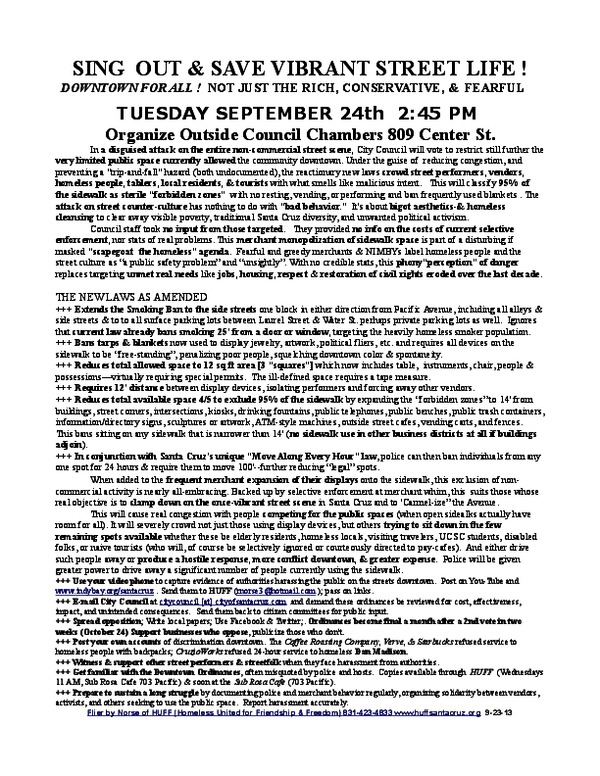
In a disguised attack on the entire non-commercial street scene, City Council voted to restrict still further the very limited public space currently allowed the community downtown. Under the guise of health concerns, reducing congestion, and preventing a “trip-and-fall” hazard (none of which is documented), the reactionary new laws crowd street performers, vendors, homeless people, tablers, local residents, & tourists together & sterilize 95% of the sidewalk as “forbidden zones” for resting, vending, or performing.

This is a merchant/right-wing attack on the street counter-culture. It has nothing to do with “bad behavior.” It’s about “bigot aesthetics”–clearing away visible poverty, traditional Santa Cruz diversity, and political activists. Council staff showed no input from those impacted (other than merchants) and had no info on costs or stats documenting problems.

THE NEW LAWS
The new law changes:
+++ Extends the Smoking Ban to the side streets one block in either direction from Pacific Avenue, including all alleys & side streets and to to all surface parking lots in downtown between Laurel Street and Water St. perhaps private parking lots as well (Julie Hendee, one of the authors of the law wasn’t sure!).
+++ Requires street artists, street vendors, panhandlers, and political activists to provide “freestanding” display devices such as tables or boxes on which to hoist above the sidewalk anything with them. This bans tarps & blankets now used to display jewelry, artwork, political fliers and likely laying objects directly on the sidewalk. This includes panhandler’s cups and caps as well as street performers’ guitar cases and change bowls.
+++ Reduces the total display device space to 16 sq ft now to include all the person’s personal possessions;
+++ Requires a 12′ distance between display devices, isolating community members.
+++ Reduces available space 4/5 to include 95% of the sidewalk by expanding the “forbidden zones” to 14′ from buildings, street corners, intersections, kiosks, drinking fountains, public telephones, public benches, public trash compactors, information/directory signs, sculptures or artwork, ATM-style machines, outside street cafes, vending carts, and fences. This bans sitting on any sidewalk that is narrower than 14′ (stops use of all sidewalks in other business & beachfront districts).
+++ Defines “display devices” as any kind of container “capable of being used for holding…tangible things”—which may include a backpack or sleeping bag, making likely its use against homeless people.

When added to the frequent merchant expansion of their displays onto the sidewalk in front of their shops this exclusion of non-commercial activity will be nearly all-embracing. This, of course, suits those whose objective is to drive away the once-vibrant street scene in Santa Cruz and ‘Capitola-ize” the Avenue.

The resulting congestion will have people competing for the public spaces (when there is actually room for all). It will severely crowd not just those using display devices, but others trying to sit down in the few remaining spots available whether these be elderly residents, homeless locals, visiting travelers, UCSC students, or naive tourists (who will, of course be selectively ignored or courteously directed to pay-cafes). And either drive such people away or produce a hostile response and more conflict downtown.

FIGHT BACK AGAINST THE WEALTH-A-FICATION OF DOWNTOWN SANTA CRUZ
+++ Use your video phone to show authorities harassing the public on the streets downtown. Post on You-Tube and http://www.indybay.org/santacruz . Send them to HUFF (rnorse3 [at] hotmail.com ).
+++ E-mail City Council at citycouncil [at] cityofsantacruz.com .and demand these ordinances be reviewed for cost, effectiveness, impact, and unintended consequences by citizen committees and with public input.
+++ Spread opposition; Write local papers; Use Facebook & Twitter;. Ordinances become final a month after a 2nd vote in two weeks (October 24) Support businesses who oppose, publicize those who don’t.
+++ Post your own accounts of discrimination downtown. The Coffee Roasting Company & Starbucks recently banned large backpacks; CruzioWorks refuses 24-hour service to Dan Madison for his homeless appearance.
+++ Come to City Council 3 PM September 24th to oppose the 2nd Vote on these laws!
This side of the flier by Norse of HUFF (Homeless United for Friendship & Freedom) 831-423-4833 http://www.huffsantacruz.org 9-14-13

Some Thoughtful Comments

NOTE BY NORSE:  Doug Loisel is the former Director of the Homeless Services Center, who liberalized some rules there, provided the first 24-hour bathroom access in Santa Cruz, and was unusually accessible–in stark contrast to the current director–the poverty pimpstress Monica Martinez.
Martinez has colluded with police and neighborhood bigots in creating a “no impact” (i.e. no homeless) zone around what I now call the Homeless (Lack of) Shelter Center (since it doesn’t provide shelter to any significant number of homeless people).
She has failed to defend homeless people’s rights, dignity, and safety in the face of intensifying hostility from police and vigilante groups.  She is apparently accepting an ID program that will require police checks and plans to use over $100,000 to set up a “security gate”–or so the local Sentinel newspaper claims.
Loisel will be calling in to my Free Radio show Thursday night 9-12 between 6 and 8 PM.  The show streams  at http://tunein.com/radio/FRSC-s47254/   and archives at http://radiolibre.org/brb/  .   Call in at 831-427-3772 with comments and questions.

             Monterey County, Take A Page from Santa Cruz County

 by D.B. Loisel 9-11-13

In life there’s always a back-story, the private story that lies beneath the public story. With homelessness the back-story seems to be either forgotten or ignored in the service of finding a reason for our economic woes, public safety concerns and increased crime. The portrayal of the homeless as the primary cause for economic decline has become popular in cities like Santa Cruz and that is the sad public story. Santa Cruz has identified the homeless as it’s scapegoats, even though it’s irresponsible and inaccurate to blame the homeless for community problems. There is no research that indicates a link between the homeless and increases in crime, decreased public safety or economic hardship. This perception is a local government and media fabrication.


There is a mythological hope these problems would decline, in a cause and effect fashion, with the decline in the homeless population and so the crusade to rid the community of homeless persons is collectively justified. The sad crusade led by the media, local government, small businesses and law enforcement marches forward in a grossly expensive, ill conceived and poorly organized plan to decrease homelessness and thus fix Santa Cruz’s tribulations.


Monterey County officials are beginning to consider how to best manage the homeless in their community. The City of Santa Cruz, with it’s chronic and significantly higher homeless population appears to be at a place of unmanageable frustration with their ability to manage the homeless. The City of Santa Cruz, apparently believing they are replete of options, has initiated taking careless punitive measures against the homeless.

As the economy continues to meander along, Santa Cruz businesses pressure the City council to purge areas of commerce, such as retail stores, small businesses, restaurants and coffee shops, of the “scourge” of the homeless. It seems the homeless are considered a nuisance and drive patrons away. Despite the fact there isn’t any evidence that homeless folks negatively impact local economies, the pervasive belief persists that businesses are adversely affected.


Recently it seems this belief was reflected in the Salinas restaurant owner who nearly beat to death a homeless man who was spending too much time near his restaurant and received a nine year prison sentence for this act of violence (I purposely avoided using the pejorative term “loitering” – when a homeless person stays awhile in a park it’s called “loitering,” when a family stays awhile in a park it’s called a “picnic”). Unsure of whether to take a compassionate approach or a law-enforcement no sit no sleep protect the asphalt and medians approach, Monterey County is currently contemplating what direction to take.


In truth, we can’t even pinpoint why people become homeless or why they stay homeless, let alone estimate their impact on local economies. The tendency is to move forward with spit and vinegar to address and eliminate the homeless scourge.


This gung ho approach often leads to disaster and occurs when public policy is dictated by passion and emotion rather than sound research. When this occurs the potential for misguided decisions increases exponentially, often resulting in unanticipated human suffering. In the absence of sound research, extremely careful consideration needs to be given when leaders chart the direction of community public policy.


A study conducted by UC Berkeley regarding the homeless suggests, “no one believes there is a simple, single cause. Explanations fall into two main categories. One puts primary emphasis on the debilitating personal attributes of many of the homeless—alcoholism, crack cocaine addiction, and personality disorders—and the changes in social policy toward these illnesses.


Rapidly rising rents, rapidly declining numbers of low-income rental units, and deceleration in federal housing programs are noted but are not thought to be central. The other emphasizes the economics of the low- rent housing market while acknowledging the many debilitating personal attributes of many of the homeless. Neither camp denies the importance of making more housing accessible to the poor.” Befuddling.


So the front story is that personal attributes and the high cost of housing are the primary causes of homelessness, the back story is much darker and painful. The life histories of homeless persons reveal common shared experiences, including violent victimization, that contribute to their becoming homeless. A Toronto study of homeless persons found that 49% of women and 16% of men experienced childhood sexual abuse compared with rates of 13% and 4% in the general population. High levels of family violence, lack of care, and sexual abuse are common in the histories of homeless persons, suggesting these are also contributing factors.


A history of family violence also predicted failure to exit homelessness. The quandary of the homeless: mental illness, high rent, drug addiction, and victimization as a child. These are the folks prohibited from laying down on sidewalks and medians, and this is the man that was nearly beat to death in Salinas for “loitering.” We are generous with ourselves when we perceive ourselves as an educated society.


In times of panic, communities try to find someone or something to blame for their troubles, and the homeless are an easy target. I think it’s important to

mention the recession of 2008 wreaked havoc on business in both areas with homeless persons and without homeless persons.


The 2008 economic collapse, in hindsight, was clearly a result of the deregulation of the banking institutions, mass-incarceration of non-violent drug offenders, corporate greed, the war in Iraq and the sub-prime mortgage scandal, all subsets of the Bush neo-con experiment. These problems were a trickle down result of the Bush mega-ignoramuses’, and we are still trying to recover. It’s easy to understand communities like Santa Cruz, feeling disempowered and frightened, trying to understand why their businesses have failed, would blame the homeless. Santa Cruz has sought to control the homeless population as a means to return their sense of control over their dim economic circumstances.


The immediacy and visibility of the homeless population breeds contempt. It’s a lot easier to target what’s presently visible than an abstract and infinitely complex federal monetary system based of obfuscation and deception. Corporations spend a lot of money on public relations. In other words, it’s hard for people to connect the financial anxiety they experience to derivatives but it’s easy to connect it to a dirty person sitting in front of a Starbucks asking for spare change.


Studies show that indoor and outdoor substance use occurs at about the same rate, yet for obvious reasons outdoor substance users are disproportionally represented in the legal system, thus it’s easy to focus on homeless substance use. Another angle Santa Cruz has taken to marginalize the homeless is to portray homeless substance use, particularly IV substance use, as a major public safety hazard. Through inaccurate media “exposés,” the homeless are depicted as miscreants wandering aimlessly leaking disease infected hypodermic needles for children to step on. This portrayal is at best completely irresponsible journalism and at worst a despicable willing misrepresentation of the facts.


The odds of actually being infected by any disease by stepping on a hypodermic needle are less than microscopic (the Center for Disease Control states that it is extraordinarily rare that HIV or Hepatitis is transmitted by a needle-stick injury by stepping on a needle outside a health care setting). This frenzied non-sense is akin to other completely false fear provoking media fabrications such as these gems: killer bees, weapons of mass destruction, Halloween razor blades in apples and the crack baby “epidemic”. An off shoot of this portrayal is that needle exchange programs, which radically reduce the number of needles that are irresponsibly tossed, are under attack as well.


Another wrinkle on the homeless back-story is that permanent, safe housing is totally inaccessible to the homeless. I recently moved from a small but functional studio apartment to a larger more lavish apartment with a fireplace (it’s good to be housed on those rainy winter nights). The move cost me $2,330 dollars in first and last months rent and the cable box. The steps to finding and obtaining an apartment are daunting even for the employed and housed person. For those who haven’t attempted to move lately here’s the drill:


Find a place on Craigslist (which means access to a computer and the internet), fill out the credit application (and pay the $25.00 non-refundable fee), provide a valid California ID, provide a mailing address, get a bank account, explain any negative credit issues, explain any past legal matters, provide three references, show your work history, provide your work number to verify employment, provide a phone number, buy pots,  pans, utensils, cleaning supplies, some food, a bed, blankets, sheets and stay sober. For the homeless the housing system is exclusive, making the transition from homeless to housed essentially impossible.


It seems that the City of Santa Cruz has decided the best way to handle their homeless predicament is by bullying through the use of extraordinary restrictive “safety” ordinances. Groups with names like Take Back Santa Cruz [TBSC] have an oddly combative tone and the momentum seems to be towards aggression. The over-zealous public safety laws seem to have led to law enforcement slipping its leash. This is evidenced by the Youtube video taken by Brent Adams on April 22, 2013 of a homeless man being thrown to the ground by law enforcement for public intoxication.


Although focusing on the homeless as a root problem sooths public fears, the reality is that Santa Cruz is not going to ordinance, citation or incarcerate its way out of its homeless dilemma. America has already tried that approach with the war on drugs and now we’re left with the highest rate of incarceration per capita than any other developed country and a nearly bankrupted State of California. Public policy that attempts to use law enforcement as the means to force the homeless out of their community will never work because people who have nothing to lose have nothing to lose.


When economic leverage fails the only option left is using violence and Santa Cruz has taken the low road. Santa Cruz’ strategy is to choke the homeless out of their community by appealing to the societies worst fears by the intentional marketing of the homeless person as a menacing, dangerous, drug addicted, filthy creatures with no redemptive qualities. Society makes obtaining private space for these folks nearly impossible, and yet concurrently and systematically closes down public space for those who have no private space.


Homeless concentrations are often explained by the “magnet theory of homelessness,” that providing services is an enticement to the homeless and draws them into communities that offer an elevated level of social services.


This theory suggests that providing less rather than more services to the homeless will reduce homelessness in a geographic area. I don’t believe this is true, or if it is true only it’s an added benefit to the four fundamental reasons why Santa Cruz has a disproportionately high level of homelessness.


The first reason is there is the easy availability of drugs, and people do drugs, and that is a fact. No matter what a person’s station in life is, reality is that people like to, at times, alter their natural state of consciousness and the homeless are no different. Some people prefer an altered state of consciousness and can’t stop themselves – we call this addiction. We don’t have a drug problem among the homeless, we have a drug problem among Americans, and the homeless are part of America. Santa Cruz has a high availability of drugs, and this keeps homeless persons anchored.


The second reason is that Santa Cruz it has an established homeless community. People are social organisms, and the homeless are no different. For those who cannot negotiate the barriers to finding permanent housing, they will seek out, find and partner with like persons. The third is the climate and scenery in Santa Cruz are distinct and attractive, the same features that residents enjoy, the homeless enjoy too. This reality contradicts our unspoken belief the homeless are emotionless, unmoved by art, beauty, relationships, human touch.


Shocking, as it may seem, homeless persons enjoy living in a beach community just as much as everyone else. Santa Cruz has 262 sunny days per year. If you want to know why the homeless live in Santa Cruz, then ask yourself why anyone lives in Santa Cruz – it’s gorgeous, “hippy-esk,” mild, quaint, temperate, easy to breath. Everybody wants to live in Santa Cruz. The fourth reason is there is easy access to areas of foot traffic and commerce. The homeless need money, even those who receive benefits from the government, and panhandling is the best and often the only way the homeless can get cash.


Another angle that Santa Cruz has adopted to justify the implementation of impotent ordinances is the casting of the homeless as a public safety threat. The creation of the Public Safety Citizens Task Force by its name alone indicts the homeless as a threat to housed persons. There is absolutely no research that supports this myth.


The homeless are simply not a public safety threat. Homeless persons tend to not perpetrate violence or any other imposition on non-homeless persons, other than asking for change. The homeless have higher rates of legal issues because they tend to acquire nuisance violations, such as loitering, public intoxication, petty theft, etc. Statistically, the homeless are no more prone to commit violent crime than a non-homeless person.


The overwhelming evidence is that violent homeless crime is almost always perpetrated against other homeless persons. My observation is that inter-homeless crimes occur and go unreported because the homeless are forced into isolated areas where law enforcement is unlikely to patrol. Rape is an on-going problem among the homeless so women involuntary partner with males solely for the reason of protection in exchange for providing these “protectors” sexual access.


The reality is the homeless are not going to leave our communities, the economic impossibility of the homeless procuring housing ensures this. Unless America decides to seriously commit to providing low and no income housing the homeless, without discriminating against people who choose to use substances or have criminal records, they will be will be inextricably embedded and woven into our communities.


With this in mind, we need to accept our responsibility in the homeless riddle. Homeless encampments are unsanitary because there’s no running water, no sewage system, no trash pickup. The homeless urinate and defecate in public because there are no bathrooms available. The homeless use drugs publically because there is no safe place for them to use drugs. The homeless sleep and sit on sidewalks, because there is no other safe place to sleep or sit. If the community wants the homeless to be clean, provide them with showers, and if the community wants them to wear clean clothes, provide them with laundry facilities.


People aren’t homeless; they suffer from a homeless condition. To say people are homeless is like saying that people suffering from cancer are cancer.


Homelessness doesn’t define the entirety of a person, it’s a part of a person’s story. A person suffering from homelessness has the same hopes, dreams, passions, interests, feelings and curiosity that we all have. The homeless are not soulless reptilian creatures wandering zombie-like among the living (a.k.a. – housed persons). They are us. We rob these individuals of dignity when we narrowly define them according to their living situation. Dehumanization is the first step to marginalizing a population and stereotyping is the second – we label the homeless as lazy, mentally ill, drug addicts, exploitive, violent, etc. Apparently there is a push in Santa Cruz to force the homeless to carry I.D. cards, which is eerily analogous to having a number tattooed on a wrist and would only further widen the divide. A civilized society includes all its citizens, not just those who happen to have the good fortune to be housed.


Monterey County should make a close study of Santa Cruz and with any luck realize its the attributes of Santa Cruz that draw and keep the homeless there. The hundreds of thousands of dollars spent on hiring private security, handing out nuisance tickets (which will never be paid and only creates more barriers to housing for the homeless), incarceration, leveling heavy handed law enforcement which leads to exorbitant law suites is wasted money. There is no return on investment in trying to force the homeless out and their strategy isn’t working.


Monterey should look closely at the decisions it makes and be prudent as they move forward with creating compassionate effective public policy regarding the homeless.

Who’s Watching Us in Santa Cruz?

NOTES BY NORSE: 

Deputy Chief Steve Clark presented his usual smarmy defense of this system, noting the upsurge in car thefts. I was the only one questioning this agenda item when it came up at City Council two days ago with Clark and Chief Vogel standing by to push it through.

They needn’t have bothered. No Council member sought to require any anti-surveillance protections, clarification of which records were retained, etc. One can understand the crypto-fascist majority of Bryant, Terrazas, and Mathews supporting this. Or the unapologetically fascist Robinson and Comstock.

But the psuedo-progressives Posner and Lane following along?   Well, ask yourselves what police expansions these two have ever opposed?

Community members should demand to know what kind of records are currently being kept on innocent people by the SCPD and what surveillance devices are currently being funded and/or accessed by police agencies. Just demanding public records as to where the surveillance cameras are placed could be helpful.

If anyone has information about where Santa Cruz surveillance cameras are placed, please pass it on to HUFF.

Santa Cruz Police to Add Cameras That Can Track Every Driver in the City

Some think the system which monitors every license plate on a road could be a ‘1984’-like invasion of privacy.

Posted by Brad Kava (Editor) , September 11, 2013 at 04:20 AM
patch

With little debate or discussion, the Santa Cruz City Council Tuesday approved the purchase of $38,000 of cameras that can photograph and keep indefinitely the license plates of every car entering or leaving the city.

Called Automated License Plate Readers, the technology has been controversial in other cities, with freedom advocates claiming it is a step toward a 1984 surveillance system. The ones proposed by local police are mobile and can be kept in an officer’s car and set up when needed. They can read thousands of license plates per minute.

The money comes from a federal grant to help local agencies buy equipment. Police across the country have used them for cameras and other paramilitary equipment. The sheriff’s department will share in the funds.

Santa Cruz Deputy Chief Steve Clark told the council the technology would greatly help in retrieving stolen cars, and could have helped in a number of unsolved cases, such as the disappearance of antique dealer Deanna Brooks, who went missing 13 months ago and has never been found.

He said it could have possibly helped in the shooting of a UCSC student who survived a gunshot wound to the head at a bus station last year and has remained unsolved.

The city will purchase eight mobile units that can track traffic at major entry points, Clark said. Milpitas has used similar technology.

At issue in some cities is the question of how the technology can be used. The American Civil Liberties Union has issued a 26,000 page report on the monitoring, calling it an invasion of privacy and raising poignant questions, none of which were asked by the city council.

For example, do police have a right to monitor and keep information on drivers not suspected of a crime?  Are the records public, and if so, could a citizen subpoena them, for example, in a divorce case to check on a cheating spouse? Can an insurance company get ahold of them to determine who was driving a car or how well they were driving?

Under what restrictions would the police use the information and for how long would they keep it?

The ACLU says of the “ALRP” technology on its homepage:

“The documents paint a startling picture of a technology deployed with too few rules that is becoming a tool for mass routine location tracking and surveillance. License plate readers can serve a legitimate law enforcement purpose when they alert police to the location of a car associated with a criminal investigation. But such instances account for a tiny fraction of license plate scans, and too many police departments are storing millions of records about innocent drivers.”

A report by the International Chiefs of Police Association listed some concerns about personal liberties and the readers:

“Recording driving habits could implicate First Amendment concerns. Specifically, LPR systems have the ability to record vehicles’ attendance at locations or events that, although lawful and public, may be considered private. For example, mobile LPR units could read and collect the license plate numbers of vehicles parked at addiction counseling meetings, doctors’ offices, health clinics, or even staging areas for political protests.”

Civil rights groups sued the Los Angeles Police Department over use of the cameras.

For further comment go to:  http://santacruz.patch.com/groups/police-and-fire/p/santa-cruz-police-to-add-cameras-that-can-track-every-driver-in-the-city?ncid=newsltuspatc00000001&evar4=picks-2-post&newsRef=true

Santa Cruz Street Performers Crushed In Under New Ordinances

https://www.indybay.org/newsitems/2013/09/09/18742960.php?show_comments=1#18743077

by Robert Norse

Wednesday Sep 11th, 2013 9:46 AM

Street performers will be severely impacted.

Their allowable performance area will be reduced from the current standard–having an 18 sq ft table and being able to have other items outside that area–to 16 sq ft and having to have all their personal possessions (including musical instrument cases) inside that area.

They will be required to provide stand-up tables or boxes on which to perch their stuff (actually creating more of a trip-and-fall hazard–one of the laughable undocumented excuses used to sugarcoat this attack on the street scene). In effect they’ll be required to store their personal goods inside these devices

How many poor people can actually afford to purchase such devices? How many homeless people can store them at night?.

They will be required to be 12′ away from each other—limiting still further the total available space (under the second phony pretext—also asserted without proof or documentation–that there were “conflicts”).

But most important, the 10′ “forbidden zones” have been increased to 14′–something specifically rejected by extensive hearings in 2002 and 2003 when several committees and the City Council itself in repeated sessions debated the issue. Street performers then vocally and accurately pointed out that the expanded zones (which were at that time designed to corral and deter homeless and poor people panhandling and sitting) would severely impact the performers. The Downtown Commission as well as a Joint Council-Commission Task Force recommended and got the Council to limit the damage to 10′.

This new expansion “no man’s land” (the forbidden zones bans on tabling, sitting, sparechanging, vending, etc. essentially only consumer access to stores) cuts available performance space down to about 1/5th of what it was.

How so? Rough estimates in 2002 were that the sitting and panhandling ban (which were increased from 6′ to 14′) eliminated 95% of the sidewalk for “legal behavior”. The 10′ forbidden zones finally settled on after extensive research and public debate eliminated 75% of the sidewalk for “display devices”. Street performers will now be in the same position as sitters and sparechangers have been for the last decade—legal on only 5% of the street (as distinguished from the previous 25% (and that was a generous assessment).

Since then, additional forbidden zone creators like “public art”, directory signs, trash compactors, and other items have been added to the landscape. Additional bike racks have been put in creating less space for traditional Santa Cruz street activity.

The new ordinance now proclaims that any street musician who performs with a cup or open guitar case (a “display device”, to quote the ordinance, “anything capable of holding tangible things”) will be illegal within 14′ of a forbidden zone indicator.

The forbidden zones extend within 14′ of:
buildings,
street corners,
intersections,
kiosks,
drinking fountains,
public telephones,
public benches,
public trash compactors,
information/directory signs,
sculptures or artwork,
ATM-style machines,
outside street cafes,
vending carts,
and fences.
(See http://www.codepublishing.com/CA/SantaCruz/?SantaCruzNT.html under MC 5.43.020).

The Council’s claim that it wants to “avoid confusion” and “make things consistent” disguises the fact that this kind of consistency punitively sucks up the public space. Comments by City Council members (Robinson, Comstock, Mathews, Terrazas) seemed to indicate “aesthetics” (i.e. Get rid of the indications of visible poverty) and merchant sensibilities (more space for us and our customers) were the major indicators.

No concrete evidence of “trip and fall”, congestion, ongoing conflict problem, or any other real public safety concern was presented.

But, of course, this ties in nicely with the City’s redefinition of “Public Safety” as “Homeless Removal”.

Real public safety concerns might be aesthetically and economically “desirable” alcohol abusers lured by the city’s nightlife, but hey–they pay good money for their raucous behaviors and “contribute to the economy of the city”.

The real issue is how to restore and reclaim the public spaces that the Downtown Association and Take Back Santa Cruz–operating through the City Council–have stolen…again. Perhaps a kazoo brigade? Perhaps chairs distributed to homeless people to sit (sitting in a chair anywhere on Pacific Ave sidewalks is legal if you’re not blocking the sidewalk)? Perhaps link-ups with Palo Alto attorneys who have already committed themselves to challenging anti-homeless laws there?

The law comes up for a second reading on September 24th.

I’ll be hoping to write more about this infuriating situation if I can find the steam.

Fighting Back Against City Council’s “Crowd and Crush Street Vendors and Performers Ordinances”

https://www.indybay.org/newsitems/2013/09/09/18742960.php?show_comments=1#18743107

by HUFF (posted by Norse)

Wednesday Sep 11th, 2013 11:24 PM

HUFF voted to call a protest with food, possibly music, and speakers on Sunday September 22nd at 1:30 PM in front of Forever 21 near Soquel and Pacific Avenues in anticipation of the final vote on the ordinances the afternoon of September 24th at City Hall.

A preliminary organizational meeting will be held Saturday September 14th at 5 PM on the steps of the main post office after the Food Not Bombs meal.

We encourage folks to pass the word to street performers, street vendors, homeless people being targeted by police, rangers, and security thugs, as well as political activists–all of whom will be severely impacted by these downtown ordinances that reduce tabling, sparechanging, vending, and performing space by 4/5.

RECENT REPORTS OF POLICE AND MERCHANT HARASSMENT AND DISCRIMINATION
Reports are coming in of mass harassment at the Red Church driving away sleepers on Tuesday morning and of mass ticketing of sleepers up near the railroad tracks a few days earlier. Travelers newly arrived are getting camping tickets, but not being informed that such tickets are subject to dismissal if the victim gets on the waiting list of the Homeless (Lack of ) Services Center. Trespass tickets are being used as a substitute for camping tickets in order to avoid the mandatory dismissal required by MC 6.36.055.

The downtown Coffee Roasting Company, according to its staff, is now refusing service to homeless people with large backpacks. Brent Adams reports that a family of three (mother, father, and child) bought coffee last night, and then were told to leave after the father brought in a laptop computer. If you are a regular customer or simply concerned about this kind of hateful attitude, please speak to the management and let them now how you feel. Also please post any more recent accounts of such repulsive behavior.

Sean Deluge created the flyer.

Fresno’s Third Day of Destruction Against Homeless Encampments

NOTES BY NORSE:  Fresno activists provide portapotty facilities and trash pick-up’s for the surviving homeless encampments, and document the City’s destructive activities–as shown below.  They have also prompted renewed ACLU legal activity to require the City to live up to the “store, don’t destroy homeless property” order of the $2.3 million Kinkaid settlement of 2007.   Santa Cruz, by contrast, has no 24-hour bathroom, and its only concession to homeless (and indeed broader public) health and safety is to spend $15,000 on a segregated fenced-off portapotty (still projected with no actual facility yet set-up) on the San Lorenzo levee.   The cost of renting a portapotty is $100 per month.   Instead of using thr $15,000 to keep open bathrooms already there in San Lorenzo Park and the parking garages, Santa Cruz city council homeless-degraders are spending three times that amount to set up a “Security Gate” at the Homeless (Lack of) Services Center at Coral St.
Also on the Council’s “harry the homeless” agenda today are measures severely reducing the public space available for street vendors, street artists, sparechangers, street performers, and political activists downtown plus further anti-smoking laws targeting homeless smoker–see “Shafting Non-Shoppers: Expanding the Destructive Downtown Ordinances” at https://www.indybay.org/newsitems/2013/09/09/18742960.php?show_comments=1#18742963

https://www.indybay.org/newsitems/2013/09/09/18742970.php

Central Valley | Health, Housing, and Public Services

The City of Fresno Destroyed the Only Shelter these Homeless People had
by Mike Rhodes ( editor [at] fresnoalliance.com )
Monday Sep 9th, 2013 2:15 PM

These photos are from week 3 of the City of Fresno’s demolition of homeless encampments in the downtown area. Photo below: City of Fresno workers destroy a homeless shelter on San Benito, near H street.

While city officials claim to be on the verge of bankruptcy they did manage to find enough money to destroy the only shelter hundreds of homeless people had. The city would not help by providing drinking water, portable toilets or trash bins, but they were out in force to bulldoze tents, tarps, and wood structures built by the homeless in downtown Fresno.

§Brown Beret member Hashid Kasama observed the demolition

by Mike Rhodes Monday Sep 9th, 2013 2:15 PM

§Typical street scene today on H street

by Mike Rhodes Monday Sep 9th, 2013 2:15 PM

§Photo 6

by Mike Rhodes Monday Sep 9th, 2013 2:15 PM

Another example of homeless people using creative modes of transportation to escape the demolition

§Most people used shopping carts to move their property

by Mike Rhodes Monday Sep 9th, 2013 2:15 PM

§Some people just had too much stuff to move

by Mike Rhodes Monday Sep 9th, 2013 2:15 PM

§Josh and Martha take a short break from packing

by Mike Rhodes Monday Sep 9th, 2013 2:15 PM

§Tearing into a shelter with a bulldozer

by Mike Rhodes Monday Sep 9th, 2013 2:15 PM

§Homeless people tried to save anything of value

by Mike Rhodes Monday Sep 9th, 2013 2:15 PM

§Dignity in the midst of chaos

by Mike Rhodes Monday Sep 9th, 2013 2:15 PM

§Rounding up the homeless dogs

by Mike Rhodes Monday Sep 9th, 2013 2:15 PM

§This is just one of many dogs that were taken by the SPCA

by Mike Rhodes Monday Sep 9th, 2013 2:15 PM

© 2000–2013 San Francisco Bay Area Independent Media Center. Unless otherwise stated by the author, all content is free for non-commercial reuse, reprint, and rebroadcast, on the net and elsewhere. Opinions are those of the contributors and are not necessarily endorsed by the SF Bay Area IMC. Disclaimer | Privacy | Contact

Shafting Non-Shoppers: Expanding the Destructive Downtown Ordinances

https://www.indybay.org/newsitems/2013/09/09/18742960.php

Shafting Non-Shoppers: Expanding the Destructive Downtown Ordinances
by Robert Norse ( rnorse3 [at] hotmail.com )
Monday Sep 9th, 2013 11:33 AM

In a disguised attack on the entire non-commercial street scene, tomorrow’s afternoon City Council meeting will rubberstamp restricting Continue reading

Keith McHenry on the Santa Cruz Eleven

Santa Cruz Eleven, the Lessons of Food Not Bombs and The Broader Austerity Crisis
by Keith McHenry (posted by Norse)
Sunday Sep 8th, 2013 2:13 AM

Keith McHenry has visited Santa Cruz numerous times to support the Santa Cruz Eleven (four of whom are still charged with phony felonies). Their “crime” was to report on, witness, and be supportive of a Continue reading