ACLU of Santa Cruz County supports the Santa Cruz 11

Becky Johnson: One Woman Talking

April 12, 2012

Original Post


ACLU of Santa Cruz County
123 Liberty Street, Santa Cruz, CA 95060
STATEMENT OF SUPPORT
Eleven local activists have been charged with a variety of offenses arising from the occupation of a vacant bank building last fall. We have two primary concerns regarding this prosecution. First, at least some of the defendants are journalists who were present to report on the protest. We condemn any attempt to criminalize their exercise of the crucial First Amendment right to gather and disseminate information about this newsworthy event. All charges based on this constitutionally protected activity should be dropped immediately.
Second, it appears that some of the defendants may have been charged due to their past adversarial relationship with law enforcement officials. The Constitution requires that the enormous power of government be exercised fairly and even handedly, and not be based on the identity or past actions of the defendants. The District Attorney should re-examine the basis for the charges, and the Court must ensure that these activists are not being selectively prosecuted.
Very truly yours,
Peter Gelblum
Chair, Board of Directors
ACLU–Santa Cruz Chapter
 
ACLU of Santa Cruz County
123 Liberty Street, Santa Cruz, CA 95060
April 4, 2012
Ashley Morris
ACLU of Northern California
39 Drumm Street
San Francisco, California 94111
Dear Ashley:
The following case summary and request for support is being submitted on behalf of the entire Board of Directors of the Santa Cruz County Chapter of the American Civil Liberties Union and its more than 2,000 members:
As you may know, several of our local activists have been charged with a variety of offenses arising from their alleged involvement with the occupation of a vacant bank building late last fall. That matter is referenced as Santa Cruz County Superior Court Case Number F22196. The Reporters Committee for Freedom of the Press submitted an amicus Letter Brief on behalf of two of the defendants in early March. I have attached a copy of that brief for your review, and the pdf may also be found online at santacruzindymedia on the Indybay.org website.
There are several reasons why we believe that Northern California should rise to the defense of these members of our community individually and as a group:
First, all of these defendants are either journalists, members of our local press, and/or activists committed to the Occupy Movement––and particularly Occupy Santa Cruz. Therefore, we believe that civil liberties are being broadly threatened by the continuing prosecution of these cases.
Secondly, none of these defendants “occupied” the premises in the same sense that those who remained on the property for several days did. (See Reporters Committee Letter Brief, page three, paragraph 4.) Indeed, these defendants were participating in constitutionally protected activities either as news gatherers or as supporters of the activists inside the occupied building.
Thirdly, in our opinion, the charges being pursued by our local District Attorney are over broad and overreaching in consideration of the facts. Each of these defendants has been charged with (1) felony conspiracy to commit a misdemeanor (Penal Code Section 182(a)(1); felony vandalism (PC Section 594(b)(1); misdemeanor trespass by entering and occupying (PC Section 602(M); and misdemeanor trespass and refusing to leave private property (PC Section 602(O). The facts in support of these charges as adduced through discovery provided by the District Attorney are both scant and unpersuasive even in the absence of any civil liberty considerations.
Ashley Morris
Page Two
April 4, 2012
Fourthly, it is also our opinion that these defendants are being selectively prosecuted in a manner directly related to the existing adversarial relationship several of these defendants have with both our local police department and the District Attorney’s office. According to reports published and/or broadcast by local news media, anywhere from 150 to 300 individuals entered and exited the bank building during the 75-hour occupation, including local elected officials. And, yet, only these eleven defendants have been charged.
Fifthly, we believe that significant civil liberty issues arise on the facts of this case. Although we are mindful that the constitutional guarantees of freedom of speech and free assembly do not confer immunity from prosecution on those who choose to participate in arguably unlawful activities, it is of critical importance that clear distinctions be made between the exercise of the aforementioned rights in the context of direct political action. In our view, these defendants posed no threat to public order or private property by their actions either as chroniclers of the events or as ardent supporters of the occupiers and the occupation.
It is therefore our considered opinion, duly ratified by a unanimous vote of our Board, that an amicus Letter Brief appropriate to these facts and circumstances be submitted to our Superior Court on behalf and in support of the named defendants. Although the submission of an amici curiae brief is procedurally unusual at the non-appellate level, it is not barred by existing case law and may serve to provide the presiding Court with relevant information.
Should Northern California agree to draft and submit such a brief, it may be addressed to:
Honorable Paul P. Burdick
Judge of the Superior Court
County of Santa Cruz
Santa Cruz Courthouse
701 Ocean Street
Santa Cruz, CA 95060
Of course, you and your staff will need to independently review and assess the merits of this case in light of our shared mission to defend civil liberties. Please feel free contact to me directly via e-mail or by phone should you have any additional questions.
On behalf of the Board of Directors, Santa Cruz Chapter ACLU, I thank you for your consideration of this matter of local importance and concern.
Very truly yours,
Peter Gelblum
Chair, Board of Directors
ACLU–Santa Cruz Chapter

Occupied

Becky Johnson: One Woman Talking

April 12, 2012

Original Post

by John Malkin

FOUND ONLINE HERE.

Three days of barricades, meetings, dance parties and sleeping inside a vacant bank—and charges of trespassing, vandalism and conspiracy against 11. A deeper look inside some of the lesser-known aftereffects of the local Occupy Movement.

Seventy-four days after the birth of the Occupy Movement in September 2011, a self-described “anonymous, autonomous group standing in solidarity with Occupy Santa Cruz,” entered a building in Downtown Santa Cruz that had been vacant for three years. A press release from occupiers explained that the building, formerly owned by Wells Fargo and now leased to the bank, would be “transformed into a community center.”

With a blend of political idealism and practical naiveté, the occupation of a 13,447- square-foot vacant building, located at 75 River St., became a complicated and illegal experiment in social change. Of the reported 200-300 people to venture inside the building between Wednesday, Nov. 30 and Saturday, Dec. 3, 11 have been singled out by the Santa Cruz Police Department and charged with misdemeanor trespassing, vandalism and felony conspiracy to commit trespass. The group of 11 suspects includes two Indymedia journalists, three alternative media journalists and some of Santa Cruz’s most visible activists, one of whom says she never went inside the building. Charges were filed by the district attorney on Feb. 8, more than two months after the takeover.

The 11 are: Brent Adams, Franklin Alacantara, Bradley Stuart Allen, Alex Darocy, Desiree Foster, Becky Johnson, Cameron Laurendau, Robert Norse, Edward Rector, Gabriella Ripleyphipps, and Grant Wilson.

“It’s a curious list,” comments Mike Rotkin, five-time mayor of Santa Cruz. “They were obviously trespassing,” he acknowledges, “but charging them with felony conspiracy to do misdemeanor things? It seems overblown.”

Current Mayor Don Lane agrees. “I was surprised by the conspiracy charges,” he says.

Felony conspiracy has a maximum three-year prison sentence and is perhaps one of the most severe charges against national Occupy-related events since the movement began six months ago. Rebekah Young, assistant district attorney prosecuting the 11, advises, “I don’t think anyone from the prosecution or defense expects that [three years] to be imposed. It’s up to the judge.”

On Nov. 30, 2011, Occupiers inside an empty former bank prevent Santa Cruz Police from entering the building. In addition, many of the 11 say they didn’t do graffiti or vandalism. “If you’re united in concerted action [trespass] and something else happens during that [vandalism] … you can be held libel for it,” explains Young. According to police reports, a Wells Fargo representative estimated $30,000 in damages to the building, including a $6,000 janitorial fee.

The “re-purposing” of the vacant building came at a time when Occupy encampments were established in dozens of U.S. cities and just two days after activists had occupied a building at UC Santa Cruz on Nov. 28. Also fresh in many minds were images of activists being shot at with rubber bullets in Oakland and pepper-sprayed at the University of California at Davis.

A varied mix of people with a diversity of intentions visited the River Street occupation. Many didn’t know each other. Dozens attended meetings, attempting to create a community center. Others appreciated a warm place to sleep. Some came to party or just check out perhaps the strangest episode in recent local history. What follows is a view of the occupation from first-hand accounts of some people who ventured inside, including city officials, activists, journalists, concerned community members and passersby, as well as insight into the arrests and current trials of 11 people.


You’re looking at a barricade right now!’

On Nov. 30, 2011, about 75 people walked across the Water Street bridge in Santa Cruz in a march that was publicized to “picket corporate banks … and march to a foreclosed property.” After protesting at Chase Bank on Ocean Street, the group went to 75 River St., located directly across the San Lorenzo River from the local Occupy Santa Cruz tent village.

What happened next took many by surprise. According to those interviewed for this story, someone approached the front doors of the vacant building and walked in, without permission or payment (monthly rent is about $28,000, according to a representative from Barry Swenson Builder, co-owner of the building). Police speculate that a key had been taken earlier from a lock box.

At 6 p.m., 24 Santa Cruz policemen in riot gear confronted about 30 occupiers barricading themselves inside the building, where they were busy crafting banners and re-arranging furniture. About 100 protestors rallied outside the building, interlocking arms and blocking police access at times. Police struggled to enter the building and during scuffles police hit at least two people with batons, according to police reports obtained and eyewitnesses. One policeman wrote in his report of the incident that coffee was thrown onto him. “I could not see out of the left side of my face shield,” he wrote. “I suspected it was coffee with a lot of cream or more likely a latte.”

Though police were absent during most of the three-day occupation, the first hours were tense. “They [SCPD] tried for 30 minutes to get into the building,” explains Simon, one of the occupiers and a self-described pacifist. “We held large pieces of furniture. They couldn’t get enough manpower on the outside because we were able to double that many on the inside. We had the advantage because we didn’t have shields and batons to hold.”

In a video posted to YouTube SCPD officers with helmets, shields and batons are seen backing away from protestors. One officer is heard saying, “We’ll leave if you don’t follow us,” which is what happened. Police did not return for three days, according to to several people interviewed who were coming and going from the building. Police reports obtained for this article reveal that police surveilled the occupation from an undisclosed vantage point.


Tent in a Vault

Back at the barricade the scene continued to unfold. As the day went on, several people at the former bank were interviewed for this article, including a concerned woman who spoke in urgent tones to a teenager inside the occupied bank, saying, “Please be careful!”

The teenager responded: “That’s my mom. We’re holding the building and not planning on going anywhere.”

On top of the barricade there was a man wearing a black mask and cap. He pointed to the pile of furniture and said: “You’re looking at a barricade right now.” From inside of the bank, he asked if I’d like to come in. I declined. A man sporting a backpack climbed over the couches and metal desks, followed by another man holding a gas mask.

Some occupiers set up camp, erecting a “tent in a vault” within the empty bank. “When are the cops coming back?” asked the gas-mask guy.

“We’ve already faced them off once tonight,” he said. “We’ll be locking down and we’re asking people to make the decision to stay either in or out. There’s running water, electricity, bathrooms, food and a smoking area. We also have roof access. Are you coming in?”

Observers would view the barricade as a symbol of the failure of some occupiers to meet their goal of creating a community center.

“People don’t want to come in if it’s barricaded!” reflected one of the occupiers who goes by the name of Jean. “If I was some lay person I’d be afraid to come in.”

The longevity of the “bank action” was perhaps stunted because occupiers hadn’t decided if it was more a statement against capitalism or an effort to create a community center. Additionally, anticipated support for the occupation was apparently overestimated.

“It’s a terrible dichotomy where you have some intention of working on this community center or a place where homeless can get out of the weather … and during the same discussion we’d have proposals about how to defend ourselves from a SWAT team,” Simon* explains. “Those two activities counteract each other.”

On the second day of the occupation, many came and went through a side door, though mainstream journalists were not greeted warmly.

One reporter was given a short tour with her camera and Occupiers described a variety of things taking place inside of the building: down one hallway, an office door was opened and a couple was making love on a sleeping bag on the floor; in the next room a young woman was curled up sleeping; the thick bank vault door lay wide open, revealing a camping tent where piles of cash were once stashed.

Meanwhile an “empathy cafe” was under way upstairs.

“There were people walking in and out of the bank. It was a very casual atmosphere,” Jane* adds. “I was invited to facilitate a compassion circle there. Maybe I’m naive, but it [the occupation] didn’t have an air of unlawfulness about it.”

Several people commented on how it had seemed legal to enter the building after seeing city officials and others go inside without any police action. In an interview for this article, one person, who requested to remain anonymous, said, “There was no ‘no trespassing’ signage and no police saying, ‘It’s against the law to enter this space.’”

Another noted: “I understand the police put up no trespassing signs. The signs got torn down pretty fast. I never saw those signs.”

The occupied building was visited by city council- member Katherine Beiers, the city manager Martin Bernal and half a dozen mainstream and independent journalists, according to witnesses. SCPD reports reveal that councilmember Beiers was recommended for prosecution, though the DA has so far declined. City Manager Martin Bernal adds, “The mayor (Don Lane) asked me go inside … I spoke with police first.”

The following are descriptions from two people who entered the occupied building; one is facing trespassing, vandalism and conspiracy charges and the other is not. (Can you tell which one goes before a judge this month? Note the answer at the end of this article.)

X: “I stepped in as a concerned community member … In the evening they were in a circle talking about respecting the property, the space, and strategies. After about an hour I left the meeting. I was still not clear as to what their long-term vision was.”

Z: “I arrived at the bank less than an hour after it was occupied. I saw people on the roof. I was there shortly after the first people went in. I went in and sat down … They were having a meeting.”

On Saturday, Dec. 3, police arrived at around midnight to discover that the bank was once again empty. According to those interviewed, police had made it clear that they were preparing to return and arrest anyone inside. They secured the building and it was soon boarded up and fenced. A sign in front with “occupied” painted over the word “available” had been removed.

“We’re thankful authorities secured the building and there was a peaceful resolution,” says Ruben Pulido, a spokesperson for Wells Fargo.

Pulido declined to comment on the charges against the 11 people.


Forgive Us Our Trespasses’—Occupy’s Phase Two

On the first night of the occupation (Nov. 30), a lively general assembly unfolded in front of the building, according to those interviewed. A young woman summed up one vision through a crackling bullhorn: “We’re challenging capitalism, accumulation of property and the expropriation of our wealth through our labor.”

The March on Water Street moved beyond the Occupy camp. A banner reading “Reclaim Space—Reclaim our Lives” was hung above a counter where bank tellers had once smiled and counted out bills. People played music, ate dinner and taped up signs.

“Wells Fargo is a fit target,” one occupier said. “They’re responsible for predatory lending, foreclosing on taxpayers’ homes and then getting billions in bailout money.”

Another solemnly added, “This is part of an ongoing resistance that started more than 500 years ago. This is phase two of Occupy.”

The Occupy Movement was greatly inspired by the Arab Spring and actions in Spain and Greece where public and private property were occupied in 2011. This strategy connects to myriad political occupations of land and buildings by Native Americans (Wounded Knee: 1973), Zapatistas (Mexico: 1983 to present), Landless Workers Movement (Brazil: 1984 to present), and Homes Not Jails (San Francisco: 1992 to present), to cite a few examples.

“This next phase of the movement will be made of surprise, short, sometimes one-day occupations,” says Kalle Lasn, editor of adbusters magazine, and one of the people responsible for sparking the Occupy Movement. “We can occupy banks for a few hours. We can occupy buildings … for four days or maybe four weeks.”

Provocative “phase two” occupations have continued; In January, Occupy London activists occupied a vacant bank. On April 1, a vacant building in San Francisco was taken over for 24 hours by Occupy activists who established a “community center, shelter and food bank.” Seventy-five people were arrested for trespassing—none for conspiracy— according to news reports. One unfurled banner read: “Give us this day our daily bread, Forgive us our Trespasses.”

Was the occupation of a vacant bank off-track from goals of freedom and justice? Or will history include it as a direct action that contributed to positive social transformation? Either way, the necessary conditions for long-term support for the action—community support and a breakdown of authority—were simply not present.


Not Enough Indians’ —Private Property

During the Santa Cruz occupation, not far from the tent in the vault, three words in purple paint graffiti read: “Not Enough Indians.”

While the Occupy Movement gained momentum by identifying with the “99 percent”— a growing majority of Americans who feel they’re being adversely affected by political and economic systems—this local building occupation revealed an underlying concept to contend with: private property.

If the message of Occupy were synthesized into one question it might be this: “Where can we go without permission or payment?” Local occupiers perhaps tried one answer to this question by taking over a vacant bank (one of at least three downtown) and discovered that the broader community was not on the same page because, as one of the 11 now charged explained, “Private property is thought of as this holy thing.”

Occupiers resorted to barricading the entrance of the empty bank.In fact, this attitude is fairly young. Local historian Sandy Lydon offers, “The concept of individual private property was not a well-developed one with the local and regional Indian groups. Each group had a particular territory which they would defend against encroachment by neighboring groups, but it was generally understood to be an “us” and “them” defense, not a “me” and “mine.”

Private property is now a firmly embedded concept in our culture. Some local observers of the River Street occupation commented: “What if occupiers came into my house?”

They are, perhaps, pointing to a human need for safety. And to a fear that private homes and vacant buildings may be equal targets for the Occupy Movement. Local occupy activists addressed the issue, saying that the takeover of vacant buildings is rooted in unjust economics; as wealthy corporate banks lie empty and receive government assistance, they’re foreclosing many into homelessness.

Simultaneously, public space has dwindled as city government has decreased common areas by posting closing hours at places like the river levee and town clock. City Councilmember Katherine Beiers explains, “It’s a way to give power to police to move people. City hall is now posted, and the side of the public library. There is a kind of closing in.”

One occupier interviewed said: “That building was chosen because it had ties to Wells Fargo … There’s so many empty private spaces and so few public spaces.”

“Ultimately, bank property that’s not being used should belong to the people,” says Mike Rotkin, a self-described socialist. “It should be re-purposed in a public way. But I don’t think you can do that by physical force.”


Party All The Time

On Friday night, Dec. 2, the community was invited to the occupation for a pot luck meeting to discuss next steps. Things didn’t go as planned, according to those interviewed. Though ground rules were posted (including no alcohol or drugs) dozens of people came to party in the vacant bank.

“I was surprised when I went in on the second night and saw how different it was,” one occupier, who was inside multiple times, reveals. “People were on their phones. They’d say, ‘I texted [UCSC’s] College Nine and told them to come down.’”

Multiple occupiers interviewed said that they attempted to stop graffiti and vandalism, but the size of the building and number of visitors made it difficult.

“I was in and out of the bank on a fairly regular basis,” Simon* notes. “The last two nights I had a departure with some of the characters in there. Some activists were replaced by people who didn’t have an activist grounding and had a confrontational mode. It was time to leave. I wasn’t willing to get arrested for somebody else’s vandalism.”

Though occupiers experimented with bag-checks at the door, damage was done. “Some people wanted to come in and vandalize things,” says Jean*. “A lot of people didn’t understand the community center idea.”

At least two occupiers phoned and met with police in an attempt to negotiate for time to clean up. “We wanted the power back on so we could vacuum,” Jean explains. “We wanted to mop and get the graffiti off the walls.”


Guilty Until Proven Innocent?

In addition to the 11 already charged, DA Bob Lee told media in a February press release that, “More people may be charged and more charges may be filed.” Though common as investigations unfold, the statement has had an early effect.

“It creates a chilling effect in the community for people to lend support,” says Morgan*, one of the 11 being charged with trespassing, vandalism and conspiracy. “They don’t know if they might be drawn into this situation somehow.”

“That idea of ‘innocent until proven guilty,’ it doesn’t feel that way,” Morgan adds. “People had officers come to their homes and arrest them. That seems unnecessary in this situation.”

Chris*, another of the 11 charged, says he was shocked to learn he was on the wanted list. “I was told how not to get arrested by ‘running the gauntlet,’” he says. “I would have to get into the courthouse without getting arrested. I was very nervous because there’s police all over. It feels like we’ve been punished already.”

For some, the prosecutions are having a counter-effect. “The way the police and DA have treated me and other activists is radicalizing us,” explains Chris*. “I was only peripherally involved in the Occupy Movement—now I’m going to lots more meetings.”

The labeling of occupiers as “anarchists” has also played out in media and legal framing of the case. On page 126 of police reports regarding the River Street occupation is a request for “priority processing” of fingerprints taken from the occupied building, with this reason given: “Anarchist protestors still in the city.”

“They use ‘anarchist’ as a label that allows them to take aggressive steps,” says Chris. “It would be harder for them to say, ‘concerned community members took over an empty space.’”


A Knock On The Door’

Terri* camped at Occupy Santa Cruz for two months after becoming homeless. “I was sleeping in the cold,” she remembers, “and here’s this warm building that’s been empty for three years and has electricity and water. There was a kitchen upstairs with a stove, microwave, fridge—everything.”

Terri was arrested on Feb. 8. “There was a knock on the door,” she says. “I opened it and there’s three sheriffs. I said, ‘My mom and I are going to the courthouse now. Please let me turn myself in.’ They said, ‘Nope.’ She was in jail for seven hours. “They wouldn’t feed me or give me water.”

“I already have money troubles and my mom got diagnosed with cancer. Now I’m facing felony charges,” Terri explains. “Bottom line: I tried to commit suicide … The emotional stress is way more than you could expect.”

Another activist, who was arrested while making breakfast, says: “I never entered the building. The people charging me are misusing authority.” She spent one night in jail. “I appeared before the judge in shackles. I was treated like a dangerous criminal. This is punishment prior to trial.”


The Morning After

Seven hours after city police took over the vacant bank, ending the three-day occupation, the tent camp at San Lorenzo Park was raided by sheriff’s deputies. Later that day the OSC general assembly included a discussion of the bank take-over, with anger, empathy, solidarity and other feelings expressed. Probably the understatement of the day regarding the vacant bank occupation was, “Perhaps it was not fully thought out.”

“Occupy Santa Cruz didn’t approve of that action … When it ended yesterday evening peacefully, we were delighted,” one longtime OSC says.

Others blamed the occupation for that morning’s raid of the encampment. Through various interviews with those there at the time, one woman reportedly scorned: “Your impatience has had drastic results.”

Another longtime Occupy activist said, “There’s a whole raft of reasons why what was done at 75 River St. is a great idea. Sure, it was illegal, but what’s more important is the illegitimacy of the political economy.”

And another Occupy activist commented, “Occupy Santa Cruz is a protest of the 99 percent versus the 1 percent. Taking a bank is a good way to highlight the principles of this movement.”

According to first-hand accounts, that morning a man in a wheelchair rolled by the once-again empty bank and commented on the building occupation: “They had an interesting theory behind their trespass. As wacky as it was, I kind of liked it … It’s the empty bank on the corner. It’s of no use, so why not occupy it?”

After the occupation, the masked man from the barricade is looking to the future. “We learned we could occupy something,” he says. “We’re going to take that same zeal and energy that we showed taking that bank and we’re going to help defend people’s houses. That’s one of the things we’re about—it’s in our name: Occupy.”n

Pre-trial hearings for some of the Santa Cruz Eleven are scheduled for April 16 and 23, 8:15 a.m. at the County Courthouse. (Answer: Z faces charges. X does not) *Some names were changed. John Malkin is a local journalist and musician.

All photos: Bradley Stuart indybay.org


CONSPIRACY TO COMMIT JOURNALISM

“I was there as a photojournalist. The charges are unfounded.”

Those are the words of Bradley Stuart Allen, who attended the UC Santa Cruz social documentation program from 2006 to 2008. “I’ve been documenting demonstrations and other events in the community,” he says. Allen is one of 11 charged in the 2011 vacant bank occupation.

Former Santa Cruz Mayor Mike Rotkin testified on Allen’s behalf at a recent preliminary hearing. “He’s a journalist. It doesn’t make sense that they popped him,” says Rotkin. “He’s no different than the Sentinel photographer that went into the bank. Neither of them should have been arrested.”

Allen has support from the National Press Photographers Association, Reporters Committee for a Free Press, Society of Professional Journalists, and civil rights photographer Bob Fitch. Allen adds, “I had no foreknowledge there was going to be an occupation of a building. I showed up to an event as a photojournalist.”

Attorneys for Allen and Alex Darocy, also among the 11 being charged, have argued that the two visited the occupation as journalists. Assistant DA Rebekah Young says they, “… have no immunity as a reporter for being prosecuted for trespass laws.”

While some of the 11 may have been inside the occupied building, no evidence has yet directly connected any to acts of vandalism.

“They’re not actually doing an investigation and getting the people who did the damage,” says Allen, whose day job as a substitute teacher has suffered since being charged. He surmises, “The police are targeting individuals and putting them through a tremendous burden. The real conspiracy is against specific activists.”

Trials for Allen and Darocy, separate from the other nine, are scheduled to begin May 20.

A closed bank put to good use

Becky Johnson: One Woman Talking

April 10, 2012

Original Post

Looks like a Community Center – SCPD Photo inside 75 River St. Dec 5 2011

NOTE TO READER: This article was published by SocialistWorker.org last December (but this is the first I’ve seen it.) I like the article a lot, but I’m not aware that protesters “tore down no trespassing signs.” It’s my understanding that the building was not properly posted with “No Trespassing” signs prior to the occupation. Also, there is no parking garage for the building. Perhaps the article refers to a large parking garage nearby. — Becky Johnson, defendant

A closed bank put to good use

Ian Steinman reports from Santa Cruz, Calif., on a bold action by Occupy activists.

December 6, 2011

ARTICLE FOUND ONLINE HERE.

IN THE middle of a nationwide crackdown on the Occupy movement and facing threats of police harassment and the cold weather, a group of activists in Santa Cruz, including both Occupy Santa Cruz community members and University of California Santa Cruz students, organized the occupation of a former bank located at 75 River St., successfully defending it for four days, starting from Wednesday, November 30.

Photo by defendant, Bradley Stuart Allen Nov 30 2011

The bank, formerly the Coast Commercial Bank, has been empty and unused since it was consolidated into Wells Fargo’s empire and closed in March of 2008, one of the many unused, vacant offices and commercial buildings in Santa Cruz which stand as monuments to the depth of the economic crisis and the contradictions of a system which maintains massive homeless and unemployment amid foreclosed homes and vacant offices.

The occupation of the building, its reappropriation for use by the community, represented the first time in over three years that the building had seen any use and the first time ever that it functioned as a productive rather than parasitic force in the community.

– – – – – – – – – – – – – – – –

THE SEIZURE of the bank was promoted and built in advance in an open and democratic way. Although the tactical restrictions of a building occupation made it necessary to conceal the target, the event was promoted as a picket of banks and an attempt to reclaim a foreclosed property.

By presenting the action in this way it was possible to build momentum around the action in advance and do broad outreach, including announcing the march to student occupiers at the Hahn Student Services building at UCSC on November 28. Although the crowd gathered for the initial rally at the Occupy Santa Cruz encampment was comparatively small–about 100 people–most knew what to expect from the action and were prepared to defend the space.

The group assembled at 2:30 p.m. and then marched with chants and a mobile sound system to picket outside a local branch of Chase Bank before moving to the target, located next to a branch of Wells Fargo.

As protesters entered the bank, flyers were passed out announcing the action and declaring that “Spaces like this one, reclaimed from the wealthiest 1 percent, are places where we can seek redress to our grievances. In the years to come, this space will be used to organize humanitarian efforts, house a library and provide a forum for discussions.”

Photo by Schmuel Thayer of the Santa Cruz SENTINEL Nov 30 2011

Occupiers opened the doors to the public, no trespassing signs were torn down, and furniture, bedding, food and other supplies were brought in to begin transforming the bank into a home. Almost immediately, about eight police officers attempted a first sortie to shut down the occupation–however, as the crowd outside linked arms and rallied in defense, the cops retreated temporarily.

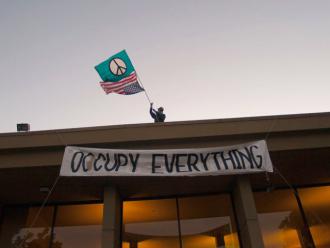
A banner proclaiming the slogan “Occupy Everything”–an idea which first made its appearance in 2009 at an occupation at UC Santa Cruz–was hung from the roof. A real estate sign claiming the space as available was painted over to say Occupied. Signs were hung up with slogans such as “Capitalism left this place to die. We’re here to bring it back to life,” and “This bank occupied our lives…Now, we occupy it!”

After a couple hours, police started to block traffic from passing in front of the occupied bank, and it became clear they were massing in the parking garage of the building. Reconnaissance by protesters revealed that police had set up a lookout post out in a second story office in the closed Wells Fargo Bank next door, from which they were spying on protesters and preparing to coordinate the coming assault.

The assault came rapidly and unexpectedly at 6:24 p.m. Occupiers were caught off guard as about 30 riot cops attempted to seize control of the entrance to the building and push back the protesters. Although the police succeeded in preventing the doors from being closed, barricades in front of the door stopped them from gaining entrance.

Although initially taken off guard, the crowd, which by now had swelled to about 150 people outside the building, with more than a dozen inside the bank, reformed itself and surrounded the cops. The front lines of the protesters outside linked arms and advanced on the police. After a 20-minute standoff, the riot police, outnumbered and outflanked, began to retreat and had to ask the crowd for permission to leave.

The mood among the crowd was a surge of exhilarating confidence. Facing a coordinated police assault, protesters had succeeded in turning back riot cops, and even forcing them to ask permission to leave.

In the aftermath of this victorious confrontation with the police, protesters worked on expanding the defenses of the occupied space. Rocks were spread out to make a police advance in formation more difficult. But attempts to reinforce the defenses within the building didn’t change people’s understanding that the number of people mobilized within and without would be the decisive factor in keeping the occupation going.

Around 8 p.m., a General Assembly of around 75 people convened. Several speakers eloquently expressed the power of the example this action could set for the Occupy movement, with one speaker saying “I want to be a part of history” and exhorting others to join in the process of moving the Occupation movement inside, into a bank, which presents the perfect target.

Around 50 people slept in the occupied bank overnight, expecting a second police assault to come at any moment. However, the demonstration by protesters outside earlier, and the political climate created by the widespread popularity of the movement around the country, apparently was sufficient to stop another attempt by police to break up the occupation. After a mostly sleepless night, the occupiers awoke to to the task of further publicizing the takeover and gathering more people to its defense.

– – – – – – – – – – – – – – – –

WHILE ACTIVISTS mobilized and did outreach to the campus and community, the local elite mobilized their own campaign through the media. Although coverage at the beginning of the occupation was comparatively objective, as the occupation continued, the local media, in particular the Santa Cruz Sentinel, were transformed itself into transmission belts for the intimidating threats of the Santa Cruz Police Department.

The police threats and statements were revealing. In response to concerns from other property owners with vacant property, Police Chief Kevin Vogel said on Friday morning, two days after the occupation began, “You can always count on police to kick people out.”

Early on Saturday morning, in an article in the Santa Cruz Sentinel, Vogel threatened protesters with the possibility of felony vandalism and even burglary charges. Deputy Chief Steve Clark said that among those inside, “Mothers are going to jail. Babies are going to Child Protective Services.”

The media campaign wasn’t limited to threats by police. One property manager, Darius Mohsenin, threatened a tenant supposedly involved in the occupation, declaring, “If he’s not going to respect the rights of this property owner, then I’m going to evict him.”

The occupation held strong over four days, functioning as a community center and a rallying point for the movement. However, as protesters faced a combination of physical exhaustion, escalating police threats and difficulty in mobilizing sufficient supporters to defend the building over a longer period of time, they decided on a tactical withdrawal. Demostrators cleaned and vacated the building on Saturday night.

Although the occupation has ended, the occupiers in a statement released Saturday night emphasized the gains the action has made and the tone it set for the movement:

Though our establishment in this physical space was unfortunately brief, our goals were in part successful: to show that through courage, determination and action, we the disenfranchised can seize our dreams. The case for community self-empowerment stands stronger than ever. For every occupation repressed, a dozen will rise in its wake. This is just a beginning

75 River Street Case Completely Tainted

Becky Johnson: One Woman Talking

April 6, 2012

Original Post


NOTE TO READER: Thanks to my friend, Bob Lamonica, for this letter that succinctly sums up the nature of this highly political prosecution of eleven local activists and alternative-media journalists. Bob opposed the occupation last November (I praised it) but he believes that DA Bob Lee is over-charging. — Becky Johnson, Ed.


FROM: SANTA CRUZ SENTINEL

MARCH 29, 2012

LETTERS TO THE EDITOR

Found Online Here.

75 River St. case completely tainted

I never agreed with the 75 River St. activity, but I will stand up for the indicted’s right to equal treatment before the law. The indictments are like losing something in the dark, but looking for it in the light where you can see.

Proximity has become cause for jail and shackling in Santa Cruz, as happened to Becky Johnson, who, by all accounts, wasn’t even in the building. If such consequences are justified, they should be applied equally to anyone in or near the building at the time in question.

Eleven out of hundreds present have been indicted, arguably for political reasons. Felony conspiracy to commit a crime. Misdemeanor trespass. Felony vandalism. Prosecuted as charged, they would be deprived the right to vote, even drive a car.

The entire case is tainted beyond recovery by law enforcement’s sloppy work. All charges against everyone must be dropped, in the name of prosecutorial misconduct.

Bob Lamonica, Santa Cruz

Stop the federal pot raids

Editorial

SF Chronicle, April 5, 2012

A months-long crackdown on medical marijuana by federal prosecutors has reached new heights with this week’s raids on Oakland dispensaries. It’s time to call off the overboard tactics and deal sensibly with regulating a drug that increasing numbers of Americans feel poses little harm.

The latest incident only furthers the tone-deaf image of the U.S. Department of Justice, whose agents stormed well-known medical pot dispensaries in Oakland, the de facto center of efforts to expand marijuana cultivation and use. Since last fall, federal officials have sent warning letters to landlords of outlets and served notice that Washington won’t tolerate medical marijuana sales.

It’s a ridiculous stance that mocks a serious issue. Last fall, federal prosecutors said the therapeutic use of pot had led to abuses, crime and profiteering. Spend 15 minutes outside a dispensary and it’s easy to see their point: a steady stream of customers who hardly resemble the sick and suffering intended to benefit under a “compassionate use” initiative passed by California voters in 1996.

But Prohibition Era-style sweeps won’t work. First, it’s a confusing message coming from the Obama administration, which telegraphed three years ago that a crackdown was a low priority. Since then, the policy has gone in the opposite direction: Stop all sales now.

Second, easing the availability of medical marijuana also has lowered the public’s fear factor of the drug. The result? Washington is losing all credibility by pursing efforts to shut down dispensaries. One of this week’s targets – the Oaksterdam University that teaches pot cultivation and legal rules – suggests that Department of Justice officials make no distinction among operators.

Finally, the federal raids ignore the core of the issue: bridging the gap between unbending federal controls and growing numbers of states, including California, that want updated consideration of the drug.

To be sure, court rulings and legal obstacles make change difficult. In California’s case, there needs to be more debate and study on clarifying a confused picture. The voter-passed initiative didn’t spell out rules on supplying marijuana to dispensaries, quality control, medical standards or financial operations, so there is plenty California can do to clean up its act.

Yet this confusion doesn’t excuse this week’s raids. This state has moved beyond a total ban on marijuana to a new phase: finding a workable way to allow the compassionate use of a drug. Washington should wake up to reality.

Man stabbed in Santa Cruz early Tuesday morning

Stephen Baxter – Santa Cruz Sentinel
Posted:   04/03/2012

SANTA CRUZ – A 43-year-old transient man was stabbed in the back during a fight with another transient early Tuesday morning.

Santa Cruz police spokesman Zach Friend said the victim was staying at an illegal campsite behind a building on the 500 block of Front Street.

Randolph Vaden Tolley, 44, went to the campsite and got into a fight with him about 4:30 a.m., Friend said. The victim grabbed a golf club and chased Tolley to Cathcart Street.

Tolley tackled him and stabbed him in the back, police said.

Police found the victim on his side with a stab wound. Tolley stood about 15 feet away holding a folding knife.

The victim was transported to an out-of-county trauma center. He was released from the hospital on Tuesday, according to police.

Tolley was arrested on suspicion of assault with a deadly weapon, Friend said. Tolley is being held in County Jail in lieu of $25,000 bail, according to jail records.

“Investigators are working to interview additional witnesses today to build a better picture of what occurred before the stabbing,” Friend said Tuesday.

Santa Cruz police ask anyone with information to call the anonymous tip line at 420-5995 or leave a tip at www.santacruzpolice.com or by the mobile application at http://m.santacruzpolice.com.

S.F. Occupy activists evicted from building

Ellen Huet and Erin Allday
SF Chronicle, April 3, 2012

Police on Monday evicted and arrested nearly 80 Occupy activists who had taken over an empty San Francisco building the night before and had stockpiled bricks and supplies with the apparent intention of staying long-term.

Officers in riot gear stormed the two-story building at 888 Turk St. at about 1:15 p.m. after tearing down a barricade protesters built to block the main entrance, said police spokesman Sgt. Michael Andraychak.

The building, which is owned by the Catholic Archdiocese of San Francisco, has been used as a music education facility by the archdiocese-associated nearby Sacred Heart Cathedral High School.

Occupy protester Beth Seligman said Monday morning that a few hundred people came into the building and stayed the night, but police said they believed that only about 80 people were inside Monday afternoon.

Activists said they chose to take over the building because they believed it has been vacant for five years and should be used as a center for health services and education instead of standing empty.

George Wesolek, a spokesman for the archdiocese, said the activists were wrong about the building’s vacant status. The building was used for regular music classes until as recently as 18 months ago, Wesolek said. The archdiocese was also considering leasing out the building and using the revenue to help with financial aid for low-income Sacred Heart students, he said.

“This is definitely not a vacant building,” Wesolek said. “It’s not forgotten. It has a purpose.”

Late Sunday night, the archdiocese signed a citizens’ arrest for the occupiers on charges of trespassing and graffiti. By Monday afternoon, police said it had become clear the protesters were planning to stay in the building for quite a while, Andraychak said.

Demonstrators had “stockpiled” bricks and cans of paint on the roof of the building, he said, and they blocked windows and doors with plywood and stacks of chairs.

After police broke through the main door, protesters fled deeper into the building, barricading doors and stairways along the way, Andraychak said. One man jumped from a second-floor window to avoid police, but was caught soon after, he said.

There were no injuries during the arrests, Andraychak said.

The interior of the building on Monday afternoon, after the protesters had been removed, was covered in spray-painted graffiti and posters and photographs from previous Occupy events. There were signs on the walls to designate sleeping areas, “media free zones” and smoking rooms.

Protesters left behind sleeping bags and backpacks, guitars and a tambourine. A half-eaten sandwich sat on a crate in one room, and in the kitchen were boxes full of fresh fruits and vegetables. In one large room on the second floor, a bowl of dog food sat next to an empty bottle of tequila.

“They had no intention of leaving,” Andraychak said.

Mayor Ed Lee, who has been criticized for being indecisive in his handling of the Occupy encampment at Justin Herman Plaza in late 2011, said before the arrests Monday that he was deferring to Police Chief Greg Suhr on plans to oust the protesters.

The mayor said he sympathized with the Occupy protesters’ concerns over vacant buildings, but suggested they compile a list of vacant properties and share it with city officials rather than going the attention-grabbing route and taking them over.

“Identifying a building is one thing,” Lee said. “When you occupy it and it’s not in a condition of livability, it could be a danger for everybody.

“I personally would love to see every vacancy in the whole city have some plan and activity going on in it,” Lee added. “I hate seeing vacancies in storefronts.”

High court upholds jailhouse strip searches

Associated Press
Santa Cruz Sentinel, April 3, 2012

(NOTE: The Sentinel published an edited version of this article. The following is the complete article.)

WASHINGTON (AP) – Jailers may perform invasive strip searches on people arrested even for minor offenses, an ideologically divided Supreme Court ruled Monday, the conservative majority declaring that security trumps privacy in an often dangerous environment.

In a 5-4 decision, the court ruled against a New Jersey man who was strip searched in two county jails following his arrest on a warrant for an unpaid fine that he had, in reality, paid.

The decision resolved a conflict among lower courts about how to balance security and privacy. Prior to the Sept. 11, 2001, terror attacks, lower courts generally prohibited routine strip searches for minor offenses. In recent years, however, courts have allowed jailers more discretion to maintain security, and the high court ruling ratified those decisions.

In this case, Albert Florence’s nightmare began when the sport utility vehicle driven by his pregnant wife was pulled over for speeding. He was a passenger; his 4-year-old son was in the backseat.

Justice Anthony Kennedy said the circumstances of the arrest were of little importance. Instead, Kennedy said, Florence’s entry into the general jail population gave guards the authorization to force him to strip naked and expose his mouth, nose, ears and genitals to a visual search in case he was hiding anything.

“Courts must defer to the judgment of correctional officials unless the record contains substantial evidence showing their policies are an unnecessary or unjustified response to problems of jail security,” Kennedy said.

In a dissenting opinion joined by the court’s liberals, Justice Stephen Breyer said strip searches improperly “subject those arrested for minor offenses to serious invasions of their personal privacy.” Breyer said jailers ought to have a reasonable suspicion someone may be hiding something before conducting a strip search.

Breyer said people like Florence “are often stopped and arrested unexpectedly. And they consequently will have had little opportunity to hide things in their body cavities.”

Florence made the same point in his arguments: He said he was headed to dinner at his mother-in-law’s house when he was stopped in March 2005. He also said that even if the warrant had been valid, failure to pay a fine is not a crime in New Jersey.

But Kennedy focused on the fact that Florence was held with other inmates in the general population. In concurring opinions, Chief Justice John Roberts and Justice Samuel Alito said the decision left open the possibility of an exception to the rule and might not apply to someone held apart from other inmates.

Kennedy gave three reasons to justify routine searches — detecting lice and contagious infections, looking for tattoos and other evidence of gang membership and preventing smuggling of drugs and weapons.

Kennedy also said people arrested for minor offenses can turn out to be “the most devious and dangerous criminals.” Oklahoma City bomber Timothy McVeigh initially was stopped by a state trooper who noticed McVeigh was driving without a license plate, Kennedy said.

In his dissent, Breyer said inmates in the two New Jersey jails already have to submit to pat-down searches, pass through metal detectors, shower with delousing agents and have their clothing searched.

Many jails, several states and associations of corrections officials say strip searches should be done only when there is reasonable suspicion, which could include arrest on drug charges or for violent crimes, Breyer said.

Susan Chana Lask, Florence’s lawyer, said, “The 5-4 decision was as close as we could get … in this political climate with recent law for indefinite detention of citizens without trial that shaves away our constitutional rights every day.”

The first strip search of Florence took place in the Burlington County Jail in southern New Jersey. Six days later, Florence had not received a hearing and remained in custody. Transferred to another county jail in Newark, he was strip-searched again.

The next day, a judge dismissed all charges. Florence’s lawsuit soon followed.

He still may pursue other claims, including that he never should have been arrested.

Florence, who is African-American, had been stopped several times before, and he carried a letter to the effect that the fine, for fleeing a traffic stop several years earlier, had been paid.

His protest was in vain, however, and the trooper handcuffed him and took him to jail. At the time, the State Police were operating under a court order, because of allegations of past racial discrimination, that provided federal monitors to assess stops of minority drivers. But the propriety of the stop is not at issue, and Florence is not alleging racial discrimination.

In 1979, the Supreme Court upheld a blanket policy of conducting body cavity searches of prisoners who had had contact with visitors on the basis that the interaction with outsiders created the possibility that some prisoners had obtained something they shouldn’t have.

For the next 30 or so years, appeals courts applying the high court ruling held uniformly that strip searches without suspicion violated the Constitution.

But since 2008 — in the first appellate rulings on the issue since the Sept. 11 attacks — appeals courts in Atlanta, Philadelphia and San Francisco have decided that a need by authorities to maintain security justified a wide-ranging search policy, no matter the reason for someone’s detention.

The high court upheld the ruling from the Philadelphia court, the 3rd U.S. Circuit Court of Appeals.

The case is Florence v. Board of Chosen Freeholders of County of Burlington, 10-945.

The Times They Are A’Changing

Spike Murphy; UCSC Student Guide Mar 29 (Spring), 2012

UCSC activism through the years

“There is a time when the operation of the machine becomes so odious, makes you so sick at heart, that you can’t take part; you’ve got to put your bodies upon the gears and upon the wheels, upon all the apparatus, and you’ve got to make it stop. And you’ve got to indicate to the people who run it, to the people who own it, that unless you’re free, the machine will be prevented from working at all!” – Mario Savio, political activist & key member of the Berkeley Free Speech Movement, Dec. 3, 1964

If anything captures the spirit and sentiment of the decades of activism at UCSC, it’s the above quote. For more than 40 years, members of the UCSC community, students, staff and faculty, have fought to make their University and Santa Cruz itself more equal and egalitarian, to forge a community that puts people above profits and encourages anything and everything that’s “outside-the-box. “ Let’s hop in the way-back machine and look at how UCSC was first transformed into a melting pot of ideas and cultures.

Like all good activism stories, it starts in the ‘60s. A few years after UCSC opened its doors in 1965, then-governor Ronald Reagan came for the Regents meeting. He was greeted by three days of protest with students and citizens from around the county in an uproar about, well, everything Reagan was doing. At the front of this movement was the Santa Cruz Black Liberation Front, demanding that College VII be named after El-Hajj Malik El-Shabazz (Malcom X) and that the College be a black college, not just in curriculum and focus, but in the makeup of everybody living, learning and working there.

Enter Herman Blake, at the time the sole black faculty member at UCSC and someone with a personal relationship with El-Shabazz. He pointed out that all kinds of people were being oppressed in California and convinced the SCBLF to endorse a plan to make College VII an Ethnic Studies college.

The first gay male teacher in the history of the nation came out at UCSC, as well as the first gay woman professor to come out.

The remainder of the sixties was relatively quiet, aside from a graduation ceremony being interrupted to give an honorary diploma to the imprisoned Black Panther leader Huey P. Newton; a little more than a decade later he would come to UCSC to get his PhD. The Academic Senate would also approve the Ethnic Studies program (though not the re-naming of College VII).

Then come the ‘70s and shit gets real. The U.S. invades Cambodia, and students across the country drop everything and rally against the national war machine. This is the beginning of an anti-war movement at UCSC that continues to this day. Highway 1 and 17 are shut down multiple times throughout the ‘70s by student protestors. After Nixon resumes bombing in Vietnam, thousands march on the county building and demand the Board of Supervisors sign a resolution disapproving of the war – which they do. We also see the first protests against the UC’s weapons labs at Lawrence Livermore and Los Alamos; these would continue for decades, with the protestors sometimes numbering as high as 10,000 people.

This is also the decade when UCSC entered the gay rights and women’s rights fight, and during the ‘70s, an explosion of gay rights groups and clubs start on campus. The first gay male teacher in the history of the nation came out at UCSC, Sociology professor Alan Sable, as well as the first gay woman professor to come out, Nancy Shaw; The Women’s Studies major is fought for and added to the curriculum, and the Santa Cruz Women’s Health Collective is formed on campus (this eventually becomes the Women’s Health Center downtown). In 1971, thanks to the thriving L

GBT movement at UCSC and the lowering of the voting age to 18 from 21, there’s a dramatic change in the political makeup of Santa Cruz. Santa Cruz has its first Pride Parade, and it becomes the first county to prohibit discrimination against employees on the basis of sexual orientation. When the anti-LGBT Briggs initiative is voted down in ’78, Santa Cruz has the highest percentage of “no” votes in the state. Sadly, only weeks later, San Francisco Supervisor and Gay Rights Superhero Harvey Milk is assassinated; 40,000 people, including many members of UCSC’s LGBT community, hold a vigil for him outside of San Francisco City Hall. When his murderer is let off with ‘voluntary manslaughter’ saying he ate too many Twinkies the night before (I wish I were kidding about that, I really do), UCSC students and even a professor join hundreds in SF in what will become known as the White Night Riots.

In 1976, the Third World and Native American Coalition forms, to unite students from various minority communities and advocate for their educational rights (TWANAC is now known as the Ethnic Student Organization Council). A year later, more than 1,000 students, organized by TWANAC and CAIR (Coalition Against Institutionalized Racism), occupy the central services (Hahn) building and demand that UC divest from South Africa, reject the Bakke decision outlawing Affirmative Action, support the Third World Teaching Resource Center and undo an increased SAT score requirement for admittance. The administration’s response was to acquiesce to their demands. Ha! Just kidding! Four hundred protesting students were arrested.

In 1980, UCSC fired Ed Castillo, the only instructor teaching Native American studies. Nearly 600 people from TWANAS and other groups marched on the Chancellor’s office and made five demands to be met in five days. When the administration issued an unsatisfactory response, 25 students from TWANAS volunteered to go on a hunger strike until their demands – aimed at creating and maintaining Native American and Third World studies at UCSC – were met. After five days, the university agreed to the students’ demands in writing. (Unfortunately, according to TWANAS, the administration failed to make good on what they’d agreed to.)

Meanwhile, gay rights and women’s rights would continue to advance steadily throughout the ‘80s. The county and the UC would continue to grant more rights for same-sex couples, and Santa Cruz would elect the first gay mayor in the country, UCSC Alum and eventual Santa Cruz AIDS Project founder John Laird. The number of LGBT groups on campus and in the city would continue to grow. The LGBT movement capped off the decade with the grand opening of the GLBN Community Resource Center in the Merrill recreation room.

The first Take Back the Night! March started at UCSC in response to a string of murders of female students by multiple serial killers, and the first Women’s Studies tenure track position was created at UCSC, as well as a feminist Studies grad program. Later that same year, women’s rights activists from the campus and all over the country staged major protests at the Miss California pageant that had been held in Santa Cruz since the 1920s. Former Sports Illustrated model Ann Simonton famously wore a dress made of meat while protesting the pageant, and the entire protest was documented in the film Miss . . . or Myth? The Miss California pageant would never return to Santa Cruz, moving to San Diego the next year.

During this whole time, the anti-nuke efforts at UCSC had been growing exponentially. Groups staged demonstrations on campus, rallied support and staged larger and larger protests at the UC weapon labs. In 1983, the UCSC Academic Senate voted overwhelmingly to sever ties with the UC’s nuclear weapons labs. At one point, 6,000 protestors encircled the Lawrence Livermore lab completely while holding hands, prompting the Department of Energy to buy a new 196-acre “buffer zone” around the property.

The ‘90s were a milder decade by comparison, with Highway 1 only being shut down once in protest of Desert Storm. After more than 25 years of students demanding it, Women’s Studies finally became a Department.

In 1990, the Coalition on Democratic Education took over McHenry Library and by doing so managed to get ethnic studies courses listed in the Schedule of Classes and the creation of a Dean of African-American Student Life position. Starting in the mid-‘90s, the Affirmative Action Coalition would work to keep Prop 209, which would end Affirmative Action in the UC system, from passing on the ballot, even at one point shutting down the campus with protestors for seven hours. Although their efforts would not defeat the proposition, they won an agreement from the Chancellor (after surrounding the Hahn building with protestors) for a seven-point plan to preserve the campus’ diversity in the wake of Prop 209.

In 1991, during holiday break, logging begins at Elfland, an Ohlone Indian sacred site on campus. A day-long student protest follows, but the area is logged and Colleges Nine and Ten are built nonetheless.

The early part of the decade sees multiple large anti-war protests take place on campus in response to the wars in Afghanistan and Iraq, with well over 1,000 people at many events. Anti-war coalitions form on campus and begin working on getting military recruiters OFF campus. One of the main organizations to come out of this period would be Students Against War (SAW) who would finally succeed, in 2006, in driving military recruiters off campus.

This period also marks the beginning of labor groups organizing the students on their behalf. Numerous days of action and protest on behalf of UC workers and employees dominated the last decade on campus, with numerous concessions made to UCSC workers.

During the mid- to late-2000s, student protests escalated. A striking example was when students protested a regents meeting on campus in the mid-2000s. This became the first time UC police pepper-sprayed students, with one student, a young black woman, suspended from the UC for three years; only through persistent protests over the next few months is she allowed to return. Then, the national media reveals that the Pentagon had been spying on UCSC activist groups, SAW in particular, with the help of the administration and members of local law enforcement. An international uproar follows – along with many student and community protests – and the Chancellor eventually convinces the Pentagon to take SAW off their credible threat list.

When the economy took a screaming nose-dive in 2008, tuition skyrocketed and the largest program and resource cuts yet would happen and are continuing. The language program was gutted; community studies was nearly obliterated and social sciences, the arts and humanities bore the brunt of the rest; 120 faculty positions were eliminated in 2008-2011 with an equal number of TAs axed; the Rape Prevention Education program is closed.

These massive cuts spark the beginning of the Occupy movement, one that would eventually spread in sentiment and execution across the country and around the world. Protests, hunger strikes and even a shutdown of campus all occur, as well as the pepper-spray and police brutality sent around the world by the international media (and thousands of cell phones).

Every step of progress, every right gained and equality recognized at UCSC came about because of the people, the community and organizations there; many of those organizations are still around, waiting for you to show up so that you can all take a brave stand and be heard again.

We can make this machine cease to function, shut it down, until they listen, until they have to listen. Neither violence nor diplomacy speak to the machine; in fact, violence feeds it. But when you stop the machine from working, when we use our bodies and our minds, our voices and our love to stop its gears and mechanisms, it will hear us. And we can say, in one voice as a community united by our differences: “Unless we’re free, the machine will be prevented from working at all!”

LA marijuana dispensary workers join labor union

Associated Press, 3-24-2012

LOS ANGELES — Marijuana dispensary workers in Los Angeles have joined a labor union to fight for their jobs in an industry that the federal government considers illegal.

Workers at 14 pot shops have formed the “medical cannabis and hemp division” of the United Food and Commercial Workers, Local 770. The 35,000-member union also represents grocery clerks, pharmacists and health care workers.

“This is the next step in professionalizing and stabilizing this new sector of the health care industry,” Local 770 President Rick Icaza said at a news conference Thursday. “This is a positive step towards successfully integrating compassionate care into our system of health care.”

Los Angeles currently caps the number of medical marijuana dispensaries, but the City Council is considering a full ban in light of a court decision that limits its ability to regulate them.

Icaza said the union would use its considerable political weight to pressure officials to find an alternative to a total ban.

That help will be welcome, said Yamileth Bolanos, president of the Greater Los Angeles Collectives Alliance, which represents dispensaries.

“It’s time to bring in some big guns,” she told the Los Angeles Times ( http://lat.ms/GQqPfS ). “Not only are they threatening access for patients, they’re also trying to take jobs away from our employees.”

Pot clinics flourished in California after voters in 1996 voted to permit people to cultivate and possess marijuana for what became nearly any medical reason. As hundreds of dispensaries opened, cities and counties struggled to interpret the state law, which was light on specifics.

Some communities sought to outlaw the pot clinics under existing zoning and other ordinances, while others tried to regulate them.

Court rulings have further muddied the waters. Last month, a state appellate court ruled that cities cannot use nuisance ordinances to ban medical marijuana dispensaries.

A Los Angeles-based appellate court last year struck down Long Beach’s attempt to license marijuana stores, ruling the local ordinance conflicted with federal law. And another appellate court upheld Riverside’s right to close and prohibit dispensaries despite the state’s medical marijuana law.

Early on in the Obama administration, the U.S. Justice Department said prosecutors wouldn’t focus on pot dispensaries that were following state medical marijuana laws even though the entire industry was considered illegal under federal statutes.

But that attitude has changed, with federal prosecutors arguing that many ostensibly nonprofit clinics are raking in money by supplying marijuana to people without a medical need.

Since last year, federal prosecutors have warned California clinics that they are illegal, filed criminal and civil charges against some owners, and threatened to seize properties that are leased to pot growers. About 140 dispensaries in more than 20 Southern California cities have been told to shut down since October when federal authorities began their statewide effort.

The crackdown hasn’t dissuaded some communities from welcoming pot shops. Earlier this month, Oakland officials granted approval for four new medical marijuana dispensaries in the city, bringing the total to eight. Officials said the four dispensaries would generate $1.7 million in annual tax revenue for the city.