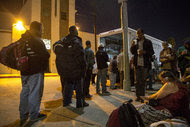
Tightening the Noose on Public Assembly: Santa Cruz City Council’s New Law 3 PM 11-26-13

New Public Assembly Restrictions Up For Initial Vote Tuesday 11-26 at City Council

by Robert Norse
Monday Nov 25th, 2013 10:47 PM

I’ve not had time to look at it carefully, but agenda item #12 rewrites the entire sections on public demonstrations for commercial and non-commercial events. The staff report can be found at http://sire.cityofsantacruz.com/sirepub/cache/2/gm3nxoa24g4uqu55k4gs1zrb/382360111252013053508496.PDF . I hope to take a longer look later, but the one thing I do notice is that the permit requirement has now tightened apparently so that 50 rather than 100 people require a permit. Additionally marching in the street is no longer provided for except through costly street closures, and permit now have to be applied for 5 days rather than 36 hours in advance. –Not that anyone seeks permits for Santa Cruz protests.

I encourage indybay readers to examine this ordinance themselves. Like the Sidewalk Shrinkage ordinance severely reducing space for public performance, political tabling, panhandling, vending, and art display, this ordinance has come with no advance notice and is likely to be rubberstamped at tomorrow’s afternoon session. For the texts of the old and new laws, go to http://sire.cityofsantacruz.com/sirepub/cache/2/gm3nxoa24g4uqu55k4gs1zrb/382360111252013053508496.PDF and look up agenda item #12.

If you value your right to publicly assemble and march in any cause, this ordinance should have a big red warning light attached to it, considering the make-up of the Council, the likely next mayor (Lynn Robinson), and the past record of this Council and the City Manager in cutting back public space, public assembly, and public accessibility.

It also may be overshadowed by the evening’s Water Solutions hearing and next City Council meeting’s Task Force Report consideration as well as the dreaded appointment of Lynn Robinson as Mayor.

The ordinance also needs to be contrasted with the Commercial Events permit.

The parallel with the recent ordinance changes throttling of street performance and art is instructive. The hypocrisy and special interest nature of the “display device” ordinance was obvious then and has become more obvious since. Obstructive commercial signs now litter the Pacific Avenue sidewalks in spite of the alleged “trip and fall” hazard. This “danger” as well as the Robinson-Comstock-Mathews “upscale aesthetics’ concerns prompted the banning of blankets on the sidewalk, the constriction of tabling, vending, and performance space, and the expansion of “forbidden zones” now encroaching on 95% of the sidewalks downtown for non-merchant activity.

But probably many have noticed that almost every performer, vendor, even political tabler down there is in violation of the letter of the law as passed on September 24th. Hosts and police have given out few if any citations. When I visited Pacific Avenue tonight there was a group of 12 traveling musicians and young folks sitting in a circle next to the Cafe Capesino kiosk playing music for donation, taking up 5 to 10 times the amount of allowed space (but, of course, blocking no one).

So may it be with this “Parade Permit” ordinance–last hauled out notoriously to ticket Whitney Wilde, Curtis Reliford, and Wes Modes for “walking in a parade without a permit” on a DIY New Years event 3-4 years ago. I have been in at least several dozen marches down Pacific Avenue in the last few decades, probably more, and none of them had a permit.

However mischievous laws in the hands of Mayor Robionson’s police instructed to be “tough” may take a different course. Police and politicians may move to punish those exercising the traditional freedoms Santa Cruz peaceful protesters have enjoyed.

The ordinance coming up tomorrow on the afternoon agenda empowers them to do so and makes spontaneous protest significantly more difficult.

by Robert Norse

Monday Nov 25th, 2013 10:49 PM

The item is on the afternoon agenda which begins at 3 PM. It is likely to come up between 3 and 4 PM.

Hope and Despair in Palo Alto

NOTES BY NORSE:  Activists are proceeding on several fronts to defend the rights of vehicularly housed folks up there.  Chuck Jagoda yesterday described on the stream of Free Radio Santa Cruz how Palo Alto activists invited and funded a Santa Barbara social worker involved in the government-run park-and-sleep program down there in hopes of replicating it in Palo Alto.  Attorneys, as can be seen from the press release below, are not waiting for the city to start ticketing homeless people peacefully and harmlessly sleeping in their vehicles, but have llaunched a pre-emptive strike with a demand letter to be followed by a letter.

Jagoda’s account is at
http://www.radiolibre.org/brb/brb131124.mp3.towards the end of the audio file.

Meanwhile Santa Cruz’s “Smear the Poor” Sentinel’s headlines for yesterday scream out the fraudulent “Task Force on Public Safety” pre-constructed agenda redefining homeless survival campers as public safety threats. (See http://www.santacruzsentinel.com/santacruz/ci_24587717/public-safety-task-force-armed-solutions-santa-cruz   ).  Strangely enough, the usually toxic stream of comments following the story has some defenders of basic human rights and common sense.  Jump on and provide your own perspective.


FOR IMMEDIATE RELEASE, NOVEMBER 17, 2013
COALITION OF PRO BONO LAWYERS TO FILE SUIT TO STOP PALO ALTO FROM
ARRESTING THE HOMELESS FOR LIVING IN VEHICLES: CALLS PALO ALTO LAW “INCREDIBLY HARSH.”

A group pro-bono lawyers from Palo Alto, California has notified the City of Palo Alto that they intend to file suit to prevent enforcement of a new ordinance that they say effectively bans all homeless people from within the city limits. According to the letter, sent by Palo Alto-based attorney Carrie LeRoy, along with co-counsel William Abrams and Paul Johnson, of the Silicon
Valley law firm of King & Spalding, and Stanford Law School professors Juliet Brodie and Michele Dauber, the law criminalizes the homeless in their daily lives and activities and is unconstitutional. The letter also contends that Palo Alto’s ordinance discriminates against the disabled homeless.
The lawyers represent several clients who stand to be arrested and imprisoned if the law goes into effect, according to Abrams. “James and Suzan Russaw are elderly grandparents who need to stay in the area to be near their granddaughter and grandchildren. Mr. Russaw is receiving regular kidney dialysis and needs to be able to drive to his medical appointments. Fred Smith is an elderly man and long-time resident of Palo Alto who, since he lost his job a few years ago, has been unable to afford conventional housing. Since Mr. Smith’s wife passed away and is buried in Palo Alto, where the two resided for most of their lives, he hopes that he will not be forced to leave the city. Mr Smith also needs to sleep in his vehicle rather than outdoors in order to avoid exacerbation of health issues. The Russaws and Mr. Smith are on every affordable housing and shelter bed waiting list in the area, but there is simply insufficient shelter in Palo Alto and Santa Clara County for Palo Alto’s vehicle dwellers.”
The lawyers are contesting the legality of Palo Alto’s Vehicle Habitation Ordinance, which was passed by the City Council on August 5, 2013. The ordinance is one of the broadest bans of its kind, banning all eating, sleeping, and resting in any car within the city limits. “This law is overly broad, and effectively means that the homeless who happen to rent or own a vehicle must leave Palo Alto or risk arrest. They cannot even stop here to eat a sandwich or read a book. This is needlessly draconian,” said Abrams, who noted that a violation of the law carries a possible fine of $1000 and six months in jail. “This is incredibly harsh,” he said.
The pro bono lawyers are working without pay in order to stop the law from being enforced.
“Our clients have done nothing wrong, are not criminals, and do not belong in jail,” said LeRoy. “They need housing, not criminal prosecution.” LeRoy was quick to point out that Palo Alto has no available shelter beds for the homeless. The local Opportunity Center which provides some housing for the homeless currently has a 20 year waiting list. “Santa Clara county in general and Palo Alto in particular have a dramatic shortage of available housing,” according to LeRoy. “It is the height of cruelty to tell people that it is criminal to sleep in your car, but that we have nowhere else for you to go within the entire county.”
The city has also banned overnight use of all city and public parks and facilities. “Palo Alto has been uniquely inhospitable to the homeless and poor,” noted LeRoy.

According to the city, the VHO was passed in order to prevent the homeless from congregating at Cubberley Community Center, a city recreational facility. However, according to LeRoy, there was no need to ban vehicle dwelling everywhere and at anytime in the city. “What about commercial and industrial areas as is permitted in Menlo Park and Mountain View? What is the basis for banning sleeping in areas where there are no homes, parks, or other people at night?” For LeRoy, who grew up in Palo Alto, the question is about the character and values of the city itself. “To me, the question is what kind of town do we want to be? I grew up in this city and have always thought of it as a compassionate, creative, resourceful and inclusive one. It would be one thing for the city to ban vehicle dwelling where it could point to readily-available, conventional housing alternatives. It is wrong, offensive and contrary to the spirit and values of Palo Alto to pass a law that, if enforced, will serve only to punish and injure Palo Alto’s poorest and most vulnerable residents—that is the criminalization of poverty.”

Attachments: Letter to Palo Alto City Attorney Molly Stump; City Staff Report 8-5-13 (Excerpt)
Contact:

William F. Abrams (650) 590-0703  BAbrams@KSlaw.com
Carrie LeRoy, (650) 470-3144 carrie.leroy@skadden.com

Palo Alto Homeless Update - Despondent Husband Found Dead At Don Barr's $25 million dollar Homeless Asylum

---------------------------------------------------- Decaying body found at shelter by Angela Ruggiero, Palo Alto Daily Post Staff Writer Mon Nov 25 2013 The decomposed body of a man who lived at a Palo Alto homeless center was found in his room, and may have been there for weeks. Lonnie Gullett, 63, was a resident of the Opportunity Center at 33 Encina Ave., where homeless people are provided rooms and services.  The Santa Clara County Medical Examiner-Coroner was called at noon Friday for his body.  The office said his death appears to be from natural causes. Friend and neighbor Lorin Krogh said he had not seen Gullette for several weeks and believes he was dead in his room for a long time. Mila Zelkha, director of strategic relations for the InnVision Shelter Network, which runs the Opportunity Center, said that employees had noticed Gullette had not been around for some time.  Employees decided to check his room on Friday, and found his body. Krogh said that Gullette had been through some bad luck recently after his longtime girlfriend Vivian “Venus” Sarmago, was attacked.  She had been beaten at the center and suffered a traumatic brain injury that nearly killed her.  Michael Rowe Guilford, 46, of San Jose, was arrested in connection with the attack on suspicion of battery and being drunk in public. Gullette spoke to the Post at the time, and said that at first, Venus seemed OK, but was later in a coma after she wouldn't wake up one day.  She was  left Stanford Hospital paralyzed and is currently in a nursing home. Victim once owned his own business Krogh told the Post yesterday that he had known Gullette for at least 10 years.  Gullette had hired Krogh to work with him on a street team to help get homeless people off the street.  Before, Gullette had been a general contractor and owned his own business in Sacramento for 15 years.  After being hospitalized he became seriously ill, and went on disability. “He was a really good guy,” Krough said. “and he was really bummed out about Venus.” Krogh said Gullette had told him “I don't know what to do,” after Venus was left in a vegetative state. Chronic health problems Krogh said that he and Gullette used to drink together years ago, before they turned sober.  Gullette had chronic health problems and used a wheelchair and Krogh said he thinks the cause of his death was natural. Gullette made Post headlines on April 4 when he fell down the embankment of San Fransquito Creek.  Gullette, who used a wheelchair to go long distances,, was able to stand.  He said he had gotten up to relieve himself, but lost his balance and tumbled 39 feet down the side of the creek bed.  Firefighters had to lift him out of the creek, but he was not badly injured. As the firemen began to pack up and leave the creek that day, Gullette pointed to the crown of first responders and said, “That's your tax dollars at work.  Those guys don't get paid enough.” 

Palo Alto: Opposition Produces Results–Legal Fightback against Anti-Homeless Bigotry

NOTES BY NORSE:  Attorneys in Palo Alto previously stepped up to the microphone when the ban was being debated several months ago and warned the city they would take every case, challenge every arrest, and fight the ban.   Since then, activists in Santa Cruz and Palo Alto have urged attorneys to preemptively seek an injunction and not wait until police actually wrote tickets.

The suit is gratifying news to those interested in an immediate and pre-emptive strike to stop the further criminalization of the homeless.  No evidence was presented of car-camper problems except in one area (the Cubberly Community Center) where the city had failed to provide adequate oversight and there the problems were hugely inflated by NIMBY community members concerned with disappearing homeless people from their neighborhood as an aesthetic problem and “perceptual” threat (i.e. no indication of serious crimes but a fear of such).The arguments used supporting the Ban are similar to those used in Santa Cruz before the rise of the “homeless are criminals and a Public Safety menace” Big Lie.  “Why don’t those who support homeless rights, simply provide private space for them?”
“The homeless aren’t parking in front of their homes!”  “Banning the right to sleep is perfectly legal.”   “City Council knows best.”  etc.

Palo Alto activists, lawyers, and attorneys, however, are fighting back unlike Santa Cruz–which sinks more deeply into paranoia, repression, and bigotry.  See the infamous Task Farce for Public Hysteria (aka the Task Force on Public Safety)’s proposed recommendations at http://www.cityofsantacruz.com/index.aspx?page=1924 ).

Mon, Nov 18, 2013, 4:39 pm

Suit threatened over city’s car-camping ban

Coalition of pro bono attorneys argues that Palo Alto’s new ordinance is cruel, unconstitutional

by Gennady Sheyner / Palo Alto Weekly

A group of Palo Alto attorneys is threatening to sue the city over a recently adopted ban on vehicle habitation, a law that they claim effectively criminalizes homelessness and that is far more draconian than car-dwelling restrictions in other jurisdiction. The coalition, led by local attorney Carrie LeRoy, is working pro bono and is representing several homeless residents who will lose the right to live in their cars when the car ban takes effect on Jan. 6. The plaintiffs include James and Suzan Russaw, a couple who the attorneys say wish to stay in the area to be close to their grandchildren. James Russaw, 84, is also receiving regular kidney dialysis and needs to be able to get to his medical appointments, the attorneys said in a letter to City Attorney Molly Stump.

[The text of the letter can be found at http://www.paloaltoonline.com/media/reports/1384880185.pdf ]

Fred Smith, a homeless man who had spoken publicly against the ban, is also a client. At the Aug. 5 meeting, shortly before the council voted 7-2 – with Karen Holman and Marc Berman dissenting – to approve the ban, Smith urged the council to reconsider.
“I recently lost my job, my wife and my house. I now live in an RV in a commercial zone. Please don’t criminalize me,” Smith said, drawing an applause.

LeRoy said in an interview Monday that the list of people represented by the group may further expand as she and her colleagues in the effort proceed with their legal opposition to the ban. Other attorneys involved in challenging the ban are William Abrams and Paul Johnson, both of the firm King & Spalding, Stanford University professors Juliet Brodie and Michele Dauber, Menlo Park-based attorney Jeff Koppelmaa, criminal attorney William Safford and Nick Selby. The group contends that the city’s new ban is far too broad and that staff has misrepresented other cities’ ordinances to the City Council before the vote.
“There were an number of attorneys who expressed real concerns and had deep reservations over whether this was actually a

constitutional ordinance,” LaRoy said.

Abrams, a partner at King & Spalding with a long history of pro bono work and high-profile cases involving civil rights intellectual property, called Palo Alto’s new ordinance “overbroad.” The effect of the law, he said, will be to force homeless individuals who own or lease vehicles to leave Palo Alto or risk arrest. It will target the city’s “invisible” population, he said, people who don’t have any other options for shelter.

In their letter, the attorneys request a meeting with Stump by Dec. 5. Unless the request is met, the letter states, “We will proceed with filing a complaint in court against Defendants on behalf of the Plaintiffs.” The defendants in this case would be the City of Palo Alto, the Palo Alto Police Department and Police Chief Dennis Burns.

The attorneys are challenging an ordinance that the council adopted on Aug. 5 after nearly two years of community meetings, outreach efforts and persistent criticism from the homeless community. The ordinance makes it illegal for individuals to use “a vehicle for a dwelling place” (it makes exception for mobile-home parks and for guests of city residents). The council adopted it largely in response to a growing encampment of homeless residents at the Cubberley Community Center and the resulting increase of police complaints about what city officials dubbed a “de facto homeless shelter.”

According to police data, the number of complaints about Cubberley dwellers had risen from 10 in 2010, to 16 in 2011 and to 39 in 2012. An August staff report noted that in some cases, vehicle dwelling has resulted in “nuisances or more serious disturbance to residents and businesses.” The passed ordinance states that vehicle habitation causes the city to “incur increased costs for policing, maintenance, sanitation, garbage removal and animal control” and that it “creates a risk to the health, safety, and welfare of those persons in the vehicles, as well as the public at large.”

Abrams rejected this argument. The city, he said, already has plenty of ordinances in places for addressing incidents in which people disturb the peace, engage in violent conduct or engage in public drug or alcohol use.

“This is directed toward getting rid of homeless people in Palo Alto,” Abrams told the Weekly.

At the Aug. 5 meeting, Stump told the council that violation of the car-dwelling ordinance would in most cases result in an infraction, though it could be turned into a misdemeanor at the city attorney’s discretion. Staff noted that enforcement would be largely based on complaints. The most severe penalty would be a fine of $1,000, Stump told the council.

Critics contend that this proposed punishment is not only draconian but illegal. In her letter, LeRoy argues that the new ordinance will “cause the poorest and most vulnerable among us to lose the only protection that they have from exposure to the elements and to ensure some measure of personal safety.”

“It cannot be disputed that sleeping in a vehicle affords better protection for homeless persons’ health and safety than living or sleeping outdoors on streets, sidewalks, benches, or the ground,” LeRoy wrote. “Enforcement of VHO (vehicle habitation ordinance) will exacerbate serious health issues and disabilities prevalent among Plaintiffs, who will be forced out of their vehicles or Palo Alto altogether to avoid criminal liability.”

In recommending the vehicle-ban ordinance, staff from the planning department from the city attorneys office cited similar bans in other neighboring jurisdictions and noted that 92 percent of the cities in Santa Clara County (all except Monte Serreno) have restrictions of some sort in place. In San Mateo County, all cities except for Colma, East Palo Alto and Portola Valley regulate vehicle habitation, a report from city staff states. Not having such an ordinance makes Palo Alto a “magnet” for vehicle dwellers, proponents of the ban argued.

Before voting for the ordinance on Aug. 5, Councilman Larry Klein talked about the city’s “obligation to protect our neighborhoods.” He told his colleagues that he had seen dozens of homeless campers during two recent tours of Cubberley.
“The dramatic increase in homeless in Cubberley sleeping in their vehicles shows that we have inadvertently become a magnet,” Klein said. “That has to come to an end.”

The attorneys contend that this argument — other cities have such ordinances and so should Palo Alto – is a misrepresentation. While most cities do indeed have restrictions, Palo Alto’s new law is both broader and more punitive than those elsewhere, LeRoy said. In Mountain View and Menlo Park, for instance, vehicle bans are limited to residential areas (in Menlo Park, this includes 300 feet within a residential zone). In Los Altos, it is illegal to “stop, stand or park a vehicle” for longer than 30 minutes between 2 and 6 a.m., when a notice is posted on the block. Palo Alto’s law, meanwhile, applies to all streets, all the time.
Furthermore, punishment for violating this ordinance in other cities is a parking citation. In Palo Alto, it could potentially be incarceration, LeRoy said. The difference between a parking ticket and possible jail time, is huge, she said. Palo Alto’s ordinance, she argued, effectively makes homelessness a crime.

“Cities across our nation have come up with restrictions that may be directed at homeless residents, but include exceptions so as to avoid punishing homeless residents for involuntary acts necessary to human survival, such as the acts of resting or sleeping,” her letter stated. “The VHO, on the other hand, is one of the most punitive ordinances in the area and it has the effect of criminalizing the status of homelessness.”

In addition to the vehicle-habitation ordinance, the council adopted a separate law on Aug. 19, mandating that all community centers, including Cubberley, be closed between 10:30 p.m. and sunrise.

LeRoy noted in an interview that the council’s ban on overnight parking at Cubberley and other community centers already addressed the major problem that the city was trying to solve in banning vehicle habitation. Given the new restriction on community-center hours, the broader ban on vehicle dwelling wasn’t tailored to address any legitimate concerns, she said.
“If vehicle dwellers can’t be here at night during normal sleeping hours, do you still need to ban vehicle habitation throughout the city?” she asked.

She contended that if the City Council knew that the proposed ordinance goes far beyond those of neighboring cities, it may have been less likely to support the proposed vehicle-habitation ban. She couldn’t say Monday what an acceptable alternative ordinance would be, noting that this might be the subject of settlement discussions.

“I think the effort now is to repeal the vehicle ordinance,” LeRoy said.

Though Stump said on Aug. 5 that violations would only be prosecuted as misdemeanors as a “last resort,” Abrams said the assurance is insufficient. The attorneys may be open at a future date to discuss alternative ordinances, but that’s a “different conversation.” The goal now is to get the recently passed ordinance off the books.

“Now, we have an ordinance that is illegal, that is unconstitutional and that needs to be stricken down,” Abrams said.


Many Posted Comments at http://www.paloaltoonline.com/news/2013/11/18/suit-threatened-over-citys-car-camping-ban


A sample:

Posted by Phil, a resident of Downtown North on Nov 18, 2013 at 5:10 pm
No worries. Law suit away if you’d like. San Francisco, Berkeley, and Santa Cruz are three of the most open and liberal cities in the country. They have all have overnight camping/parking bans which have all been tested and successfully defended in a civil court. Like I said, no worries. It also leaves me to think how quick one of these attorneys crying foul would be the first to call the police if someone was sleeping in a car in front of their house every night. A perfect example of compassionate and open when convenient. If they’re that concerned, then these attorneys and advocates should open up their personal driveways and homes to give these folks somewhere to sleep.

Posted by boscoli, a resident of Old Palo Alto 22 hours ago
They way I see it, as long as financial institutions are still allowed to sell and trade junk mortgages, as long as not one Wall Street conman has gone to prison, car-camping should not be criminalized. Once the big criminals are punished, I’d be willing to deal with car-camping. Speaking of double standards, how interesting that the already existing leaf-blower ban ordinance isn’t enforced, unrelated of course to the pressure by the manufacturers and landscape contractors, who promised demonstrations and hunger strikes in front of city hall if the ordinance is enforced.
Posted by Very Simple, a resident of Midtown 22 hours ago
If all of these attorneys and others are so concerned, they can open up their own personal property and have the homeless live there. We don’t have that many homeless in Palo Alto that they couldn’t all be accommodated in this easily by a small subset of ban opponents. That’s what real generosity is– giving of yourself to the less fortunate. Not morally preening and harassing the overwhelming majority of residents who don’t want our city turned into an open-air homeless encampment, don’t want the “San Franciscoization” of Palo Alto and are concerned about the safety of say, their kids (as mine do) going to preschool right next to a site of a homeless encampment.
Posted by Retired Teacher, a resident of Duveneck/St. Francis 20 hours ago
I applaud Carrie Leroy and her coalition for challenging this ordinance. This incredibly well-off community with its sky-high home prices and outrageous rents should find ways to help people on the margins, not threaten them with fines and jail. Many of the so-called affordable housing projects are well out of the reach of the homeless–we need more places like 801 Alma. Meanwhile, we should find more humane ways to manage the problems that do often accompany homelessness.
The suggestion that anyone who is concerned about the homeless should take them into their own homes or let them camp out in front of their homes is clearly an attempt to confuse the issue. Taking care of the less fortunate is not just the job for a few concerned people. It’s the responsibility of our entire society, and right now, we’re doing a lousy job of it.
Posted by Enough!, a resident of Greenmeadow 19 hours ago
I’ve had people living in front of my house. It was especially unsettling when my daughter was 2 years old and I couldn’t let her play outside and had to keep the drapes closed because the guy would watch us. More unsettling when we would jugs of undefined liquid on the ground, some knocked over, between his vehicle and the curb. Totally unsettling when we came home once to find the guy having a seizure on our front door steps, with paramedics attending. Disgusting when I had to go out and clean up after both the medics and the homeless person, gloves, needles and booze bottles.
I wouldn’t object if an area with a sort of rest stop with shower and toilets and cameras were to be established.
Meanwhile, the attorney’s who brought the suit are welcome to offer their driveways to anybody they please!
Posted by Concerned Retiree, a resident of Midtown 18 hours ago
Homeless means that these people do not have a home, place to live. Therefore, they are NOT “residents” of Palo Alto and are not entitled to the same rights residents are. They are also not entitled to be a nuisance or a danger to said residents. If these lawyers bringing the suit feel so strongly about the plight of the homeless, they should work with non-profits — the churches for example — which pay no taxes because of their supposed public benefits and services and get them to cooperate in finding a solution.  I do not want a homeless family or persons living on my street and I am glad that the City Council has finally done something to see that this does not happen.
Posted by Elizabeth, a resident of Midtown 18 hours ago
Palo Alto is generally a well-educated community, however there seems to be a significant lack of compassion in evidence. Perhaps it’s time to offer some free classes (open to all ages) on the subject.
All of those who think this ban is fair and wise really need to open their hearts. Sending a check off to some distant place to help others doesn’t buy you freedom from concern for those closer to home.
Get a heart!

Posted by JoAnn, a resident of Ventura 17 hours ago
Another basic human need is elimination. If porta potties were installed in a few commercial (non-residential) areas, the cars would go there. I agree it doesn’t solve the drug/alcohol problems though. A lot of these people were Palo Alto residents until skunked out of their homes by the banksters or just going broke due to divorce, layoffs, etc. They shouldn’t have to skulk away from their home town, too. What I hear about shelters is they are dangerous and people get robbed there. Would all night security help? It might be cheaper to fund. Of course, those with cars would still need a place to park them. I don’t see that the RV’s parked along Park Blvd. hurt anyone. I’ve ridden my scooter there many times and never seen an actual person, nor jugs of urine left at the curb.
Posted by Sensible, a resident of Crescent Park 17 hours ago
A real issue is simply taking a persons shelter, in this case a car, and depriving them of no other option for freedom from harm. If a city blankets a wholesale requirement then it should be at the forefront to provide an equal and opposite opportunity to balance the deprivation of a constitutional right. Even in a government shutdown when employees are deprived of their right to work and pay, they are latter paid what they are entitled to. Now I know that is a horrible example of entitlement for many who don’t like that sort of thing, but this is one of the reasons people all over the world come to enjoy the rights Americans still have…

Four Tales of Terror from the Central Valley: Fresno & Visalia Cry Out

NOTES BY NORSE:  The same cold-blooded methodical destruction of homeless survival camps is happening in Santa Cruz, night after night, week after week, month after month.

With no expansion in shelter services (less than 5% of the population is housed–even in the cramped and wretched gone-by-dawn Armory and over-booked Paul Lee Loft), stepped up ticketing, increased fines, and expanded punitive legislation are on the agenda for Santa Cruz’s Bryant-Robinson City Council as the winter closes in.A sinister co-ordination of repression long urged by NIMBY and merchant groups is targeting homeless recycling (“scavenging”), homeless vending, busqueing, and art display (shrunken sidewalk spaces available, increased patrols), stepped up Drug War policing (and an end to the City’s needle exchange, tightening of anti-marijuana policies), & quiet pressure on church food providers to relocate indoors and out of sight.

NOVEMBER 19, 2013

What Happened To The People Displaced By Fresno’s Homeless Camp Destructions?

By

Credit Rebecca Plevin / Valley Public Radio
Nancy Holmes, left, and Sinamon Blake, right, were evicted from their homeless encampment in October.

For almost a year, Nancy Holmes and Sinamon Blake were neighbors in a homeless encampment in downtown Fresno.

But city employees bulldozed their camp a few weeks ago, in an effort to rid the city of illegal structures. The two friends, and the other residents of their camp, scattered. Nancy and Sinamon ended up on a huge, dusty piece of land outside the city’s jurisdiction.

“I didn’t care for the path that Sinamon found us, but damn, we were safe,” says Nancy, 61, a borderline diabetic with asthma.
She lasted there for about two weeks.

“You blow your nose in the morning, and you have a mud pile,” she recalls.

Since then, Nancy and Sinamon have taken separate paths toward survival. Their current living situations shine a light on the housing options available to Fresno’s homeless, now that the city is cracking down on encampments.

I met Nancy last week at a house on Dakota Avenue, where she’s lived for about a week now. The Dakota Eco Garden, as it’s known, is the brainchild of local homeless advocates.

Currently, two people live inside the home, and one is in her tent on a raised platform in the backyard. A fourth is in a small, eco structure designed by architect Art Dyson that generates its own heat and air conditioning. The backyard has a huge fruit and vegetable garden.

“I have high hopes for the people who live here, eating a lot of the food from the garden and lowering their food costs,” says homeless activist Nancy Waidtlow.

After living in a tent for almost a year, Nancy Holmes says she feels saved.

“It’s between heaven and hell. Hell is out there in the dirt” – Nancy Holmes

“I can take a shower, wash my clothes, eat food, any put my food in the fridge,” she says. “It’s between heaven and hell… Hell is out there in the dirt.”

For the first time in years, Nancy finally feels like she’s back on solid ground.

“I guess you can say living in a motel you’re homeless, but we had showers, we had a stove to cook on, things like that,” she says.

Before she landed on the streets, Nancy moved from motel to motel with her daughter and grandson.=

“My daughter is a prostitute. I had food stamps, she would pay the rent and I would buy the food,” she says.

Years ago, she says, she cooked at area restaurants and hotels, and then worked as a security guard at the Fresno Art Museum.

She hasn’t worked since 2006, when she lost her security job, and later had two heart attacks.

Today, she says she’s found a new calling. I ask her if she still considers herself homeless.

“No, I consider myself a homeless advocate now, someone that’s there to help,” she says.

She pauses, and a smile comes over her face. We’re sitting on lawn chairs, and she points toward a flower garden.

“How sweet, a hummingbird!” she exclaims. “Sinamon would love that.”

The next day, I join Nancy and two homeless advocates to visit Sinamon. The dusty field is a stark contrast to the Eco Garden. It doesn’t look like a hummingbird – or a human – could survive here.

Soon, Nancy spots the make-shift structure that she shared with Sinamon and her dogs. Sinamon had been in the nearby canal, and was soaking wet. She met us at her camp, a sprawling structure that’s ingenuously made from tarps and other found items. She’s built a living room, kitchen and bedroom.

“We’re out of view of the public, which is what the City seems to be pushing so hard” – Sinamon Blake

“We’re out of view of the freeway, and far away from the street,” she says. “We’re out of view of the public, which is what the City seems to be pushing so hard, that they don’t want to see us.”

The location is remote, but it has a huge asset: Running water. Sinamon led us down to the canal. Then she waded in to scrub the dust off the fur of her biggest dog, Sheba.

“Even if there were nicer places that had grass, or had other things going for it, I would pick this, because running water is life,” Sinamon says.

Sinamon says she’s been homeless most of her life. She grew up relying on welfare, school lunches, and free snacks from rec centers.

She has, she says, “a lot of memories of blanketless or sheetless beds, a mattress in the corner of the room, and about 8 or 12 kids sleeping and sharing that bed.”

Why, then, I ask her, didn’t she want to move into the Eco Home with Nancy? One reason, she says, is she couldn’t take all of her dogs, who she loves like daughters. She says she values freedom for herself, and her dogs.

“I didn’t raise them like that, to sit in the corner, and wait to fetch,” she says. “I taught them to roam around, keep an eye on things, and run and be alive. She doesn’t have the space for that.”

To an outsider, it might be tough to see Sinamon living alone like this. But she says she’s less likely to get raped, robbed or jumped here, than in other areas where the homeless stay.

“It’s safer out there than it is to sleep in the doorway of a business downtown, or anywhere in town, actually,” she says. “It’s safer here than it is to sleep at Roeding Park, or Woodward Park, or Kearney Park, or any of the missions.”

As we say goodbye, Nancy, Sinamon and the homeless advocates point out to me the taller buildings of downtown Fresno. They can make out the women’s old encampment. It was a reminder that these women’s homeless journeys could be long from over.

Wed October 23, 2013

Fourth Fresno Homeless Camp, Considered A ‘Neighborhood’ By Residents, Is Razed

By

Credit Rebecca Plevin / Valley Public Radio
Homeless advocates were prepared to resist the destruction of the encampment.

Cinnamon has lived in a make-shift structure near the grain silos, west of Palm Avenue and H Street, for more than two years.

She says the homeless encampment there is different from others that have cropped up in downtown Fresno.

“We’re not a camp, we’re a neighborhood, a family,” she said. “We all look out for each other.”

The encampment has rules. For example, the residents decide – together – if a new person could move in.

“We’re not supposed to do anything that intrudes on your neighbor,” she said. “We’re not supposed to take from your neighbor.

When it comes to anything that affects each other, we’re all supposed to agree on it.”

This morning, Cinnamon and other residents agreed on something else: Despite the city’s order to clear the homeless encampment, they didn’t want to leave. They also didn’t have a choice.

Over the last two months, City of Fresno employees have dismantled three homeless encampments in downtown Fresno. This would be the fourth to go.

Tears streamed down Cinnamon’s face as she wondered aloud how she’d pack up all her belongings, or where she’d go. A friend handed her a mug of coffee that had been cooked over a small fire.

“They call us homeless – it’s true, we have less of a home, by their standards – but this is a home” – Cinnamon

“It’s not a clean-up, it’s a lock out,” she said. “They call us homeless – it’s true, we have less of a home, by their standards, but this is a home, this is where I rest my head, this is where I kept my food, this is where I was safe, and I had a sanctuary, at least for a moment.”

Across the railroad tracks, city workers began bulldozing the remnants of a nearby encampment.

“We’ve certainly done enough of these now,” said city spokesman Michael Lukens. “We are doing it by the book, we are doing it the way we are supposed to. We’re going in, we’re packing belongings, if people want to keep them, we’re going to document them, we’re storing them as we’re required to do, we’re trying to do everything we can to work with these folks, and we need to take the illegal structures down.”

He stressed that the goal of this clean-up, and past ones, is to rid the city of camp structures, which are considered to be public health and safety threats.

“We’re aware that people will still be on the streets, and there’s not enough housing, we just want to make sure these structures don’t come back up,” he said.

“We’re aware that people will still be on the streets, and there’s not enough housing, we just want to make sure these structures don’t come back up” – Michael Lukens

About a dozen homeless advocates were prepared to resist the destruction of the camp where Cinnamon lived, including Dixie Salazar.

“It was the last encampment, the last stand, and we were willing to stand between the bulldozers, if they were coming,” she said.

But by mid-morning, it looked as though the act of civil disobedience might not be necessary. Camp residents were generally complying with orders to pack up their belongings.

“I was ready to get arrested, if that’s what it took to try to keep them from harming these people,” she said. “The people have been harmed by these clean-ups, or destructions – that’s what they are.”

Nancy Holmes fears the harm she could face once she’s back on the streets – wherever she ends up. She’s lived in the camp for eight months, and says her neighbors protect her.

“I spent a couple nights in Roeding Park, and that was the most frightened I’ve ever been,” Holmes said. “I’ve had the safety of my neighbors, and now we don’t, so I don’t know what’s going to happen.”

City spokesman Mike Lukens expects this to be the last encampment that workers dismantle. In an e-mail, he said a city taskforce is working to ensure illegal structures don’t return. The taskforce will strive to discover and deal with the structures

before they become full-blown encampments, he said.

Tue September 10, 2013

As Homeless Camps Are Dismantled, Street Pastor Soldiers On

By

Credit Rebecca Plevin / Valley Public Radio
Pastor Ray Polk provides support through his homeless ministry.

On Monday morning, Pastor Ray Polk comforted a man who was packing up everything he owned.

“You alright?” Polk asked. As the man expressed his pain and frustration, Polk replied, “I know, I know, I know, we got to keep going forward.”

Along H Street in Downtown Fresno, the homeless were stuffing their possessions into plastic bags and shopping carts, as city workers bulldozed and raked the debris left behind.

Yesterday, City of Fresno workers dismantled the third homeless encampment in three weeks. Overall, the effort has displaced a total of about 250 people.

It’s part of the city’s efforts to rid Fresno of permanent homeless camps, which officials say are a health and safety threat. They say the goal is to connect people with housing and services.

But Polk said he wouldn’t take down the street church he constructed in the camp.

“They told me I would have to dismantle it myself and if not, they will bulldoze it down,” he said. “So I told them I couldn’t do that, I couldn’t defy God like that, and tear down something that God had me put up.”

The church is made of white slats of wood. Polk has covered them in proverbs and Bible verses. It’s covered with a blue tarp, and contains about 10 white, plastic chairs.

“I would not upon any circumstances take that down” – Pastor Ray Polk

“They make the decision,” he said of city officials. “I would not upon any circumstances take that down.”

He also ran a food distribution from the church. Next to it, he constructed a memorial to the homeless who have died. There are flowers next to each makeshift headstone.

“I figure, I’d take a piece of wood, paint it white, put their names on it, at least they can come and pay tribute to a friend or loved one, even if it’s just once a year on Memorial Day,” he said.

On Monday afternoon, city spokesman Michael Lukens said the memorial could remain, but that the church would be put into storage.

It’s not the first time that Polk, and the homeless he serves, have been displaced. But this time, Lukens says, they city has formed a task force to ensure that the camps don’t re-emerge.

“We’re making every effort, certainly more than we have in the past, to make sure we’re on top of making sure structures don’t come back up and encampments don’t return,” Lukens says.

He says the city is working with local agencies, like the Housing Authority, to find people housing.

But 28-year-old Lena Richardson has no idea where she’ll live now. She had lived in the camp for six months. Yesterday, she stood on the side of the road with her dog, Princess.

A shopping cart contained her belongings:  “My tent, my blankets, my batteries, my solar panels so I can have electricity, that’s about it.”

She said she felt puzzled, confused, and sick.

“What if they woke up the next day and they don’t know where they’re going?” – Lena Richardson

“What if they woke up the next day and then don’t know where they’re going?” she asked. “That’s depressing.”
That’s where Pastor Polk comes in. He says he’ll still be there to provide spiritual support to the homeless.

His role he said, is “comforting my brothers and sisters, hugging and embracing them while they cry, and try to uplift their spirits

like I always have done, and try to continue to give hope where hopelessness has filled.”

Lukens says the city might demolish one more camp in the next 30 days.

Tue October 22, 2013

Visalia’s Oval Park, Ground Zero For Homelessness

By

Credit Ezra David Romero / Valley Public Radio
Eric and Eva both frequent Lincoln Oval Park regularly. Eva refers to the park as a “cesspool” that is hard to escape.
The City of Visalia is known to many as the small town with the good restaurants on the way to the giant sequoias. Its bustling downtown district is home to a thriving music scene and dozens of shops and entertainment venues. But less than a mile to the north, in one of the city’s oldest neighborhoods, Lincoln Oval Park is home to a much different Visalia. It’s ground zero for the city’s homeless population.“The people in this park are a cesspool, they go around and around and around and around and they never stop, they’re insane,” says Eva, a homeless woman who has called the park next to Highway 63 home for over a year.

This century old public space has dealt with issues of alcohol, drugs and homelessness since its inception, according to Ryan Stillwater.

“I’ve got a stack of old newspapers articles and some old photos and apparently it has always been a real problem,” Stillwater says. “It was referred to a sheep pen a number of times, a trash heap.”

He was hired by the Visalia Rescue Mission two months ago to reinvent the park. His initiative will launch in the coming months as ovalpark.org.

“The people in this park are a cesspool, they go around and around and around and around and they never stop, they’re insane,” – Eva, an Oval Park Resident

“I got this quote on my board from 1893 where someone had wrote in and said the park project is a good one, everyone should lend a hand and be interested in it,” Stillwater says. “So it’s always had this unfinished project mindset.”

And that is why the city and organizations like the Visalia Rescue Mission have banded together to curb the issue.  A shopping cart ordinance went into effect on October 7. The ordinance forces anyone with a cart outside of the bounds of a shopping center to turn it over to authorities. Come December stores will be fined $50 for every cart found on the streets.

Under the new law, any homeless person found with a cart will be given a bag for their belongings. They’ll also have the option of storing their goods in a trailer at the Visalia Rescue Mission. Since the ordinance went into effect, 30 carts have been confiscated from homeless people and over 100 carts have been corralled city-wide.

Jessica Cavale is the director of development with the mission. She says the condition of Lincoln Oval Park helped spur the community to take action.

“Previous to the shopping cart ordinance it was filled with shopping carts and homeless people, prostitution, the police are always out there, and recently the city council has realized like, hey, we need to enact some step,” Cavale says.

Visalia Mayor Amy Shuklian says that working with non-profit organizations will be key to revitalizing the area. She estimates there about 1,000 homeless people in Visalia.=

“It’s gotten to the point where enough is enough,” Shuklian says. “The citizens are noticing it, it’s creeping more into the downtown and outlying areas and so we’re working on something’s that will help manage the situation.”

Credit Ezra David Romero / Valley Public Radio
Oval Park supporters hope that the park will see better days and an improved look including a new playground and more.

A five tier plan to revitalize the park was submitted to the Visalia City Council earlier this month. The council requested more information about the cost of the plan. The improvements include a new playground, security cameras, a walking path circling the park, an amphitheater, and an iron fence on the busiest side of the park. Restrooms which were once a venue for crime have now been demolished.

Ryan Stillwater’s office is in a building at the park that the rescue mission has remodeled into an event center. The mission leases the building from the city for one dollar a year. Stillwater’s main goal isn’t to serve the homeless population but to slowly change the park’s culture by producing events.

“My main job is not to act as a case manager; it is really to focus on bringing a positive influence to the park and to change its reputation,” Stillwater says. “We’ve considered rebranding it, but we decided we rather redeem Oval Park.”

But the homeless in the city are skeptical about impending changes. Eric got out of prison three months ago and now calls the park home.

“This park changing – you can’t change the park you got to change the people in it,” Eric says.

That’s where Ryan Stillwater comes in.

Shuklian says she hopes to see homelessness reduced “to a manageable way so that it doesn’t interfere with the quality of life of all Visalians.”

“Fortunately with the restrooms being torn down, the shopping cart ordinance going into effect,” Stillwater says. “What that’s doing – at least my hope – is there is a less of a convenience to be.”

And by doing that, the Rescue Mission hopes that those living on the streets of Visalia will make their way to the mission for food and what they call restoration.

“We don’t hope that they are moved out somewhere else, we hope that they are moved down to the rescue mission where we have a new community center that opened last September,” Cavale says.

Mayor Shuklian says Visalia is at the beginning stages of change, but the rapport they have with the homeless and community organizations is vital.

Shuklian says she hopes to see homelessness reduced “to a manageable way so that it doesn’t interfere with the quality of life of all Visalians.”

She also says the city and Rescue Mission will launch a campaign later this year educating the public on best practices on homelessness.

Updates from Albany and Palo Alto

NOTES FROM NORSE: In Palo Alto, activist attorney are supporting homeless struggles to retain basic rights.  In Santa Cruz night before last, reportedly a dozen tickets for survival camping were issued–though there is no legal place for the overwhelming majority of the 1500-2000 unhoused in the City.  One angry victim reported that he has been told that future citations will be misdemeanors for sleeping–even though that was specifically banned in 1999 when the Sleeping and Blanket bans were softened to allow only infraction prosecution.

Meanwhile the NIMBY Task Farce for Anti-Homeless Hysteria (deceptively termed the Citizens Task Force on Public Safety) is shitting out its final recommendations that likely include: getting the District Attorney to prosecute Sleeping Ban citations (rather than the City Attorney as is currently the case), pressuring judges to deal harshly with “repeat offenders” (i.e. survival sleepers), driving needle exchange (already banned in the City) even further away, implementing a non-“best practices” model for that exchange (while simultaneously claiming to be implementing safe practices).

Casual destruction of homeless bedding and property by Cal Tran authorities and other agencies continues to be reported by cold and gloomy homeless elders.

Where are the Santa Cruz attorneys?

Updates from the Palo Alto Daily Post

> 1. Daily Post update – HOMELESS EVICTION: A federal judge in San Francisco yesterday turned down a bid by 10 homeless people to block the city of Albany’s plan to evict them and others living on a bayside landfill known as the “Bulb.” Judge Charles Breyer said that the homeless people and a nonprofit group that joined them in the case had “failed to establish a likelihood of success on the merits” of their lawsuit, which was filed last week.
>
> 2. NEWS – Car camping ban draws legal threat:  lawyer says new law goes too far
by Breena Kerr Daily Post Staff Writer

>
> A group of attorneys are warning the city of Palo Alto that they will sue on behalf of homeless people who have been prohibited from camping in their cars under a new city law.
>
> In a letter sent to City Attorney Molly Stump, lead attorney Carrie LeRoy says that the car camping ban essentially prohibits people who live in their cars from entering the city for fear of being cited.
>
> No Citations Yet
>
> Although Palo Alto police say they do not intend issuing citations for car camping until early next year, the fine can run up to $1000 or six months in jail
>
> LeRoy, a Palo Alto-based attorney, said she represents car campers James Russaw, Suzan Russaw, Fred Smith and others. She indicated that she thinks Palo Alto should modify its policy and enact parking restrictions that are punishable by a ticket rather than misdemeanor charges, or make the ban only applicable to residential areas, as the cities of Mountain View and menlo Park do.
>
> LeRoy said in an email to the Post that she had two people with her as co-counsel, William Abrams and Paul Johnson, both of whom are professors at Stanford Law School.
>
> “Enforcement of the (ban) will cause the poorest and most vulnerable among us to los the only protection that they have from exposure to the elements and to ensure some measure of personal safety,” the letter said. “…Sleeping in a vehicle affords better protection for homeless persons’ health and safety than living or sleeping outdoors on streets, sidewalks, benches, or the ground.”
>
> LeRoy said that the disabled, chronically ill or elderly are especially vulnerable under the new law.
>
> Forced out?
>
> “Enforcement of the (ban) will exacerbate serious health issues and disabilities among plaintiffs, who will be forced out of theier vehicles or Palo Alto altogether to avoid criminal liability,” LeRoy’s letter states.
>
> “The (ban) criminalizes the homeless in their daily lives and activities and is unconstitutional,” LeRoy wrote in her letter.

Questions for a Councilmember

Micah (Posner):   Following up on the HUFF meeting of several weeks ago, I’ll attempt to briefly summarize what I’m now seeking–either clarification or action–from you on the issues raised there and earlier.  Please do it briefly and in writing.  If you feel unable to do so because of “tactical” or other concerns, please contact me by phone.  I also include some of the prior e-mail for reference.  Again, short answers are fine.  And I’d be happy to meet with you if you need clarification or elaboration.

1.  Forward to Vogel a request for an update on Vasquez’s sidewalk smash of Richard Hardy (http://www.santacruz.com/news/2013/04/30/police_video_goes_viralwith the video itself referenced in the comments that follow).  If you’ve done this, when did you do it?  If you won’t do it, why not?2.   As I understand it, at the HUFF meeting 3 weeks ago, you committed yourself to making sure that any member of the public got 2 minutes to speak on each individual Consent Agenda item–whether by pulling it yourself or some other means.  Am I correct here?  Our previous dialogue:    Is it still your position that 2 minutes is adequate public comment time for 6-30 items on the Consent Agenda that are supposed to receive a Public Hearing at the request of the public or city council?  Your response:  I think that the public should be able to speak ONCE for two minutes on each consent item that they are concerned with. I believe that this is how Mayor Bryant has been holding the meeting.   BUT THAT IS NOT THE POSITION OF THE MAYOR OR YOU AT THE LAST FEW COUNCIL MEETINGS.  RATHER YOU CAN TALK FOR TWO MINUTES ON A TOTAL OF ALL THE ITEMS AS A GROUP NOT ON EACH ONE.  AND YOU MUST COMBINE THAT WITH YOUR EXPLANATION OF WHY YOU WANT ANY OF THESE ITEMS PULLED  AND YOU MUST BE CAREFUL NOT TO SAY ANYTHING OF SUBSTANCE ON THE ITEM THAT ACTUALLY DOES GET PULLED OR YOU WON’T BE ALLOWED TO SPEAK AT THE PUBLIC HEARING–AS GUARANTEED BY THE BROWN ACT.   ARE YOU CLEAR ON THIS? Do you still support Bryant’s position claiming that you will still not be able to speak on any particular item even if you’ve successfully coaxed a council member to remove it from the agenda because you’ll then “have had your comment time?”  What if you want to speak on several Consent agenda items?  Then the time you’ve spent “persuading” a Council member to “allow” a Public Hearing on one item will leave little time to address any other item essentially violating the spirit if not the letter of the Open Meetings (Brown) Act?  I THINK YOU’VE AGREED THAT 2 MINUTES IS NOT ENOUGH TO SPEAK ON 15 ITEMS (OR EVEN A SUBSET OF THEM).  WHAT ARE YOU WILLING TO DO TO BACK UP THIS UNDERSTANDING?

3.   Have you followed up on your commitment to attend an ACLU meeting and/or letter them specifically urging them to publicly oppose the cutbacks on space for street performers, vendors, and artists recently passed by City Council over your and Lane’s objections?  Will you be doing so?  (It’s actually probably equally if not more important to request a statement supporting homeless survival rights and opposing police sweeps when there is no alternate shelter being offered–are you willing to do this?).  My previous comment is still apt:  If you are really interested in putting some energy into public education here, I believe it would ultimately encourage allies and challenge the level of hatred (and merchant discrimination) against homeless people.   I’d suggest public statements as well as public appearances at the ACLU Board and other organizations, seeking to enlist their aid and buck up their spaghetti  spines.   Useless as these groups have generally been locally, they seem like political animals who perk up at the appearance of a public official.  It also might make up in some degree (in their eyes) for your sell-out on the Cowell Beach issue  (I believe the harsh term is accurate).  Your response: That’s a great idea but is a better role for activists then elected. That’s partly what I learned by encouraging the ACLU prior to the Council Meeting.   TO REPEAT–THE CLOWNS AT THE ACLU BOARD, SCCCPL, NAACP, DON’T RESPOND TO ACTIVISTS.  BUT POLITICAL CLIMBERS AND POWER-WORSHIPERS THAT THEY ARE, THEY DO RESPOND TO VISITS FROM POLITICIANS. YOUR PROPOSAL TO SEND THE SIDEWALK-SHRINKAGE ORDINANCE AMENDMENTS TO THE ARTS COMMISSION IS A NICE TACTIC; USE IT IF YOU NEED TO REASSURE YOURSELF YOU CAN RAISE THE ISSUE PERSONALLY AND PUBLICLY WITH THE ACLU & OTHER GROUPS, BUT GO IN PERSON OR SEND WRITTEN LETTERS.

4.   I appreciate the additional info about the segregated costly Levee portapotty (i.e. potential plumbing).  I’d still like some insight into who is pushing this in the staff rather than the much more reasonable and dignified alternatie of keeping open the San Lorenzo Park bathroom, say?  Hence my request about who you talked to, when, their responses, any written communications, etc.  Hence my inquiry to you in late October:  “THE STAFF” IS NOT A HELPFUL REPLY.  ACCOUNTABILITY IS THE QUESTION HERE.  WHY WAS THE OBVIOUS KEEPING BATHROOMS THAT ALREADY EXIST OPEN AT NIGHT REJECTED?  WAS IT EVEN CONSIDERED?  I REPEAT THE QUESTION BECAUSE YOU HAVEN’T ANSWERED IT.

5.   What’s the follow-up on your request to Barisone re:  Sparks v. White?  Specifically–has Barisone responded–in writing?  If not, please renew the request–it’s likely to be helpful in court and in dealing with cops on the street.   It is my feeling that his vindictive response to finding street art and culture constitutionally protected from the “no price tags” nonsense being pushed by the police were these bogus time-place-manner restrictions that essentially constrict-to-death street performing, vending, art, and tabling downtown.  Do you have any indication around this either way?
        You replied:  I will follow up, however, the issue doesn’t seem very timely to me.
FOR ANY ARTIST TRYING TO DISPLAY HIS WORK IN A 3 1/2′ x 3 1/2′ SPACE IT’S OBVIOUSLY VERY IMPORTANT.  THEY CAN PRESENT THAT OPINION IN COURT WHEN THEY’RE HARASSED.   When did you follow-up on the Barisone request?6.   You may ignore the internal conservative pressures  that  shut down the 5 Krohn Krappers a decade ago, but I suspect we’ll hear the same crap soon about your costly portapotty “solution”.   Or we’ll find the same two-tier “homeless get surveilled; middle-class people get privacy” that is now the case in the Locust St. Parking Structure.   I suggest you head this off by getting the real records of real police concerns.   Otherwise you may find yourself swept up in a Council response to mob myths fearprompted by TBSC et. al.   This is a repeated request.   Please review  the requests in bold below and forward those questions to staff.  They are currently claiming to “have no records”.  Which frankly strikes me as steaming horseshit without benefit of portapotty.
You replied:  I don’t see what happened in the past is relevant. We will soon open the bathroom and I will be very careful about reported “problems”.  With regard to privacy issue, these didn’t seem very important to the homeless at a well attended HUFF meeting several months ago.
  HOW WILL YOUR “CARE” WITH PROBLEMS MANIFEST ITSELF?    IF THE PORTAPOTTIES WERE CLOSED IN THE PAST BY AESTHETIC PRIMADONNAS LIKE MATHEWS & ROBINSON OR THEIR STAFF ALLIES, THEN IT’S LIKELY TO HAPPEN AGAIN.  ALL THIS IS USUALLY DONE WITHOUT POLICE STATS (AS THE ORDINANCES WERE PASSED–NOR DID YOU OR ANY OTHER COUNCIL MEMBER DEMAND THEM).  IT’S NOT A “BATHROOM”, BUT A PORTAPOTTY, BY THE WAY, SO LET’S NOT TRY TO SELL SHIT BY ANOTHER LABEL.

7.  Dan Madison reports being banned from Verve for backpacks/homeless appearance.  Similar stories are coming out of New Leaf and Lulu Carpenter’s as well as the  Coffee Roasting Company.  What’s the result of your inquiry to the Roasting Company?
      You replied:  I’m having a hard time getting ahold of the owner of the Roasting Company. It changed hands several years ago from a well known local to some guy in Watsonville and the staff gave me a bum phone number for him. Could a HUFFster work on finding the contact info for the owner? If not, I will keep it on my long to do list.   A LETTER TO THE DOWNTOWN ASSOCIATION WOULD BE HELPFUL HERE ASKING THEM TO CLARIFY THEY DON’T SUPPORT POLICIES THAT DISCRIMINATE AGAINST THE HOMELESS.  Yes?8. The request you ignored seeking specific written response from P & R and the SCPD regarding the requirements, advance notice time, specific limits, costs, & appeal processes regarding Special Permits and Amplified Sound permits.  You responded:  I’ll work on this.   I did  the work and the “info” such as it is, is at  https://www.indybay.org/newsitems/2013/11/09/18746169.php?show_comments=1#18746356    PLEASE KEEP A RECORD OF REQUESTS TO STAFF, TO WHOM THEY WERE SENT, WHEN, AND THE REPLIES RECEIVED–SINCE STAFF ARE THE REAL RULERS OF THE CITY UNDER KING BERNAL.  WE WILL AT LEAST THEN HAVE A PAPER RECORD OF WHAT’S (NOT) HAPPENING. I REMIND YOU THAT YOU HAVE AN INTERN THROUGH WHICH MANY OF THESE ACTIONS CAN BE FUNNELED.

9. What is the status of the police-napped bikes?  Are they still being held hostage by city staff and the SCPD (with the help of the Bike Dojo)?  I don’t want to hear you’re “working on it”, please.   We’ve heard that for a year and a half now.   Please specify recent meetings, timetables, claims, and responsible parties.   You replied: I’m looking into this.   AGAIN…MEANING WHAT?  SPECIFICALLY?  PLEASE SEND ME A SUMMARY OF THE NUMBER OF TIMES YOU’VE MET WITH THE BIKENAPPERS AND THEIR STAFF PALS, WHEN THESE MEETINGS HAPPENED, WHAT PROMISES WERE MADE, AND WHETHER THE PROMISES WERE FULFILLED. REMEMBER–YOU’RE THERE TO SERVE THE COMMUNITY, NOT TO GREASE THE SOFT PARTS OF THE STAFF.   POOR PEOPLE ARE GOING WITHOUT BIKES BECAUSE OF YOUR “CONCERN” FOR STAFF SENSIBILITIES.  STAFF STONEWALLING ON THIS BIKE BULLSHIT  WE’VE PUT UP WITH FOR NEARLY TWO YEARS NOW.   LET US KNOW THE DATE SENT AND THE PERSON TO WHOM THE MEMO WAS SENT.  PLEASE PROVIDE A LIST OF ALL COMMUNICATIONS TO AND FROM STAFF ON THIS ISSUE IN THE LAST YEAR AND A HALF, AND PARTICULARLY IN THE LAST SIX MONTHS.


10.  You might want to consider that your complaissance with staff (the constant strokings you do as they mendaciously remove everyone’s rights using the phony Public Safety mythology are embarrassing and repugnant).  I refer to the earlier issues the Parks and Recreation blank check 24-hour stay-away-or-face-a-year-in-jail ordinance, the median law, Cowell’s Beach closure, the bucks-for-baloney “Security” gate out at the H(LO)SC.  You replied:   I consider it all the time.   AND YOU ARE TO BE COMMENDED FOR ACTUALLY RAISING THE ISSUE SHARPLY FOR THE FIRST TIME–IN THE CONTEXT OF THE LATEST SCAVENGING “INVESTIGATION” SCAM AT LAST COUNCIL MEETING.  EVERY TIME YOU CHALLENGE THIS MYTHOLOGY WITH A REQUEST/DEMAND FOR STATS, THE MORE SHAKY THEIR HOUSE OF CARDS BECOMES.  SEE ITEM xxX BELOW.

11.  I have no written response from you on CruzioWorks discrimination against Dan Madison and his son Gryphon, which I requested you seek info from.  Didn’t you agree to look into that–as a private party if not as a Council person?  What have you learned?  You replied: I’m not at all convinced that Cruzio was discriminating against the Madisons based on their housing status and don’t intend to get involved.   YOU BASE THIS ON WHAT?  YESTERDAY AT CAFE BRASIL I SPOKE WITH A CRUZIO CLIENT WHO WORKED NEXT TO MADISON FOR SEVERAL HOURS AFTER HE’D PAID HIS $300; THIS GUY WAS BAFFLED WHEN THE MANAGEMENT CAME IN AND BOOTED MADISON OUT WITHOUT EXPLANATION.  WHAT HAS LED YOU TO ABANDON THIS ISSUE?
12.  Any sign of restored Needle Exchange in the City?  Please forward me a map of where Sharps Containers are available.  You replied:  Staff is working on a Sharps Container in the new bathroom. This is a good effort as it gets them in the business of figuring out how to do Sharps Containers and could be used for other locations. With regard to Needle Exchange, the Council here’s a lot more about getting rid of needle exchange at Emeline rather than the converse.   I REPEAT PLEASE FORWARD ME A MAP OF WHERE SHAPRS CONTAINERS HAVE BEEN PLACED OR DETERMINE THAT THEY DON’T EXIST.12.  When will you appoint a real activist (or anybody, for that matter)  to  the Measure K Commission?  Craig Canada might still be interested if you approach him.  The Commission is a joke, but having a strong voice there would still be helpful in exposing the rising marijuana bust rate here (and the freeze and cutback in dispensaries within the city).  What really needs doing, of course, is public statements regarding legalization and medicalization–something to talk back to the poisonous nonsense being spread by Comstock and Robinson and their TBSC friends.


You replied: I appreciate your suggestion. I think I did reach out to Craig at some point and he wasn’t interested. Feel free to refer him to me. It’s hard for me to recommend this position to someone given that the Commission is a joke. I don’t like to waste people’s time.   GIVEN THAT THE PUBLIC SAFETY TASK FARCE IS CONSIDERING ELIMINATING MEASURE K, LIMITING OR SHUTTING DOWN HEAD SHOPS, AND USING THE DRUG WAR AS PROTECTIVE COVER ON THEIR WAR ON THE HOMELESS, I THINK HAVING A STRONG VOICE THERE–EVEN ONE THAT CAN’T WIN VOTES IS IMPORTANT.   I’LL PASS THIS ON TO CRAIG.  DO I UNDERSTAND YOU’LL AGREE TO APPOINT AN ADVOCATE, IF ONE COMES FORWARD (I CAN’T VOUCH FOR CRAIG).

Sorry for the backlog, but these issues don’t go away.   Though the tone and extent of these questions may put you off, please try to respond however briefly.  That is your job.

Thanks again for getting back to the basics by attacking the Public Safety mythology as far as you did.  You need to talk to Vogel and get his specifics–since it’s my understanding from a conversation this summer that there has been no increase in crime subtantially in Santa Cruz in the last 20 years–all the comparisons with other cities of its same size aside.  Not that Vogel is the most disinterested source, of course.


Date: Wed, 25 Sep 2013 13:32:44 -0700
From: micahposner@cruzio.com
To: rnorse3@hotmail.com
Subject: Re: Reiterating some requests and questions

Dear Robert,Sorry to miss the HUFF meeting.

With regard to the shitter questions. I don’t find them pertinent/ am not interested in them. I was directed by HUFF (a couple months ago) to get a 24 hour bathroom, “any bathroom”. That’s what I’m trying to do. The one we are going to open is not the most efficient or obvious or “best” use of funds. It’s the easiest one for me to get. Welcome to government.

I’ll forward your question to Barisone.

I would be very happy to talk to the owner of the Cofee Company about backpacks. Then I’ll get back to you.

Micah

Micah:Thanks for the heads-up on the latest attack on street vendors.

Please quickly request an opinion from Barisone–who continues to stonewall me–on the City of Sparks v. White decision’s applicability here (i.e. the constitutionality of banning street artists from showing price tags for their artwork).  I’d have thought you’d have done that back in February actually,  or several weeks ago.

On the shitter front, regarding item #9 is it correct to assume that the former public bathroom in the Locust Street garage  is now gone?    I believe I’ve also pointed out to you both the wasteful and discriminatory aspect of spending $15,000 to set up what is essentially a segregated portapotty on the leevee instead of using that money to open the San Lorenzo Park and/or Soquel/Front bathrooms all night.  Your response? 

Also what’s the status of the most-expensive-portapotty ever?  How does its cost compare with the cost of the 5 portapotties set up in 1999 under the Krohn Krapper Kommission?

I have not been able to secure police data  in spite of a Public Records Act request regarding the removal of those portapotties in terms of actual crime or vandalism then.  Please seek this directly from the SCPD or via the City Manager.

You should also be advised that certain cafes are now banning people from bringing their backpacks in the store (the Coffee Roasting Company for one)–which means, unless an individual wants to risk losing her or his stuff by setting it outside (and being ticketed too boot for “abandoned property”), they can’t access that public service.   Are you willing to publicly step up to mediate problems so that cafes have another alternative to expressing their bigotry than banning homeless-looking people with backpacks (or without–Brent Adams noted a family of three turned away earlier this week from the same Coffee Roasting Company).


.


Subject: Re: City of Sparks v. White and letter to City Attorney
From: micahposner@cruzio.com
Date: Sun, 8 Sep 2013 22:07:26 -0700
To: rnorse3@hotmail.com

Dear Robert,
I hope you are aware of further efforts by 3 councilmembers to reduce selling art. It is on Tuesday’s agenda.
MicahSent from my iPad

On Sep 3, 2013, at 9:58 PM, Robert Norse <rnorse3@hotmail.com> wrote:
John:  While I appreciate this fairly boilerplate answer, I do know that in the interests of both fairness and saving the City money, you have clarified the status of certain practices and rights in Santa Cruz in the past.  Robin told me that he conferred with you several years ago after the City of Sparks decision came out, and got your agreement to encourage the SCPD to lay off (to put it gently).   Was I misinformed?
Are you saying that you’ll answer a question for a Council member but not a member of the public about this issue?
Hopefully not.
Since police are still variously misinforming artists on Pacific Avenue that they can’t display prices on their artwork (when they’re not harassing them for other things), I’d again encourage you to simply do what you did before when approached by an artist trying to stop this practice, which unnecessarily lays the city open to litigation.
It is my understanding that the decision is still valid law (one of the attorneys involved actually practices in this area), so please, step out from behind the template and be direct here.
I am also requesting Chief Vogel and the Council contact you for your “advice” here, so I’m not ignoring your suggestion either.Thanks,

Robert


From: JBarisone@abc-law.com
To: rnorse3@hotmail.com
Date: Fri, 22 Feb 2013 15:43:58 -0800
Subject: RE: City of Sparks v. White and letter to City Attorney

Robert, I passed your concern along to the Police Department and if it has questions I will do the necessary research and answer them for the department. As you are aware I work for the City Council and the various City departments. I don’t take instructions from, perform work for, or provide opinions to members of the public; nor do I publicly divulge my advice and communications to my clients unless the clients make such  a request. I would suggest that in the future, if you have a complaint or concern concerning a City employee or practice, you contact the responsible City department head. If that department head seeks my advice in connection with your issue, I will be happy to assist him or her. Thanks, JGB


From: Robert Norse [mailto:rnorse3@hotmail.com]
Sent: Wednesday, February 20, 2013 9:19 AM
To: John Barisone
Cc: Robin the rightsfinder; Ricardo Lopez; Brent Adams; Tom Noddy; Becky Johnson
Subject: RE: City of Sparks v. White and letter to City Attorney


John:  On 2-7, as you probably remember, I sent you an inquiry regarding City of Sparks v. White.  On 2-13, you advised me you hadn’t got to it yet.It’s now a week later and street performers will be attending the HUFF meeting today at the Sub Rosa.

I’d like to be able to advise them if they are acting legally, based on your understanding of the law and the police enforcement policy.

If I don’t hear from you in the next few hours, perhaps later today you can let me know–and I can them contact the performers by e-mail.

Thanks,

Robert
(423-4833)

— On Thu, 2/7/13, Robert Norse <rnorse3@hotmail.com> wrote:
From: Robert Norse <rnorse3@hotmail.com>
Subject: City of Sparks v. White
To: “John Barisone” <jbarisone@abc-law.com>
Cc: “Robin the rightsfinder” <circulation999now@yahoo.com>, “Jonathan (!) Gettleman” <jonathangettleman@yahoo.com>, “David Beauvais” <davebeau@pacbell.net>, “lioness@got.net” <lioness@got.net>, “Ed Frey” <edwinfrey@hotmail.com>, “J.M. Brown” <jammbrow@gmail.com>, “Alexis of Pier 5” <alexis@pier5law.com>, “Ricardo Lopez” <riclopez35@yahoo.com>, “Joe the strummer” <talljar@gmail.com>, “Tom Noddy” <tnoddy@aol.com>, “Brent Adams” <compassionman@hotmail.com>, “Coral (!!!) Brune” <coralbrune@hotmail.com>, “Free” <overthrowproperty@yahoo.com>, “John Malkin” <jsmalkin@hotmail.com>
Date: Thursday, February 7, 2013, 11:05 AM

John:

You may remember Robin coming in to secure an agreement from you that he could resume displaying his artwork on the sidewalk without a permit and without harassment from the SCPD even though he attached price tags.  This was several years ago in response to the City of Sparks v. White (http://seattletrademarklawyer.com/storage/White%20v.%20City%20of%20Sparks%20-%209th%20Cir.%20Opinion.pdf) decision.  He told me that you and he made such an agreement.

Several artists have told me that “Hosts” and SCPD officers have been telling them they’ll be cited if they do what you apparently oked for Robin.  I know Robin also requested an explicit change in the law and to my knowledge and his you never recommended or created it.

I want to know if you’ve change your position here and now regard art work as not First Amendment-protected (as far as explicit pricing goes).  What is the current policy and direction to the SCPD?

This clarification is particularly important because some police officers are not merely banning explicit pricing, but also claiming that showing artwork without a business license is “panhandling” even if it’s done for donation in accord with the explicit exemption of MC 9.10.010(a)  which states “A person is not soliciting for purposes of this chapter when he or she passively displays a sign or places a collection container on the sidewalk pursuant to which he or she receives monetary offerings in appreciation for his or her original artwork or for entertainment or a street performance he or she provides.”

Please let me know what the status of the White decision is regarding city policy as well as assurance that MC 9.10.010(a) is still active law.

Hope you are well.

Robert
(831-423-4833)


From: rnorse3@hotmail.com
To: mposner@cityofsantacruz.com
CC: micahposner@cruzio.com; seandeluge@gmail.com; becky_johnson222@hotmail.com; lemasterhearth@hotmail.com; spleich@gmail.com; jeanpiraino@gmail.com; deetler@gmail.com; sschnaar@riseup.net
Subject: Questions
Date: Mon, 2 Sep 2013 07:53:15 -0700

Micah:

Included for diversion:  http://www.sfgate.com/bayarea/article/Disguises-for-portable-toilets-with-something-to-4780198.php

What’s the status of the $15,000 portapotty slated to be installed near the Levy?  Why aren’t you proposing that that money be spent instead to open up the Soquel garage bathroom or the San Lorenzo restroom at night?  It would probably be cheaper, more durable, less segregated, and more sensible.

Have you e-mailed your Cruzio server to ask them why the discrimination against homeless client Dan Madison and his son Gryphon?   (See https://www.indybay.org/newsitems/2013/08/14/18741605.php ).  I include Dan’s e-mail (he does a Free Radio show under the name “Sean Deluge”) in case you wish to speak with him directly.

Robert

Debbie’s Death and the Rebirth of Compassion in Santa Cruz

NORSE’S NOTES:  They follow in the comment section of this story.  Leave your own comments at http://santacruz.patch.com/groups/around-town/p/the-sad-story-of-the-woman-who-died-in-a-camper-fire-last-week?ncid=newsltuspatc00000001&evar4=picks-1-post&newsRef=true&yPos=3349 .

The Sad Story of the Woman Who Died in a Camper Fire Last Week

A woman was touched by tragedy.

Posted by Brad Kava (Editor) , November 10, 2013 at 11:29 PM
patch

by Regina Henderson

I befriended a homeless woman whose camper broke down on Ocean St last week which was pushed on to my block. Anyone who knows me.. knows I don’t look kindly regarding this sort of thing. After 2 days, I left a terse note saying “You are being watched.. Move your vehicle” …young sketchy looking guys hanging out, garbage, shopping cart, guys on bikes coming by…. as time went on I realized the owner/occupant was a woman maybe my age.. but looked 70. I got to know her a bit … while she tried to work on her engine, I got to know her name,..Debbie.. how long she’d beein in town …since 1987…. 17 yr. old son in Felton… and she wanted to get back up there. ..she was in need of guidance and help…and I wanted to help her…while she worked on the engine every day, we chatted and I became invested in wanting to help her as her story unfolded… I told her to find someone to tow it back to Felton… she had just received the 72 hour notice…I called HSC to get help for her, a nice guy Kevin gave me his personal # and said he would tow her but needed tow straps..
I gave her his info… checked up on her… she said she was often victimized by “the 26 year old homeless kids” (her words not mine) she said she was like their mom and they took advantage of her… stole her medication, her $ etc. I checked up on her this morning and she said she wasnt feeling well… she was in the loft bed and complained about friends who did not return with the groceries she paid for etc…..
I told her to take care of herself and asked if she needed anything to help her feel better.. she thanked me and said no……About 4 PM today my husband yelled out as he was leaving on a bike ride… The RV is on fire…….I ran out and up to her truck when the firetrucks where …. just as I got there they were laying Debbie on the ground…she was not alive….. this has touched my soul on a profound and deep level…going over this with Keith late tonight…
I cant help but wonder Why? of all the “characters” I have met over the years, and the many “transients” I have encounted in this town the last 10 years…why Debbie…. why did I get so involved with trying to help this one lost soul???.. Keith said it kind of perfectly in one word “Eerie” This experience will last with me the rest of my days … RIP Debbie… I know you will be treated far better on the other side than you were treated here….

Regina Henderson
Ocean’s 11 Neighborhood Watch

Regina November 11, 2013 at 12:07 PM
After a few days of soul searching and research I have found out that we have NO program specifically geared toward Homeless women. I have to to understand and believe that homeless women are so completely vulnerable and are targets for the aggressive and crime ridden youth/young men who wear the mask of homelessness and who are running amok in our community. In honor of Debbie… I am committed to opening this dialogue NOW and work toward a way/space that we can nurture and give comfort to the truly vulnerable homeless… our women on our streets without a place to call home. I understand that the HSC has just purchased a house/property next to the Evergreen Cemetery in Harvey West… I have a call out to them and look forward to hearing back … perhaps we can make this space a safe place for the homeless women of our community… in honor of Debbie…Debbie’s Home…..
jmelhuff November 11, 2013 at 01:34 PM
Regina, Thank you for writing this. I’m so sorry to hear of this terrible tragedy. Hoping this raises awareness in our community.
Kathryn Paul November 11, 2013 at 03:50 PM
Thank you very much for the nice words you have said about a friend. I have new Debbie for about ten years and yes she has had much more tragic in her life. This has been very shocking for myself as I just seen her around the first, and now she is gone. I do know that yes, she had a very hard life, but now she is with her Guardian Angle..(Her Daughter) RIP, My friend Debbie…
Eve Roberson November 11, 2013 at 05:18 PM
When I read the article in the paper I immediately called another older woman I know who lives in her camper truck because she cannot find housing either. Thankfully, she answered my call but she is still not close to finding a home either. We have tried to locate some help for her but as you found, Regina, there is apparently none. Our social service net has a big hole in it and I support your suggestion. Eve, Local Live Oak Neighborhood Watch
warren west November 12, 2013 at 02:59 PM
what sc social services have a big hole / is that why im a retired senior nurse who has been homeless 20 yrs.
warren west November 12, 2013 at 03:01 PM
perhaps people paying taxes are getting ripped off by there gov.
There is no shelter for 95% of the homeless community in Santa Cruz–including the most vulnerable–women and children. HUFF (Homeless United for Friendship & Freedom) and other activists have been trying for years to require the City Council to designate even the most rudimentary facilities–some “gone by dawn” parking lots (as they have in Santa Barbara now), a Sanctuary campground (as proposed by Brent Adams and others), or at the very least some Safe Sleeping Zones where homeless families can sleep without fear of being ticketed (the fine is now around $150).The fear of groups like Take Back Santa Cruz and other neighborhood NIMBY’s has blocked City Council from taking even the most elementary steps to let folks sleep–not anywhere and everywhere–but somewhere. When protest camps arise (as they naturally do–since there are 1500-2000 homeless in Santa Cruz without legal shelter), they are dispersed and the leaders prosecuted.

One activist, Gary Johnson, received a two-year sentence for sleeping four nights on the bench at the courthouse with a “Sleep is Not a Crime” sign. Yet the drumbeat to make life harder for the poor outside gets louder. Vigilante groups spur the Mayor’s anti-homeless Task Force on Public Safety to propose ever more repressive legislation and harsher enforcement.

But, as Regina’s story, experience, and research shows, once people really look into what’s available, who’s impacted, and even the cost of the current War on the Poor, the picture shifts harshly into focus. Perhaps there is hope after all.

Running Roughshod over the Recyclers: More Stench from the Santa Cruz Hatemongers

NOTES  BY NORSE:  City Council will be asked to research a non-existent “criminal problem” around recycling based on the fears, fantasies, and political buttons being pushed by right-wing NIMBY’s in our community.  The City Attorney and Police Chief (surprisingly) have already pointed out that (a) state law preempts attacks on local recycling centers, and (b) there are zero reports of bikes being stolen to be sold for recycling profits.  Still the staff forges ahead.  The following was my comment on the Sentinel on-line article at http://www.santacruzsentinel.com/ci_24486415/santa-cruz-council-examine-impact-recycling-centers :


        A pretty transparent assault on homeless survival activity that hurts no one and actually benefits the environment. Even throw-aways now aren’t good enough for the Evil Homeless. Any scheme, no matter how cruel and counter to the Santa Cruz community (as distinguished from its governmental) compassionate traditions) is now on the table.
        Looks like centrist Democrats are now eagerly feeding from the fascist trough, their snouts in the air scenting the foul wind and which way the plague of hate blows as they eagerly troll for votes from the activated Hate Mob.
        Expect attacks of food-providers soon–as “criminal enablers”. Oh, wait,, that’s already happened out at the Homeless (Lack of) Services Center turning an already no-shelter-for-most “campus” into a prison annex with a $100,000 “security gate”, ID cards, and other “public safety” measures–as the zombie corpse of Drug War insanity stalks the day.
        The results of the City Council’s latest attempt to placate the Take Back Santa Cruz NIMBY’s with their street performer slaughter legislation can be seen downtown: Of the few that remain, almost all are in “illegal” locations. Self-righteous bigots and their SCPD and yellow-jacket
Hostile-apatality allies [“Hosts”] are apparently biding their time. Waiting for legitimate outrage against these laws to cool before moving in to pick off individuals with threats, citations, and arrests.
        Is the sight of poverty so unbearable and frightening that otherwise intelligent people can descend to this kind of abuse? Give a politician a constituency, I guess, and they’ll run with it, no matter how deep the slime.
        The spurious use of environmental, public safety, and economic concerns is, of course, liberal cover for another attack on the visible poor. So much easier to treat humans as trash, if you cover the roar of the compactor and the cries of pain with reassuring rhetoric, sweet reason, and checkbook ethics.

Santa Cruz council to examine impact of recycling centers

By J.M. Brown  Santa Cruz Sentinel  Posted:   11/08/2013 05:44:01 PM PST

SANTA CRUZ — The Santa Cruz City Council will consider Tuesday recommendations for the city to more closely monitor the impacts of recycling redemption centers.


Out of mounting concern about the theft of recyclables, bikes and copper, the Transportation and Public Works Commission suggested in September the city scrutinize records of California Redemption Value centers that pay people for turning in cans, bottles and scrap metal. The panel also recommended requesting the state reconsider laws requiring such centers in local communities.


Noting that many people recycle at home now, commission Chair Richelle Noroyan said she doesn’t believe the redemption centers are needed.


“It’s almost encouraging people to break into the recycling containers,” she said.


Noroyan understands there are disadvantaged people who are not committing crimes and are picking up littered recyclable material for income. But she fears the theft of recyclables and scrap metal may partially fuel the local drug trade, and stealing from curbside containers costs the city revenue that funds environmental programs.


Public works staff have suggested the council ask the state for help in address scavenging and change zoning rules to treat redemption recycling centers as a conditional use in all areas where they are allowed. The staff also suggested reviewing for six months reports that Santa Cruz’s two CRV centers are required to file with police to determine what kind of scrap metal is being recycled and by whom.


Councilman Don Lane said stealing should certainly be discouraged, but he said he also feared requesting the removal of recycling centers could eliminate a way for poor people to earn money and increase the amount of recyclable material that ends up in the garbage.


“If you don’t have a recycling center for them to turn it in to, there isn’t much incentive,” Lane said. “It would be important to get a little more analysis of that before we move in that direction.”


Also Tuesday, the council will consider a request from the parking division to halt the 11-year practice of allowing electric vehicles to park for free at downtown meters and in parking garages. Since the incentive program was started in 2002, the city has reported a surge in electric vehicles charging at city stations for free, growing by more than 180 percent since 2010.


The city will continue the free charging because the state only permits electric companies to sell power, but the cost is expected to go up as the popularity and performance of electric vehicles increase. Electric vehicles pay to park near the beach and wharf, but the city has lost nearly $8,000 since 2010 on free parking for nearly 3,500 vehicles at the Soquel/Front garage downtown.


“As the numbers have grown and we’ve been adding more electric charging stations, (the incentive program) has achieved its desired purpose,” City Manager Martín Bernal said.


The council also will vote Tuesday on awarding a $7.1 million contract for the final phase of the Bay Street Reservoir replacement. The costs will be covered through capital improvement funds.


The Public Works Department will request spending $100,000 in capital improvement funds to share in the costs of roadway, bike lane and sidewalk improvements sought by the city on the southwest corner of Ocean and Water streets so a property owner can more easily develop the long-empty site.
Follow Sentinel reporter J.M. Brown at Twitter.com/jmbrownreports

IF YOU GO

SANTA CRUZ CITY COUNCIL

WHEN: 3 p.m. Tuesday
WHERE: Council Chamber, 809 Center St.
INFORMATION: www.cityofsantacruz.com


SOME COMMENTS:


So here’s what we have going on: People advocating for more nanny state! We have a small group of haters that can’t stand unsightly poor people in their neighborhood, attempting to force absurd draconian policies upon the community. They’re getting away with it because most people in SC are apathetic, and don’t bother to do a little research. Perusing this document, I see Michael Becker a Take Back Santa Cruz admin, Brook Crumpton from the Clean Team, Richelle Noroyan a flip-floppy City Council hopeful, and several other TBSC sympathizers. When is Santa Cruz going to wake up and see the agenda of gentrification that’s being pushed here? This war on the poor is pretty blatant, and eventually they’ll climb the ladder to where the policies that they’re pushing affect those of us who live in houses and earn moderate incomes.
How about this City Leaders… We’re going to start a movement to pull out all of the CRV from your blue money bins that we put out once a week for you to extract! We pay the CRV, and then basically hand it over to you, and now it sounds like you rely on it as a source of income. If you’re going to try and ram through another poor hating agenda, I think it’s time for a little push back.

Raleigh – I think you are absolutely correct that there needs to be a recycle center – just for the reasons you stated. However, it becomes a little concerning for people to have people going through their garbage.
The reason I commented to your first comment, and you continue on with the response is about “progressive”. It appears that you support allowing homeless to hangout at street corners, smoke pot, drink, bum for money, collect recycleables and just basically not respect our community or neighbors’ property. If I misunderstood you – sorry.
I bet that we could sit down at a table, and have very, very similar viewpoints on most things. However, I’m a bit more libertarian in my views. If people want to dig through my garbage to find a scrap to live, fine! I threw it out, you can have it! Also, I support ANYONE hanging out in any public space, as long as they’re abiding by the laws of common sense and respect. People that look dirty, or who are poor have just as much right to be downtown as you or I. We each will have a different line of acceptable behaviors, and laws make for that societal demarcation. I personally don’t care if people are hanging out on Pacific asking for money, I simply tell them no. Simple. Done. Do we need more laws to deal with it? Have we become so dependent on the government (police) that we can’t even say no? Are we so helpless that we grovel to the City Council to be our savior? Apparently so.
Collecting recyclables? Go for it. To me that’s actually respecting our community! And who am I to stifle some poor soul from putting food on their table after they work all day collecting a valuable resource that would have otherwise gone to a landfill?
Do I trust any report from these small town crony politicians, and hater community groups who are trying to enact a surveillance state in conjunction with more ridiculous laws? No way!
Yes this is a serious issue in Santa Cruz, and it needs to be dealt with. Don Lane loves to neglect and enable.

NORSE NOTE:  For more about Ken Collins and his idea of “clean-up’s” see https://www.indybay.org/newsitems/2013/05/15/18736901.php  

Richelle Noroya, you are showing everyone in this town just how narrow minded and classist you really are. I will not even mention how morbidly obese you appear on the web.
So, in a town that encourages reacycling and sustainablity, you suggest to close recycling centers because it might spur drug trade? The we should close the Flea Market, Yard Slaes, Pawn Shops or any other business for that matter as it could also contribute to this problem. Get Real, people need to make a living, including these recycling center owners who are taxpaying busuness owners contributing to Your community.
Please be aware that there are anti racketeering laws put in place just to stop the cornering of markets. That includes the recyclables you speak of as a commodity. You simply cannot control an open and legitimate market, it is against the law and you should know that.
You might be in a postion now where you don’t need the money. That could change, be very thankful you are where you are. Don’t underestimate your fortune and try to show some compassion for your fellow humans. Even the middle class family that uses a recycling center to help pay bills!

Homeless Human Rights Violations–in Fresno and Santa Cruz as Winter Approaches

NOTE BY NORSE:  Santa Cruz’s downtown main drag, Pacific Avenue,  is now a curious scene of regular violation of the new Downtown Ordinances that exclude 95%+ of the sidewalks in business districts from sitting or setting up a table.  The laws impact anyone with a “display device”–expansively described as “anything capable of holding tangible things” (i.e. a cup for a panhandler, a table for a political petitioner, a guitar case seeking donations for a busqueer).  Almost every singer, sitter, performer, or vendor that I’ve seen is in technical violation of these ordinances since so much obviously innocent behavior is simply rebranded as “criminal”.   This fits in nicely with the right-wing claims of a homeless “crime wave” requiring public money and police attention–soon to be ceremoniously announced by Mayor Bryant’s new Citizens Task Force on Public Safety (http://www.cityofsantacruz.com/index.aspx?page=1924 ).

                               Obviously uninterested in going after every instance of sitcrime, strumcrime, or sparechanecrime, cops and their cheery parapolice pals the “Hospitality” Hosts walking the beat beside them pick and choose who to harass and “move along” or ticket.  The casual and regular use of selective enforcement has soaked its way deeply into political acceptability as to be clearly visible almost  any time of day along Pacific Avenue.
That’s not enough for some CSO’s (Community Service Officers) who reportedly loom over homeless folks thumbing through their ticket books announcing new unwritten crimes that require the sitter to be 50′ from a crosswalk or building.  Or suddenly a Host announces the homeless sparechanger is sitting in a “performance zone” (of which there are none) and must move on.  And seeing to get a permit to play music or display artwork in more than 12 square feet is generally not an option, except in a very few locations (See “Shrinking Sidewalks and the Permit Fantasy” at https://www.indybay.org/newsitems/2013/11/09/18746169.php  ).   Some homeless wiseheads are learning to justify either their peaceful panhandling or their simply sitting by making colorful signs and selling them as artwork;  this is similar to the brief rush of kazoo players a decade ago that hit the avenue when expanded forbidden-to-sit zones were created for homeless people but not those “performing”.
And mass ticketing of homeless people continues in San Lorenzo Park as recently as 11-10, according to one rudely awakened sleeper.
Property seizures are still a relatively ordinary occurrence with receipts haphazardly given, much property being taken to the city dump, and the police property room open only two days a week for two hours on those days.
Coming up next at City Council tomorrow afternoon–investigation into the feasibililty of cracking down on homeless recyclers by relocating recycling centers to more distant places or eliminating them entirely.  The City Attorney has already reluctantly told the bigotbackers on the Council that this conflicts with state law, but the “cut off all survival avenues” staff presses on.   Julie Hendee, a particularly nasty entrenched city staffer was recently heard scolding a church group for feeding people in public on the sidewalk, urging them to move indoors and out of sight.
  Food Not Bombs soupslinger Keith McHenry reports on crackdowns across the country against FNB food servers (http://anarchistcook.wordpress.com  ).
   Fresno, at least, is still the site of an ongoing lawsuit against earlier police violations (see http://www.necn.com/12/27/12/Fresno-homeless-lawsuit-survives-legal-c/landing_nation.html?&apID=d6771ce98a814833907a33ec0be52b35 and http://weap.org/humanrights/the-pursuit-of-justice/homeless-victory-in-fresno-has-implications-for-the-nation—by-mike-rhodes.htm).

Are Homeless People’s Human Rights being Violated in Fresno?
by Mike Rhodes ( editor [at] fresnoalliance.com )
Monday Nov 11th, 2013 5:15 PM

Homeless people in downtown Fresno, like the two in the photo below, are being harassed by the Fresno police. They are being told they can’t sit on public sidewalks, their property is being taken, and some say their constitutional rights are being violated.


“They told me I could not sit on the sidewalk and that I could only stay if I sat on the curb with my feet in the gutter, or if I sat entirely in the gutter,” Lori (not her real name)* told me. “A friend of mine got a citation for sitting on the sidewalk, because her sleeping bag and other stuff was beside her.”Violet (not her real name)*, a homeless woman who lives near the Poverello House, confirmed that citations are being given by the police to people who have their property with them. “If you go into the Pov (the Poverello House – a homeless social service agency in downtown Fresno) to eat and you leave your stuff on the sidewalk the police will take it,” Violet said. If homeless people have property with them they are being cited for having “debris on the road” and if they leave it for a few minutes it is hauled away.

One woman told me she had been taken to the hospital and when she returned everything she owned was gone. She does not know if the police took it, but said that even if they did she could not re-claim it, because she is too sick to walk to the storage facility and carry it back. She begged me for a couple of dollars to buy some adult diapers, to replace the ones that had been taken.

Down the street, Ben (not his real name)* said that on Saturday he had received a sleeping bag and tent from a the Sleeping Bag Project. He put up the tent on Santa Clara street Saturday night. In the morning he got up to go to the bathroom, but when he returned it was gone. He is sure the police took it.

Violet said the same thing happened to her daughter a couple of days ago. “She was gone for a few minutes and when she returned, the tent was gone,” Violet claimed. “The police come every morning at dawn and kick our tent, yell our names, and tell us to get up and move on.” Violet says that the harassment is so bad that she and her friend have to take shifts watching their property. Sometimes she will go eat at the Poverello House and sometimes her friend can go. They can only go together if they hide their property somewhere that can’t be found by the police.

For more information about attacks on the homeless in Fresno, see:

Where Hope Goes to Die
Sunday Nov 3rd, 2013
http://www.indybay.org/newsitems/2013/11/03/18745912.php

The Grain Silo/Canal Bank Homeless Encampment is Destroyed
Wednesday Oct 23rd, 2013
http://www.indybay.org/newsitems/2013/10/23/18745312.php

Grain Silo Homeless Encampment Posted for Demolition
Thursday Oct 10th, 2013
http://www.indybay.org/newsitems/2013/10/10/18744664.php

City of Fresno Finds New Ways to Harass the Homeless
Wednesday Oct 9th, 2013
http://www.indybay.org/newsitems/2013/10/09/18744608.php

***

Mike Rhodes is the editor of the Community Alliance newspaper. He can be reached by email at editor [at] fresnoalliance.com .

* Homeless peoples real names are not being used in this story out of concern of retaliation.


Fresno v. Santa Cruz–a Contrast in Homeless Activism

NOTES FROM NORSE:   Fresno activists, provide material support (portapotties, toiletries, a water source) to existing encampments in Fresno (with no legal authorization from authorities or financial support from government sources).   Fresno activists also rush to encampments being dismantled, document the havoc being wrought by authorities, and even actively resist that destruction by placing their own bodies on the line.

                  Santa Cruz activists content themselves with e-mail reports (like this one), appeals to political and community authorities to create a “Sanctuary Camp” , NO support or regular documentation of the tightening grip about the throat of the local Santa Cruz homeless, touchie-feelee “let’s understand the homeless” sessions, and chats with public officials in the airy hope of finding a “solution”  acceptable to a homeless-hostile City Council.  Meanwhile police crackdown on those who rest, socialize,  display their art, or perform for donation downtown as well as sleepers with no legal place to be at night.   The latest assault is City Council’s scheduled research into an anticipated attack on homeless recyclers at City Council today at 3 PM.

Identifying Potential Sites of Campgrounds for (Homeless) Members of
The Public: A Quest for Humanity on the Streets of Fresno, California
By Paul T. Jackson
T  a  b  l  e     o  f     C  o  n  t  e  n  t  s
Prologue
Formulation of a Legal Solution to a Legal Problem
Liability with Respect to Third-party Conduct
Liability with Respect to Water on Proposed Campgrounds
Liability with Respect to Use of Fire on Proposed Campgrounds
I.     Along the East Side of Regional Sports Complex: Proposed Campground for Semi-autonomous, (Homeless) Members of the Public                                                  
II.    93721 Heavy-industry Corridor: Proposed Campground for (Homeless) Members of the Public with Mobility Issues
III.   93706 Light-industrial Corridor: Proposed Campground for Campers Who Are Bicyclists, Electric Wheelchair Users and Addicts                                                 
Conclusion                                                                                                                 
Prologue
For many years now, local churches, masjids, synagogues, and temples—their members impelled by a desire to reduce suffering in the homeless communities of Fresno, California—have raised funds to purchase fire-and water-resistant tents. So have conscientious, albeit agnostic residents in this city. Such tents are vitally necessary to the lives of homeless people, and are to be the only form of shelter in any campground the City will permit on the proposed public campgrounds to be discussed in this paper.
However, without assurance that, after the tents are set up, neither the City nor any other public entity will declare a “cleanup” only to tear the tents down and store them in bins virtually inaccessible to the owners of the much-needed tents awaiting alleged abandonment thereof, the religious, spiritual, and just plain decent impulses to live and let live would be imprudent. Our modest efforts to alleviate such needless suffering in our community would be frustrated by a City impelled by alleged concerns of health and safety necessitating abatement of each and every homeless encampment under the terror of the City’s territory, including even that which had been set up near the grain silos where concern for neither health nor safety appeared to anyone yet on this past October 23rd suffered the fate of all other woebegone people who, though lacking customary homes, seek to keep body and soul together. They seek to survive, despite the edict of some less-enlightened, if not benighted institutions whose leaders have the audacity to declare them to be mere street people or “infidels,” allegedly alienated from the dignity which we know to be inherent in every natural person.
Now, therefore, we have come to realize that definite steps must be taken so that our efforts to alleviate such suffering will no longer prove vain; that tents and sleeping bags purchased with hard-earned money for the health and safety of homeless people undoubtedly living harder lives do not end up forever lost to their owners as a result of measures allegedly taken for their health and safety; and that the people who need these donated items may use them safe and secure in the knowledge that the land on which they do is legally available to them under reasonable conditions and not a labyrinth of rules and regulations, such as are imposed at one facility housing some two percent of the local homeless population, while the remaining 98 percent endure waves of officially sanctioned repression.
Formulation of a Legal Solution to a Legal Problem
Since solutions concerning availability of land to those people who truly need it, must come through the legal system, it is self-evident that solutions will be wrought in that system. If traditional politicking—letter-writing, lobbying, petitioning, and picketing—were enough to bring about the necessary land reform, it would have been achieved long ago in an area with plenty of food and land to share.
We know solutions to homelessness must exist in Fresno, land-poor though the city is. The area is very rich in land and the foods grown here. Land, food, tents, and sleeping bags are primarily what the homeless people here need. If the City would but open public lands to the public—a seemingly obvious proposition—caring, socially responsible residents will see to the other three needs. A reasonable legislative body will open public land as a campground if furnished with unlocked bathrooms with running water for rinsing one’s hands, a duty of personal hygiene which most of our homeless wouldn’t shirk if given the chance, and if not entirely forgotten after having been locked out of public bathrooms downtown for so very long. With the bathrooms and dumpsters that will be made available to them, the living conditions of homeless individuals will satisfy the “health and safety” requirements of which local public politicians and officials drone in their attempt to justify “cleanups.” And a court of law could find a campground with these basic amenities of hygiene satisfies those requirements, often cited by those officials, though by means never the officials intended: Unimproved public land opened as a campground for (homeless) members of the public!
Most homeless individuals in Fresno, California need access to public services which are delivered downtown. Selecting the location of a proposed campground is usually made with that consideration in mind. Though land is plentiful, vacant public land is not. Selection of potential sites, which the writer makes using the City’s website (http://gis4u.fresno.gov/viewer/), is a quest for all of the prerequisites the City must satisfy to use the law empowering it to open unimproved (or vacant) public lands; to avoid schools and parks incurring opposition to a proposed campground; and of course to choose location where it’s possible for us to enable (homeless) campers to meet the basic necessities of life.
Liability with Respect to Third-party Conduct
Criminality among homeless individuals has recently been documented and reported in The Fresno Bee. It’s sure to be the hue and cry of those local politicians who will oppose any proposal of the Fresno Homeless Advocates that the city open a campground. Generally, the City, as any public entity, is not liable for injury resulting from third-party conduct, whether negligent or criminal, on unimproved public land opened pursuant to chapter 2 of the Tort Claims Act. (See, e.g., Gov. Code, § 830.2 and § 835.)
However, in opening public lands as campgrounds for (homeless) members of the public, the City incurs liability if it’s reasonably foreseeable that a person will use property adjacent to public property (or the property itself) with due care, yet the person’s use results in danger due to a condition which exists in conjunction with some particular feature of the public property. “If the third party’s negligence or criminal conduct is foreseeable, such third party conduct may be the very risk which makes the public property dangerous when considered in conjunction with some particular feature of the public property.” (Swaner v. City of Santa Monica (App. 2 Dist. 1984) 150 Cal.App.3d 789, 804 [198 Cal.Rptr. 208].)
The City, by erecting a barrier on the perimeter of a campground, addresses its said liability if it takes a precaution against a motorist who (using due care) tries to make a U-turn crossing into a proposed campground or negligently crosses into it. The barrier need not prevent any possibility of a large truck from entering one of these proposed campgrounds. However, it must be so constructed as to make entry thereinto by a motorist an act of negligence entirely on his part, and not the City’s. It must be high enough above ground level and present a vertical face to the average motor vehicle that would alert any responsible motorist he is violating the boundary of the street and putting life and limb at risk.
Additional study is necessary to determine the specifications of the barrier.
In virtually all other conceivable cases, the City is immunized under Government Code, section 835 for any injury resulting from third-party conduct.
Liability with Respect to Water on Proposed Campgrounds
Access to potable (drinkable) water will remain a challenge for occupants of a proposed campground. Such water is not furnished in all wilderness areas, governed by the same law (ch. 2 of the Tort Claims Act, contained in Cal. Gov. Code, §§ 830—840.6) as that under which public land will be opened within our city limits. Where potable water is not available, a bathroom faucet may be set to produce only a trickle of water for cleaning one’s hands, discouraging its consumption and satisfying the minimum requirements of the Health and Safety Code.
We anticipate that occupants in outlying campgrounds lacking running, potable water will, at least over the short term, demonstrate the self-reliance, resourcefulness, and cooperativeness of homeless people of former tent cities “cleaned up” or destroyed by the City. We believe that they’ll secure and replenish drinking water for their own communities.
Liability with Respect to Use of Fire on Proposed Campgrounds
“Fire rings” are shallow concrete basins, usually about 4 feet in diameter. (Historically, these were used on California beaches, both for recreation (bonfires) and cooking, though they’re now banned on most of the state’s 108 public beaches.) Barbecue pits tend to be deeper.
The California Fire Code is contained in Part 9 of Title 24 of the California Code of Regulations (www.calregs.com). The San Joaquin Air Pollution District has jurisdiction to give prior approval permit any open burning under conditions stated in the District’s authorization (Cal. Fire Code, § 307.2.1). And if an open burning “creates or adds to a hazardous or objectionable situation,” the fire code official may order such fire extinguished (Id., § 307.3).
To keep themselves warm in wintertime, homeless people would probably be happier with a fire 15 feet away, rather than 50 feet away from any structure. Generally, an open burning must be 50 away (Id., § 307.4). However, if built in an “approved container,” a fire may be as close to a structure as 15 feet therefrom (Id., § 307.4, exception 1).
Additional study is needed to determine the specification of an “approved container.”
But if the pile size is 3 feet or less in diameter and 2 feet or less, the fire must be at least 25 feet away from a structure (Id., § 307.4, exception 2).
 “Open burning, bonfires, recreational fires and use of portable outdoor fireplaces shall be constantly attended until the fire is extinguished. A minimum of one portable fire extinguisher complying with Section 906 with a minimum 4-A rating or other approved on-site fire-extinguishing equipment, such as dirt, sand, water barrel, garden hose or water truck, shall be available for immediate utilization.” (Cal. Fire Code, § 307.5.)
Selection of a campground may require consideration that a fire may create a hazardous or objectionable situation on certain lands. The first of three proposed locations could produce such a situation, requiring further study.
I. Along the East Side of Regional Sports Complex: Proposed Campground for Semi-autonomous, (Homeless) Members of the Public
Just to the east of the Fresno Regional Sports Complex are three large tracts of vacant land, presumably publicly owned. Their current use is actually non-use; they’re vacant. The City’s current plans are to use them as an open space/regional park, which would be adjacent to the sport complex.
With respect to the intersection of S. West Ave. and W. Annadale Ave., the tracts are on three corners, excluding the SE. The tracts to the NE and NW of the intersection span almost as far N as W. Jensen Ave. The tract on the SW corner is about half the area of that on the NW corner of that intersection. All three tracts are remote from residential parcels.
As vacant land without landscaping, buildings, or other improvement, these appear to qualify as “unimproved public land” within the meaning of California Government Code section 831.2, so that “[n]either a public entity nor a public employee is liable for an injury caused by a natural condition” thereof. (Ibid.)
The Fresno Homeless Advocates may propose that the City leave all three tracts unimproved, except for the paving of roads, construction of bathrooms, and furnishing of dumpsters and access to sanitary (though non-potable) water. These public works do not “improve” the land such as would remove it from coverage by section 831.2, supra. But these public works furnish the land with the basic necessities of an overnight, long-term campground. The Fresno Homeless Advocates may propose that the City revise its plan accordingly.
Whole families will have the opportunity to come from local churches to visit this large campground. While parents serve and/or share food with needy campers there, children (under proper supervision) will use the sports facilities at the adjacent complex. Churches that now serve food in Roeding Park and that sometimes find they end up with excess food, will coordinate with others in Fresno’s religious community, so that food and potable water are served to meet people’s needs in both large parks. (The sports park is about 4 mi away from the Pov’.)
We anticipate these proposed campgrounds will comport with the City’s recent (Nov. 9, 2013) recoding of the nearby Running Horse property, now called Mission Ranch, for large-scale commercial farming. The presence of such farming implies the absence of residences and schools, which would likely incur opposition to the proposed campground.
However, a threat to the feasibility of a campground on this tract appears if the vacant land, like the sports complex adjacent thereto, is reclaimed landfill. If so, methane emissions would appear to present a safety hazard to anyone using a controlled fire on such land, whether for cooking food, bodily warmth, or storytelling or other fireside recreation. The heat of a barbecue pit could raise the temperature of the soil on which it rests, possibly resulting in methane emission at dangerous levels. And if methane were emitting on hotter days of the year, any fire could present even greater risk to the public.
Further study is necessary.


II. 93721 Heavy-industry Corridor: Proposed Campground
For (Homeless) Members of the Public with Mobility Issues
Two vacant parcels lie to the S of the intersection of S. Cherry and S. Railroad avenues. The parcels are particularly helpful to those homeless individuals who have difficulty cooking for themselves, and/or mobility issues hindering them from walking long distances.
The parcels are only 0.6 mile away from the Pov’, an estimated 12-minute walk (or wheelchair ride). To the S of those two are three more, also in the 93721 ZIP code, i.e.: Parcel Nos. 28282828 and 23202320, both lying to the SW of the intersection of E. Florence Ave. and S. Tulip St. These are 1.1 mile away from the Pov’, an estimated 21-minute walk.
While constructing restrooms on all public campgrounds, including both of the parcels at Cherry and Railroad, the City would do well to furnish the two last-mentioned parcels with ramps leading to the restrooms. The City, as any public entity, is not required by the Americans with Disabilities Act to make every recreational area accessible to disabled individuals. But, to fulfill the ADA’s purpose of making public facilities equally available to disabled individuals, the bathrooms at the 93721 campgrounds should be furnished with ramps.
III. 93706 Light-industry Corridor: Proposed Campground for Campers Who Are Bicyclists, Electric Wheelchair Users and Addicts
In the 93706 ZIP Code, there’s a cluster of five parcels, all of which are listed as vacant land.
In the industrial corridor, no residential parcels or public parks are nearby. Nor are there any schools, the nearest being the Teocalli Dance Academy, which is 0.3 mile to the northwest.
The cluster of parcels has one which is fairly remote: A large parcel on the SW corner of the intersection of E. Church Ave. and S. Golden State Blvd. Just 0.1 mile to the west of that intersection is S. Sarah St.; on that street, 475 feet to the S of Church is Foundry Park Avenue, from which the same corner lot is accessible. Continuing  0.2 mile on Foundry Park Avenue (past Wilson’s Motorcycle), the said avenue comes to a fork: A 0.2 turn to the NE, connecting with Golden State, and the same avenue continuing SE another 0.1 mile to reach Ry-Den Truck Center at the cul-de-sac.
The four remaining parcels in the cluster are on either side of the 0.2 mile long avenue connecting to Golden State.
As vacant land without landscaping or buildings, these appear to qualify as “unimproved public land” within the meaning of California Government Code section 831.2, so that “[n]either a public entity nor a public employee is liable for an injury caused by a natural condition” thereof. (Ibid.)
Assuming campers have some means of transportation, they’ll have two services within their reach. The Turning Point G Street Residential Re-Entry Center is just 0.3 mile to the northeast, an estimated 7-minute walk on Golden State Boulevard. The proposed campground will be convenient for recovering addicts.
The Pov’ is 1.4 mile away—an estimated half-hour walk or ten-minute bicycle ride—mostly along Golden State Boulevard. Using this route, which is low traffic and also the shortest to the Pov’, campers will avoid the dance academy, which is the only public facility in the area.
Conclusion
In our quest for legally sustainable, politically suitable, and truly feasible solutions to homelessness, we are confronted by chapter 2 of the Public Tort Claims Act. This chapter contains laws permitting a public entity to open unimproved public land to the public. To provide a base of stability for Fresno’s harried homeless population, we propose homes be made available to them in the manner of a campground. Such a proposal appears the quickest for the great majority of the people and the least costly without jeopardizing life and limb, let alone the immorality of the City’s apparent war against homeless individuals.
To that end, we have moved that the Fresno Homeless Advocates propose the City open the above mentioned “vacant” parcels near downtown, and the large “vacant” tract three miles to the east thereof. To make our proposal legally and politically viable, we must see it through the City’s eyes. Therefore, we attempt to address liabilities arising if the City were to open the vacant (unimproved) public lands for our stated purpose. Whatever liabilities each location poses to the City, and  whatever advantages each poses to the proposed campers, the writer hopes this paper has invited the Fresno Homeless Advocates to engage in serious thought into the kinds of considerations necessary to formulate a viable proposal that would alleviate the living conditions of our longsuffering homeless communities.