UC chancellor raised no objection to baton report

Nanette Asimov
SF Chronicle, February 21, 2012

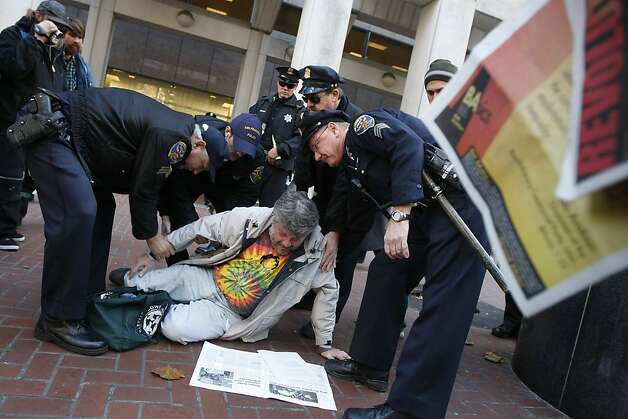
E-mails have surfaced that for the first time reveal UC Berkeley Chancellor Robert Birgeneau was informed on Nov. 9 while traveling that police used batons to forcibly remove an encampment involving hundreds of student Occupy protesters, yet did not call a halt to their use.

The use of force was criticized as excessive not only by students who were hit and are suing the university, but also by faculty and others.

The Nov. 9 protest is under investigation by a campus Police Review Board to determine who authorized use of batons by police, seen on video hitting nonviolent student protesters who had pitched tents in violation of campus policy. The five-member Review Board, convened by Birgeneau in November, is also holding hearings to determine a timeline of events that day and whether police conduct was appropriate.

Birgeneau, who was traveling in Asia on the day students first set up tents as part of the Occupy movement, received an e-mail from Provost George Breslauer soon after the first of two police confrontations with protesters on Nov. 9.

“Police used batons to gain access to the tents,” Breslauer wrote, describing a scene in which 300 to 400 students had locked arms to prevent police from moving in. “This is likely to continue for days, I suspect.”

Birgeneau responded a few hours later.

“This is really unfortunate,” the chancellor wrote. “However, our policies are absolutely clear. Obviously this group wanted exactly such a confrontation.”

A second e-mail from Birgeneau reiterates the no-tent policy and refers to the mishandling of Occupy Oakland, where tensions were inflamed in October after Mayor Jean Quan at first permitted encampments, then had police remove them forcibly. She then reversed course but eventually had the tents removed for good.

“It is critical that we do not back down on our no encampment policy,” the chancellor wrote Breslauer, copying the message to several other executives. “Otherwise, we will end up in Quan land.”

Chancellor’s apology

Birgeneau has apologized for the events of Nov. 9. He also told almost 400 members of the Faculty Senate on Nov. 28 that he was “extraordinarily disturbed” by what happened and that, as chancellor, he took full responsibility.

He told the faculty that he had explicitly prohibited police from using tear gas or pepper spray.

“Unfortunately, we did not at the same time discuss the use of the baton,” Birgeneau told the faculty.

In two open letters to students, faculty and others on campus, Birgeneau also did not reveal that he knew police had used batons. Instead, he wrote on Nov. 14 that “we cannot condone any excessive use of force against any members of our community.”

Linda Lye, an attorney with the American Civil Liberties Union of Northern California, which obtained the e-mails through the Public Records Act, identified what she called a “deeply troubling” discrepancy between how the chancellor is represented in his open letters and testimony to the Faculty Senate and how he appears in the Nov. 9 e-mails.

She said the letters and testimony “paint a misleading picture of the role (Birgeneau) played while abroad, which was in reality that he was in active contact and affirmatively set the tone for the university’s response” to protesters.

‘Batons used after the fact’

UC Berkeley spokeswoman Claire Holmes, who was among four campus executives copied on the e-mails, strongly disagreed with Lye’s interpretation.

“He found out that there were batons used after the fact,” Holmes said. “The chancellor acknowledged that that was unfortunate, but that we don’t want to abandon (the policy) that we don’t want people to camp. I don’t think you can infer from the e-mails that he’s authorized” the use of batons.

At their November meeting, the Faculty Senate passed four resolutions disapproving of Birgeneau’s handling of the Nov. 9 protest.

Yet Bob Jacobson, Faculty Senate chairman, said the e-mails by themselves fail to indict the chancellor because they don’t indicate who first authorized police to hit the nonviolent students with batons.

“I hope that the entire set of statements is going to come out at some point, and we’ll have this entire history,” Jacobson said.

Meanwhile, the ACLU plans to send a letter today to the Police Review Board, informing them of the new information.

A choice that smarts

by Peter Burke

Feb 16, 2012

Residents can opt out of Smart Meters, like the one shown here, but it will cost them $75, plus $10 per month, to avoid the new technology. Peter Burke/Press-Banner

Residents can opt out of Smart Meters, like the one shown here, but it will cost them $75, plus $10 per month, to avoid the new technology. Peter Burke/Press-Banner

Pacific Gas & Electric Co. customers in Santa Cruz County received certified letters by way of the U.S. Postal Service last week describing the fees they would pay to opt out of the widespread Smart Meter program.

PG&E notified customers following a Feb. 1 decision by the California Public Utilities Commission that it would charge a $75 one-time setup fee and a $10 monthly meter-reading charge for all customers who keep their traditional analog meters, rather than switch to wireless Smart Meters at no charge. Customers must respond by May 1 to opt out, according to PG&E.

Those notified were all on the Smart Meter Delay List — customers who had requested PG&E delay the installation of the wireless meters while the utilities commission decided on the specifics of the opt-out program.

Santa Cruz County Supervisor Neal Coonerty, who represents most of Bonny Doon and part of Santa Cruz, said he had heard from many residents on the topic of Smart Meters, most recently about the new fees.

“They’re mostly unhappy about the cost of opting out,” Coonerty said. “They feel it’s unfair and punitive and makes it more difficult to refuse the Smart Meter.”

Coonerty said he thought PG&E could eat the cost of keeping analog meters and sending employees to read them.

“(The fee) seems like a way to discourage people from opting out,” he said. “They seem like a labor-saving device for (PG&E).”

Scotts Valley’s Joshua Hart, head of watchdog stopsmartmeters.org, contends that the decision was made by a regulatory agency that wants to protect the Smart Meter program, despite 49 local California governments passing moratoriums or opposing the change.

“The real reason for the opt-out fee is not to cover PG&E’s costs — it’s simply to encourage people not to opt out,” Hart said.

A PG&E customer service representative explained this week that the fee would pay for a worker to check that an existing analog meter was in working condition. A sticker would then be placed on the meter to notify other workers to skip installing a Smart Meter in its place.

The utilities commission ruled that PG&E must monitor the costs associated with the opt-out program and could charge more if costs were higher than anticipated — or refund customers’ money if costs were lower.

PG&E assumed 145,800 customers would opt out in the study done for the California Public Utilities Commission. The company estimated to the commission that opting out would cost the company $416 per customer, a number far below the $75 fee the CPUC agreed PG&E could charge customers. The actual cost will depend on how many customers opt out.

Smart Meter debate heard by commission

The California Public Utilities Commission heard from Smart Meter opponents and proponents before ruling on the opt-out details.

Included in the hearing were people who opposed the meter because of radio-frequency emissions, as well as those who complained about the accuracy of the meters and the prohibitive cost of opting out to low-income or fixed-income families.

PG&E argued in favor of the meter and offered different opt-out scenarios. The company preferred to use a Smart Meter with the radio turned off as the alternative, rather than keeping an analog meter.

Stopsmartmeter.org’s position, Hart said, is that Smart Meter technology can cause long-term damage to the brain, DNA and other parts of the body. He recommends that people opt out, don’t pay the fee and do anything they feel they need to keep their analog meter.

“The bottom line is people need to take care of their own safety,” he said.

The PUC, however, cited several studies that deemed the devices safe.

Hart also recommends keeping $75 on hand in an account as a safeguard.

The commission ruled that income-qualified families under the California Alternate Rates for Energy program would pay a reduced $10 opt-out fee and $5 monthly fee.

The commission still ruled in favor of the digital technology as a way to manage California’s energy supply, reduce greenhouse emissions and manage future power plant development costs, however.

“We remind parties that while we believe that residential customers should be offered an opportunity to opt out of receiving a wireless Smart Meter, the selected option should not impede state energy objectives,” commissioners wrote in the Feb. 1 ruling. “As such, it is important that the selected opt-out option has the capability to allow customers to take advantage of smart grid benefits in the future.”

The Smart Meter collects gas- and electricity-use data and transmits it every 15 minutes by way of radio frequency to a network access point. The access point aggregates the information and sends it to PG&E by way of a cellular signal.

The constant readings allow customers to view their use hour by hour and also allow PG&E to charge different rates during peak-use hours, which fall during weekday afternoons.

How to opt out:

  • Go to www.pge.com/smartmeteroptout.
  • Call 866-743-0263.

A day after DA’s Office announces charges, one arraigned in takeover of former bank building

JESSICA M. PASKO – Santa Cruz Sentinel
Posted:   02/09/2012

SANTA CRUZ – One of the 11 people charged in connection with the takeover of a vacant bank building last year was in court Thursday morning for arraignment on charges of trespassing, conspiracy and vandalism.

Becky Johnson appeared in shackles and red jail clothes in front of Judge Ariadne Symons, and pleaded not guilty to the charges. Symons agreed to grant attorney Ed Frey’s request that Johnson be released on her own recognizance and ordered her to return to court March 2 to confirm a preliminary hearing date.

Johnson is among those named in the criminal complaint announced Wednesday by District Attorney Bob Lee in connection with the three-day takeover of a former bank at 75 River St. A group declaring themselves to be

A man flashes the victory and peace sign to fellow Occupy protesters atop the roof of the former home of Coast Commercial Bank on River Street. (Shmuel Thaler/Sentinel)

acting “anonymously, autonomously in solidarity with Occupy Santa Cruz” illegally entered the building on or about Nov. 30 and remained there for nearly three days, eventually leaving without incident after numerous police negotiations.Under the terms of Johnson’s release, she was ordered to stay away from 75 River St. and cooperate with all law enforcement.

Another defendant named in the complaint is longtime Santa Cruz activist and demonstrator Robert Norse, who has frequently clashed with police and city officials. According to court records, Norse, referred to in court documents as Robert Norse Kahn, 64, was served a warrant Wednesday charging him with trespassing, felony conspiracy and vandalism. In a signed order, he was released on his own recognizance and agreed to appear in court on Feb. 21.

Those also named in the complaint are Brent Elliott Adams, Franklin Cruz Alacantara, Bradley Stuart Allen, Desiree Christine Foster, Cameron Laurendau, Edward Rector, Gabriella Ripley-Phipps, Grant Garioch Wilson and Alex Darocy.

Mike Rowe, chief of the investigations department at the Santa Cruz County District Attorney’s Office, said he did not know how many of the warrants had been served as of

Occupy Santa Cruz members took over a vacant building on Water Street on Wednesday afternoon. (Shmuel Thaler/Sentinel)

Thursday afternoon.According to jail records, Foster, 19, was booked into County Jail Thursday morning in lieu of $5,000 bail. Darocy was arrested on the charges just before noon Wednesday, according to the Sheriff’s Office, but jail records showed he was not in custody Thursday. The Sheriff’s Office did not have record of arrests of any of the other defendants as of Thursday afternoon.

Occupy Bernal, Petaluma zero in on foreclosures

Carolyn Said
SF Chronicle, February 6, 2012

Tim Nonn blamed himself when he and his wife lost their Petaluma house to foreclosure 18 months ago after his job was outsourced and her store fell victim to the economic downturn.

“I didn’t even tell anyone in my church, I was so ashamed,” he said.

When the Occupy movement launched last year, Nonn said, “all of a sudden I found my voice and was able to let go of shame and self-blame. I realized this wasn’t just my problem; people are being foreclosed upon by the thousands.”

Along with liked-minded neighbors, he formed an Occupy Petaluma movement in October that soon focused on a specific goal: prevent local foreclosures.

In San Francisco’s Bernal Heights neighborhood, a group of residents has formed Occupy Bernal. Its aim, too, is to stop local foreclosures.

“Our model is classic community organizing where the people directly impacted by the issue share the leadership and speak for themselves with the support of their neighbors,” said one of the group’s founders, activist Buck Bagot, a Bernal resident since 1976.

The two homegrown Occupy groups exemplify new models springing up for the protest movement, even as they personify its message about economic inequality. Both are taking a hyper-local focus on an issue with national ramifications, while also lobbying for broad-based policy changes. Both rebut the frequent criticism that Occupy lacks goals and direction. As smaller, tight-knit, focused groups, they’re able to avoid the volatility of agitators who have caused some recent protests, notably those in Oakland, to veer into aggression and violence.

The two local groups employ different approaches. Occupy Petaluma ( www.occupypetaluma.com) has forged a cooperative relationship with banks, credit unions and police. Occupy Bernal ( www.occupybernal.org) is more confrontational, mixing some street theater with a plan to physically resist evictions. But they share a common thread of trying to forestall foreclosures and provide a voice for struggling homeowners.

Occupy Petaluma

“Vigils are the heart of what we’re doing,” Nonn said. Starting Feb. 19, the group will hold a weekly Sunday afternoon gathering in a downtown park for struggling homeowners to share their stories.

“The vigils and signs are different ways to help people in our community to come forward and begin to heal,” he said. “People have been deeply traumatized by the foreclosure crisis. Not only those facing foreclosure and eviction – the 20 million people whose mortgages are underwater are living with fear and stress every day about their financial situation. We need to let go of our shame and fear and help one another heal from this trauma so we can unite together and help keep people in their homes.”

The group is also declaring its town a “Foreclosure Prevention Zone,” pledging to organize participation, educate the public, advocate for government action and support neighbors.

At the end of the year, it persuaded the City Council to pass a holiday moratorium on foreclosures and evictions, something that many banks and other institutions were already doing. While much of that may be symbolic – the council has no jurisdiction over bank foreclosures, for instance – it has translated into some results.

Greg Morgan, president of Wells Fargo North Coast Valley, which handles seven counties north of the Golden Gate, said he has a “constructive, respectful” relationship with Occupy Petaluma.

“I was pleasantly surprised by their clear objectives,” he said. “We were able to come to common ground around realistic goals, not blanket statements.” At the group’s request, he was able to postpone some foreclosures to give former homeowners time “to get resituated and hold on to their dignity,” he said.

Morgan hopes that the government’s revised plan to refinance deeply underwater houses, which Wells will implement this month, will allow more homeowners to afford their mortgages.

Petaluma Mayor David Glass, a longtime municipal bond trader who says he never dealt in mortgage-backed securities, is fully behind Occupy Petaluma.

“They held one successful assembly after the other and built goodwill inside the community,” he said. “They got their message out without any hostility.”

Still, he admits: “Petaluma can’t wave a magic wand and pass a resolution and say somehow we will be an island where foreclosures don’t happen. This is more to set a stage where reasonable dialogue can take place.”

Petaluma resident Wendy Booth-Stahnke was laid off in 2008. After 18 months, she found a new job that pays much less. Her teenage son helps out by tutoring and doing odd jobs; she started raising her own vegetables and chickens and dipped into her 401(k) to make mortgage payments. But her home’s value has dropped, and her efforts to get a loan modification have been fruitless. She said the support of her neighbors in Occupy Petaluma has been heartening.

“Even though so many people are in this position, it is an isolating feeling,” she said. “I didn’t know where to turn, and they are filling that gap.”

Rep. Lynn Woolsey, D-Petaluma, said she considers Occupy Petaluma “a breath of fresh air.”

“They are giving a voice to those devastated by this economic crisis,” she said. “They take a very pragmatic, respectful, solution-oriented approach. They might be a model to others that there are ways to have a win-win.”

In fact, Nonn said similar movements have formed in Ohio, New Jersey and other Northern California towns. “We have weekly conference calls with people from around the country,” he said.

Occupy Bernal

Also inspired by the larger Occupy movement, Occupy Bernal sprang into being in December when several residents realized that dozens of their neighbors – largely people of color – were facing foreclosure. They drew 75 people to their first meeting and went door to door to struggling homeowners, offering to help them fight foreclosures.

“We all love our neighborhood and its diversity and don’t want to see it turn into a yuppie enclave like much of San Francisco,” said Beth Stephens, an art professor at UC Santa Cruz who helped start Occupy Bernal.

At a colorful protest on City Hall steps in January, Occupy Bernal, which included the self-styled “Wild Old Women” affinity group, got that day’s foreclosure auctions canceled.

Ed Donaldson, housing counseling director at nonprofit San Francisco Housing Development Corp., has worked with Occupy Bernal to advise the neighbors facing foreclosures. “I think it’s great that residents are raising their voices out of concern about what’s happening to their neighbors,” he said.

He thinks big changes can come from such steps.

“President Obama, who talked about the housing crisis in the State of the Union, takes his lead from what’s happening on the ground,” he said. “It’s been demonstrated time and again that if folks are interested in having their issues addressed, there has to be an outcry.”

Alberto Del Rio, a life insurance agent, is struggling to keep the Bernal house his parents bought in 1973.

“If it wasn’t for the members of Occupy Bernal, I would not have known where to go,” he said. “They came to my house and told me, ‘We want to save your house.’ ”

The group and Donaldson have gotten a foreclosure auction on his home postponed twice, while he continues to seek a loan modification, he said.

After discovering that Wells Fargo services more troubled Bernal mortgages than other banks, Occupy Bernal met with Wells executives and asked them to escalate resolution of those cases.

“It’s about pressuring the bank executives, right now Wells Fargo particularly, to have some kindness and compassion and work with people,” said artist and educator Annie Sprinkle, a longtime Bernal resident. “That’s all we’re asking for, is for them to be reasonable and make it possible for good people, families to stay in their houses.”

Bagot put it more bluntly. “We’ve tried talking with Wells Fargo and would like to continue, but if (they are unresponsive) we will have no choice but to try to embarrass the hell out of them,” he said.

Stephens said she and others are realistic about what can be accomplished.

“I’m not delusional enough to think it will be an easy thing or that banks will suddenly embrace us as a positive financial strategy for them,” she said. “We understand that. But they could renegotiate the loans.

“I think acting in local community and actually seeing those results – whether or not we’re actually able to stop the banks, the people at least know that their neighbors care about them,” she said. “Working at the local neighborhood level can be very empowering.”

Demonstrations

Occupy Oakland: Protesters are planning to march through downtown Oakland today to show support for demonstrators who have been arrested. Their schedule is as follows, according to their website:

9 a.m.: Rally inside Wiley W. Manuel Courthouse.

Noon: Rally at Frank Ogawa Plaza.

1 p.m.: March to Wiley W. Manuel Courthouse again.

2 p.m.: Pack courthouse again.

Counterprotest: Residents and merchants plan to stage a “Stand for Oakland” protest today over the lost business, violence and cost of security they say have resulted from Occupy protests. Their countermarch is scheduled to begin at 11:45 a.m. at Frank Ogawa Plaza.

Occupy, Oakland blame each other for violence

Demian Bulwa and Justin Berton
SF Chronicle – Monday, January 30, 2012

Oakland officials and Occupy protesters confronted the fallout from their increasingly toxic conflict on Sunday, a day after the tensions reignited in chaotic, often violent demonstrations that resulted in at least 400 arrests. Once again, each side blamed the other for sparking the violence.

City officials took stock of the damage from Saturday’s clashes, which included injuries to three police officers and several protesters, as well as vandalism inside City Hall.

There, dozens of protesters had broken in with a crowbar, grabbed an American flag, and ignited it on the front steps.

“It’s like a tantrum,” Mayor Jean Quan said while showing the damage inside the building, which included a broken model of City Hall she estimated to be 100 years old. “They’re treating us like a playground.”

Quan said Occupy Oakland had “refused to be nonviolent” and, as a result, was “turning off the rest of the movement.” She said police would step up efforts to obtain restraining orders against some protesters to keep them from approaching City Hall.

Interim Police Chief Howard Jordan, at an afternoon news conference, said 14 outside police agencies had provided mutual aid to Oakland. He did not know the exact number of people arrested.

Outside City Hall on Sunday, some activists who had gathered in Frank Ogawa Plaza condemned the officers who responded aggressively Saturday to stop Occupy Oakland from seizing the vacant Henry J. Kaiser Convention Center and turning it into a headquarters for the movement.

They accused officers of using batons, beanbag bullets and tear gas without justification.

“Whatever qualms people have with Occupy Oakland, it’s the police who have committed the most egregious violence,” said Scott Johnson, a 34-year-old Oakland resident. “They instigated the violence by not allowing us to take over an unused building.”

Future action

Later Sunday, at a “general assembly” in Ogawa Plaza, a few hundred people discussed a variety of proposals for future action, including a call for a general strike on May 1.

But the disorganized nature of Saturday’s demonstration, and the hours-long street skirmishes that were broadcast on television and the Internet, left some protesters with mixed feelings.

Some said the building takeover was poorly planned and that they did not condone the actions of those who vandalized City Hall or threw rocks and other objects at police.

“Today we need to clean up again,” said Rachel Dorney, 23, who said she was pushed to the ground by a police officer during the rally. “I know that people are pissed at the cops and that’s how they act out, but it just hurts Oakland.”

Others said the movement in Oakland has strayed too far from the core message of economic justice.

Officer Johnna Watson, a police spokeswoman, said the officer who suffered the most serious injuries was struck in the face by a bicycle, suffering a cut. A second officer was cut on the hand, she said, and a third had a bruise.

She said some of the arrested protesters were released after being processed through County Jail, while others – including those suspected of felony assault – would be held until they post bail.

Jordan said at least three journalists were temporarily detained Saturday, including Gavin Aronsen, an editorial fellow at Mother Jones, who was taken to Santa Rita Jail in Dublin before being released.

Watson displayed items she said were recovered from protesters, including knives, mace, scissors and a tear gas canister, as well as a large shield that protesters had used while clashing with police.

The shield was 7 feet wide and 4 feet tall, with corrugated metal siding over a wood frame. Seven metal handles were bolted to the frame, and the words “Commune move in” were painted in red and black.

‘New territory’

“They’re well-built, they’re maneuverable and they’re effective,” Watson said of the shields. “We have to change our police strategies. This is new territory for law enforcement.”

Watson said her department needs its officers to return to their regular duties. Oakland has had five homicides since Friday night.

The police focus on Occupy activists was a cause of concern for Isaac Kaly, who said his Oakland church, Kingdom Life International Ministries, had been broken into late Saturday or early Sunday by burglars. Kaly, an assistant pastor, said church officials called police at 9:45 a.m. Sunday but were told that officers were too busy to respond.

“They said they would come out (Monday) to take a report,” Kaly said. “Everybody deserves service. That’s why we pay the police.”

Saturday’s demonstration, which brought more than 1,000 people downtown, began on a festive note. After a brief noon rally at Frank Ogawa Plaza, Occupy supporters, accompanied by a small marching band, filled the street with banners.

Jordan said he did not consider the rally to be peaceful, however, because of marchers’ plan to seize a building and because some of the protesters slashed tires as they walked.

Secret destination

Most marchers had no idea where they were going, because organizers kept secret the building they hoped to seize. Tensions rose as marchers arrived at the long-shuttered convention center just south of Lake Merritt and began tearing down fences.

Police ordered marchers to disperse after someone in the crowd threw what appeared to be a smoke bomb at the officers. The protesters refused, touching off the first of several confrontations.

Police pushed the crowd back down 12th Street toward downtown, and eventually the demonstrators ended up where they had begun – back at Frank Ogawa Plaza.

Their numbers smaller than before, the marchers set out from the plaza a second time after dark, heading north. Again it was unclear where the group was headed.

At one point, around 6:30 p.m., police cornered marchers near the YMCA at 24th Street and Broadway, and some of the protesters burst into the building, surprising people working out in the gym.

Nineteen people were arrested earlier in the day. Jordan said 44 people were arrested inside the YMCA, with scores more taken into custody outside.

Police said the mass arrests were necessary because protesters failed to obey orders to disperse. But some protesters said the arrests were made unlawfully, before they had a chance to follow police orders, and suggested that they might take legal action against the city.

Boulder Creek Collective worker says pot gave him his life back

Rosy Weiser
SC Sentinel:   01/28/2012

SOQUEL – Boulder Creek Collective founder Marc Whitehill, a former nurse, has seen a lot of people come through his doors seeking medical marijuana, enough that he thinks he has a pretty clear idea of the patient demographic at most local dispensaries.

He estimates 60 percent are 40 or older and use cannabis “to avoid taking much harsher pharmaceutical alternatives to treat nausea, sleeplessness, anxiety and aches and pains,” he said. They use the medicine instead of resorting to common prescription painkillers and tranquilizers.

Another 20 percent are youngsters with no visible signs of illness.

“With them, I have to trust the physician that they made the right call,” he said.

But the last category, the 20 percent who are chronically or terminally ill receive special attention at the Boulder Creek Collective. If not for these patients, medical cannabis might not have grown into a burgeoning industry.

One such patient is Gary Goldsworthy, 42, who was given a free membership at the collective in exchange for volunteer hours about two years ago. Goldsworthy was diagnosed with Crohn’s disease, an inflammatory bowel disorder that triggers the immune system to attack the gastro-intestinal tract, when he was 27.

During a long period of remission, Goldsworthy had been a successful musician who toured nationally with acclaimed blues artist, James Armstrong. But an additional diagnosis of skin cancer and the removal of several lymph nodes a few years ago caused a resurgence of the Crohn’s and sent him downhill fast.

When he first discovered marijuana as medicine, he had been housebound for more than a year, confined to his bed and the bathroom, hardly able to eat and suffering from diarrhea and intense abdominal pain, among other symptoms.

“I kept on getting advised by nurses to try [marijuana] because I don’t get a natural appetite,” he said, explaining that smoking has allowed him to regain some semblance of his former life, bringing him out of the house and allowing him to eat regularly and have more energy.

Against the advice of his doctors, Goldsworthy eventually decided to forgo the mainstream treatments that cost $50,000 a year, in favor of marijuana which he got for free, and which he thought did a better job addressing his symptoms.

“My symptoms are semi-manageable now,” he said. “I was on disability and SSI but I’ve been able to be self-sufficient.”

Goldsworthy now works as a part-time paid employee at the collective handling admissions. He continues to receive enough free medicine to smoke three to four times a day, around meal times.

Occupy Oakland activists rally for former pariah

Demian Bulwa, SF Chronicle – Monday, January 9, 2012

Occupy Oakland protesters are rallying behind Marcel "Khali" Johnson, a mentally ill man who was arrested during a demonstration outside City Hall last month. Photo: Courtesy Adam Katz / SF

Occupy Oakland protesters are rallying behind Marcel “Khali” Johnson, a mentally ill man who was arrested during a demonstration outside City Hall last month. Photo: Courtesy Adam Katz / SF

PLEASANTON— One obstacle Occupy Oakland faced after building a City Hall encampment came not from authorities but from within – a mentally ill homeless man with a long prison record who witnesses said beat fellow campers in fits of rage. Some were so frightened they moved out.

No one called the police on the man, who called himself “Kali.” Instead, he was banished in an act of freelance justice, with a protester knocking him unconscious with a two-by-four Oct. 18. Police cleared the tent city a week later, and Mayor Jean Quan has cited the incident as a motivating factor.

Times have changed. On Monday, dozens of Occupy Oakland protesters went to a courthouse in Pleasanton to rail against prosecutors for filing assault charges against Marcel “Kali” Johnson, 38. Some said they forgave him and have come to see him as a good man who needs support, not more prison time.

“That’s the beauty of Occupy,” said Laleh Behbehanian, a UC Berkeley graduate student trying to help Johnson. She spoke after telling activists how they can visit him, in groups of four, at Santa Rita Jail in Dublin.

Improved behavior

Johnson returned to Frank Ogawa Plaza outside City Hall a couple of weeks after being knocked unconscious, witnesses said, and did better this time, helping out before police swept through the camp a second time Nov. 14.

Johnson was one of several demonstrators arrested on minor charges there Dec. 16, as Occupy Oakland sought to maintain a 24-hour-a-day vigil. The next day, at Santa Rita Jail, Johnson was accused of assaulting an Alameda County sheriff’s deputy.

According to an affidavit by the arresting officer, Deputy Clifford Malihan, Johnson struggled as a second deputy, referred to as W. Chase, tried to handcuff him and move him between housing units.

Malihan wrote that Johnson first tried to strike Chase in the head, then got behind him and wrapped his arms around him. Malihan said he performed a leg sweep, causing Chase and Johnson to fall, and punched Johnson repeatedly.

Malihan said Chase suffered cuts, bruises and neck pain, while a third deputy suffered a minor concussion from an inadvertent baton strike.

Not-guilty plea

Johnson pleaded not guilty Monday and is scheduled to return to court Feb. 6. Alameda County prosecutors say he has six felony convictions, including one for domestic violence and two for robbery that count as strikes under California’s “three strikes” law, meaning he could face up to 25 years to life in prison.

However, Teresa Drenick, a spokeswoman for the district attorney’s office, said prosecutors had decided – at least for now – not to seek a “three strikes” sentence.

Johnson’s supporters said they believed the alleged assault would not have happened if he had been given proper psychiatric care. Sgt. J.D. Nelson, a sheriff’s office spokesman, said the jail had treated Johnson appropriately but would not elaborate, citing Johnson’s privacy rights.

“Are they going to blame someone else for everything he’s done in his criminal history?” Nelson said. “Throughout the course of Occupy we’ve been accused by them of many things regarding the custody and control of inmates.”

‘It’s a family’

Activist Rachel Dorney, 23, said she had tried to calm Johnson in the early days of the Occupy camp, and when he returned after being beaten, she was scared.

“Then, once you’re in our camp, and you’re helping people out, and you’re talking and not being so aggressive, it’s a family,” Dorney said. “And you have to support everyone.”

She added, “There’s a larger issue with the system. The city won’t support people who have mental issues or who are homeless, and they come to us.”

Jaime Omar Yassin, 42, said Johnson had a political awakening through Occupy.

“He’s exactly the kind of person you would hope would get a second chance,” Yassin said, “and contribute his experiences and knowledge to the movement.”


Police arrest Occupy SF protesters

SF Chronicle, December 20, 2011

- Photo: Dylan Entelis, The Chronicle / SF

– Photo: Dylan Entelis, The Chronicle / SF
Occupy SF protester Mark Schwartzis arrested outside the Federal Reserve Building in downtown San Francisco on Monday. Schwartz was one of three protesters issued citations by police for allegedly violating the sit/lie ordinance. Police have complained recently about the drain that all the protests are putting on city resources.

Oakland business owners fear they won’t recover

Jill Tucker and Matthai Kuruvila
SF Chronicle, November 7, 2011

Kevin Best and Misty Rasche remember when they had waiting lists for a Friday reservation at their bistro in the historic Old Oakland business district.

That was in 2007, before the recession hit and a series of angry protests that would come to define downtown Oakland.

Most recently, business at their B Restaurant & Bar has been harmed further since Occupy Oakland tents went up at City Hall on Oct. 10. Best and Rasche worry that the collateral damage from the protest may be the final blow for their restaurant.

“If we go two more months like this,” Best said, “it’s a wrap.”

Their restaurant is five blocks from the encampment. Businesses closer have suffered more, and not only from a loss of customers. Windows have been broken, street fires have been set, and graffiti has become part of the landscape, block after block.

Best and Rasche, West Oakland residents, don’t want to leave.

But as downtown business owners, they have been on a never-ending roller-coaster ride through the recession and the impact of high city unemployment rates, a series of high-profile protests and the disruptive demonstrations, and now Occupy Oakland, with its two tear-gassed melees in a little more than a week.

Despite it all, what may hurt most is the damage to the area’s image.

Unfulfilled promise

For a downtown that held such promise just a decade ago, it’s been painful journey.

“We own this restaurant because we love Oakland,” Rasche said. “You want to believe in it so bad.”

Since January 2009, the city has had three protests over the fatal police shooting of a BART passenger and one about cuts to higher education. The latest protest has been going for 27 days, including Wednesday’s general strike, which turned violent in the late-night hours.

The damage done by a small element of Occupy Oakland could have long-lasting effects on a downtown already struggling to overcome a bad reputation for business.

“Many, many Oakland residents … feel that this is disrupting every effort this city has made to have economic development,” said Councilwoman Pat Kernighan. “This has set us back 15 years.”

In the week before Wednesday’s general strike, three businesses pulled out of downtown lease negotiations, including one with 100 employees and another needing 35,000 square feet of space, said Joe Haraburda, president and CEO of Oakland Metropolitan Chamber of Commerce.

At the same time, the tents and civil unrest have pushed some restaurant receipts down 50 to 60 percent, he said.

Mayor Jean Quan, who grew up around her family’s restaurant in Livermore, said such businesses run on a 5 percent profit margin and have a hard time absorbing even one lost day.

She said she knows of two restaurants downtown that are closing because of recent losses.

In addition, workers have lost wages as stores have closed for safety reasons or to show support for the marches.

Some companies that might have considered Oakland’s downtown, with its lower rents and convenient access to transportation, are looking elsewhere.

“People are afraid to come downtown,” said retail consultant Helen Bulwik, president of New Market Solutions. “How do you sell it at this point? What you cannot sell is safety and security.”

Vacant storefronts line Broadway, the main downtown artery, despite a comparatively healthy 15 percent commercial vacancy rate inside the tall office buildings.

The Men’s Wearhouse and Whole Foods, both damaged during last week’s strike, moved into the neighborhood in recent years, but Oakland remains an urban city without a significant retail presence downtown, Bulwik said.

It wasn’t supposed to be this way.

In the late 1990s, revitalization efforts that tried to bring back the downtown area included refurbishing the Fox Theatre and bringing 10,000 new residents into the neighborhood.

A vision shelved

Restaurants, retailers and business would follow, reasoned then-Mayor Jerry Brown, who spearheaded the drive.

In 2005, the city promoted the revitalization efforts, noting new restaurants, residents and $7.3 million in updated streetscape.

“New sidewalks, street tree plantings, pedestrian amenities, historic lighting, street furniture and sidewalk widening will encourage downtown patrons to stroll and explore our vibrant downtown,” a Meet Downtown Oakland fact sheet said.

On paper, it looked like the city was on the cusp of a major renaissance, with Gap, Starbucks and other national retail chains buying into the plan.

Gap’s 2001 opening at the corner of 14th Street and Broadway offered a major vote of confidence in downtown Oakland, Brown said at the time.

Five years later, Gap was gone.

About the same time, the recession hit the new downtown residential projects hard, leaving some condominium developments more than a third empty, while others were pulled off the market entirely to wait out the economy.

With Brown’s “if you build it they will come” concept on hold, there is no strong retail base, especially downtown, to attract Oakland shoppers, who spend $3 billion outside the city every year, Bulwik said.

What Oakland needs is a boom of retail along upper Broadway – some 3 million square feet of space – which could bring the lost business back into the local economy, Bulwik said. That could be the game changer Oakland needs, she said. But that’s for another day.

To be sure, bright spots exist in other parts of Oakland, with the Temescal and Rockridge districts thriving.

In 2011, an estimated 1,200 jobs were added to the downtown and Lake Merritt communities, said Marco Li Mandri, consultant to the Downtown Oakland and Lake Merritt/Uptown District associations.

“Oakland has got this steady march forward,” he said, adding that it’s outsiders who are bringing it down.

“They believe the venue for demonstrations against the state in general is 14th and Broadway,” he said.

Choice of target questioned

Indeed, with only one Fortune 500 company and about a 16 percent unemployment rate, many residents wonder why their city is the target of an Occupy movement directed at the economic elite.

Why aren’t the protesters in San Ramon, where Chevron just announced a near-record profit of $7.83 billion, asked Bill Jackman, an independent statistician and programmer.

“Why pick on the city that’s down?” he said.

Oakland resident Jerry Bloodsaw called it a failure of leadership to stand tall against the tent encampment and the outsiders who make the city look bad.

“Oakland still is a good city,” the finance worker said during his lunch break downtown Thursday. “That fear factor, we need to get rid of it.”

Jean Quan angers Occupy camp’s supporters, rivals

Matthai Kuruvila and Justin Berton
SF Chronicle – November 5, 2011

Mayor Jean Quan told residents and others gathered at a raucous City Council meeting this week that the Occupy Oakland encampment at City Hall is damaging the city.

Hundreds of jobs are being lost, police are being diverted from violent parts of town, some businesses are closing, and others are choosing not to locate in downtown Oakland at all, she said at Thursday’s special City Council meeting.

Yet at the same meeting, three of Quan’s staunchest supporters urged the council to support the Occupy Oakland encampment. One of them, Don Link, told The Chronicle that they spoke at the meeting on behalf of a group that emerged from Quan’s mayoral campaign and is led by Quan’s husband, Floyd Huen.

Quan’s actions during the past two weeks have left both supporters and opponents of the Occupy Oakland camp bewildered and frustrated.

Her mixed messages, whether she delivers them herself or through others, indicate that she is unwilling to make a decision, Councilman Ignacio De La Fuente said.

“Honestly, I think her nature cannot allow her to make a decision. The city is really suffering the consequences of that,” said De La Fuente, who has emerged as the mayor’s most vocal critic on the council since she took office.

After first supporting the camp, forcing it to close and then allowing it to spring back up, Quan now appears to be leaning toward wanting the camp evicted again.

Residents, police angry

Quan has been criticized for flip-flopping on Occupy by business owners, residents and the Oakland police union, which issued an open letter to residents Tuesday saying police were confused and did not know how to respond to protesters because of the mayor’s mixed signals.

At Thursday’s council meeting, Khalid Shakur, 43, who has camped since the first day, said to Quan, “Mayor Quan, I hold you personally responsible” for the poor relationship that has developed between the city and the camp.

The criticism comes from the other side as well.

Oakland resident Phillip Johnson, who wants the camp removed, said, “Somebody has to stand up for this city. Ms. Quan, you’re a good person, but the business community doesn’t like this.”

Meanwhile, Quan has continued trying to work with the campers in Frank Ogawa Plaza outside City Hall, but many are ignoring her and her administration’s requests for cooperation.

The city’s inability to get protesters to cooperate was apparent again Friday when campers who gathered for a morning meeting were met by Arturo Sanchez, assistant to the city administrator. Sanchez reiterated the city’s concerns over a propane tank in the camp’s food tent and the larger structures that have arisen, such as the medic tent, which is staffed by nurses twice a week.

Sanchez told the group that at some point, “those structures will have to come down,” but did not specify when. Sanchez’s warning was not well received.

“As much as you say you respect our position, please respect ours,” said a camper named Dennis, 39, who had just moved from the Occupy Santa Cruz encampment. “No structure will come down without a general assembly vote.”

Fire inspectors who walked through the kitchen Friday afternoon again asked campers to remove the propane tank, which was covered in a black garbage bag.

‘This is going to end up bad’

De La Fuente expressed grave concerns about what he said is Quan’s inability to take a stand.

“This is going to end up bad,” he warned. “If something happens and that encampment blows up because they have propane tanks, everybody is going to say, ‘Wow.’ Then it’s going to be too late.”