April 12, 2012
Original Post
by John Malkin
FOUND ONLINE HERE.
 Three days of barricades, meetings, dance parties and sleeping inside a vacant bank—and charges of trespassing, vandalism and conspiracy against 11. A deeper look inside some of the lesser-known aftereffects of the local Occupy Movement.
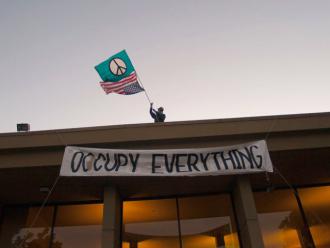
Seventy-four days after the birth of the Occupy Movement in September 2011, a self-described “anonymous, autonomous group standing in solidarity with Occupy Santa Cruz,” entered a building in Downtown Santa Cruz that had been vacant for three years. A press release from occupiers explained that the building, formerly owned by Wells Fargo and now leased to the bank, would be “transformed into a community center.”
With a blend of political idealism and practical naiveté, the occupation of a 13,447- square-foot vacant building, located at 75 River St., became a complicated and illegal experiment in social change. Of the reported 200-300 people to venture inside the building between Wednesday, Nov. 30 and Saturday, Dec. 3, 11 have been singled out by the Santa Cruz Police Department and charged with misdemeanor trespassing, vandalism and felony conspiracy to commit trespass. The group of 11 suspects includes two Indymedia journalists, three alternative media journalists and some of Santa Cruz’s most visible activists, one of whom says she never went inside the building. Charges were filed by the district attorney on Feb. 8, more than two months after the takeover.
The 11 are: Brent Adams, Franklin Alacantara, Bradley Stuart Allen, Alex Darocy, Desiree Foster, Becky Johnson, Cameron Laurendau, Robert Norse, Edward Rector, Gabriella Ripleyphipps, and Grant Wilson.
“It’s a curious list,” comments Mike Rotkin, five-time mayor of Santa Cruz. “They were obviously trespassing,” he acknowledges, “but charging them with felony conspiracy to do misdemeanor things? It seems overblown.”
Current Mayor Don Lane agrees. “I was surprised by the conspiracy charges,” he says.
Felony conspiracy has a maximum three-year prison sentence and is perhaps one of the most severe charges against national Occupy-related events since the movement began six months ago. Rebekah Young, assistant district attorney prosecuting the 11, advises, “I don’t think anyone from the prosecution or defense expects that [three years] to be imposed. It’s up to the judge.”
 On Nov. 30, 2011, Occupiers inside an empty former bank prevent Santa Cruz Police from entering the building. In addition, many of the 11 say they didn’t do graffiti or vandalism. “If you’re united in concerted action [trespass] and something else happens during that [vandalism] … you can be held libel for it,” explains Young. According to police reports, a Wells Fargo representative estimated $30,000 in damages to the building, including a $6,000 janitorial fee.
The “re-purposing” of the vacant building came at a time when Occupy encampments were established in dozens of U.S. cities and just two days after activists had occupied a building at UC Santa Cruz on Nov. 28. Also fresh in many minds were images of activists being shot at with rubber bullets in Oakland and pepper-sprayed at the University of California at Davis.
A varied mix of people with a diversity of intentions visited the River Street occupation. Many didn’t know each other. Dozens attended meetings, attempting to create a community center. Others appreciated a warm place to sleep. Some came to party or just check out perhaps the strangest episode in recent local history. What follows is a view of the occupation from first-hand accounts of some people who ventured inside, including city officials, activists, journalists, concerned community members and passersby, as well as insight into the arrests and current trials of 11 people.
You’re looking at a barricade right now!’
On Nov. 30, 2011, about 75 people walked across the Water Street bridge in Santa Cruz in a march that was publicized to “picket corporate banks … and march to a foreclosed property.” After protesting at Chase Bank on Ocean Street, the group went to 75 River St., located directly across the San Lorenzo River from the local Occupy Santa Cruz tent village.
What happened next took many by surprise. According to those interviewed for this story, someone approached the front doors of the vacant building and walked in, without permission or payment (monthly rent is about $28,000, according to a representative from Barry Swenson Builder, co-owner of the building). Police speculate that a key had been taken earlier from a lock box.
At 6 p.m., 24 Santa Cruz policemen in riot gear confronted about 30 occupiers barricading themselves inside the building, where they were busy crafting banners and re-arranging furniture. About 100 protestors rallied outside the building, interlocking arms and blocking police access at times. Police struggled to enter the building and during scuffles police hit at least two people with batons, according to police reports obtained and eyewitnesses. One policeman wrote in his report of the incident that coffee was thrown onto him. “I could not see out of the left side of my face shield,” he wrote. “I suspected it was coffee with a lot of cream or more likely a latte.”
Though police were absent during most of the three-day occupation, the first hours were tense. “They [SCPD] tried for 30 minutes to get into the building,” explains Simon, one of the occupiers and a self-described pacifist. “We held large pieces of furniture. They couldn’t get enough manpower on the outside because we were able to double that many on the inside. We had the advantage because we didn’t have shields and batons to hold.”
In a video posted to YouTube SCPD officers with helmets, shields and batons are seen backing away from protestors. One officer is heard saying, “We’ll leave if you don’t follow us,” which is what happened. Police did not return for three days, according to to several people interviewed who were coming and going from the building. Police reports obtained for this article reveal that police surveilled the occupation from an undisclosed vantage point.
Tent in a Vault
Back at the barricade the scene continued to unfold. As the day went on, several people at the former bank were interviewed for this article, including a concerned woman who spoke in urgent tones to a teenager inside the occupied bank, saying, “Please be careful!”
The teenager responded: “That’s my mom. We’re holding the building and not planning on going anywhere.”
On top of the barricade there was a man wearing a black mask and cap. He pointed to the pile of furniture and said: “You’re looking at a barricade right now.” From inside of the bank, he asked if I’d like to come in. I declined. A man sporting a backpack climbed over the couches and metal desks, followed by another man holding a gas mask.
 Some occupiers set up camp, erecting a “tent in a vault” within the empty bank. “When are the cops coming back?” asked the gas-mask guy.
“We’ve already faced them off once tonight,” he said. “We’ll be locking down and we’re asking people to make the decision to stay either in or out. There’s running water, electricity, bathrooms, food and a smoking area. We also have roof access. Are you coming in?”
Observers would view the barricade as a symbol of the failure of some occupiers to meet their goal of creating a community center.
“People don’t want to come in if it’s barricaded!” reflected one of the occupiers who goes by the name of Jean. “If I was some lay person I’d be afraid to come in.”
The longevity of the “bank action” was perhaps stunted because occupiers hadn’t decided if it was more a statement against capitalism or an effort to create a community center. Additionally, anticipated support for the occupation was apparently overestimated.
“It’s a terrible dichotomy where you have some intention of working on this community center or a place where homeless can get out of the weather … and during the same discussion we’d have proposals about how to defend ourselves from a SWAT team,” Simon* explains. “Those two activities counteract each other.”
On the second day of the occupation, many came and went through a side door, though mainstream journalists were not greeted warmly.
One reporter was given a short tour with her camera and Occupiers described a variety of things taking place inside of the building: down one hallway, an office door was opened and a couple was making love on a sleeping bag on the floor; in the next room a young woman was curled up sleeping; the thick bank vault door lay wide open, revealing a camping tent where piles of cash were once stashed.
Meanwhile an “empathy cafe” was under way upstairs.
“There were people walking in and out of the bank. It was a very casual atmosphere,” Jane* adds. “I was invited to facilitate a compassion circle there. Maybe I’m naive, but it [the occupation] didn’t have an air of unlawfulness about it.”
Several people commented on how it had seemed legal to enter the building after seeing city officials and others go inside without any police action. In an interview for this article, one person, who requested to remain anonymous, said, “There was no ‘no trespassing’ signage and no police saying, ‘It’s against the law to enter this space.’”
Another noted: “I understand the police put up no trespassing signs. The signs got torn down pretty fast. I never saw those signs.”
The occupied building was visited by city council- member Katherine Beiers, the city manager Martin Bernal and half a dozen mainstream and independent journalists, according to witnesses. SCPD reports reveal that councilmember Beiers was recommended for prosecution, though the DA has so far declined. City Manager Martin Bernal adds, “The mayor (Don Lane) asked me go inside … I spoke with police first.”
The following are descriptions from two people who entered the occupied building; one is facing trespassing, vandalism and conspiracy charges and the other is not. (Can you tell which one goes before a judge this month? Note the answer at the end of this article.)
X: “I stepped in as a concerned community member … In the evening they were in a circle talking about respecting the property, the space, and strategies. After about an hour I left the meeting. I was still not clear as to what their long-term vision was.”
Z: “I arrived at the bank less than an hour after it was occupied. I saw people on the roof. I was there shortly after the first people went in. I went in and sat down … They were having a meeting.”
On Saturday, Dec. 3, police arrived at around midnight to discover that the bank was once again empty. According to those interviewed, police had made it clear that they were preparing to return and arrest anyone inside. They secured the building and it was soon boarded up and fenced. A sign in front with “occupied” painted over the word “available” had been removed.
“We’re thankful authorities secured the building and there was a peaceful resolution,” says Ruben Pulido, a spokesperson for Wells Fargo.
Pulido declined to comment on the charges against the 11 people.
Forgive Us Our Trespasses’—Occupy’s Phase Two
On the first night of the occupation (Nov. 30), a lively general assembly unfolded in front of the building, according to those interviewed. A young woman summed up one vision through a crackling bullhorn: “We’re challenging capitalism, accumulation of property and the expropriation of our wealth through our labor.”
 The March on Water Street moved beyond the Occupy camp. A banner reading “Reclaim Space—Reclaim our Lives” was hung above a counter where bank tellers had once smiled and counted out bills. People played music, ate dinner and taped up signs.
“Wells Fargo is a fit target,” one occupier said. “They’re responsible for predatory lending, foreclosing on taxpayers’ homes and then getting billions in bailout money.”
Another solemnly added, “This is part of an ongoing resistance that started more than 500 years ago. This is phase two of Occupy.”
The Occupy Movement was greatly inspired by the Arab Spring and actions in Spain and Greece where public and private property were occupied in 2011. This strategy connects to myriad political occupations of land and buildings by Native Americans (Wounded Knee: 1973), Zapatistas (Mexico: 1983 to present), Landless Workers Movement (Brazil: 1984 to present), and Homes Not Jails (San Francisco: 1992 to present), to cite a few examples.
“This next phase of the movement will be made of surprise, short, sometimes one-day occupations,” says Kalle Lasn, editor of adbusters magazine, and one of the people responsible for sparking the Occupy Movement. “We can occupy banks for a few hours. We can occupy buildings … for four days or maybe four weeks.”
Provocative “phase two” occupations have continued; In January, Occupy London activists occupied a vacant bank. On April 1, a vacant building in San Francisco was taken over for 24 hours by Occupy activists who established a “community center, shelter and food bank.” Seventy-five people were arrested for trespassing—none for conspiracy— according to news reports. One unfurled banner read: “Give us this day our daily bread, Forgive us our Trespasses.”
Was the occupation of a vacant bank off-track from goals of freedom and justice? Or will history include it as a direct action that contributed to positive social transformation? Either way, the necessary conditions for long-term support for the action—community support and a breakdown of authority—were simply not present.
Not Enough Indians’ —Private Property
During the Santa Cruz occupation, not far from the tent in the vault, three words in purple paint graffiti read: “Not Enough Indians.”
While the Occupy Movement gained momentum by identifying with the “99 percent”— a growing majority of Americans who feel they’re being adversely affected by political and economic systems—this local building occupation revealed an underlying concept to contend with: private property.
If the message of Occupy were synthesized into one question it might be this: “Where can we go without permission or payment?” Local occupiers perhaps tried one answer to this question by taking over a vacant bank (one of at least three downtown) and discovered that the broader community was not on the same page because, as one of the 11 now charged explained, “Private property is thought of as this holy thing.”
 Occupiers resorted to barricading the entrance of the empty bank.In fact, this attitude is fairly young. Local historian Sandy Lydon offers, “The concept of individual private property was not a well-developed one with the local and regional Indian groups. Each group had a particular territory which they would defend against encroachment by neighboring groups, but it was generally understood to be an “us” and “them” defense, not a “me” and “mine.”
Private property is now a firmly embedded concept in our culture. Some local observers of the River Street occupation commented: “What if occupiers came into my house?”
They are, perhaps, pointing to a human need for safety. And to a fear that private homes and vacant buildings may be equal targets for the Occupy Movement. Local occupy activists addressed the issue, saying that the takeover of vacant buildings is rooted in unjust economics; as wealthy corporate banks lie empty and receive government assistance, they’re foreclosing many into homelessness.
Simultaneously, public space has dwindled as city government has decreased common areas by posting closing hours at places like the river levee and town clock. City Councilmember Katherine Beiers explains, “It’s a way to give power to police to move people. City hall is now posted, and the side of the public library. There is a kind of closing in.”
One occupier interviewed said: “That building was chosen because it had ties to Wells Fargo … There’s so many empty private spaces and so few public spaces.”
“Ultimately, bank property that’s not being used should belong to the people,” says Mike Rotkin, a self-described socialist. “It should be re-purposed in a public way. But I don’t think you can do that by physical force.”
Party All The Time
On Friday night, Dec. 2, the community was invited to the occupation for a pot luck meeting to discuss next steps. Things didn’t go as planned, according to those interviewed. Though ground rules were posted (including no alcohol or drugs) dozens of people came to party in the vacant bank.
“I was surprised when I went in on the second night and saw how different it was,” one occupier, who was inside multiple times, reveals. “People were on their phones. They’d say, ‘I texted [UCSC’s] College Nine and told them to come down.’”
Multiple occupiers interviewed said that they attempted to stop graffiti and vandalism, but the size of the building and number of visitors made it difficult.
“I was in and out of the bank on a fairly regular basis,” Simon* notes. “The last two nights I had a departure with some of the characters in there. Some activists were replaced by people who didn’t have an activist grounding and had a confrontational mode. It was time to leave. I wasn’t willing to get arrested for somebody else’s vandalism.”
Though occupiers experimented with bag-checks at the door, damage was done. “Some people wanted to come in and vandalize things,” says Jean*. “A lot of people didn’t understand the community center idea.”
At least two occupiers phoned and met with police in an attempt to negotiate for time to clean up. “We wanted the power back on so we could vacuum,” Jean explains. “We wanted to mop and get the graffiti off the walls.”
Guilty Until Proven Innocent?
In addition to the 11 already charged, DA Bob Lee told media in a February press release that, “More people may be charged and more charges may be filed.” Though common as investigations unfold, the statement has had an early effect.
“It creates a chilling effect in the community for people to lend support,” says Morgan*, one of the 11 being charged with trespassing, vandalism and conspiracy. “They don’t know if they might be drawn into this situation somehow.”
“That idea of ‘innocent until proven guilty,’ it doesn’t feel that way,” Morgan adds. “People had officers come to their homes and arrest them. That seems unnecessary in this situation.”
 Chris*, another of the 11 charged, says he was shocked to learn he was on the wanted list. “I was told how not to get arrested by ‘running the gauntlet,’” he says. “I would have to get into the courthouse without getting arrested. I was very nervous because there’s police all over. It feels like we’ve been punished already.”
For some, the prosecutions are having a counter-effect. “The way the police and DA have treated me and other activists is radicalizing us,” explains Chris*. “I was only peripherally involved in the Occupy Movement—now I’m going to lots more meetings.”
The labeling of occupiers as “anarchists” has also played out in media and legal framing of the case. On page 126 of police reports regarding the River Street occupation is a request for “priority processing” of fingerprints taken from the occupied building, with this reason given: “Anarchist protestors still in the city.”
“They use ‘anarchist’ as a label that allows them to take aggressive steps,” says Chris. “It would be harder for them to say, ‘concerned community members took over an empty space.’”
A Knock On The Door’
Terri* camped at Occupy Santa Cruz for two months after becoming homeless. “I was sleeping in the cold,” she remembers, “and here’s this warm building that’s been empty for three years and has electricity and water. There was a kitchen upstairs with a stove, microwave, fridge—everything.”
Terri was arrested on Feb. 8. “There was a knock on the door,” she says. “I opened it and there’s three sheriffs. I said, ‘My mom and I are going to the courthouse now. Please let me turn myself in.’ They said, ‘Nope.’ She was in jail for seven hours. “They wouldn’t feed me or give me water.”
“I already have money troubles and my mom got diagnosed with cancer. Now I’m facing felony charges,” Terri explains. “Bottom line: I tried to commit suicide … The emotional stress is way more than you could expect.”
Another activist, who was arrested while making breakfast, says: “I never entered the building. The people charging me are misusing authority.” She spent one night in jail. “I appeared before the judge in shackles. I was treated like a dangerous criminal. This is punishment prior to trial.”
The Morning After
Seven hours after city police took over the vacant bank, ending the three-day occupation, the tent camp at San Lorenzo Park was raided by sheriff’s deputies. Later that day the OSC general assembly included a discussion of the bank take-over, with anger, empathy, solidarity and other feelings expressed. Probably the understatement of the day regarding the vacant bank occupation was, “Perhaps it was not fully thought out.”
“Occupy Santa Cruz didn’t approve of that action … When it ended yesterday evening peacefully, we were delighted,” one longtime OSC says.
Others blamed the occupation for that morning’s raid of the encampment. Through various interviews with those there at the time, one woman reportedly scorned: “Your impatience has had drastic results.”
 Another longtime Occupy activist said, “There’s a whole raft of reasons why what was done at 75 River St. is a great idea. Sure, it was illegal, but what’s more important is the illegitimacy of the political economy.”
And another Occupy activist commented, “Occupy Santa Cruz is a protest of the 99 percent versus the 1 percent. Taking a bank is a good way to highlight the principles of this movement.”
According to first-hand accounts, that morning a man in a wheelchair rolled by the once-again empty bank and commented on the building occupation: “They had an interesting theory behind their trespass. As wacky as it was, I kind of liked it … It’s the empty bank on the corner. It’s of no use, so why not occupy it?”
After the occupation, the masked man from the barricade is looking to the future. “We learned we could occupy something,” he says. “We’re going to take that same zeal and energy that we showed taking that bank and we’re going to help defend people’s houses. That’s one of the things we’re about—it’s in our name: Occupy.”n
Pre-trial hearings for some of the Santa Cruz Eleven are scheduled for April 16 and 23, 8:15 a.m. at the County Courthouse. (Answer: Z faces charges. X does not) *Some names were changed. John Malkin is a local journalist and musician.
All photos: Bradley Stuart indybay.org
CONSPIRACY TO COMMIT JOURNALISM
“I was there as a photojournalist. The charges are unfounded.”
Those are the words of Bradley Stuart Allen, who attended the UC Santa Cruz social documentation program from 2006 to 2008. “I’ve been documenting demonstrations and other events in the community,” he says. Allen is one of 11 charged in the 2011 vacant bank occupation.
Former Santa Cruz Mayor Mike Rotkin testified on Allen’s behalf at a recent preliminary hearing. “He’s a journalist. It doesn’t make sense that they popped him,” says Rotkin. “He’s no different than the Sentinel photographer that went into the bank. Neither of them should have been arrested.”
Allen has support from the National Press Photographers Association, Reporters Committee for a Free Press, Society of Professional Journalists, and civil rights photographer Bob Fitch. Allen adds, “I had no foreknowledge there was going to be an occupation of a building. I showed up to an event as a photojournalist.”
Attorneys for Allen and Alex Darocy, also among the 11 being charged, have argued that the two visited the occupation as journalists. Assistant DA Rebekah Young says they, “… have no immunity as a reporter for being prosecuted for trespass laws.”
While some of the 11 may have been inside the occupied building, no evidence has yet directly connected any to acts of vandalism.
“They’re not actually doing an investigation and getting the people who did the damage,” says Allen, whose day job as a substitute teacher has suffered since being charged. He surmises, “The police are targeting individuals and putting them through a tremendous burden. The real conspiracy is against specific activists.”
Trials for Allen and Darocy, separate from the other nine, are scheduled to begin May 20.