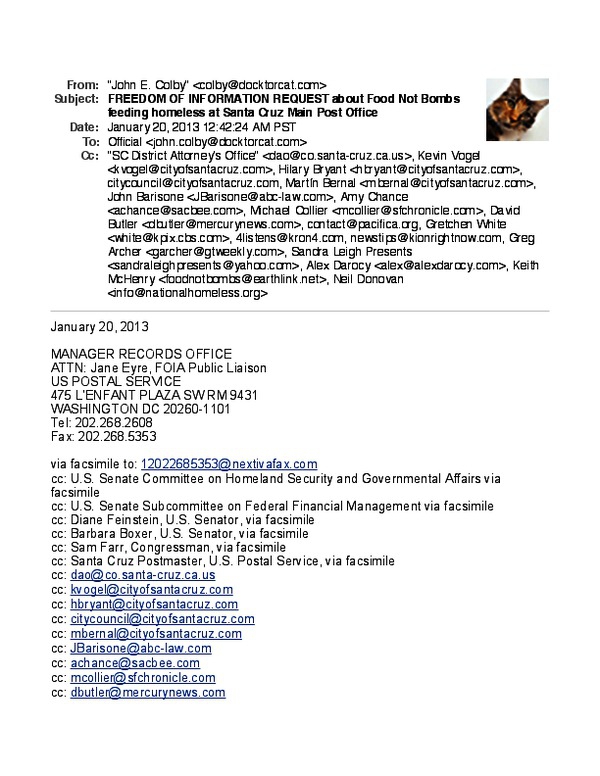
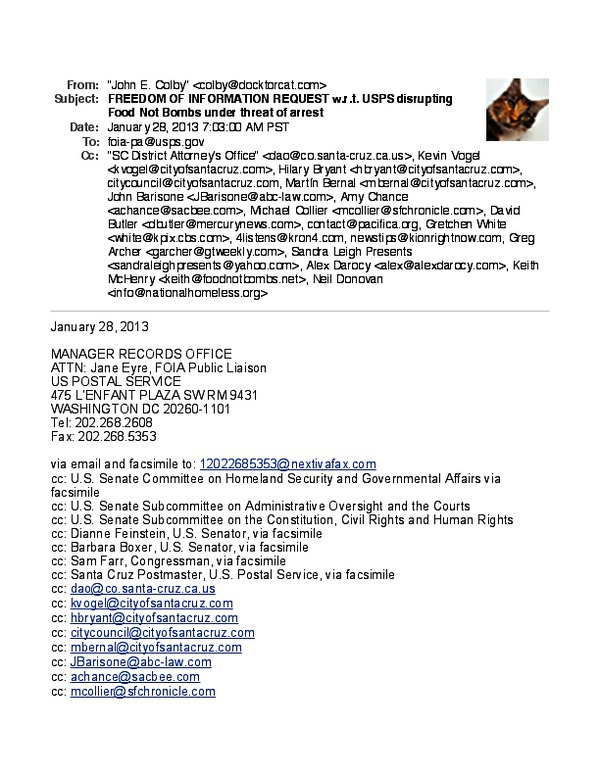
Food Not Bombs Under Attack at Its 4 PM Saturday Feeding on the Main Post Office Steps

For the original article and extensive comments that follow go to – http://www.indybay.org/newsitems/2013/01/19/18730563.php
by Robert Norse

Saturday Jan 19th, 2013 10:43 PM

Arriving with warnings and cameras, two uniformed officers threatened Food Not Bombs workers with criminal actions today for staffing a table distributing meals to hungry and homeless people. The sergeant noted he’d be forwarding information to District Attorney Bob Lee’s office for further action and interrogated several of the workers there while photographing those eating, those serving, and those watching. I sent the following letter to Food Not Bombs co-founder Keith McHenry:

From: rnorse3 [at] hotmail.com
To: foodnotbombs [at] earthlink.net
CC: …
Subject: FNB in Santa Cruz Under Attack
Date: Sat, 19 Jan 2013 22:38:32 -0800Keith:

A police officer and his sergeant superior appeared at the main post office steps today shortly after 4 PM where Food Not Bombs was doing its weekly feeding.

The officer advised the FNBers that they were “trespassing” (though the post office was open; people were coming in and out; the meal was set off too the side in an area not traveled by the usual customers; and FNB workers noted a previous encounter with Sgt. Azua had seemed to establish there were no violations of the law happening). He took a number of photos of the workers, who continued to feed people (30-40 people came through by my casual count in the hour or two that FNB was there). Santa Cruz FNB had been serving at the post office for the last month.

A sergeant arriving afterwards sought names and information from the workers and stated they were “gathering evidence of trespass” at the request of the postmaster.

Several of the workers were upset by this police intervention. A number of those served were scared or angry. The meal continued, but with significant consternation.

The police seemed to indicate they would be returning.

I would encourage you to alert other FNB activists that this is happening in Santa Cruz and they may need support against legal or extralegal police action that seems to now be on the horizon.

I’ll be playing some audio of this on my radio show tomorrow between 9:30 AM and 10:30 AM at 101.3 FM, streaming at http://tunein.com/radio/FRSC-s47254/ , and archived at http://www.radiolibre.org/brb/brb130120.mp3 (about 2 1/2 hours into the audio file).

Please call in (831-427-3772) if you have any suggestions any time before 1 PM PST.
(831-423-4833)

Thanks, Robert

Burdick Babies Bad-Faith Barrister

by Robert Norse
Sunday Jan 6th, 2013 1:55 AM

D.A. Bob Lee’s Bigtop of Fanciful Felonies returns to Department 6 at 9 AM on Monday, January 7th at the County Courthouse for a Preliminary Hearing for the remaining 7 of the Santa Cruz Eleven. It seemed clear, Friday, at the Readiness hearing that Burdick had developed an unusually soft spot in his heart for the terminally-incompetent assistant-D.A. Rebekah Young. who has been handling the case, missing deadlines, misinforming (or lying) to the defense and the court, and failing to provide requested evidence. The defendants are falsely charged with felony conspiracy, felony vandalism, and misdemeanor trespass in the peaceful occupation of bankster Wells Fargo’s leased but 3 1/2 years vacant bank at 75 River St.

TURNING A BLIND EYE TO A PROSECUTION ABUSES IN AUGUST
Back in August, in spite of extensive and perhaps wilful negligence, Rebekah Young got a slap on the wrist and a pass from Judge Burdick. He refused to drop the charges even though Young’s phony reassurances, delays, and outright violations of court orders had delayed the Preliminary Hearing for six months as she ignored defense demands for police reports, video tapes, and internal memos. This was all as of mid-August.

The consequences to the defendants were significant. One remained out of work because of the felony charge. Another had attempted suicide. Two others were living in their vehicles, barely able to scrape up enough money to come to court again and again.

At that August hearing, Burdick added insult to injury. He postponed the hearings for another five months. He also refused to hold an immediate hearing to determine how Young should be sanctioned for her prosecutorial misconduct, delaying the hearing until January 4, 2013—the Friday court appearance.

Then he refused to postponed any sanctions hearing five months and similarly prolonged the agony of the defendants for another half year. Some can not get credentials with phony felony charges hanging over their heads.

Young’s violations were repeated and, it seemed to everyone but Burdick, intentional. she’d explicitly violated court orders to provide all requested information (video and documents requested months before) by August 23rd, upsetting even Burdick. She claimed the D.A.’s office had made all records available for viewing there—an unusual procedure—but every defense attorney present, swore this was simply not the case.

On August 23rd, Burdick also declined to impose any evidentiary sanction (that is, excluding evidence that Young either negligently or intentionally with held in the face of repeated requests).

THE JANUARY 4TH HEARING
It was a fairly short court appearance. Six defendants (Cameron Laurendeau didn’t make it down from the Bay Area) and five attorneys (Jesse Rubin, Franklin “Angel” Alcantara’s lawyer, and Brian Hackett,Gabriella Ripplyphipps lawyer had a sub).

And one judge—Paul Burdick.

The purpose of the hearing was to establish “readiness for the Preliminary Hearing” on Monday January 7th. And to finally—half a year later—establish some punishment for D.A. Rebekah Young’s repeated violation of discovery procedures and court orders, essentially withholding information from the defense and lying about it.

At the January 4th hearing, Burdick had become even more tender-hearted towards Young. Attorney Alexis Briggs (Cameron’s lawyer) suggested that the D.A.’s office or Young personally be required to pay $7000 for her expenses. He gave the attorneys a little more than 48 hours to produce arguments justifying any financial sanctions against her and provide a full record of expenses incurred by the attorneys because of Young’s lawless behavior.

Why, asked several of the defendants, was the judge only considering the consequences to the attorneys—how about the defendants? No attorneys raised the issue.

CONSEQUENCES TO THE REAL VICTIMS
Two cannot get their teaching credentials renewed since questionable felony charges are hanging over their heads. Franklin “Angel” Alcantara missed his grandmother’s funeral in Fresno when forced to attend a hearing in August 2012 on threat of arrest if he didn’t. Defendant, Becky Johnson, was not able to attend her 40th Class Reunion out of state, nor help a longtime girlfriend in Washington State when she provided hospice care for her partner of 25 years until his death October 2nd. Yet at Friday’s hearing, Judge Burdick would only consider sanctions in the form of travel expenses incurred for out-of-county lawyers, and only up to a maximum value of $1000.

As a final insult, Burdick advised Briggs and her fellow attorneys that he would only consider financial sanctions under $1000 even though the expenses of two of the attorneys (David Beauvais and Briggs) were five to seven times that amount. Both had to make repeated trips down for unnecessary court appearances that simply required again postponing because Young had held back evidence.

Why would Burdick consider reimbursing only a small fraction of the costs incurred? Because to grant any amount over $1000 would mean an automatic complaint to the Bar Association—something Burdick didn’t want to happen to the D.A. Young. I was furious about Burdick’s apparent complicity in moving to shield Young from the consequences of her misconduct. And at my attorney David Beauvais when he declined to file such a charge independently. To me, this showed how even “activist” attorneys back off to protect their legal colleagues, privileges and prestige, fearing the condemnation of their peers.

Lee has publicly claimed that his main concern is to pay off Wells Fargo’s inflated and unlikely $26,000 in alleged “damages” before he will consider dropping charges. Burdick stated he intended for the preliminary hearing to last only 1 day beginning Monday at 9:00 AM in Dept 6.

Even though a previous Preliminary Hearing for two defendants had lasted three days, and one for four defendants two days, Rebekah Young in the breezy fashion so typical of her suggested the hearing for seven defendants, would take only one day. This, in spite of the fact she was calling six police officers and the defense at least two witnesses.

The hearing is scheduled to begin at 9 AM Monday morning in Dept. 6. Bring popcorn and tomatoes. There may be a brief meeting of supporters and defendants before the hearing, so come early–particularly if you want a free (for two hours) parking spot.

The opinions above are my own and do not necessarily represent those of any of the other SC-11 or their supporters.

MORE BACKGROUND
For a broader discussion of the background, see my comments following the Santa Cruz Sentinel’s surface-skimming account of the January 4th Readiness Hearing at
http://www.santacruzsentinel.com/localnews/ci_22313495/thirteen-months-later-hearing-set-monday-7-charged .

For more information visit the SC-11 website at http://www.santacruzeleven.org or call SC11 Media liaison, Steven Pleich at 831 466 6078

§Sentinel’s Usual Plus My Comments

by Robert Norse Tuesday Jan 8th, 2013 2:49 AM
at http://www.santacruzsentinel.com/localnews/ci_22328776/no-ruling-yet-whether-those-charged-75-river .

Sgt. Michael Harms, while adopting a wide-eyed “just trying to help” pose–his signature posture–shifted his story several times to attempt to incriminate innocent people.

I actually like Sgt. Harms personally, but the record is pretty clear.

His testimony attempted to smear Gabriella Ripplyphipps as a “spokesperson” for the “conspiracy”, when there was no testimony she was ever in the building but attempted to assist police at their initiative through phone contact and actually going to the police station to (successfully) avert violence and assist the police in clearing the building voluntarily.

Harms also repeatedly mischaracterized the level of noise and inaudible warnings given to the group. He also attempted the ludicrous makeover job of describing the police assault–backed up by a line of menacing police in riot gear as being an attempt to “protect the protesters” (from being hurt by the furniture barricade set up).

In so far as he advised his military-minded superiors (like the ever-smug and sniggering Deputy Chief Steve Clark) to back off, he does need to be credited with avoiding a riot. This, of course, was after having initially provoked scores of people outside the building by using a squad of riot police with active batons instead of real negotiations.

When the community response forced the police to back off ( their Grenadier Squad with “riot control” tear gas, etc. was at the ready and on the scene according to prior testimony), lots of likely property destruction was averted.

I wonder if the next time a protest like this happens, activists will be so trusting and controlled. The duplicity of the police in rewarding the peaceful ending of this occupation with delayed felony charges against peacemakers, reporters, and supporters is likely to be long-remembered.

Outside the courtroom, Harms hypocritically expressed “regret” that he was there, but the force of his testimony showed his intentions, loyalties, and objectives. To incriminate, convict, and make examples of activists engaged in peaceful high-profile protest that challenges corrupt institutions and practices in the community directly.

It’s important to understand his role as a steady opponent of First Amendment activity in Santa Cruz.

From the Drum Circle dragnet to the First Night DIY citations of 2010 against Wes Modes, Whitney Wilde, and Curtis Reliford to the ceaseless vendetta against Anna Richardson and Miguel de Leon to drive them out of the downtown to this latest exercise in hypocrisy, Harms has through his actions shown his true pretentions to social service sweetie as mostly protective color.

Drum Circle Dragnet: http://www.indybay.org/newsitems/2010/05/14/18647910.php http://www.indybay.org/newsitems/2010/04/28/18646028.php
The Richardson/deLeon smackdown: http://www.indybay.org/newsitems/2010/03/20/18642123.php
Undermining the DIY New Year’s Parade: http://www.indybay.org/newsitems/2010/07/18/18654218.php

When the chips are down, Harms is there with the force to intimidate. And intimidation is what this latest judicial jamboree is all about. With a large dash of “saving face” and a sprinkling of meat for the “Take Back Santa Cruz” mob.

LATEST COMMENTS ABOUT THIS ARTICLE
Listed below are the latest comments posted about this article.
These comments are anonymously submitted by website visitors.

TITLE AUTHOR DATE
lawyer clarification Jessica Monday Jan 7th, 2013 5:22 PM

Convicted of “Unlawful Lodging,” Homeless Advocate Linda Lemaster Hopes to Abolish 647(e)

by Alex Darocy

Jan 15th, 2013

More than two years after originally being cited for lodging on the morning of August 10, 2010 during the Peacecamp demonstrations, which were held to protest the sleeping ban that criminalizes homelessness in Santa Cruz, Linda Lemaster’s trial began on November 6, 2012. After three days of listening to testimony, a jury found her guilty of lodging during Peacecamp, and on December 6, Lemaster was sentenced to community service and probation by Judge Rebecca Connolly. In an interview conducted on January 3 of this year, Lemaster said she believes now, even more than when she left the trial, that her being cited for lodging was about breaking up a political protest that relied on a law enforcement strategy that is anti-homeless and has a homeland security agenda. “I don’t think that trial had much if anything to do with justice,” Lemaster said. [Top photo: Linda Lemaster speaks to supporters outside of the Santa Cruz courthouse before her sentencing on December 6, 2012. Scroll down for more photos.]

linda-lemaster-lodging-trial-647_e_-santa-cruz-courthouse-december-6-2012-1.jpg
linda-lemaster-lodging-tr…


“One of my goals is to get rid of this law,” Linda Lemaster said, referring to California Penal Code 647(e), or unlawful lodging. After nearly being removed entirely from the state’s law books in recent years, the law was tweaked a bit, but it still remains. It is mostly used as a move-along law for homeless people in San Diego and Santa Monica, according to Lemaster.

“I think it was a political trial.” Lemaster said.

“The law seems to be used entirely against homeless people and demonstrators right now in California. We haven’t been able to find another recent example of its use.”

Lemaster plans to appeal the conviction, saying, “The appeal is more of a chance to focus on the law, rather than me.”

Some advocate for a change in the lodging law, but she wants it completely removed because, “I just think with that kind of history even if they change it a little, two years, and they will change it a little more.”

Linda Lemaster had been a social and political advocate for the homeless and an activist in Santa Cruz County for over 30 years when she was issued a citation for “unlawful lodging” during the Peacecamp demonstrations. Originally held to protest the sleeping ban in the City of Santa Cruz, section 6.36.010 of the municipal code, which makes it illegal to sleep outside during the hours of 11pm and 8:30am in the city, Peacecamp was initiated at the Santa Cruz County Courthouse and Government Center by a group of local homelessness activists on July 4, 2010.

Community members gathered at the court house during the evenings and either slept or protested there to make a strong statement against the criminalization of homelessness locally. The action quickly grew and began to included a large number of homeless community members who were looking for a safe place to be at night.

Lemaster, the founder of the organization “Housing Now! in Santa Cruz”, originally attended Peacecamp to make one on one contact with both homeless people and other advocates.

“I use Housing Now! in Santa Cruz as a vessel to stay in touch with how homeless people feel about stuff,” Lemaster said about the group that had non-profit status for its first ten years, and was under welfare’s parent support groups. Now it is mostly just her and whatever volunteers she can find.

“Sometimes I’m warning homeless people how to be discreet at night, or this is where the services are. It takes different forms, but because it is ongoing, I think of it as a medium to help me to know when, and how, we can do more,” she said.

“I feel like it is my job through Housing Now! in Santa Cruz to inform other people…to let people know, ‘look this isn’t right, you cant even have a blanket.'”

At Peacecamp, Lemaster found the one on one contact with homeless people and advocates she was looking for. “I’ve gone to a lot of demonstrations…That’s what is consistent no matter where I have been, no matter whether it is a few people or it’s a hundred people…that there are people who never get to express themselves.”

Eventually, Lemaster became part of a support network at the demonstrations that had her, on the evening of August 9 into the morning of August 10, 2010, attempting to stay up all night to help a sick friend who wouldn’t leave.

Over the course of that evening, another friend handed her a blanket, and she wrapped it around herself. She lay down on the concrete outside of the courthouse, and she may have fallen asleep. When deputies arrived early that morning as part of their enforcement campaign against Peacecamp, Lemaster fit their description of who to target for a lodging citation, which she receive at 4am that morning.

Later, that act of taking a blanket and wrapping it around herself as she lay down to rest during Peacecamp, may have played a large part in her conviction, and according to the District Attorney, it was one of the major examples of evidence that she was “unlawfully lodging.”

The definition of lodging that was used can be applied, according to the California penal code, to both public and private places, and in the case of Lemaster’s trial, was worded specifically as follows:

“To lodge means to occupy a place temporarily, or to permanently or temporarily settle or to live in a place. It may, but does not have to include, sleeping, the laying down of bedding, the storing personal belongings, or carrying on cooking activities. Lodging means more than merely falling asleep, but less than moving in permanently.”

Lemaster felt that the process of arriving at the legal definition of lodging to be used in her trial was not fair. “To me it was very frustrating,” she said. She feels that the definition of lodging that deputies were using when they cited people at Peacecamp in 2010 was vastly different from the legal definition arrived at for the purposes of her trial in late 2012.

“Four days in a row….the judge changed her mind out of hearing of the jury about what that would mean,” Lemaster recalled.

Furthermore, whenever the DA came in and said he didn’t like part of the definition they were working on, Lemaster felt that the judge “accommodated him every time.”

After the trial had begun, the DA even wanted to change the definition again, she recalled. “How can you prepare on either side, for your trial, if everyday it’s a different meaning,” Lemaster wondered.

Whether she fell asleep or not on the morning of August 10 at Peacecamp may not have been the primary reason the jury sided against her, according to two members who stayed to discuss their motivations after the verdict was read, Lemaster said.

“The jury foreman said that they all felt that the lodging law would have pertained to anyone once the policeman made his first warning to go, and so they had no choice but to find me guilty,” Lemaster said. She added, “the other guy, not the foreman, said, like two to three minutes passed and you were still there like you wanted to talk to him (like you could have been leaving).”

“I tried to talk to him [the sheriff’s deputy] when they came around ticketing people, which is what made look like I wasn’t going to leave to some jurors, that I stood while people scrambled, so I wasn’t afraid enough,” Lemaster explained.

“If the law is that kind of…soggy, that not moving fast enough makes you lodging and someone else who is scrambling for cover isn’t lodging, there is another good reason that it should be exposed so that ordinary people who have their brains working can get in on this conversation,” she concluded.

To Lemaster, the jury also apparently felt that using the lodging law was justified in breaking up a political protest.

“The jury foreman said that they all felt that the lodging law would have pertained to anyone once the policeman made his first warning to go, and so they had no choice but to find me guilty,” she said.

Lemaster also felt that the judge in her trial treated Peacecamp as a public safety issue, as opposed to a peaceful demonstration.

“The inclination of judge Rebbecca Connolly, was to not acknowledge the demonstration, but look at is as public health and safety issue, but as my attorney Johnathon Gettleman pointed out, if it was a health and safety or public safety issue, there’s an appropriate department of the county government to deal with that, and they didn’t even think to call them.”

“You just can’t have a law that is both landlord-tenant law, pushing homeless-around law, a status crime, a public safety code, and whatever use you want to put it to. You know? I mean, this isn’t England, this is the U.S.A…It’s too broad in general.”

Ultimately, Lemaster felt she was targeted for lodging because she didn’t leave the scene when deputies arrived. “Because I didn’t scurry in fear when the deputies walked up…I must be guilty of lodging.”

“Everybody went with the idea that just being there made me guilty, and that makes me want to appeal it in and of itself, to appeal the decision, that if that jury is correct, then we have this big status crime problem, if just being there is the crime, you know, and if they are wrong, then there is something wrong with the courts. But I am not quite ready to be in the front of that parade, I can see that the courts are under great stress.”

Lemaster sees the possibility of appealing her case as a method of challenging the state’s lodging law, but she says the city and Peacecamp’s original target is still the main issue on her mind.

“I’m still committed to a campaign to change the 6.36.010 sleeping ban for the City of Santa Cruz. It’s a long-term commitment, but we have a city council that there’s is no point in lobbying. I disagree with some other activists that that’s the outlet for educating everyone. I think until people feel differently, ordinary people, we wont get very far exposing how unfair that law is, but it needs to be done when the opportunity comes.”

Over the course of the three decades Lemaster has been involved in homeless issues, she has done everything from feeding people through Food Not Bombs, to working for the county in various official capacities to help the homeless. She has participated in a number of demonstrations, and has chaired governmental bodies concerning homelessness and violence against women. She also has first hand experience; she has been homeless herself.

One example she recalls of an early success in her endeavors to help those without a fixed address, was when she fought for the rights of homeless people to vote.

“Even though it had already been litigated, the county wasn’t letting them register to vote. This was in the very late 70s or maybe 1980 and it took an attorney and I taking them to court, and making us argue all over again that even if they were on a heater grate on the sidewalk, if they were willing to describe where that was, and apply to be a valid voter which you have to do a month before the election, then they are entitled to vote, and it easily won in court once you went to all that trouble,” Lemaster recalled.

She has been involved with governmental agencies long enough to notice a change in how certain issues are being addressed. At the time she was fighting for the right for homeless people to vote, she said that she and other activists wouldn’t necessarily be able to persuade the county to change policies without going to court, but at that time she felt that they could at least, “bring problems one by one to the county government.”

Lemaster’s advocacy work also lead her to help motivate county officials establish a location where welfare recipients in Watsonville could cash their checks. There was a time when those living in the southern part of Santa Cruz County would have to travel to Santa Cruz to cash their benefits checks. After Lemaster paid a personal visit to county officials, a solution was found within two weeks.

The manner in which the authorities dealt with Peacecamp was different, Lemaster noticed.

“What I think is most different now, is there is a set of, I don’t know if they are beliefs, policies, or a driving philosophy, but it seems to me that there is homeland security agenda that has changed how government responds to some situations,” she said.

Lemaster felt that more governmental agencies should have been involved in the decision making process regarding Peacecamp, but none appeared to take an interest in getting involved.

“Now there were people through Peacecamp, there was someone from the SPCA, someone who used to be a county social worker, people who in their own conscience, during the day mostly, came down and checked out who was there. But in the whole infrastructure of county government, nobody thought to do that.”

Consequentially, Lemaster felt that law enforcement was left to deal with Peacecamp on their own, and they handled it as a complaint driven process.

“They made this plan to whip the whole thing out, and give people like me a ticket, based on the complaints they had, as it was shown in the testimony during my trial, and their own first hand perception, what they decided from their own contact, that’s all they had behind them to plan, and I want to go to the county and say I feel that was remiss.”

“They didn’t even think of the court, they didn’t even think of talking to social workers.”

Though some of the individuals who helped devise the plan to deal with Peacecamp were county officials that Lemaster herself had worked with in the past, she pointed out that, “all of these executive decisions were left more or less to Plageman [Lieutenant Fred Plageman of the sheriff’s department].”

Lemaster also pointed to Plageman’s testimony during her trial where he stated that he had looked to law enforcement models that were being employed outside of Santa Cruz County when he found the lodging law, as opposed to looking to social workers within the county.

“It’s like using a nuclear weapon to whip out Hiroshima, It’s a little overkill,” she cautioned.

“They deserve to have the CAO [the County Administrative Office] and the actual County Board of Supervisors, or an appropriate agent in their place as policy maker, in on that conversation, rather than shut down what they knew was a first amendment protest. I know they carefully put words in that warning [the flier that deputies handed at Peacecamp warning individuals they were lodging] saying we were guilty of lodging to make it sound like a demonstration doesn’t count at night, but that’s not true.”

Beyond the police-centered decision making, Lemaster also compared the way deputies conducted law enforcement activities as being “homeland security” influenced.

“At Peacecamp I’m seeing them [sheriff’s deputies] on one day, they are comrades, they put their arm around one of the guys when they walk up to him, they check in with everyone, it’s very casual. They seemed to remember people’s names, even if they hadn’t seen them for a few days,” she recalled.

When it came to the evening she was issued a citation, however, Lemaster felt their demeanor completely changed. She recalled trying to engage in conversation with deputies a number of times that morning, but they wouldn’t answer her questions, telling her, “We’re a team, we can’t talk to you now,” and, “We really have to do this exactly the same [each time], so bare with us,” she recalled.

“Their personal self is still wanting to be comrades, but they have a protocol, and in my opinion, it’s a homeland security protocol,” Lemaster observed.

“They were like people one day, and then when they decided, they got their lodging law and decided a campaign, they stayed in the role of this military, four man team. Two four man teams the first night, and one the night I was there.”

“That’s why I was having trouble getting to ask a question,” she explained “They said that, ‘We have to treat each one of you exactly the same.'”

“Indicating it was a military approach,” Lemaster thought.

She also felt that this “military” approach, as she put it, was expanded on when the Santa Cruz County Sheriff’s department used similar law enforcement techniques during the period Occupy Santa Cruz spent at the courthouse in 2011, which was during the height of the national occupy movement.

“Because Peacecamp had happened, and up to that point they had gotten away with it, they were willing to feel a little more emboldened and capable of the larger group with this homeland security type approach at Occupy Santa Cruz,” she said.

An even deeper problem for Lemaster is anti-homeless bigotry, which she feels is “pervasive” and says is also something that had to do with law enforcement’s strategies for dealing with Peacecamp.

“I really believe the sheriff’s deputies would have had a more adequate strategy if they weren’t being reactionary, and I believe they were reacting to people in the county building complaining. Complaining about the same old stuff everybody complains about, about a fifth of which is even possibly true.”

Peacecamp was reportedly receiving sanitation-related complaints, and Lemaster felt the complaints which were from county employees working in the building, who were coming into first-hand contact with the demonstration, were really about homeless people themselves, and they weren’t fair.

“We don’t go around excoriating each other for smoking cigarettes,” she observed, “but we go around excoriating homeless people for leaving a butt behind, as if they had a choice.”

“As long as they were looking at all the homeless people crashed there, and their friends, as “the other” they’re not really looking at the whole situation when they have to resolve a problem.”

“Homeless people come from the same culture that we come from when we are not homeless, but they have to live in a culture that is much more immediate and much more dangerous.

“I expect more from law enforcement. When they are bringing extra people out, I think they need to study the problem beforehand.”

Even though Lemaster feels her ability to communicate directly with the county has changed over the years, she said, “I consider them my allies still.”

“We used to go to the same workshops together…we used to be immediate allies…we used to be part of a team that would confront people,” Lemaster said about some of the county officials who had a say in the decision making process regarding law enforcement strategies at Peacecamp.

“Because of the adversarial nature of the court, and in my opinion you don’t have to be honest in court these days, We are put like we are on two different sides of a team that is at war with each other, and that is the opposite of what I just tried to do for most of my time. that I had any choice about, in the last 40 years. It was frustrating.”

Even more frustrating for Lemaster was how she effectively became silenced during her trial, saying, “I was put out of my life, I was put out of my volunteer work, my relationship to my community, because I had to hold my tongue as far as anything in the county was concerned.”

While Lemaster felt she was once able to visit in person any and every county official she wanted to communicate with, being on trial for lodging forced her to hold her tongue in many situations she once would have openly confronted, because she feared her actions or words could have been used against her in some way during her trial.

“I’ve been doing something for 40 years to help poor people, and one part of that is when I find something where the system doesn’t work, I try to show that to people, or even fix it, or help fix it, or find out who can fix it.

“So if it is people on GA [General assistance] can’t get GA if they are not already in the system, that’s easy to fix, you just tell everyone, and then they’ll say, ‘OK,’ and it somehow trickles up to the Board of Supervisors eventually.”

“Real people suffered because I wasn’t able to be that liaison for them,” Lemaster said.

When defending her decision to not plead guilty, or take a plea deal, Lemaster was not only informed by her outlook as a Quaker, which guides her to never lie, but also by a desire to maintain a certain moral high ground in the community as an advocate for others.

“Doing the kind of changes that affect people in some practical way in their lives for the better requires a credibility,” she said.

Lemaster said she was offered a plea deal by the District Attorney’s office in 2011 which would have reduced her misdemeanor to an infraction if she would plead guilty to “disturbing the peace.”

“I wouldn’t have minded the infraction’s apparent purpose. But I was being asked to say that I was disturbing the peace on Dec 10th at 4 am or so? I mean, they wanted me to say either guilty or no contest. They were asking me to say an outright lie, expecting me to,” Lemaster recalled.

“I couldn’t,” Lemaster explained.

To her, pleading guilty would have felt like, “totally denying PeaceCamp2010, my new friends from there, and what it had meant to me…it was just that compromise that felt like being pressed to lie.”

“I don’t think that trial had much if anything to do with seeking justice,” Lemaster concluded. “I think it was a political trial, and I feel strongly about that, more so than when I left the trial…I think the District Attorney was given political marching orders when they picked him.”

“In our country and in Santa Cruz County, is this a homeland security state where the government decides who is a terrorist, or who is a good citizen, or who is not even worthy of naming? Or is Santa Cruz County still under the Constitution that we think of as the lead legal document of our land, where people even if they happen to be homeless have certain civil rights, and even some human rights are acknowledged in our constitution, and even more clearly so in the state constitution.”

Lemaster plans to continue raising awareness about the laws that outlaw sleep in Santa Cruz.

She also plans to file an appeal in her case to fight Judge Connolly’s claims that the lodging law is constitutional, and she wants to make a presentation before the Santa Cruz County Board of Supervisors that outlines “missteps” on the county’s part in relation to how sheriff’s dealt with Peacecamp 2010.

Finally, Lemaster also wants to begin a campaign that she hopes will achieve statewide participation of “homeless friendly” groups and supporters to, “take the lodging law 647(e) off the books.”

Lemaster calls her motivation a, “simple and moral imperative,” because, “consequences are way too harsh for houseless and homeless folks. It has to get exposed.”

Lemaster feels that Santa Cruz is poised to be a leader in finding better solutions to end homelessness.

“The legislature is under the same pressures that the court is, and the county is, and their deputies, to keep the homeless out of sight, because within the scheme of things, within our status quo, our government’s status quo, they don’t have the tools they need to solve the problem.”

“So, under pressure from the citizenry at large, and whatever delusions some of them are carrying with them, the police just keep pushing them back, and criminalizing them, sweeping them. If you have to shove them in a van, or put them in jail overnight, at least that curb is clear.”

“It’s the mentality of LA, and small towns like Yreka, and obviously in Santa Cruz. Santa Cruz could be a leader. The City and County of Santa Cruz could be a leader in finding solutions.”

“They are going to have to be a leader, in either a kind of demonic abuse of people, or solutions that are inclusive. One way or the other, just because of the cost of housing here, and not having the infrastructure that a city would have for people when they fall, or when they are hurt, or when they can’t get to the hospital.”

Note: The following is a first hand account of Linda Lemaster’s lodging trial in November of 2012. It primarily focuses on evidence and testimony that was admitted into the court record, as opposed to an analysis of the legal arguments in the trial, though some of the legal wrangling was noted.

For a complete report of Linda Lemaster’s trial for unlawful lodging, either scroll past the photos at the bottom of this article, or click on this link to go directly there:
http://www.indybay.org/newsitems/2013/01/15/18730225.php#18730255

For more information about Linda Lemaster and her work advocating for poor people and the homeless, see her blog at:

http://hearthbylinda.blogspot.com/

Alex Darocy
http://alexdarocy.blogspot.com/

MORE PHOTOS AND COMMENTS AT http://www.indybay.org/newsitems/2013/01/15/18730225.php
Santa Cruz Eleven Down to Four and Conspiracy Charges Dismissed at Preliminary Hearing

Image

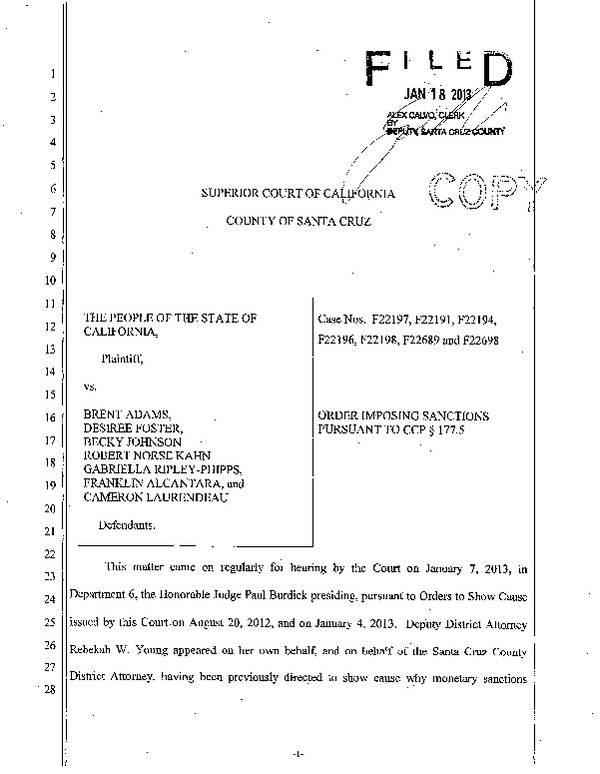
At a preliminary hearing on January 8, holds were removed on three community members who were charged in association with the 75 River bank occupation in Santa Cruz. All of the charges against Desiree Foster, Robert Norse, and Becky Johnson have been effectively dismissed by Santa Cruz Judge Paul P. Burdick. Charges still remain in effect for four defendants, Brent Adams, Franklin “Angel” Alcantara, Gabriella Ripley-Phipps, and Cameron Laurendeau, and Burdick removed conspiracy from the counts they face. Their arraignment date was set for January 22 in Santa Cruz. Additionally, the judge sanctioned District Attorney Rebekah Young with a $500 fine for the violation of a discovery order, saying that he had never imposed a sanction like this on the District Attorney’s office before. [Photo: After the hearing concluded.]


santa-cruz-eleven-prelim-courthouse-january-8-2013-1.jpg
santa-cruz-eleven-prelim-…


The January 8 court appearance was the second day of a preliminary hearing for the seven defendants, and after the prosecution had called all of its witnesses, Robert Norse’s attorney was preparing to call their first defense witness when Judge Burdick stopped them, saying that testimony on behalf of Norse may be unnecessary.Burdick stated that he wasn’t seeing any evidence that there was an agreement to trespass, which was necessary to establish the conspiracy charge against all seven defendants, and about Norse, Johnson, and Foster specifically, he stated that he had heard nothing to lead him to believe that they were present in the bank building after police had arrived on scene to give what he described as “the warning” that they were trespassing.After a break, Burdick gave the attorneys on both sides a chance to respond to the legal issues he had referenced.
The judge began by stating that he had found that the evidence showed that the authority to remove demonstrators from the building wasn’t given by Wells Fargo until 6 or 6:30 pm on November 1, and the warnings and “no trespassing” fliers weren’t posted on the building by the police until December 1.The judge stated that the evidence further showed that Foster, Johnson, and Norse were not observed on the premises after 6:30 pm, meaning they were not “given notice” that they were trespassing, which is a requirement of the section of the code they were being charged with, 602(o). 602(o) also requires a refusal to leave after having been given notice.
In the absence of these requirements, the judge asked what evidence the prosecution had for conspiracy.”Conspiracy can be shown by conduct,” Young said, and she gave an example of police testimony that stated Desiree Foster was seen in front of the bank, “waving people in.”The judge responded by citing a 1990 ruling which found that for crimes which have been alleged to have occurred during free speech assemblies, “something more than circumstantial evidence” is required to prove conspiracy.

Judge Burdick stated that the occupation of the bank at 75 River appeared to be a “spontaneous occupation” after the doorway was opened with a key, and that it wasn’t shown that there was an agreement made to commit a crime. He then stated that he wasn’t going to hold any of the defendants on the conspiracy count.

Community members first entered the vacant bank building located at 75 River Street in Santa Cruz after a march to it and other banks on November 30, 2011, which was during the height of the national occupy movement. The march to 75 River Street was promoted as a march to a “foreclosed property” and initially the address of the location was not given out by the organizers. Some of those involved said they wanted to turn the large building, which had been vacant for more than two years at the time, into a community center.

The space, which is leased by Wells Fargo from the owner Barry Swenson, was eventually abandoned by the demonstrators on December 2, but some damage was left as a result of the occupation, and the estimated costs to repair it justified felony charges in the eyes of the District Attorney’s office.

In February of 2012, Eleven people were charged in association with the occupation, and charges against them included felony conspiracy to commit vandalism and/or trespass, felony vandalism, misdemeanor trespass by entering and occupying, and misdemeanor trespass by refusing to leave private property.

Preliminary hearings began in February for all eleven individuals, and charges were dismissed against Ed Rector and Grant Wilson by Judge Burdick in April of 2012, and Bradley Stuart Allen and Alex Darocy, both Indybay journalists, had the charges against them dismissed also by Burdick in May of 2012.

The remaining four defendants now have two weeks until their arraignment on counts which have been reduced to misdemeanor trespass (602(o)), and felony vandalism, which the judge found was a “natural and probable outcome” of the trespass (the so-called aiding and abetting legal theory).

“I do not want this case to linger,” Judge Burdick stated.

The final matter dealt with at the preliminary hearing was the sanction against DA Young.

“I do not believe DA Young was acting in bad faith,” Judge Burdick stated, but he added that there was no “substantial justification,” for her non-compliance with discovery orders given in 2012.

The judge found that her actions had caused a six month delay in the preliminary hearings, and defense attorneys pointed out that the “consequences to defendants were great.”

Two defendants had to sleep in their cars as a result of the delays, one defendant missed a family member’s funeral, and a variety of other serious life-impacts were described.

Defense attorneys wanted the fine increased to $1500, but Judge Burdick left it at $500 to cover “clerk’s expenses,” and the defense attorneys weren’t compensated in any way for the extra time they put in.

The arraignment for defendants Brent Adams, Franklin “Angel” Alcantara, Gabriella Ripley-Phipps, and Cameron Laurendeau is set for January 22 at 8:15.

For more information about those charged, see:
http://santacruzeleven.org/

Alex Darocy
http://alexdarocy.blogspot.com/

§Inside the courtroom after the hearing concluded

by Alex Darocy Thursday Jan 10th, 2013 5:50 AM


santa-cruz-eleven-prelim-courthouse-january-8-2013-2.jpg
santa-cruz-eleven-prelim-…


After the hearing concluded, supporters were excited that three more individuals had the charges against them dismissed.

§Robert Norse speaks with Gabriella Ripley-Phipps

by Alex Darocy Thursday Jan 10th, 2013 5:50 AM


santa-cruz-eleven-prelim-courthouse-january-8-2013-3.jpg
santa-cruz-eleven-prelim-…


Robert Norse (on the right) speaks briefly with Gabriella Ripley-Phipps as she left the courtroom after the hearing concluded.

§Becky Johnson

by Alex Darocy Thursday Jan 10th, 2013 5:50 AM


santa-cruz-eleven-prelim-courthouse-january-8-2013-4.jpg
santa-cruz-eleven-prelim-…


Grant Wilson looks on as Becky Johnson and her attorney are interviewed after the hearing concluded.

§Franklin “Angel” Alcantara, Desiree Foster, Becky Johnson

by Alex Darocy Thursday Jan 10th, 2013 5:50 AM


santa-cruz-eleven-prelim-courthouse-january-8-2013-5.jpg
santa-cruz-eleven-prelim-…


Featured in this picture: Franklin “Angel” Alcantara on the left, Desiree Foster and her mother and her attorney, and to the right Becky Johnson, after the hearing concluded.

§Brent Adams

by Alex Darocy Thursday Jan 10th, 2013 5:50 AM


santa-cruz-eleven-prelim-courthouse-january-8-2013-6.jpg
santa-cruz-eleven-prelim-…


Brent Adams speaks with his attorney after the hearing concluded.

§Robert Norse, Franklin “Angel” Alcantara

by Alex Darocy Thursday Jan 10th, 2013 5:50 AM


santa-cruz-eleven-prelim-courthouse-january-8-2013-7.jpg
santa-cruz-eleven-prelim-…


Robert Norse on the left and Franklin “Angel” Alcantara to the right, after the hearing concluded.

§Before the hearing concluded

by Alex Darocy Thursday Jan 10th, 2013 5:50 AM


santa-cruz-eleven-prelim-courthouse-january-8-2013-8.jpg
santa-cruz-eleven-prelim-…


Robert Norse with Gabriella Ripley-Phipps and her mother. Before the hearing concluded the mood was considerably lighter. Cameron Laurendeau tries to relax a bit in the background.

§Correction

by Alex Darocy ( alex [at] alexdarocy.com ) Thursday Jan 10th, 2013 5:06 PM
Cameron Laurendeau’s arraignment hearing is scheduled for February 1, not January 22 with the others, due to a work scheduling conflict.

Comments  

by Robert Norse

Thursday Jan 10th, 2013 1:07 PM

Nice coverage in word and photo, AlexBURDICK AIDS AND ABETS AN ONGOING POLITICAL PROSECUTION
Burdick’s theory was a strange one. He held that evidence that the four remaining defendants were guilty of misdemeanor”trespass after being warned to leave” (PC 602o) justified holding them for “felony vandalism”.

This, even though no evidence was presented by the D.A. after 11 months that any of them vandalized.

Burdick claimed that it was a “natural and probable outcome” of four people who had allegedly been told to leave and then refused to do so. How so?

The argument, if you credit it at all, in this kind of peaceful First Amendment protest, goes better with the charge that Burdick dropped for all the defendants–602M, trespass to occupy. If proved, I suppose, it might by this tortured “aiding and abetting” argument link someone “occupying” with the damage done by someone else at some other time–since it was an “occupation”. Burdick, however, dropped these charges.

But failure to leave at one point is clearly unrelated to vandalism committed by parties unknown sometime in the three day period.

As a spontaneous First Amendment demonstration, there might have been dozens of people willing to openly acknowledge and face “trespass” charges in court for a peaceful brief occupation of a 3 1/2 year vacant bank building as a matter of principle–however Bob Lee, burnishing his “law ‘n order” image came back with these absurd felony conspiracy and vandalism charges. But the charges were unnecessary to begin with, because everyone left the building–peacefully.

The action, as I understood it, was taken to expose Wells Fargo and challenge the waste of vacant building space and need for a community center and homeless shelter here in Santa Cruz. These are simply facts which few dispute.

INFLATED CHARGES MARCH ON
But D.A. Lee inflated the charges with felony conspiracy and felony vandalism, presenting no evidence of either conspiracy or vandalism (by the people specifically charged). Some might suggest this shows shoddy police and D.A. work since police had the option to enter the bank and ID/detain/cite/arrest the people inside at any time during the three days. Particularly after the large crowd of people outside the bank on November 30th had dispersed. Or send in undercover cops to document the real perpetrators of vandalism.

Instead police chose to selectively target and then forward some of their least-favorite activists for prosecution to the D.A., ignoring numerous others, claiming they “couldn’t identify” anyone else. And the D.A. chose to prosecute some of those least-favorite activists, ignoring some (including former Mayor Beiers whom the police had recommended for prosecution).

The whining and abusive accusations of Deputy-Chief Steve Clark denouncing Burdick seem an additional pit of clueless cacophony in this ongoing circus. Or a self-serving commotion to distract from his own department’s bad decisions. See http://www.kionrightnow.com/story/20548286/police-das-office-respond-to-charges-dropped-for-3-bank-protesters.

Once set in motion, the prosecutorial juggernaut was supposed to roll on, I guess- regardless of how crappy Clark’s SCPD work was. The whole scene gives the impression of a political prosecution arranged to save the face of the SCPD, assist in intimidating the (already dispersed) Occupy Santa Cruz movement, and provide a kind of “show trial” for political activists in the to show how “tough” on direct action First Amendment activity the SCPD and their pals in Bob Lee’s office could be. Allcosting far far more than the supposed damages in the building.

SCPD LOOKS FOR SCAPEGOATS FOR ITS OWN BAD CHOICES
At the time, I thought that Chief Vogel made a good decision not to continue the violent assault of the SCPD in front of the building which they began (and were ready to reinforce with chemical weaponry, according to court testimony). However those who cooperated with the SCPD to help a “peaceful exit”, were ultimately punished for their good deeds and face prison time now. Even though the actual evidence presented by police and prosecution do not add up to the elements of the two crimes–something that will hopefully be shown at trial if these charges survive a Motion to Dismiss, coming up after the Arraignments later this month.

Finally, Bob Lee assigns one inexperienced relatively clueless assistant D.A. to face eleven defense lawyers. Given that she got endless support from judges along the way, who ok-ed time and time again on her failure to provide requested evidence, perhaps D.A. Bob Lee felt she didn’t need additional help. But if he were really serious, I’d have thought he’d provided her with additional back-up once her cases were dismissed one after another.

The fact that he did not further indicates this is some kind of token effort, perhaps undertaken out of concern for impoverished banksters in town? Or done to appease rising right-wing forces before the November election? Who knows?

THE REAL ISSUES
All charges needed to be dropped. Real sanctions not just token ones need to be pressed against Rebekah Young, even if that means formal complaints to the Bar Association with real consequences. Civil lawsuits need to be filed against the authorities who masterminded this life-consuming ordeal of the last year. New standards for police and prosecutorial behavior need to be established to restore the First Amendment here in Santa Cruz and lift the fear that has hovered over the activist community.

Empty buildings are the crime. Freezing weather is the reality. Foreclosure is the continuing threat. And the real criminals are at large and in power.

by Linda Ellen Lemaster

Thursday Jan 10th, 2013 2:14 PM

Left the courtroom after hearing Honorable Judge Paul Burdick’s terms and decisions for the coming Trial, thinking about the “sanctions” Burdick imposed on assistant D A Rebecca Young’s “quality of work”, especially regarding disclosure of evidence, to Indictees and their legal counsel.The judge said it’s important that the amount be modest so as not to trigger a California Bar Assn or state ‘trigger’ with misconduct charges against Young a possibility. So he decreed $500+ to go to the court clerk’s department. As defendant Becky Johnson noted after court, “No wonder, the recording clerks are working on seven cases at once!”

So goes the Empire in the hologram of Usury.

Compassionate Judge Burdick? Or perhaps attempting even-handedness? At any rate, Burdick went on to note how rarely a judge actually invokes Ssnction orders. Culminating with, “In fact I have never done this before.” Then Judge Burdick seemed to reassert the authority of his own Black Robes and the real moment we all shared in his courtroom, and promised the trial would be fast and on track.

I believe that the sanctions are even more significant as part of the Santa Cruz Eleven story BECAUSE the judge was bent on keeping his “punishment” or fine with the confines of the pretrial. I lately consider what we’ve learned of impacts between Homeland Security, the FBI and Wall Street money crooks amplifying some sort of Shadow Government running amok. So it is refreshing to see this judge reassert his authority. I wish him the luck of Solomon.

by John Thielking

Friday Jan 11th, 2013 6:28 AM

Congratulations on Robert, Becky and one other person getting their charges dismissed. Since Rebecca Young (quoted in the ch 46 article http://www.kionrightnow.com/story/20548286/police-das-office-respond-to-charges-dropped-for-3-bank-protesters) agrees with the judge on the legal technicality surrounding the dismissal decision, I see little likelyhood that charges will be refiled against those 3 defendants.

by Denica

Friday Jan 11th, 2013 7:47 AM

Great news. Had to sit this one out cause I have a terrible cough but was there in spirit. This has been daunting and unfair towards some really inspirational people.

by Sylvia

Friday Jan 11th, 2013 9:28 AM

“If you change the way you look at things, the things you look at change.”Max Planck

A police officer testified to expectations of hostility, aggression, a superbowl-like atmosphere, that vandalism was inevitable. I wonder locally what events he based that on, what crowds, what rallies, what demonstrations at the Town Clock that turned negative. Even trained observers can see what they expect to see. Disorder was expected; police arrived in riot gear and had tear gas on call. Local activists were expected; police identified and charged one person who was only on the grass. The judge believes vandalism is a ‘natural and inevitable consequence’ of trespass.

Social change is about changing the historic consequences, setting new expectations and results. The police looked at the bandanna masks and saw attempts to evade identification. I saw the bandannas as symbols of cohesion and support, like the pink ribbons, yellow ribbons, other cause identifiers. Law enforcement seems to be looking for leaders, individuals to blame and punish — a leaderless group doesn’t fit the structure: the success or blame goes to the project.

There had been federally orchestrated enforcement and suppression – this lens created the view. Santa Cruz Police Department was compliant. – they found what it expected and helped create it.

by Robert Norse

Friday Jan 11th, 2013 5:58 PM

The City on a Hill story on the dismissals and arraignments is at http://www.cityonahillpress.com/2013/01/10/santa-cruz-eleven-down-to-four/.My comments on that story:

The D.A., SCPD, and media swooped down on a peaceful protest designed to bring attention to the officially-tolerated (indeed government-funded) bankster frauds of Wells Fargo.   Rather than developing a strategy for reining in the Wells Fargo criminals whose crimes created damages exponentially greater than any vandalism that happened at the vacant bank.

There was no evidence presented any time during the last eleven months (at endless court appearances) that any of the defendants (including the for still being held for trial) had anything to do with the vandalism.  Additionally, based on my understanding of the events, I would say that these defendants had nothing to do with the graffiti and damage that occurred.  Ironically the evidence presented by the D.A. shows that several of those charged went to some lenghs at personal risk to encourage a peaceful outcome to the whole situation–successfully.   No good deed goes unpunished, as the saying goes.

The legalistic noose by which assistant D.A. Young now tries to hang the remaining four of the Santa Cruz Eleven is an absurd legal theory that defines common sense.  It runs like this.  If  they “trespassed” in the bank at any time, then the “necessary and probably consequence” of that “trespass”  was to “aid and abet” anonymous identified vandals–even if the defendants never knew them or their actions, entered and left before they arrived, etc.

Further, Young by no means presented any persuasive evidence that the four even trespassed.  The definition of 602o requires not just that you be seen in the building by a police officer, but that you be told by the owner’s agent to leave and then refuse to do so.   If that’s not proven, Young’s crazy “aiding and abetting”felony vandalism charges (punishable  by three years in prison) get flushed away.  Her only “evidence of vandalism” is the claimt hat the remaining defendants were illegally there and that their mere presence magically  “aided and abetted”.

Why would Burdick buy such a farfetched theory?   He said at an earlier Preliminary Hearing he was very upset at the vandalism apparently wanted someone to pay for the damage.   Apparently anyone present will do.  He may also have felt sufficient political pressure that required him to scapegoat someone responsible for the exorbitant charges that Wells Fargo claimed they paid in the clean-up–business given to out-of-county companies when presumably cheaper local business were available.

Police couldn’t or didn’t bother to actually document and identify real vandals on the scene and make arrests there–even for trespass.  They could have done this without risk to the officers or the people in the building after the first night.   But without real suspects, Burdick is stuck with the people the police forwarded–who also largely happen to be high-profile activists whose political actions they dislike.  So Burdick holds four for arraignment and trial.

After that January 22nd arraignment (for 3 of the 3), there’ll doubtless be a Motion to Dismiss.  A similar motion ended the court nightmare for two earlier defendants (reporters Bradley Allen and Alex Darocy) earlier this year.  The dismissal motion will be heard before another judge.  Before the  community dares to hope, remember that this is a well-oiled, politically-biased judiciary.  don’t count on any sense of justice burrowing its way through D.A. Bob Lee’s year-long and mile-high mound of crap.

Young’s claim that she came up with “new evidence”, for example, is another lie (among many she’s told the court).  The testimony of Sgt. Harms was not new, but was available when she screwed up the first Prelminary Hearing against Alcantara and Laurendau by having Detective Gunter contradict himself  on the stand about so simple an issue as what day he was there.  That should have been the end of the case there, along with strong sanctions for her withholding evidence and lying about it to the defense and the court.

Instead, Judge Burdick apparently believing it was Be Kind to Incompetent D.A.’s Week let her drag the case on for another nine months–and now for god knows how many months into 2013.

I’ve let myself spend far too much time writing about this phony case.  I can’t seem to help myself.

We must return to the original focus:  justice and equity.  Don’t let the police and prosecution terorize us into finding real and immediate answers to far more important questions.

How do we address survival threats against the homeless community (who face freezing temperatures, shelter for less than 10% of them, and official harassment under the Sleeping and Camping Bans)?

How do we end the wellp-financed foreclosure fraud menace of Wells Fargo and its bankster buds?

Empty buildings and obscene profits are the crime.  Those who waste time and money harassing the taxpayers are the criminals

by A. Supporter

Friday Jan 11th, 2013 7:26 PM

And what do the remaining four want the community to do for them?

by John E. Colby

Friday Jan 11th, 2013 11:41 PM

DA Bob Lee and his incompetent prosecutor Rebekah Young laid themselves as well as City and County government open to serious lawsuits. They can be sued for color of law violations amongst others like prosecutorial misconduct. The SCPD opened the City of Santa Cruz up to litigation by their officers perjuring themselves and advising DA Bob Lee to charge the Santa Cruz Eleven.The City and County of Santa Cruz have deep pockets. They, DA Bob Lee and prosecutor Rebekah Young must be held accountable so there is no repeat of this debacle.

I advise the Santa Cruz Eleven to shop for good attorneys ASAP. Remember to file tort claims against the City and County within 90 days of the dismissal of your cases to preserve your rights to sue City and County government.

by Legal eagle

Saturday Jan 12th, 2013 12:07 PM

…prosecutors are absolutely immune from being sued for their decisions whether or not to pursue charges. Before posting the nonsense you do, talk with a real lawyer…

by John E. Colby

Saturday Jan 12th, 2013 2:14 PM

Prosecutors are not immune to being sued for prosecutorial misconduct and violating civil rights under color of law. They are not immune to being sued for abusing their positions of authority.

by John E. Colby

Sunday Jan 13th, 2013 3:16 AM

Reading on the topic of litigating against prosecutors for misconduct shows that prosecutors enjoy far reaching immunity from lawsuits because of past Superme Court decisions:http://usatoday30.usatoday.com/news/washington/judicial/2010-10-05-federal-prosecutor-immunity_N.htm

Thus Bob Lee and Rebekah Young thought they could misbehave with impunity.

However they are subject to administrative complaints filed with the California and American Bar Associations. They can be fined. Their bar licenses can suspended or taken away.

Yet I think the more effective route is to file color of law complaints with the U.S. Department of Justice (USDOJ) and the FBI. The USDOJ and FBI have far ranging powers to obtain evidence, interview witnesses and use other means to pursue their investigations. The USDOJ and FBI can apply both civil and criminal sanctions.

http://www.fbi.gov/about-us/investigate/civilrights/color_of_law

I recommend filing bar complaints — it can’t hurt — and filing color of law complaints too. Bob Lee and Rebekah Young must be held accountable. They cannot walk away thinking they are above the law. Asserting your rights protects the rights of those who come behind you. Ensure Bob Lee and Rebekah Young are never able to persecute obviously innocent citizens.

Bob Lee and Rebekah Young believe they are above the law. That’s why they were so arrogant. They cannot not walk away without consequences. That would truly be a crime.

by Legal eagle

Sunday Jan 13th, 2013 6:26 PM

…at your link John. It appears the “color of law” statutes only apply to law enforcement officers and not prosecutors. The FBI has no jurisdiction to investigate the DA’s office.

by John E. Colby

Sunday Jan 13th, 2013 10:05 PM

The District Attorney’s Office is a local law enforcement agency. They have engaged in a pattern or practice of conduct that deprives persons of rights protected by the Constitution or U.S. laws. The U.S. Department of Justice is empowered to initiate a civil action against the Santa Cruz County District Attorney’s Office. Their criminal division is empowered to investigate corrupt local officials.Watch out Bob Lee and Rebekah Young.

To quote from the FBI website:

“Civil Applications

Title 42, U.S.C., Section 14141 makes it unlawful for state or local law enforcement agencies to allow officers to engage in a pattern or practice of conduct that deprives persons of rights protected by the Constitution or U.S. laws. This law, commonly referred to as the Police Misconduct Statute, gives the Department of Justice authority to seek civil remedies in cases where law enforcement agencies have policies or practices that foster a pattern of misconduct by employees. This action is directed against an agency, not against individual officers. The types of issues which may initiate a pattern and practice investigation include:

Lack of supervision/monitoring of officers’ actions;
Lack of justification or reporting by officers on incidents involving the use of force;
Lack of, or improper training of, officers; and
Citizen complaint processes that treat complainants as adversaries.
Under Title 42, U.S.C., Section 1997, the Department of Justice has the ability to initiate civil actions against mental hospitals, retardation facilities, jails, prisons, nursing homes, and juvenile detention facilities when there are allegations of systemic derivations of the constitutional rights of institutionalized persons.”

by Legal eagle

Monday Jan 14th, 2013 5:50 AM

…John, I realize we may be getting into semantics here, but the DA’s office is not a law enforcement agency. Only people who pack badges and guns are law enforcement. The DA is the “People’s” lawyer, representing the State of California and victims of crimes in court. The top law enforcement officer in any county is not the DA but the sheriff. Your “color of law” theory has no wings…

by Sylvia

Monday Jan 14th, 2013 10:44 AM

So to whom is the DA accountable? The Board of Supervisors refuses oversight, wouldn’t reduce the DA’s budget. I’m not aware of any cost-benefit analyses. The office is elected, accountable to the voters. Is a recall petition the only move? And what’s the point of that if there is not another candidate?

by Legal eagle

Monday Jan 14th, 2013 1:40 PM

…is up to the voters. And the civil grand jury, if a complaint is filed and the jury decides to investigate.

by John E. Colby

Monday Jan 14th, 2013 1:52 PM

To quote:”The District Attorney is the chief law enforcement officer of the county and works closely with all police departments in the county and state and federal law enforcement officials on investigations and crime-fighting and public safety initiatives.”

http://www.lehighcounty.org/departments/districtattorney/tabid/542/default.aspx

To quote:

“A District Attorney is the chief law enforcement officer for the county in which he/she is elected.”

http://www.luzernecounty.org/county/row_offices/district_attorney

To quote:

“By law, the district attorney is the chief law enforcement officer in the county.”

http://www.co.lake.ca.us/Assets/DistrictAttorney/docs/What+is+a+Prosecutor.pdf

by G

Monday Jan 14th, 2013 2:58 PM

Yes, where is the accountability? Who has jurisdiction over whom? The consent of the governed is a fragile thing!It is interesting to note how consistently lax and hand wavy the ‘law and order’ crowd is when it comes to the tyranny of the SCPD, DA, and Santa Cruz County judges (and large, felonious corporations, etc). In fact, one could easily draw the conclusion that apologists for authoritarianism are a reliable indicator of where the problems lie…

Someone say hey to Angel for me. There in spirit.

Assemblyman Ammiano’s Homeless Bill of Rights Sounds Better Than Expected

Ammiano’s “Homeless Bill of Rights”: Part Civil Rights, Part Prison Reform

Posted on 09 January 2013

By Dan Aiello


State Assemblyman Tom Ammiano (D-San Francisco) is following through on his promise to reform California’s prisons with the introduction of a homeless rights bill intended to decriminalize homelessness in the Golden State, protecting “some of society’s most vulnerable members.”

Make no mistake, Assembly Bill 5 is as much prison reform, as it is civil rights, legislation.

Among other things, the proposed law would require legal representation for anyone cited under local loitering, camping or panhandling ordinances.

It would give “every person in the state, regardless of actual or perceived housing status,” the rights to “use and move freely in public spaces,” to “rest in public spaces,” and to “occupy vehicles, either to rest or use for the purposes of shelter, for 24 hours a day, seven days a week,” according to Ammiano’s press release.

“Overall, this bill is about not being discriminated against if you are homeless,” said Ammiano. “A lot of it is aspirational. This is what we would love in a perfect world,” said Ammiano today.


In an interview last month regarding the Assemblyman’s wish to see significant prison reform, Ammiano told California Progress Report that our prisons have been an expensive “weapon of first choice” in the war on drugs, mental illness and homelessness.

Ammiano is a new generation of state government “reform” legislators – a California political legacy dating back to progressive Governor Hiram Johnson – and has fiercely sought to decriminalize marijuana while advocating its taxation as a revenue source for state government. It is the use of state prisons “as our weapon of choice in the wars on drugs, the mentally ill and the homeless, yes its increasingly illegal in this state to be homeless,” that was the biggest contributor to a prison population that has until realignment seemed uncontrollable, Ammiano told CPR.

“We have focused too much time money and effort at criminalizing mental illness, victimless crimes and homelessness and then perceiving all inmates as if they are all the same, and that has been part of our problem,” Ammiano told CPR.

Ammiano was pragmatic in what he told CPR was a waste of taxpayer dollars for a state “not any more safe,” for incarcerating administrative parole violators who missed appointments with parole officers, mental illness, victimless crimes like drug possession and and incarceration of the homeless for loitering, panhandling and camping.

California spent $72,000 per year, per prisoner in 2012. The Golden State has the highest recidivism rate in the nation, nearly 20 percent higher than the next highest state correctional system. And 45 percent of those who were returned to prison in the three year post-release time period were returned for “administrative parole violations, including missed appointments and positive drug tests,” according to the state’s 2011 survey. According to a 2012 Pew study, the total cost to California taxpayers for returning those former inmates who did not commit a violent crime or felony: $1 billion dollars.

Ammiano told CPR he believes placing the homeless and mentally ill in overcrowded state prisons is “immoral,” and likened their imprisonment to that of being thrown into state-run “Gladiator Academies.”

Ammiano Seeks New Moral Compass for California’s “Failed” Prisons

Posted on 04 December 2012
By Dan Aiello

In the wake of California’s election last month where voters passed two propositions aimed at reducing the number of inmates in California’s overcrowded prison system, the State Assembly’s Safety Committee Chair says he will introduce major prison reform this session targeting a correctional system failure rate that persists as the highest recidivism rate in the nation.

“With voters approving both propositions 30 and 36, I believe we are in a position to achieve significant prison reform to reduce our failure rate and begin decreasing our prison population,” San Francisco Democrat Assembly member Tom Ammiano told the California Progress Report recently.

“It’s not going to be easy as the issues that affect our prisons and inmates are complicated and numerous, but I believe we can achieve real reform if we are determined, strategic and remain focused on that goal,” Ammiano said.

Proposition 30, along with providing funding to California’s educational system, also will provide funding to local jails. These funds are intended to offset the cost city and county jails will incur as a result of the inmate population increases under the realignment plan which Governor Jerry Brown (D) introduced after a

Federal court ruled California’s overcrowded prison conditions amounted to “cruel and unusual punishment.”
Voters also passed proposition 36, amending the state’s tough on crime “Three Strikes” law largely attributed with tripling California’s inmate population within a few years of its passage. While the “Three Strikes” law was championed by conservative lawmakers, those same politicians opposed all legislation aimed at offsetting the cost to the state for the surge in inmate population that “Three Strikes” produced. As a result, California’s existing prisons became grossly overcrowded and increasingly dangerous for inmates. With no hope for a political solution, the state’s correctional system remained in crisis until a Federal court intervened last year, forcing state lawmakers to approve a plan to reduce the population.

“Thankfully, prop 36 reduces the number of those eligible for three strikes to only criminals who have committed serious offenses and not something like missing an appointment with a parole officer,” stated Ammiano, who said the state’s prison population actually began increasing “when Reagan closed the state’s mental institutions.”

But Ammiano, the legislator who has fiercely sought to decriminalize marijuana while advocating its taxation as a revenue source for state government, said it was the use of state prisons “as our weapon of choice in the wars on drugs, the mentally ill and the homeless – yes its increasingly illegal in this state to be homeless” that was the biggest contributor to a prison population that has until realignment seemed uncontrollable.

“As the state’s prison population rose, bad ideas flourished as a result,” Ammiano told CPR. “The same attitudes that said, ‘let’s just build more prisons,’ took money away from mental health, educational, vocational and rehab programs offered inside our prisons and outside to parolees.”

“Well duh,” Ammiano mocked, “we did everything to increase our prison population and the CDCR’s failure rate. Why are we surprised?”

In an annual report on the nation’s recidivism rates by state, 2012 saw California continue to lead by an increasingly wide margin the percentage of released felons who are re-incarcerated on new charges. The annual recidivism survey comparing how state correctional systems perform at successfully re-integrating their inmates has continued to rank California’s correctional system the worst failure rate, and by a large margin.

Just as the performance of the state’s educational system is assessed by the number of graduates and their test scores, the recidivism rate of the California Department of Corrections and Rehabilitation reflects the system’s success at returning inmates to society by providing the percentage of parolees re-incarcerated within three years following their release.

Inmates released from California prisons are at least 20 percent more likely to be arrested and returned to prison then the second worst state, and up to 45% more likely to be back behind bars as their counterparts in the state with the lowest recidivism rate.

While in the past Californians largely blamed the individual for his or her return to prison, such empirical evidence, while not exonerating California inmates of all culpability, does shift the focus of reform efforts away from the incarcerated and toward the correctional and justice systems, including the purpose of incarceration, the experience of those incarcerated and even the crimes for which California has deemed incarceration an appropriate punishment.

“They took the money set aside for programs like Restart aimed at employing the ex-felons and used it to build more capacity for prisoners,” said Ammiano, suggesting a high rate of recidivism was the inevitable result of that strategy.

Additionally, Ammiano said that by sending the perpetrators of victimless crimes – such as someone possessing a small amount of marijuana – to overcrowded prisons, Californians inadvertently increased the number of potential felons and repeat offenders, as otherwise crime-naïve individuals were prosecuted for smoking pot and found themselves in highly tense and dangerous overcrowded prisons, which Ammiano referred to as “gladiator academies.”

“We’ve sent otherwise law-abiding citizens to prisons that were essentially gladiator academies, where an inmate is forced to choose between being a victim or victimizing others.”

Ammiano, whose legislative record has shown fiscal prudence, pointed out that California’s recidivism rate in 1980 was just 32% compared with 71% today. California currently pays more than $72,000 per prisoner per year. Reducing today’s prison population by 10% would result in a $233 million dollar per year savings, 20% would result almost a half billion dollar savings to the state’s general fund, so Ammiano says it is in the interests of both the fiscal conservative and the progressive politician to support prison reform that results in a smaller prison population, both at the state and county levels.

Assemblyman Ammiano cited a recent international magazine article where San Francisco’s Chief of Police pointed out that the City and County of San Francisco’s $422 million dollar jail budget had only a few million allocated for parolee re-entry, drug rehabilitation and mental illness programs.

“We need to start moving money toward Restart and other re-entry programs,” said Ammiano. “We need to address mental illness as just that, not as crime. It’s just not right that we have criminalized being mentally ill in this state. We’re smarter than that. We know better about these things now.

“There’s no question that our correctional system is a failure,” Ammiano told CPR. “Even by comparison to other correctional systems, it’s a failure. But the reasons our prisons are failing are beyond their control and I would challenge anyone who would look to blame our prisons, their staff or the staff of the CDCR. The reasons our system is failing are our laws, our budget priorities, our justice system and a host of reasons we need to address that are outside the authority of the CDCR. That’s why I intend to introduce legislation to move us forward, further forward than the governor’s realignment which has slowly begun to turn the tide on our prison population,” said Ammiano.

Assemblyman Ammiano said he plans to visit Pelican Bay, the site of last year’s hunger strike by inmates.


Dan Aiello reports for the Bay Area Reporter and California Progress Report.

Ammiano Seeks New Moral Compass for California’s “Failed” Prisons

Posted on 04 December 2012
Printer-friendly versionPrinter-friendly versionSend by emailSend by emailBy Dan Aiello
In the wake of California’s election last month where voters passed two propositions aimed at reducing the number of inmates in California’s overcrowded prison system, the State Assembly’s Safety Committee Chair says he will introduce major prison reform this session targeting a correctional system failure rate that persists as the highest recidivism rate in the nation.
“With voters approving both propositions 30 and 36, I believe we are in a position to achieve significant prison reform to reduce our failure rate and begin decreasing our prison population,” San Francisco Democrat Assembly member Tom Ammiano told the California Progress Report recently.
“It’s not going to be easy as the issues that affect our prisons and inmates are complicated and numerous, but I believe we can achieve real reform if we are determined, strategic and remain focused on that goal,” Ammiano said.
Proposition 30, along with providing funding to California’s educational system, also will provide funding to local jails. These funds are intended to offset the cost city and county jails will incur as a result of the inmate population increases under the realignment plan which Governor Jerry Brown (D) introduced after a Federal court ruled California’s overcrowded prison conditions amounted to “cruel and unusual punishment.”
Voters also passed proposition 36, amending the state’s tough on crime “Three Strikes” law largely attributed with tripling California’s inmate population within a few years of its passage. While the “Three Strikes” law was championed by conservative lawmakers, those same politicians opposed all legislation aimed at offsetting the cost to the state for the surge in inmate population that “Three Strikes” produced. As a result, California’s existing prisons became grossly overcrowded and increasingly dangerous for inmates. With no hope for a political solution, the state’s correctional system remained in crisis until a Federal court intervened last year, forcing state lawmakers to approve a plan to reduce the population.
“Thankfully, prop 36 reduces the number of those eligible for three strikes to only criminals who have committed serious offenses and not something like missing an appointment with a parole officer,” stated Ammiano, who said the state’s prison population actually began increasing “when Reagan closed the state’s mental institutions.”
But Ammiano, the legislator who has fiercely sought to decriminalize marijuana while advocating its taxation as a revenue source for state government, said it was the use of state prisons “as our weapon of choice in the wars on drugs, the mentally ill and the homeless – yes its increasingly illegal in this state to be homeless” that was the biggest contributor to a prison population that has until realignment seemed uncontrollable.
“As the state’s prison population rose, bad ideas flourished as a result,” Ammiano told CPR. “The same attitudes that said, ‘let’s just build more prisons,’ took money away from mental health, educational, vocational and rehab programs offered inside our prisons and outside to parolees.”
“Well duh,” Ammiano mocked, “we did everything to increase our prison population and the CDCR’s failure rate. Why are we surprised?”
In an annual report on the nation’s recidivism rates by state, 2012 saw California continue to lead by an increasingly wide margin the percentage of released felons who are re-incarcerated on new charges. The annual recidivism survey comparing how state correctional systems perform at successfully re-integrating their inmates has continued to rank California’s correctional system the worst failure rate, and by a large margin.
Just as the performance of the state’s educational system is assessed by the number of graduates and their test scores, the recidivism rate of the California Department of Corrections and Rehabilitation reflects the system’s success at returning inmates to society by providing the percentage of parolees re-incarcerated within three years following their release.
Inmates released from California prisons are at least 20 percent more likely to be arrested and returned to prison then the second worst state, and up to 45% more likely to be back behind bars as their counterparts in the state with the lowest recidivism rate.
While in the past Californians largely blamed the individual for his or her return to prison, such empirical evidence, while not exonerating California inmates of all culpability, does shift the focus of reform efforts away from the incarcerated and toward the correctional and justice systems, including the purpose of incarceration, the experience of those incarcerated and even the crimes for which California has deemed incarceration an appropriate punishment.
“They took the money set aside for programs like Restart aimed at employing the ex-felons and used it to build more capacity for prisoners,” said Ammiano, suggesting a high rate of recidivism was the inevitable result of that strategy.
Additionally, Ammiano said that by sending the perpetrators of victimless crimes – such as someone possessing a small amount of marijuana – to overcrowded prisons, Californians inadvertently increased the number of potential felons and repeat offenders, as otherwise crime-naïve individuals were prosecuted for smoking pot and found themselves in highly tense and dangerous overcrowded prisons, which Ammiano referred to as “gladiator academies.”
“We’ve sent otherwise law-abiding citizens to prisons that were essentially gladiator academies, where an inmate is forced to choose between being a victim or victimizing others.”
Ammiano, whose legislative record has shown fiscal prudence, pointed out that California’s recidivism rate in 1980 was just 32% compared with 71% today. California currently pays more than $72,000 per prisoner per year. Reducing today’s prison population by 10% would result in a $233 million dollar per year savings, 20% would result almost a half billion dollar savings to the state’s general fund, so Ammiano says it is in the interests of both the fiscal conservative and the progressive politician to support prison reform that results in a smaller prison population, both at the state and county levels.
Assemblyman Ammiano cited a recent international magazine article where San Francisco’s Chief of Police pointed out that the City and County of San Francisco’s $422 million dollar jail budget had only a few million allocated for parolee re-entry, drug rehabilitation and mental illness programs.
“We need to start moving money toward Restart and other re-entry programs,” said Ammiano. “We need to address mental illness as just that, not as crime. It’s just not right that we have criminalized being mentally ill in this state. We’re smarter than that. We know better about these things now.
“There’s no question that our correctional system is a failure,” Ammiano told CPR. “Even by comparison to other correctional systems, it’s a failure. But the reasons our prisons are failing are beyond their control and I would challenge anyone who would look to blame our prisons, their staff or the staff of the CDCR. The reasons our system is failing are our laws, our budget priorities, our justice system and a host of reasons we need to address that are outside the authority of the CDCR. That’s why I intend to introduce legislation to move us forward, further forward than the governor’s realignment which has slowly begun to turn the tide on our prison population,” said Ammiano.
Assemblyman Ammiano said he plans to visit Pelican Bay, the site of last year’s hunger strike by inmates.

Preliminary Hearing Begins for Seven Defendants Associated with 75 River Bank Occupation

by Alex Darocy ( alex [at] alexdarocy.com )
Tuesday Jan 8th, 2013 12:55 AM

On January 7, a preliminary hearing began for seven of those charged in association with the Fall 2011 occupation of the vacant bank at 75 River Street in Santa Cruz, when community members hoped to “liberate” the space and turn it into a community center during the height of the national Occupy movement. After a variety of legal delays, the court will decide who, if any, of the seven of the eleven who were originally charged will stand trial. Charges against four of the individuals were previously dismissed in 2012.

75-river-preliminary-hearing-santa-cruz-11-january-7-2013-1.jpg
75-river-preliminary-hear…

The seven defendants, Cameron Laurendeau, Franklin Alcantara, Gabriella Ripley-Phipps, Brent Adams, Robert Norse, Becky Johnson, and Desiree Foster, and their seven attorneys were present, as was prosecutor Rebekah Young, and Santa Cruz Judge Paul Burdick.

The attorneys huddled around the defense desk with their laptops and various documents, as six of the defendants sat on the bench, lined up behind them. One defendant, Desiree Foster, was forced to sit in the audience section of the court and located two rows back, placing her far away from her legal council during the proceedings.

Three prosecution witnesses took the stand before the day was over: Lt. Larry Richard, Sgt Michael Harms, and Officer Michael Headley, all of the Santa Cruz Police Department.

The current seven defendants are still charged with crimes that carry serious penalties if they are found guilty, including felony conspiracy to commit vandalism and/or trespass, felony vandalism, misdemeanor trespass by entering and occupying, and misdemeanor trespass by refusing to leave private property.

Charges were dismissed against Ed Rector and Grant Wilson by Judge Burdick in April of 2012, and Bradley Stuart Allen and Alex Darocy, both Indybay journalists, had the charges against them dismissed also by Burdick in May of 2012.

The preliminary hearing is set to continue on Tuesday, January 8 at 10am in Dept 6 at the Santa Cruz Courthouse at 701 Ocean Street in Santa Cruz.

For more information about those charged, see:
http://santacruzeleven.org/

Alex Darocy
http://alexdarocy.blogspot.com/

§Santa Cruz Courthouse

by Alex Darocy Tuesday Jan 8th, 2013 12:56 AM

75-river-preliminary-hearing-santa-cruz-11-january-7-2013-2.jpg
75-river-preliminary-hear…


§Support the Santa Cruz Eleven

by Alex Darocy Tuesday Jan 8th, 2013 12:56 AM

75-river-preliminary-hearing-santa-cruz-11-january-7-2013-3.jpg
75-river-preliminary-hear…


§Supporters filled the hall in front of Dept 6

by Alex Darocy Tuesday Jan 8th, 2013 12:56 AM

75-river-preliminary-hearing-santa-cruz-11-january-7-2013-4.jpg
75-river-preliminary-hear…


§

by Alex Darocy Tuesday Jan 8th, 2013 12:56 AM

75-river-preliminary-hearing-santa-cruz-11-january-7-2013-5.jpg
75-river-preliminary-hear…


§

by Alex Darocy Tuesday Jan 8th, 2013 12:56 AM

75-river-preliminary-hearing-santa-cruz-11-january-7-2013-6.jpg
75-river-preliminary-hear…


§

by Alex Darocy Tuesday Jan 8th, 2013 12:56 AM

75-river-preliminary-hearing-santa-cruz-11-january-7-2013-7.jpg
75-river-preliminary-hear…


§Sgt Harms and Robert Norse

by Alex Darocy Tuesday Jan 8th, 2013 12:56 AM

robert-norse-michael-harms-scpd-gunter-richard-winston-santa-cruz-11-january-7-2013-8.jpg
robert-norse-michael-harm…


Robert Norse hams it up with Sgt Michael Harms of the SCPD. In the background are Officer Winston, Officer Gunter, and Lt Richard, all of the Santa Cruz Police Department.

§

by Alex Darocy Tuesday Jan 8th, 2013 12:56 AM

75-river-preliminary-hearing-santa-cruz-courthouse-11-january-7-2013-9.jpg
75-river-preliminary-hear…


§

by Alex Darocy Tuesday Jan 8th, 2013 12:56 AM

75-river-preliminary-hearing-santa-cruz-11-january-7-2013-10.jpg
75-river-preliminary-hear…


Desiree Foster (in the blue dress) is seated two rows back from the other defendants.

§

by Alex Darocy Tuesday Jan 8th, 2013 12:56 AM

75-river-preliminary-hearing-santa-cruz-11-january-7-2013-11.jpg
75-river-preliminary-hear…


§

by Alex Darocy Tuesday Jan 8th, 2013 12:56 AM

75-river-preliminary-hearing-santa-cruz-11-january-7-2013-12.jpg
75-river-preliminary-hear…


§Sgt Michael Harms testifies

by Alex Darocy Tuesday Jan 8th, 2013 12:56 AM

paul-burdick-michael-harms-scpd-75-river-preliminary-hearing-santa-cruz-11-january-7-2013-13.jpg
paul-burdick-michael-harm…


§

by Alex Darocy Tuesday Jan 8th, 2013 12:56 AM

courthouse-75-river-preliminary-hearing-santa-cruz-11-january-7-2013-14.jpg
courthouse-75-river-preli…


§

by Alex Darocy Tuesday Jan 8th, 2013 12:56 AM

75-river-preliminary-hearing-santa-cruz-11-january-7-2013-15.jpg
75-river-preliminary-hear…


§

by Alex Darocy Tuesday Jan 8th, 2013 12:56 AM

75-river-preliminary-hearing-santa-cruz-11-january-7-2013-16.jpg
75-river-preliminary-hear…


§Officer Michael Headley of the SCPD

by Alex Darocy Tuesday Jan 8th, 2013 12:56 AM

michael-headley-scpd-75-river-preliminary-hearing-santa-cruz-11-january-7-2013-17.jpg
michael-headley-scpd-75-r…


§Robert Norse and Franklin Alcantara

by Alex Darocy Tuesday Jan 8th, 2013 12:56 AM

75-river-preliminary-hearing-santa-cruz-11-january-7-2013-18.jpg
75-river-preliminary-hear…


§

by Alex Darocy Tuesday Jan 8th, 2013 12:56 AM

75-river-preliminary-hearing-santa-cruz-11-january-7-2013-19.jpg
75-river-preliminary-hear…


§Court Separation

by Alex Darocy ( alex [at] alexdarocy.com ) Thursday Jan 10th, 2013 6:14 AM
I have interviewed several defendants about Desiree Foster sitting in the audience of the court during the preliminary hearings, and it is still unclear to them how it was decided that she sit there. Though she was seated there fully with the judge’s knowledge, I cannot say definitively that it was due to a “mandate,” so I am retracting my use of that word in the comments section of this article, and I am also retracting the statement in the article that she was “forced” to sit in the audience section..

Comments  (Hide Comments)

by Keep it Real

Tuesday Jan 8th, 2013 8:22 AM

You slant the article by implying that Desiree was forced to sit removed from council, while your photo clearly shows empty seats in the row ahead of her that would have allowed her to sit closer.

Keep it real; the choice was hers.

by Robert Norse

Tuesday Jan 8th, 2013 8:45 AM

by Alex Darocy

( alex [at] alexdarocy.com ) Tuesday Jan 8th, 2013 8:52 AM

I intended to focus on the fact that Desiree was separated from her attorney, I believe per court instructions, as one defendant was forced to sit outside in the court room’s audience area. I believe it was a mandate, not a choice.

If you look at my photos, you can tell how far away the audience is from the attorneys, no matter what the seating configuration.

by John E. Colby

Wednesday Jan 9th, 2013 12:34 AM

None of these defendants should ever had to set foot in the courthouse. Their persecution by DA Bob Lee and his prosecutor Rebekah Young is a local disgrace. DA Bob Lee and prosecutor Rebekah Young conspired to deprive the Santa Cruz Eleven of their civil rights under the color of law by abusing their positions of authority.

In addition to setting themselves up for civil lawsuits for color of law violations, I suggest filing color of law complaints with the U.S. Department of Justice and the FBI.

I am willing to assist the Santa Cruz Eleven file color of law complaints with the U.S. Attorney General and the FBI. I have filed civil rights complaints with the U.S. Department of Justice before. Done right, this could initiate an investigation which could eventually result in civil and/or criminal penalties for DA Bob Lee and prosecutor Rebekah Young.

DA Bob Lee and prosecutor Rebekah Young must be held accountable for their misdeeds. They are a local disgrace.

by Sum Dim

Thursday Jan 10th, 2013 12:03 AM

Becky on some forum, was commenting on how the defendants were “victimized” by this process. In fact, I think she suggested that the defendants were the “only” victims in all of this. Both her supporters and her detractors were commenting that this ruling was a “victory” for the accused, disagreeing on whether they were happy about that, or whether it made them wish to go throw themselves off the nearest bridge in despair.

I would put it to Becky and all the other participants in this process, on all sides, that the process itself, due process, specifically, has been the saving grace, and the affirmation that much is right in our world. The defendants were no more victims here than were the shareholders of Wells Fargo and whichever Berkshire Hathaway reinsurers actually pay to fix that building. Nor were they victims any more than the citizenry of Santa Cruz are when Robert Norse makes everyone waste $150,000 fighting silly lawsuits over perceived injustices that, as the courts ultimately rule, exist only in his rich imagination.

The defendants received due process in all it’s glory. We should all thank our fellow citizens for the opportunity to live in a society where we can all receive a fair hearing.

In many places in the world, an Occupy movement couldn’t happen, and people like Robert and Becky would be taken out back and summarily executed. Not only does that not happen in America, but they receive a fair shake every time they go to court. Sometimes they win, sometimes they lose. But every time, justice is served.

Let us all give thanks for that. And congratulate them on their acquittal today.

by Linda Lemaster

Thursday Jan 10th, 2013 8:30 AM

Dim Sum, I am personally sympathetic with your view of justice. And truly am grateful we still have relative freedom, and the right to defend ourselves against our accusers in some degree in this Country, not so for most of humanity.

But, when you suggest Due Process is working, could you define “due”? I have become alarmed at the rate of compromise and outright neglect gearing California’s courts.

Like our roads, “Lady Justice” has really taken a series of direct hits, and has not had the upkeep and systems management required for an infrastructure to keep pace with increases in demand. Not just population bubbles; also the monolithic growth of demand for legal answers in a field of (i believe) accelerated economic and cultural changes.

by Sum Dim

Thursday Jan 10th, 2013 2:47 PM

Linda, before I begin, I am Sum, of the Leicstershire branch of the Dim family, and not Dim, of the famous Sum family from Gangnam, South Korea.

No worries. It’s a common mistake.

I’m not sure how, directly, to answer your question, but I get the impression that the thrust of your query is that you feel that the defendants didn’t receive their fair share of justice; that is to say that they were owed more justice than they received.

As I indicated, I feel that this process has affirmed that much, but not all, is right in our society. One could quarrel over the imperfection of the system, and to what extent the quality of justice is strain’d. However, the fact that the system produced the result it did, does in itself give the lie to the popular refrain on this site that we are living in a police state, and that our civic leaders and judiciary are akin to Nazis and fascists. Can you recall a police state in which the police were told to stuff it, and the state’s prosecutors were fined for failure to comply with an evidentiary process? Of course not. In a police state, justice would have been meted out at the point of a gun, within an hour or two of that OccuDome thing being erected.

So, while Robert and Becky have won this battle, in a sense, in so doing, they have lost the bigger argument, which is over their claim that the system is incapable of justice.

Stalin didn’t allow people to wear bathrobes in his halls of government. Robert wouldn’t make it very long in an actual Stalinist state. People have died on battlefields in faraway places so that people like he and Becky Johnson can behave the way they do. This is a noble and a necessary thing in the furtherance of freedom. This terrible price, and the other expenditures associated with the machinery of keeping a free society functioning freely, such as police and courts, prosecutors and public defenders, are what we accept as the price of our freedom. It’s worth remembering that its isn’t free. Quite conversely, it is extraordinarily dear. It’s a pay-to-play system, and when one engages it in the manner of the Santa Cruz Eleven (or Seven, or Four…), then one must be prepared to also bear the costs of seeking justice.

So, I’ve no sympathy for the defendants here, but I also have no sympathy for the police or the prosecution, who were either wrong, or incompetent. The only person I feel sorry for is Burdick, who must’ve been really exasperated at this enormous waste of his time.

I’ll say again though, that the winners here are all of us, and the prize is our imperfect freedoms, for which we should all give thanks.

by John E. Colby

Friday Jan 11th, 2013 3:31 AM

Sum: you conflate two kinds of oppressive political systems with each other. Stalinism is one end of the control spectrum. The other end is the society employing the “Iron Cage” employed in Western Capitalist societies. In some ways the Soviets had more freedom because they had no illusions about the control matrix they lived inside.

Here is some reading for you Sum:

Max Weber described the bureaucratization of social order as “the polar night of icy darkness”.

http://en.wikipedia.org/wiki/Iron_cage

I also recommend Erich Fromm’s Escape from Freedom:

http://www.amazon.com/Escape-Freedom-Erich-Fromm/dp/0805031499

Tent City Time in Santa Cruz? Salnas says Yes.

Humble Surroundings: Cory Meek (left) and girlfriend Rita Acosta stand outside 
of Soledad Street’s Tent City on Christmas Day.

Humble Surroundings: Cory Meek (left) and girlfriend Rita Acosta stand outside of Soledad Street’s Tent City on Christmas Day. Arvin Temkar

Stable Shelter

Salinas homeless build a rules-driven tent community on Soledad Street.

Arvin Temkar

Thursday, January 3, 2013

It’s Christmas on Soledad Street. “Festive” isn’t a word normally associated with this part of Salinas, where crates and tarps substitute for homes, and worn buildings hover stonily over drug deals and fights. And yet, even in this refuge of the desperate or addicted, there is evidence of holiday cheer.
Marking the entrance of Tent City is a Christmas tree, adorned with red and gold ornaments and battery-operated lights. Barely taller than the tents themselves, the tree is a point of pride for the residents who live here.
Tent City, also known as Tents by the Gardens, is a collection of about 20 tents and 30 or so people occupying a corner of an otherwise empty lot. Next to the lot is a garden, maintained by CSU Monterey Bay students involved in the university’s service learning program.
Residents are careful to distinguish their living area from the other illicit encampments that have mushroomed around Soledad Street’s Dorothy’s Kitchen, a gathering point for the city’s homeless. Tent City is a community.
Further into the encampment, more signs of Christmas. A few bright stockings hang above the doorway of a spacious gray tent, and inside, over a cabinet, there’s a wall clock with a drawing of Santa and his sleigh. A pillowcase on the mattress that was found in a nearby dumpster says, “Merry Christmas.”
“Christmas is my favorite holiday,” says Rita Acosta, who lives in the tent with her boyfriend and two dogs, Princess and Prince Charming. “Just because I’m here doesn’t mean I’m not going to celebrate.”
Acosta, 45, and her boyfriend, Cory Meek, are leaders in a movement to organize some of the homeless on this street. Their mission: To create a safe environment in which they won’t be bothered by the police or neighboring derelicts.
Tent City is about two months old. It was started after the last “sweep,” when police forcibly uprooted the clusters of tents that had sprung up on the street and its alleys.
But it’s also possibly part of a cycle: Tents and jerry-rigged homes crop up, and eventually degrade into dens of drug-use and filth. Someone calls the cops, the cops kick everyone out, but sooner or later people come back.
Tent City wants to break that cycle, at least for its own people. The residents – mostly couples, but also a few single women who want the protection of a group – think if they can prove that they’re responsible, the city and the cops will leave them alone, and maybe even help them out.
To ensure orderliness, residents must respect a few basic ground rules: no visitors after 10:00 pm; no drugs or fighting in or around tents; respect your neighbors; no harassing any tent neighbors or visitors; no clutter or garbage outside of tent area.
So far the rules seem to be working. The community has already kicked out a couple of residents who were using drugs, Acosta says. And, the lot is clean, compared to surrounding encampments. In front of Acosta’s tent is a small trash can, and there are other larger ones scattered about between tents.
Another major element is safety, which means no unwanted guests. Residents say they feel safe for the first time in a long while, knowing they’ve got others to watch out for them. It may seem strange, residents say, but petty thieves prey on the homeless too.
Professionals who work with the homeless on Soledad Street know little about the movement.
“I would really say that’s an emergent organic leadership that’s coming to the fore, more than anything we’ve instigated,” says Seth Pollack, director of CSUMB’s service learning program.
Acosta says residents got the idea after attending a meeting of the Salinas Downtown Community Board, a homeless advocacy council now working to get portable toilets for Soledad Street.
During the meeting there was talk of the Dignity Village, a city-recognized encampment in Portland, Ore. Acosta hopes Salinas will follow suit and partner with residents to create temporary shelters that will allow them to get on their feet without fear of getting caught up in another sweep.
She says not everyone on the streets is an addict – she was the victim of housing fraud, and lost her home and her job. Others in the community just want to be left alone, and not be mixed up with the roughhousers elsewhere on the street.
Dorothy’s Kitchen coordinator Rick Slone believes the effort could bring public empathy to the plight of the homeless – a step in the right direction. But he isn’t confident the plan will work, at least not before the next sweep. There are a number of issues with the lot Tent City occupies, not least of which is the toxic lead beneath the ground.
Residents say if they get swept away, they’ll just restart the encampment.
“I think it’s really cool everyone’s come together and banded together as a community,” says DJ Olf, 25, who says he’s been homeless in Salinas since February. “We all kind of look out for each other as family, which is a really rare thing among homeless people.”

http://www.montereycountyweekly.com/news/2013/jan/03/stable-shelter/

Lost in Landers’ Library Labyrinth: Show Us the Records!
by Robert Norse ( rnorse3 [at] hotmail.com )
Saturday Dec 29th, 2012 3:14 PM

After the Library Board magnified the penalties on such “abuses” as having “unattended property” in the library on December 4th, I put in a Public Records Act request to determine what quantity of complaints provoked the change that increases a one month suspension of “library privileges” to six months. After a month, I’ve still received no answer. For those with extra time on their hands, here’s the progress of that journey:

NO SLEEPING BAN BUT INCREASED PENALTIES GENERALLY
While a strong voice from the community defeated one small part of the heightened penalties in the County’s public library system (the “Sleeping Ban” provision), everything else requested by Teresa Landers, Head Librarian, passed. And the Sleeping Ban is likely to be brought up again at a subsequent meeting now that its chief opponent Katherine Beiers is off the City Council (which appoints two members to the Library Board). David Terrazas, the other Council appointee, seems gung-ho to socially cleanse the library of the blight of visible homeless people there (or insist they store their property in non-existent lockers, have a good night’s sleep at a non-existent safe sleeping spot, and shower at hard-to-find shower services before entering the privileged portals).

At the bottom of every e-mail Teresa Landers’ sends is a boilerplate quote: “The libraries’ most powerful asset is the conversation they provide–between books and readers, between children and parents, between individuals and the collective world…Turns out that libraries have nothing at all to do with silence.” Bella Bathurst, “The Secret Life of Libraries,” The Guardian (U.K.), May 1, 2011.

But did this same Landers spearhead the campaign to increase penalties and tighten rules around service dogs, bad-smelling people, sleeping, and unattended backpacks in the library? We don’t know since she’s refused to reveal the history of her e-mails on the subject (as required by the Public Records Act).

The latest set of procedures, which she twice argued for at the November and December library board meetings expands broad disciplinary/exclusion powers of library staff. Apparently the focus is to exclude “troublesome” homeless people “using” the library with their backpacks, odors, and sleep-deprived (city-created) disability.

But what is the real magnitude of the problem. I could get no answers from her at the Library Board meeting in early December (“I don’t have my records with me”). When I tried to get access to records subsequently, well–read on…

Bruce Halloway, a member of the public in the audience at the December meeting, several times addressed the Board. On one occasion he remarked that Landers had refused to provide him with access to the previous meeting’s minutes, instead brushing him off and telling him to write out a Public Records Act request and wait 10 days.

I expressed concern that Landers had not provided an Agenda packet to the audience, so we could tell what the Board was talking about. Nor had the Agenda provide any clarity about which items were open for public comment and which were not—something apparently the Chair decided arbitrarily. See “Update: Small Victory, Larger Defeat” at http://www.indybay.org/newsitems/2012/11/30/18726836.php?show_comments=1#18727113

SEEKING WISDOM IN OLD RECORDS
To delve deeper into the reasons for the new anti-homeless policy, I sent the following Public Records Act Request on December 4th:

To whom It May Concern:

Please provide access to all  copies of complaints against patrons at all branches of the Public Library system from Jan 1, 2012 through the present as well as any records, e-mails, statements, written, audio, or visual regarding library policies impacting library rules that might result in a warning or suspension of library access.   This would include communications to and from the public, public officials, police, security agencies, and  any other group or person around this issue.

Please also provide access to copies of all agendas and minutes of the Board’s meetings through 2012.

I prefer e-mail access to these records.  In the event this is not possible, I would like to see the records prior to deciding which ones I need to copy.

Please advise  me whether a hard copy of the minutes of the prior meeting and agenda packet was available at each of these  meetings.

Further, please  advise me as to whether action items were listed as such on the agendas.

Finally, please advise me as to whether a public comment was provided for each agenda item (as it was not at the December 3rd meeting, except for the one “staff report” item on the rule changes).

I would suggest you publicly announce all these conditions will be corrected at the next meeting or face a Brown Act complaint.

If you have any questions regarding  this request, feel free to call me.

Thanks in advance for your assistance.
Robert Norse (831-423-4833)

Not having heard from her, on December 12th, I sent this follow-up:

Please acknowledge receipt of the Public Records Act request and advise me of its status. Thanks, R. Norse

RESPONDING TO A NON-RESPONSE
Still not having heard from her, four days beyond the legal deadline she is required to respond by, on December 18th, I sent the following:

Teresa:

You have not responded to my query of December 4th.  That feels rude and unhelpful.  It also throws into question your suggestion to a member of the public prior to the last Library Board meeting that making a Public Records Act request in writing is the proper public mode to secure records you are unwilling to provide informally.  You may recall you refused to provide a copy of the minutes from a previous meeting because of “staff problems” and required him to make a written Public Records Act request.

More important, however, you have also not responded to the Public Records Act request in that e-mail (repeated below for your convenience).  This contravenes state law, requiring a response within 10 days or some explanation of the delay.  For your convenience I have emphasized in bold the specifics requested in the Public Records Act communication of December 4th.

You have also not advised me of the status of the request as requested in the e-mail below of December 12th.  Please do so ASAP.

You also declined to make available the agenda packet of the Board at the last Library Board meeting, nor to assure us that this will be done for all future meetings as a matter of public right under the Brown Act.   Please reassure us on this straightaway.

Moreover the make-up of the agenda seemed to make it unclear which items were actually agenda-ized (and so required the Board to hear public comment) and which weren’t.  Again, I request you clarify that for future meetings this be made obvious to the public, so that the chair is not put in the position of differentially allowing comment on some items, and not on others.

If you decline to provide an answer to the other simple questions put forth in the December 4th e-mail, you require me to  seek further public records which I feel unnecessarily burdens you and your staff, so please avoid this by being direct and concise.

If you are not the appropriate person to address these concerns, please so advise me.  I am also cc-ing the chair of the meeting.  I believe that between the two of you, you share responsibility here.

Thanks, Robert Norse

I included a copy of the original Public Records Act request of December 4th with the first three paragraphs reprinted in bold for emphasis.

TERESA RESPONDS
To this, Teresa responded (on December 18th). She wrote “I provided the information requested that I have available to the City Clerk’s office which processes Public Records Act requests for the Library. That office will be responding to your request if they have not already done so.”

Note she did not answer any of the questions directly whatsoever, information she surely had about providing agendas to the public, etc.

I replied on the same day: Thanks, Teresa. Please send me a copy of your forwarding request–which would include the date forwarded. It’s not clear to me why you didn’t respond directly to me, since you clearly have the information and I’m the one who wants it. Could you clarify?

She declined to send me a copy of her forwarded e-mail to the City Clerk’s office but did right (again on the same day): “The City Clerk’s office has a way to track requests so they handle them for us. Also, some of the information you requested is not in the Library’s possession so the City Clerk;s office handles gathering the information.”

This, of course, ignored any information she might have and sloughed off any personal responsibility which she likely has for creating agendas, making them available, providing her own e-mails on the subject to the Board, etc.

ANGER FROM THE STREETS & THE SLAPDOWN THAT FOLLOWED
Ricardo Lopez, a street musician who can often be found in front of downtown New Leaf on Pacific Avenue, wrote Landers an angry letter about the situation which included some harsh criticism such as

“Come on T.L.. whatta ya thinking? …You’re above the law, because the law is for the people who have so much less wealth than you, right?…you’re… apparently nursing some kind of psychological misanthropy … Quit. Let someone else make the city run right….Just buckle down at Macdonald’s or Taco Bell, or where ever your new job is, and work hard to make Santa Cruz a better place in your own little way, which is much better than your doing now. Right? You can’t or won’t or don’t want to do your job. So it will be easier if you’ll just get out of the way, and let a decent, moral, psychologically stable, and more importantly competent person administer…”

Within a week, Lopez notes, he was accosted in the library by a burly First Alarm security guard under the new “unattended property” (he’d left his backpack at another table while using the library computer, he says). Lopez reports that though he was able to retrieve his backpack, which the guard threatened to “throw outside”, he is now apprehensive about returning to the library.

PERSISTING IN THE PUBLIC RECORDS ACT REQUEST BUT STILL NO CIGAR…
In response to Landers e-mail, I replied: Thanks again, Teresa. I  don’t see a copy of the e-mail forwarded to the City Clerk. Could you please  forward  that to me, please, as requested since this Public Records Act is now overdue. Also  while I  appreciate your forwarding requests about information you do not have to the City Clerk, it would save time (and frustration) for you to forward information you do have to members of the public directly.  Will you be doing this or will you continue to reroute requests through the City Clerk? Thanks, R

The next day city administrator/clerk Bren Lehr cc-ed me that he was directing Nydia Patino to provide some long-awaited answers. I thanked him.

On the same day one of Lehr’s workers sent me an e-mail advising me that Board packets from 1997-2005 were available for review and that more recent ones were on-line at http://www.santacruzpl.org/aboutscpl/govern/ljpb/. She also included the Manual for “Problem Situations” dated 2007 (without the latest harsher measures passed by the Board three weeks before) and some e-mails between Landers and different groups. However there was no specific record of the supposed complaints that prompted the tightened policies.

There were some interesting exchange between Councilmember and Library Board member Terrazas & Landers suggesting that a “Triple Fine Zone” be established at the library, similar to the one to rein in drunken revelers (and collect a bit of cash for the City bureaucrats) on Halloween, the 4th of July, and New Year’s. I’ve yet to parse those but hope to do so soon with an additional report.

STILL LOOKING FOR THE RECORDS–AND ANOTHER DELAY UNTIL AFTER THE HOLIDAYS
So I replied the next day:

Pursuant to California Gov’t Code 6253(a) I ask you to collect the Library’s completed “incident reports” for year 2012 for all branches, so that I may arrange to inspect them at the Santa Cruz Main Library, and choose to have some or all of them copied for me.

Note that although these incidents reports are declared to be confidential and to not be public records, your agency cannot declare records to be exempt from the California Public Records Act (CPRA) by fiat. They are not investigatory records of a security agency. They are not personnel records. I do not believe they are exempted by any California state law from being made available for my inspection. The privacy of third party individuals may be protected by redacting those portions of these records prior to my inspection.

If these records are available electronically, such as in PDF or DOC formats, then I ask that they be made available to me electronically, preferably by email.

Thank you for ensuring the operations of the Santa Cruz library are open and transparent to the public by fulfilling this request without obstruction or unnecessary delay.

And a day later, Landers replied: “The incident reports you have requested are not maintained by the Library. Once we have reviewed them they are filed with the risk management division of the City. That office is closed until January 7, as is the City Clerk’s office.  The City Clerk’s office will arrange for you to review those documents after January 7. They are not available in electronic form.”

That Landers made no mention or itemization of complaints received over the last year in pressing for a new policy or in formulating one in internal memos, seems to me unlikely. It was also her responsibility to have responded to this request by December 14th—which included forwarding it to the Risk Manager. The point being that unless one continues to apply persistent pressure, answers don’t come.

Those who wish to weigh in on this issue can find e-mails for the Library Board (minus Beiers) at http://www.indybay.org/newsitems/2012/11/30/18726836.php .


Comments  (Hide Comments)

by John E. Colby

Saturday Dec 29th, 2012 4:46 PM

It’s a sad day when even the libraries in our city lack openness and transparency. It’s a library FGS. If a library acts like a secret government agency it shows the entire city government has devolved into being completely anti-democratic.

Santa Cruz is a plutocracy, where most of the citizenry are sitting on the outside. Government functionaries feel no responsibility to the citizens. They believe their agencies exist to serve themselves, not the citizenry. They don’t see themselves as being employed by and responsible to the public but acting for themselves at their own whims.

We must take back our government (because they have stolen it away from us).

by Sylvia

Sunday Dec 30th, 2012 8:39 AM

I too am disturbed by seeing blue uniforms patrolling within and without the downtown library, and I appreciate the persistence in trying to get information and ensure transparency. I think Occupy Santa Cruz could make this a project, be available for comfort and a resource to those who don’t fit into the library patron image, have an ongoing presence during all open hours. There’s an opportunity to draw attention to a local problem – no place to shelter or sleep – in a positive way that might shame electeds into acting and reinvigorate Occupy.

by Bruce Holloway

Monday Dec 31st, 2012 8:42 AM

Robert, thanks for the chance to discuss some of this on your show yesterday, approximately between 4:00:00 and 4:30:00 here:

http://radiolibre.org/brb/brb121230.mp3

We never quite got around to the apparent violation of Brown Act subdivision 54957.5(c) in the form of a map which was not provided to the public at that meeting.

I’m going to miss Katherine Beiers. She has more brains and guts than almost anyone twice her size. Maybe she’ll apply to be the next citizen member of the library board.

I’m thinkin someone named Bren is a gal.

I wrote “Bruce Halloway, a member of the public in the audience at the December meeting, several times addressed the Board. On one occasion he remarked that Landers had refused to provide him with access to the previous meeting’s minutes, instead brushing him off and telling him to write out a Public Records Act request and wait 10 days.”

But I learned from Bruce in a later conversation (mentioned above by Bruce) on my radio show that he had actually been searching for earlier minutes–the minutes to recent meetings are on line. Apologies to Teresa and Bruce for this misunderstanding.

Also I was informed last week that a copy of all the complaints made by and to library staff last year in all branches of the library is now available for viewing at the City Council offices at City Hall at 809 Center St. Just tell them you’re looking for the Library Complaints Public Records Act information which Robert Norse requested.

As I understand it, these complaints will only be viewable for another few weeks before they’re returned to the storage archives and will then require another 10 days or more to secure. If anyone takes the time to go through them, please note your thoughts. I’ve only checked over a fraction of them so far.

Right-wing Fresno Moves Ahead of “Liberal” Santa Cruz: Editorial in the Fresno Bee

28 Dec 2012

NOTE FROM NORSE:   Santa Cruz authorities–instead of focusing on the winter emergency for homeless people, the rising death rate, the shelter scarcity, and the increasing vigilante and police abuse of homeless people–are giving credence to “feces, needles, violence, and crime” mythology.  These issues are used by groups like Take Back Santa Cruz, Santa Cruz Neighbors, and the Downtown Association to forward their political schemes of criminalizing poor people and driving the visible homeless out of town.
Clearly what we need is a successful lawsuit like the one Fresno activists successfully pressed back in 2007.  Getting attorneys to take such a lawsuit depends on having lots of video and first-hand testimony about authorities destroying homeless gear.   I’m making a public records act request to determine how much property was picked up and actually stored last year.  If you have information, complaints, or want to help, please contact HUFF at 423-4833.


EDITORIAL: Judge allows homeless suit back into federal court

Thursday, Dec. 27, 2012 | 10:15 PM
We are ending a joyful holiday season of mercy, charity and compassion this week with Fresno being held accountable for its treatment of the poorest among us: the homeless.
U.S. District Court Judge Lawrence J. O’Neill ruled Wednesday that the fundamental issues of a lawsuit filed by people who alleged the city violated their rights will go forward. The city had asked that the case be dismissed.
The judge found that there is reason to bring this case to trial. His decision raises several questions:
Did the city violate a 2008 federal-court settlement over previous cleanup sweeps?
Did the city put the health and safety of the homeless in danger when it destroyed some shelters last winter? Does the timing during harsh weather reveal ulterior motives?
Answers to those and many other points will be considered in court while the evidence is heard.
There is a big problem in this city. Officials paid out $2.3 million in taxpayer funds to address previous violations. If the new rules were not followed, we could pay again.
Progress has been made since 2008. The city’s progressive philosophy of providing housing for the homeless and stabilizing their lives is commendable, but it cannot be the city’s only course of action. The officials also must attempt to solve the difficult problem of where the homeless live before they find housing.
Homelessness is a daunting challenge for major cities across America and Fresno is no exception. Just look anywhere in town — north, south, east or west — and it is clear that despite many worthwhile public and private efforts we see people living on the streets.
Constant vigilance is required. Encampments spring up with 10 people and within weeks, there can be colonies of shanties with dozens of residents. Nevertheless, the city must make every attempt not to put people in harm’s way while clearing homeless camps. In winter, inclement weather affects the health and safety of those without roofs over their heads.
Mayor Ashley Swearengin needs to ensure that all staff members at city hall are aligned in making the health and safety of the homeless a priority.
This is not only a question of mercy, charity and compassion but of law.

NOTES FROM FRESNO ACTIVISTS:

Kelly Borkert

I read it as a CYA attempt to distance themselves from the C of F policies they have reported upon so uncritically in the role of stengrapher. Literally.
I wish I could raise my expectations. I’ve seen their editorial and opinion pieces over the last 6 or 8 years. They are in danger of being blamed for whatever the City has led us into.  A little plagiarism and they look so much better, today. Just remember the differences between a mountain king and a coral snake. I wish them the best in their recovery.  and all of you a great new year!
kelly
Nancy Waidtlow

The emphasis on putting the homeless in harm’s way seems new. Different from just destroying their belongings. Sounds like a big step.

 Mike Rhodes
You know I’m a critic of The Fresno Bee’s coverage of homeless issues and most of their editorials.  That is why I was so pleased to read their editorial about the lawsuit in this morning’s paper.  In one form or another, this is what I have been saying for the last several years.  The text of the editorial is below.  Also, the link to the online version is here:

Mike Rhodes  Editor  Community Alliance Newspaper

Santa Cruz’s Hostility-pitality Squads Seem to Be Part of a Nation-wide Anti-Homeless Effort

28 Dec 2012

NOTES FROM NORSE:  Berkeley is plagued with its “Ambassador” program–critiqued below by long time activist and singer Carol Denney.  Santa Cruz has its “Hosts”, “Hospitality”, or “Hostility-pitaility” Program.  Described as “the eyes and ears of the police”, the hosts, most particularly one named Denise Miller, has been accused repeatedly of aggressively hostile behavior towards homeless people, street performers, and other low-income folks trying to socialize on Pacific Avenue here.
Our own Downtown Association [DTA] seems to be similarly implicated in funding this para-police program–sort of a friendly fascism–which attempts to “gently” enforce “quality of life” amendments to the Constitution created by the DTA, the Santa Cruz Neighbors, Take Back Santa Cruz, and other nasty anti-homeless groups.
Recently D. Miller has been accused of repeated harassment of street performer and jewelry (and local Cabrillo student) Brianna Brewer.  Brewer recently won a case in court that overturned Miller & SCPD Sergeant Bush’s unlawful criminalization of emotional support animals on Pacific with police retaliating immeidately against Brewer with a higher level of harassment, ticketing, and charging (misdemeanor “disturbing the peace” for denouncing Miller’s continued harassment).
We need the kind of analysis locally that Denney has done for Berkeley.  We also need a Hostwatch, someone to follow and document the behavior of these yellow-and-black costumed folks and particularly zealous warriors like Miller seems to be.  Please contact HUFF at 831-423-4833 if you’d like to involve yourself in this project.

Ambassadors for Whom? Occupy Your Merchant Association, 12-11-12 (News Analysis)

By Carol Denney
December 18, 2012
A group of local activists (and occasional bystanders) joined in song to sing anti-Downtown Berkeley Association Christmas carols in the BART Plaza in an effort to bring awareness to the privatization of public space on Sunday, December 16th, 2012.

Ted Friedman
A group of local activists (and occasional bystanders) joined in song to sing anti-Downtown Berkeley Association Christmas carols in the BART Plaza in an effort to bring awareness to the privatization of public space on Sunday, December 16th, 2012.

Most people think they’re ridiculous, but harmless. They walk around downtown Berkeley in bright lime green shirts identifying themselves as “ambassadors”, a new version of an older program which hit the wall years ago as a kind of homeless patrol doling out “services” to some and calling the police on others. The merchant association claims the “ambassadors” work on making the downtown more welcoming.

Their green shirts in Berkeley have the logo of the Downtown Berkeley Association (DBA), which, along with the Business Improvement District (BID), contracts with Kentucky-based Block by Block to execute the program. Block by Block’s slogan is “Safety, cleaning, hospitality and outreach solutions for downtown improvement districts.” Block by Block currently runs 46 programs in cities from Akron, Ohio, to Yakima, Washington.

What do the “ambassadors” do? They sweep and pick up trash. They clean up graffiti, the definition of which apparently includes anything not officially written by the city or the Downtown Berkeley Association itself, which has the keys to a glass-covered information kiosk by the BART Station for their members’ use alone. If you put up a poster about your missing dog, they’ll tear it down within seconds claiming it’s illegal. They steam wash sidewalks so repeatedly that anyone carrying everything they own is likely to have their few belongings soaked and ruined. But that’s not all they do.

Block by Block “ambassadors” are not unionized. They’re paid considerably less than city maintenance crews and have fewer if any benefits, so one could argue that they save the city money, albeit at the expense of city workers. But their assignment is wider than picking up the occasional fast food wrapper:


“The largest drivers of negative perceptions are frequent low level quality of life crimes. Our ambassadors are a significant part of a proactive safety and security strategy to challenge unwanted activities.”[1]

Years ago, when Berkeley’s Downtown Berkeley Association changed its name from the Downtown Business Association, it lamented that most merchants were unwilling to call the police and sign formal complaints against “problematic street behavior,” behavior which was not specifically criminal but which they felt might discourage shoppers. They even created signs for merchants with a circle with a line through it over an out-stretched hand in an effort to encourage both merchants and customers to call the police on a special phone number if they saw examples of “problematic street behavior” assumed to depress business.

The outrage over the public funding of this effort to target the homeless, who are obligated to exist in public and more often the victims of than the perpetrators of crime, eventually gave birth to Berkeley’s Business Improvement District (BID), a private entity which levies an assessment from the property owners within its geographical confines as well as an assessment from the city itself (and thus the public) from public spaces such as plazas. In this way, what was once a public common space becomes a revenue source for the privately run and utterly undemocratic entity, the BID, which then patrols public space and regulates public behavior.

Business improvement districts began in the 1960’s and are now a worldwide phenomenon. Enabling legislation at the state level sets the stage for the local business improvement districts, according to Paul Boden of the Western Regional Advocacy Project, one of the few groups which has made a specific study of BIDs. Only 51% of the property owners within the district’s confines are required to create a BID, and in some places the threshold is as low as 31%.
Block by Block’s particular genius was in crafting a program model that could then be plugged into any town’s BID.

“They have a plan, and the plan is to gentrify downtown and make it like a shopping mall,” states Boden. “They’re self-perpetuating in that they found a funding stream that is pretty fucking limitless.”

Berkeley’s DBA tried twenty years ago to criminalize panhandling with a law that was first overturned by an outraged public’s referendum, then put on the ballot by a council majority, then passed in the next election by a bare majority of voters, and finally tossed out by the courts as unconstitutional. They probably counted on that same bare majority of voters to pass an anti-sitting law, underestimating both Berkeley voters’ common sense and a small but dedicated group of civil rights defenders.

The “ambassador” program has had previous incarnations. At one time it was a locally based program that, according to at least one former DBA board member, did occasionally connect homeless people with appropriate services. The decision to outsource it to Block by Block was not, according to the former member, a DBA board decision. The current DBA board tends to be populated more by large property owners than local business owners, and decisions once the province of the board tend today to be made by a smaller, less representative group, according to former staff.

The current “ambassadors” in the Block by Block model treat the poor on public streets as a nuisance. One “ambassador” was recently seen sweeping repeatedly around the feet of a woman wrapped in a blanket on a bench who had all her belongings with her. He swept immediately to her right, then right under her under the bench itself, then immediately to her left, then under her under the bench again, continuously sweeping inches from her body. It’s safe to suggest that no well-dressed bench sitter would be similarly treated.

Some of the Block by Block staff was formerly on the street themselves, which the DBA suggests helps establish rapport with poor and homeless people. But the mission, according to former DBA staff, has moved away from connecting people in need with services and toward “moving homeless people out of town,” a mission at considerable odds with developing rapport. Boden says this is not unusual. The mission of a BID, he says, is to create the same atmosphere as a shopping mall.

“Take that environment and take that kind of control and plop it down in your downtown. That’s what a BID is for,” says Boden. There are seven or eight BIDs in San Francisco. There are 37 in Manhattan.

If you’re a downtown merchant obligated geographically to pay a fee to the Business Improvement District and you oppose the discriminatory policies aimed at the poor, you can object aloud, of course. You have to be brave enough to weather the potential backlash from the merchant association and participating businesses, some of which might be enthusiastic about relocating the homeless. Business is tough, after all, and the homeless are easier to target than something as nebulous as the economy. The popular narrative that groups of transient youth, panhandlers, and homeless people ruin business is not supported by fact, nationally or locally, but it is the primary narrative you’ll hear from both the DBA and, with the exception of Kriss Worthington, Max Anderson, and Jesse Arreguin, the Berkeley City Council.

“Ambassadors” are not shy about relocating unwanted groups. It’s their job to engage with people whose “unwanted activities” are not necessarily prohibited by law, but are presumed to depress the vitality of a commercial district, according to Block by Block’s guidelines. It may well be difficult to spend several hundred dollars on an evening of dinner and theater without feeling guilty when you have to pass people living as best they can on the street. But the most guilt-ridden downtown shopper should be revolted by the idea that public streets are being cleared for their personal comfort. Clearing the streets of people in need deprives them of their right to exist in public space, and also deprives the larger community, both wealthy shoppers and the rest of us, of the opportunity to see and respond to human need, to realize its scope and take action.

The DBA describes transient youth, panhandlers, and homeless people alike as addicted to drugs and threats to public safety, as the failed anti-sitting law (Measure S) campaign literature made clear. The Measure S language criminalized all sitting by everyone between certain hours, even a kid on a curb with an ice cream cone. Questions about the absurdity of this were met with the assurance that the law would not be used against “those” people, raising additional issues of discrimination. But the point remains that demonizing poor and homeless people helps smooth the way for discriminatory laws, discriminatory practices, and a population deaf to honest human need.

Dr. Davida Coady, director of Options Recovery in Berkeley, defended Measure S’s extreme language without embarrassment on KQED’s Forum show before the fall election, rejecting the idea that anyone sitting on Berkeley’s streets might be just resting for a minute and enjoying the weather.

The city council, even if motivated to do so, would have little control over a BID, which is a private and privately funded entity. But Berkeley’s ambassador program does get some public funding. The BID goes before the Human Welfare and Community Action Commission in January hoping for $195,000 from the general fund. If Block by Block’s strategic plan is working, there will be a rash of complimentary articles published just before the funding meetings which make the “ambassadors” look like compassionate saints and the Block by Block program seem essential to commercial districts’ success. Most newspapers, strapped for local copy, will print the press releases without question.

A May 2011 City of Berkeley report on the “Public Commons for Everyone Initiative” describes the “ambassadors” as having made “a marginal change, if any, in the overall quality of life in the Telegraph and Downtown areas.” This may mean a further reduction in funding for the controversial program, or it could mean an even more determined effort to criminalize some other aspect of homelessness now that Berkeley voters rejected the anti-sitting law.

Those who oppose local efforts to make public spaces the sole territory of well-heeled shoppers need to recognize that as revolting and undemocratic as the local politics of greed-based legislation can be, the local campaigns against the poor are just examples of a national program systematizing those efforts coast to coast. Block by Block may tailor Akron’s program slightly differently than Yakima’s, but the same model is being used nationwide to make sure property owners, often the largest donors to local political campaigns, govern downtown priorities. Berkeley’s Measure S, the most expensive campaign in Berkeley’s history, was funded almost entirely by large property holding companies which play an influential role on the DBA board and whose representatives were, according to a former staff member, inspired by San Francisco’s voters’ passage of Measure L, the San Francisco anti-sitting law.

Measure S may have been defeated in Berkeley, but the political pressures that created it are alive and well. Should business interests play the largest role in creating legislation? What can a community do after watching over $120,000 in Berkeley wasted trying to convince people that simply sitting down should be a crime, noting that around 40% of Berkeley’s voters supported doing just that?

Awakening the public and the media to Block by Block’s and BIDs’ tactics are part of what a concerned community needs to do to combat the juggernaut of systematic efforts to attack the human rights of the poor. The other component is leadership that simply refuses to scapegoat the poor, the real victims in both good times and bad. There is a very tangible human cost to allowing greed to play the largest role in our community and our legislative priorities.