NOTES BY NORSE: While Vancouver, Washington’s City Council acknowledges reality and votes officially to decriminalize sleeping at night singly or in camps for homeless folks there, Santa Cruz continues to stonewall and continue police harassment of the poor outside. Eugene, OR and other cities in the 9th Circuit (which includes California and Santa Cruz) have responded to the powerful DOJ “harassing homeless people who sleep at night when there is no shelter is cruel and unusual punishment” Statement of Interest in the Bell v. Boise case. Santa Cruz, in the decades long grip of hardened staff attitudes determined to sweep out of sight (if not out of town) homeless people, simply shuts down services, increases anti-homeless ordinances (anti-RV ordinances are in the works), and cracks down on protesters.
A recent reply from the most powerful official in Santa Cruz, Martin Bernal underlines the refusal to even allow peaceful protest at City Hall around our Sleeping Ban, even if the participants are awake, have no bedding, and are simply carrying a sign. Multiple citations under the anti-homeless “Park” closing law (misapplied to City Hall) MC 13.04.011 provides $198 penalty for being at City hall after
10 PM. See “
Silence from the City Manager on the Eve of the 11th Freedom Sleepers Protest” at
https://www.indybay.org/newsitems/2015/09/22/18777951.php . I encourage folks in Santa Cruz to show up at the
Tuesday night protests, if only to observe. I encourage folks from other cities to set up their own Freedom Sleeper protests to publicize and give force to the Department of Justice ruling.
Vancouver officials tour growing tent city
As city council reaffirms vote to amend camping ordinance, offers of help to find solutions stream in
-
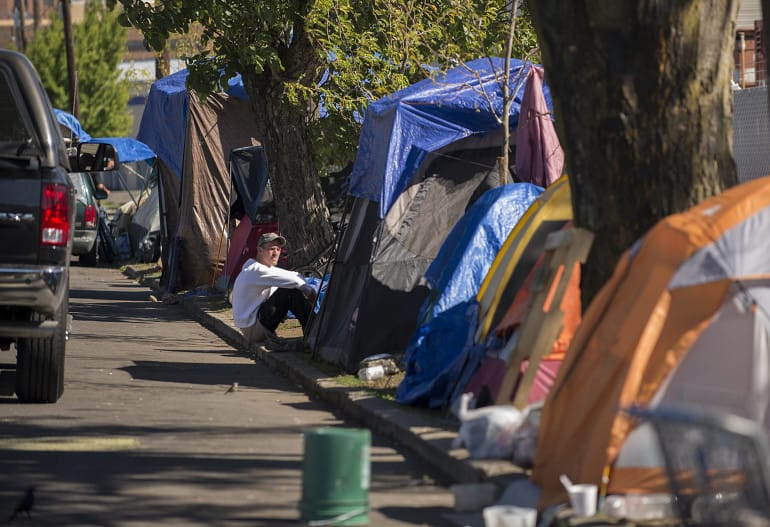
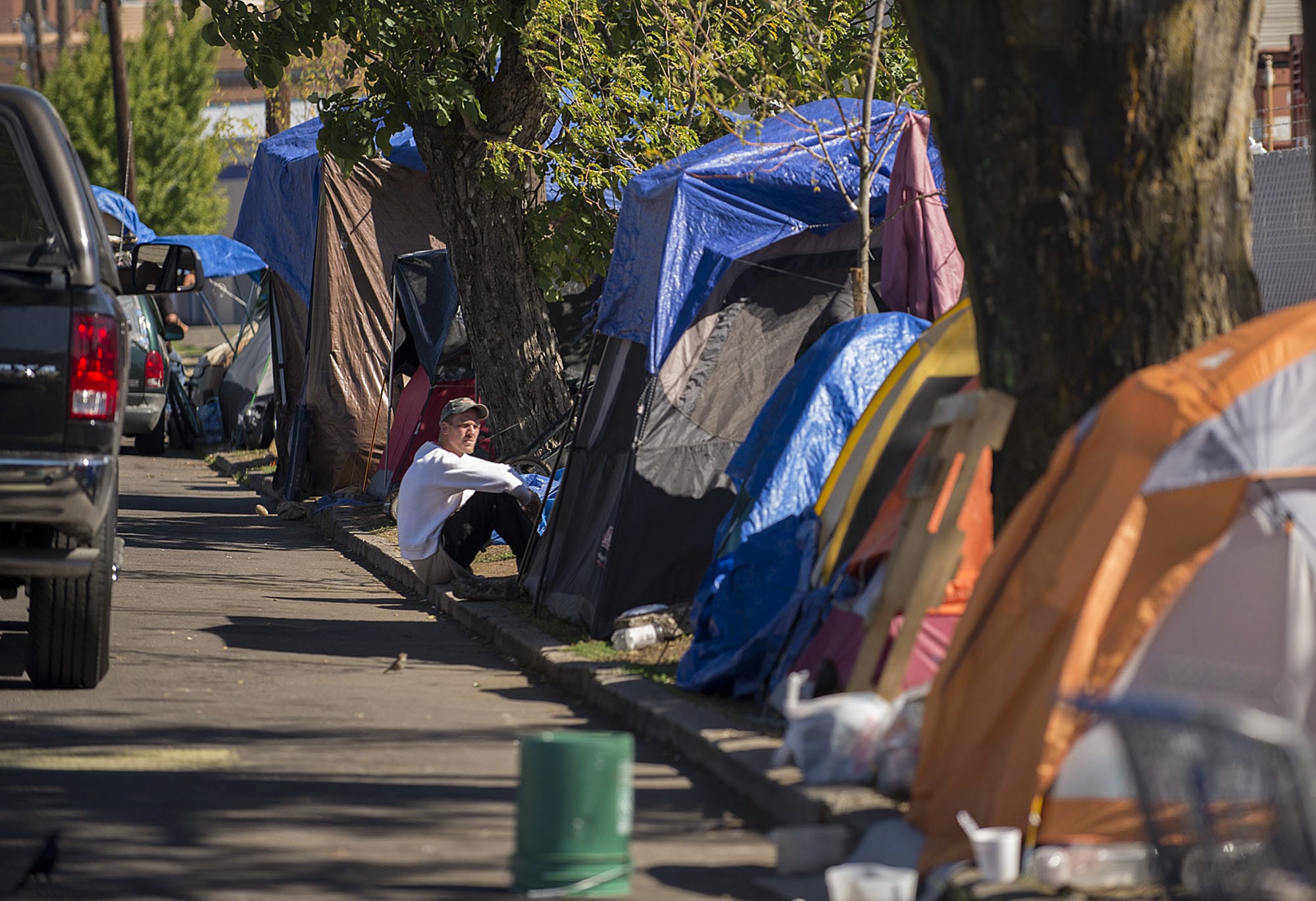
A man sits along the side of West 12th Street in downtown Vancouver that is lined with homeless camps
Monday afternoon, Sept. 21, 2015. (Amanda Cowan/The Columbian)
-
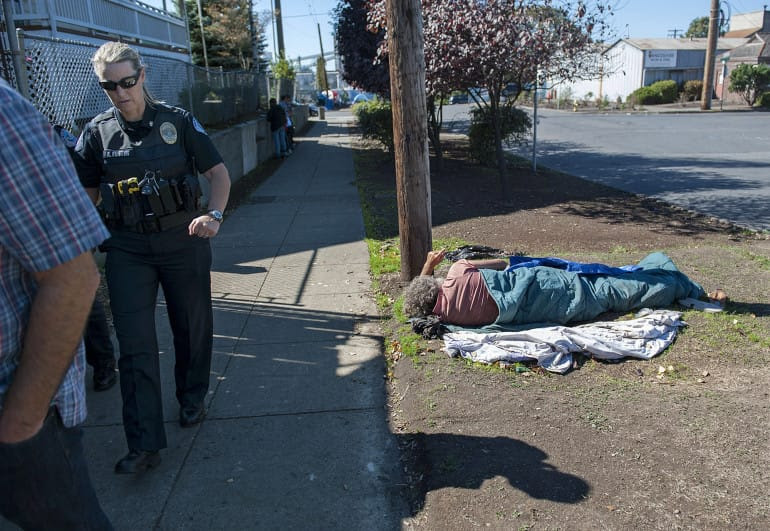
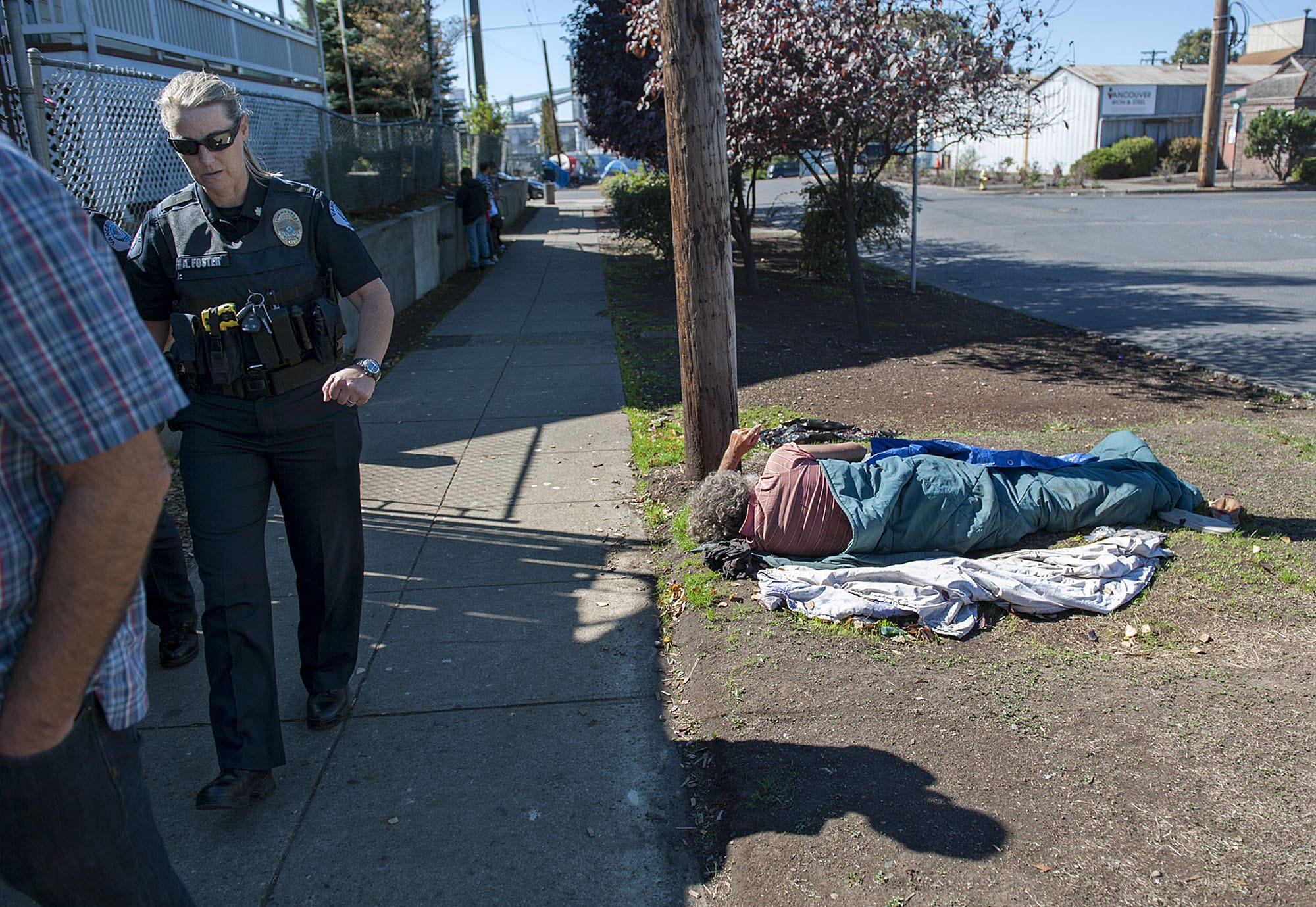
Commander Amy Foster, left, joins elected officials and others as they tour an area of downtown Vancouver facing issues with homelessness as a man sleeps on the ground nearby
Monday afternoon, Sept. 21, 2015. (Amanda Cowan/The Columbian)
-
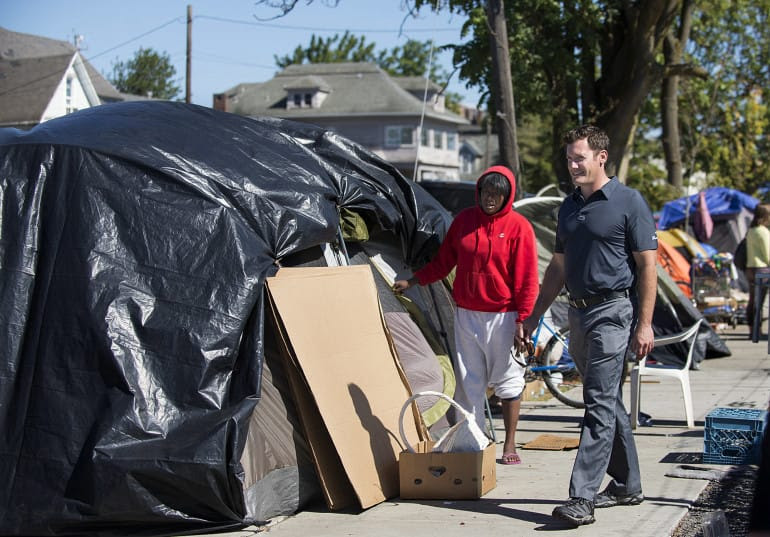
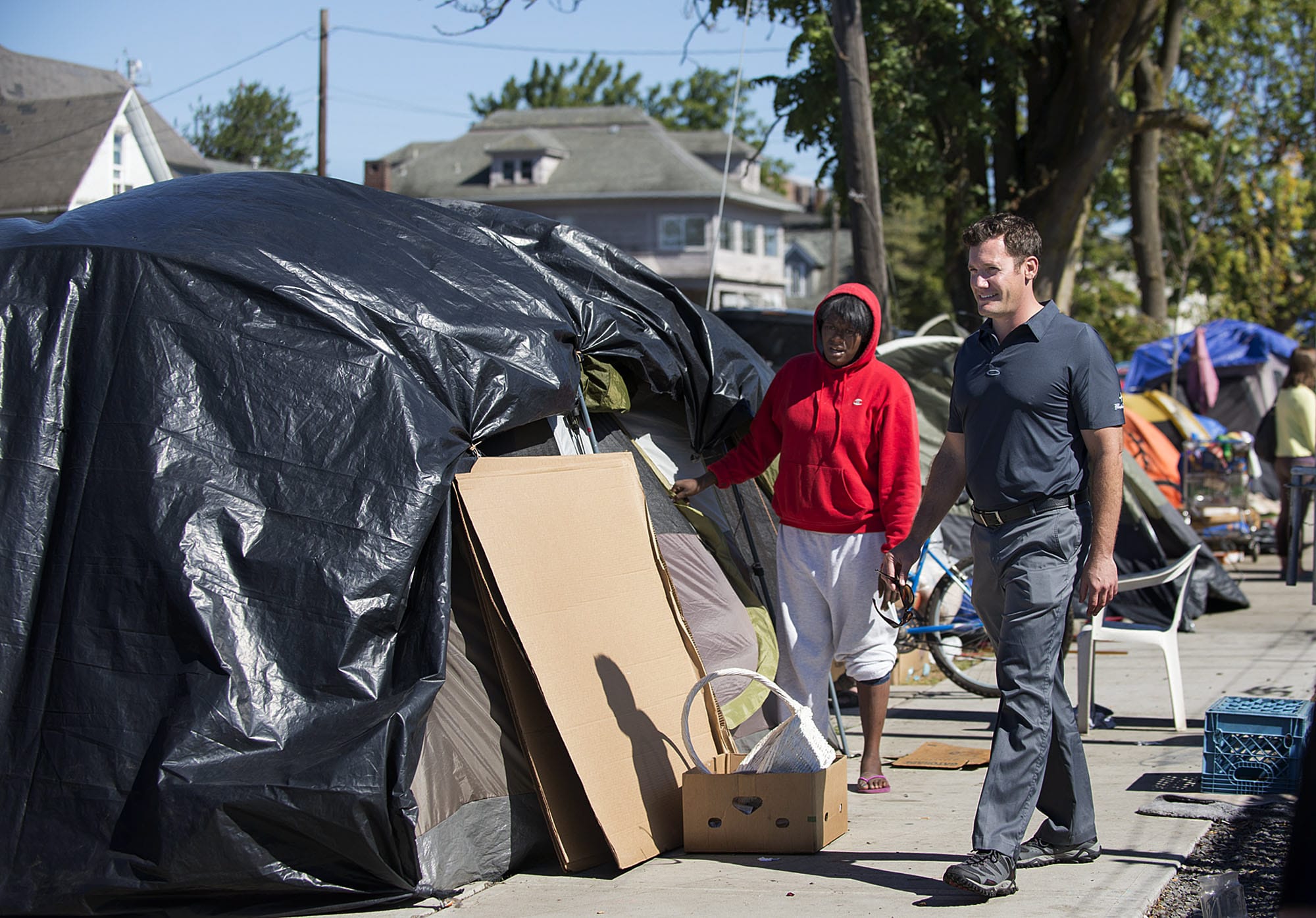
Mayor Tim Leavitt, right, walks along West 12th Street while talking with those dealing with homelessness
on Monday afternoon, Sept. 21, 2015. (Amanda Cowan/The Columbian)
-
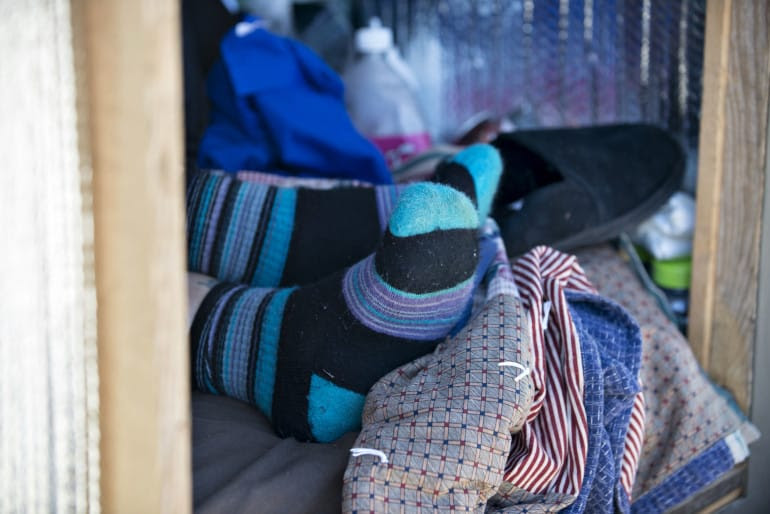
A homeless woman rests quietly in a trailer located in downtown Vancouver
on Monday afternoon, Sept. 21, 2015. (Amanda Cowan/The Columbian)
-
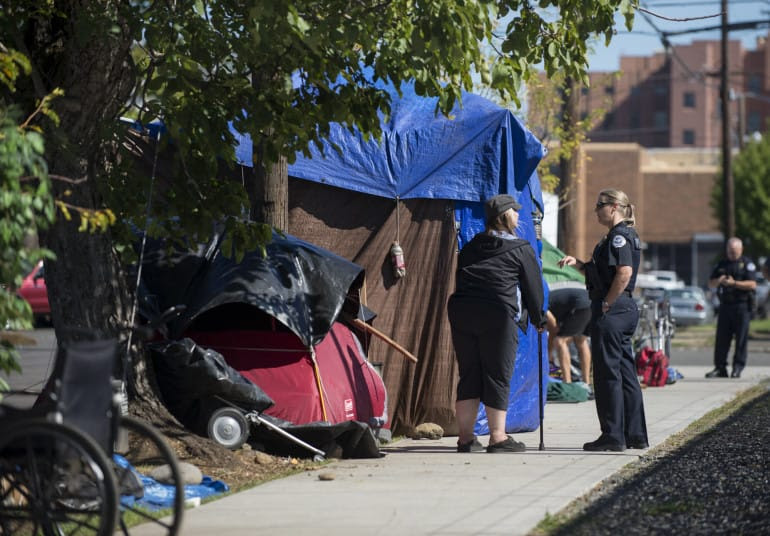
Commander Amy Foster, right, chats with a woman who camps in downtown Vancouver as she tours the area with elected officials
Monday afternoon, Sept. 21, 2015.
-
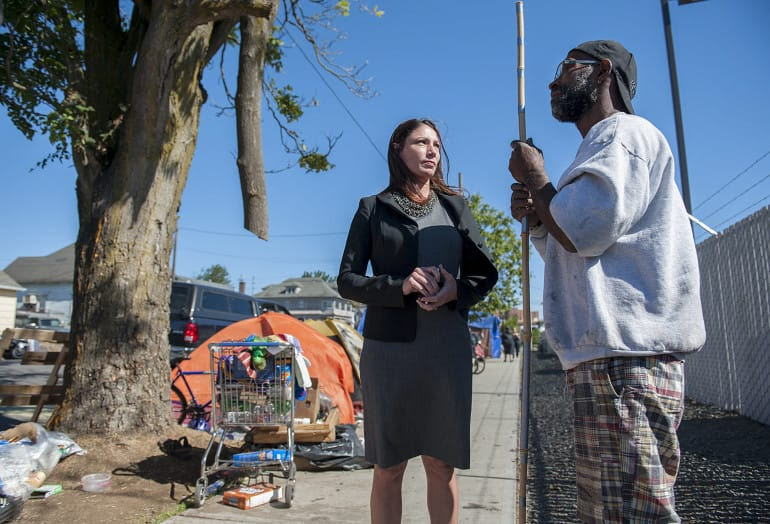
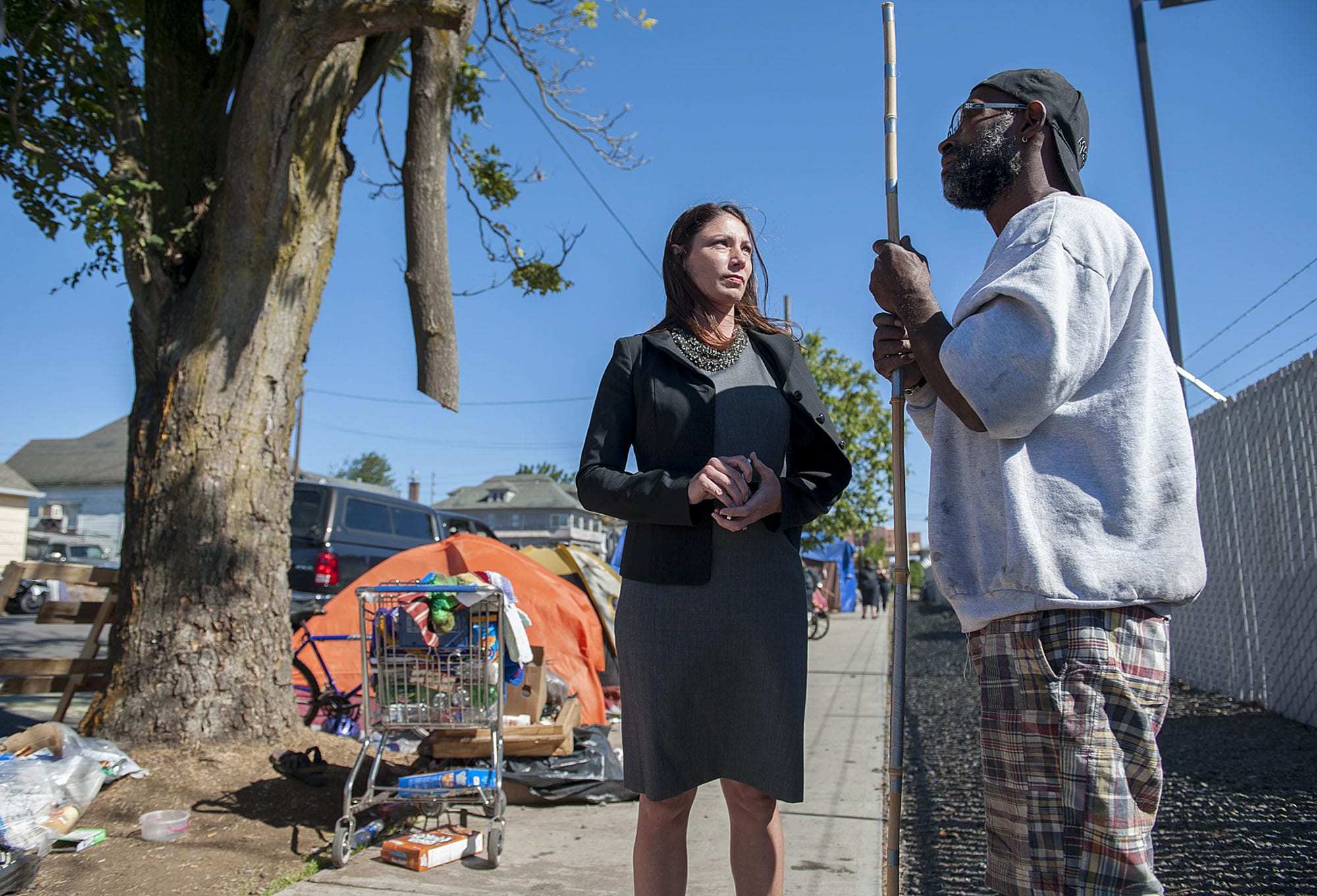
City Councilor Alishia Topper, center, talks with Calvin Chastang, who camps in downtown Vancouver, as tents lie underneath a hanging branch, upper left,
Monday afternoon, Sept. 21, 2015. (Amanda Cowan/The Columbian)
By
Amy Fischer, Columbian City Government Reporter
Published: September 21, 2015, 9:33 PM
Representatives of Vancouver’s business community, downtown and neighborhoods offered the city council their help Monday in finding solutions to the
city’s homeless problem — and as quickly as possible.
“Leaving people to the streets is not our final option here,” said John McKibbon, speaking on behalf of Identity Clark County, a nonprofit business advocacy group, during the council’s public hearing. “We do want to be involved, and we do want to help.”
A growing tent city in the west end of downtown has added to the collective sense of urgency in creating additional shelter space, sanitary facilities and services for the homeless, especially now that police stopped enforcing a city ban against overnight camping earlier this month. The city council is holding a workshop Oct. 5 to discuss progress it’s making with community partners on the issue.
Monday, the council reaffirmed its Sept. 14 vote to amend Vancouver’s unlawful camping ordinance to allow camping in public places from 9:30 p.m. to 6:30 a.m. Such overnight camping previously had been a misdemeanor. The change wouldn’t affect park hours (parks close from 10 p.m. to 5 a.m.) or laws prohibiting disorderly conduct, drinking in public, urinating in public and other health and safety issues.
The city’s legal staff recommended the change in response to a federal Department of Justice opinion issued Aug. 8 on a case pending in federal court in Boise, Idaho. The opinion states that outlawing camping in all places and all times, including when shelter space is unavailable, is cruel and unusual punishment and therefore unconstitutional.
During the public hearing Monday evening, Richard Bryleu told the council that police should show up at the homeless camp surrounding his property in the Esther Short neighborhood at 6:30 a.m. to encourage people to pack up and move along.
“It should not be an easy life,” Bryleu said. “‘Oh boy, I can go into Share House, I can get free food, I can hang out with my friends and my enemies.’”
But, he said, “it’s never going to go away. I know that. Not completely.”
As of January, there were 662 homeless people in Clark County, of which 208 weren’t sheltered, according to the annual Point-in-Time Count, an unscientific census of homeless people that’s taken on a single day. In the last two years, 6,516 people sought emergency shelter in Vancouver, of which, 82 percent were turned away because of a lack of shelter space, City Attorney Bronson Potter said, citing statistics from the Council for the Homeless.
Monday afternoon, Vancouver city leaders got a close-up view of the situation as they walked the blocks around the Share House shelter, 1115 W. 13th St. Accompanied by police, Mayor Tim Leavitt, Councilor Alishia Topper and City Manager Eric Holmes observed dozens of tents, tarps and bicycles lining the sidewalks and fences on West 12th and 13th streets, Lincoln Avenue, Jefferson Street and King Street. People milled around. Trash blew through the gutters.
“It’s as bad as it’s been in years,” observed Vancouver Police Department Cmdr. Amy Foster.
Holmes, who drives through the area several times a week, agreed.
“Three months ago, it was different. Three weeks ago, it was different,” he said.
Troy Johns, owner of Urban NW Homes, said transients frequently defecate on the doorstep of his West 13th Street office building, shower with the building’s outdoor faucets and throw their garbage next to the trash cans he’d set out. Johns pointed to the cars parked along the street that hadn’t moved in months. People were living in them, he said.
Foster said it wasn’t supposed to be that way. Under city ordinance, vehicles can’t park in one spot for more than 24 hours or they can be tagged and towed, she said. But they have nowhere to go, and forcing them to move just transfers the problem from one spot to another, Holmes said.
Topper stopped to talk to Calvin Chastang, who lives in a tent on 12th Street. She asked him, what was the solution to the homeless problem?
“Give everybody a million dollars,” he said, bursting into laughter.
“There is no solution,” said Chastang, 52. “Some of them want to be here. Some of them get stuck. … Once you get there, it’s hard to get out.”
Leavitt wondered where all the people were coming from, and why they were showing up there.
Foster said it was likely they’d already been living in Vancouver, but in hidden spots. For instance, there had been a large camp along the riverfront until construction on the downtown waterfront project began this year. Now they were coming out into the open, she said.
“It’s going to take everyone to come together and find a good solution,” Topper said.
Leavitt said until the city and its partners get a day shelter established where people can shower, the city should set up expectations that the homeless pick up after themselves. Residents of the Hough neighborhood just a few blocks a way had been cleaning up the trash. Johns said he’d certainly collected his fair share of it.
“Seeing what’s going on out here really puts an impetus on the community to figure out an alternative,” Leavitt said. “We obviously cannot continue to allow this to grow on our streets of West Vancouver.”