Lemaster Lodging trial turns into inquisition and hate-fest

Becky Johnson: One Woman Talking

November 9, 2012

Original Post

Linda Lemaster (left) attending one of many pre-trial hearings with supporters, Leslie and Kent, November 2, 2012 for a “lodging” ticket she got two years ago. Photo by Becky Johnsonby Becky Johnson

November 9, 2012
Santa Cruz, Ca. —  According to ADA Alex Byers, Linda Lemaster faces Six Months in Jail for the “crime”of sleeping/not sleeping on public/private property with /without possessions for a long/short period of time which can be intentional/unintentional, all subject to the “permission” of the “authority.”
  
Linda is on trial for PC 647 ( e ) or  illegal “lodging” under a little-used portion of the State code, which sheriff’s had not used before citing protestors at Peace Camp 2010.
According to Byers,  a protester with his/her sign attempting to peaceably assemble to seek redress of government grievances may do so:
ONLY where the govt. tells them they can.
ONLY when the govt. tells them they can.
And, apparently, NOT while sitting, lying down, or sleeping since these = lodging. And if a Sheriff tells you you can’t “lodge” then whatever you are doing is “lodging.” According to Byers, Sheriff’s didn’t need to prove a person was “lodging” in order to issue a citation. Only that they were “still there on the steps when sheriff’s came back.”

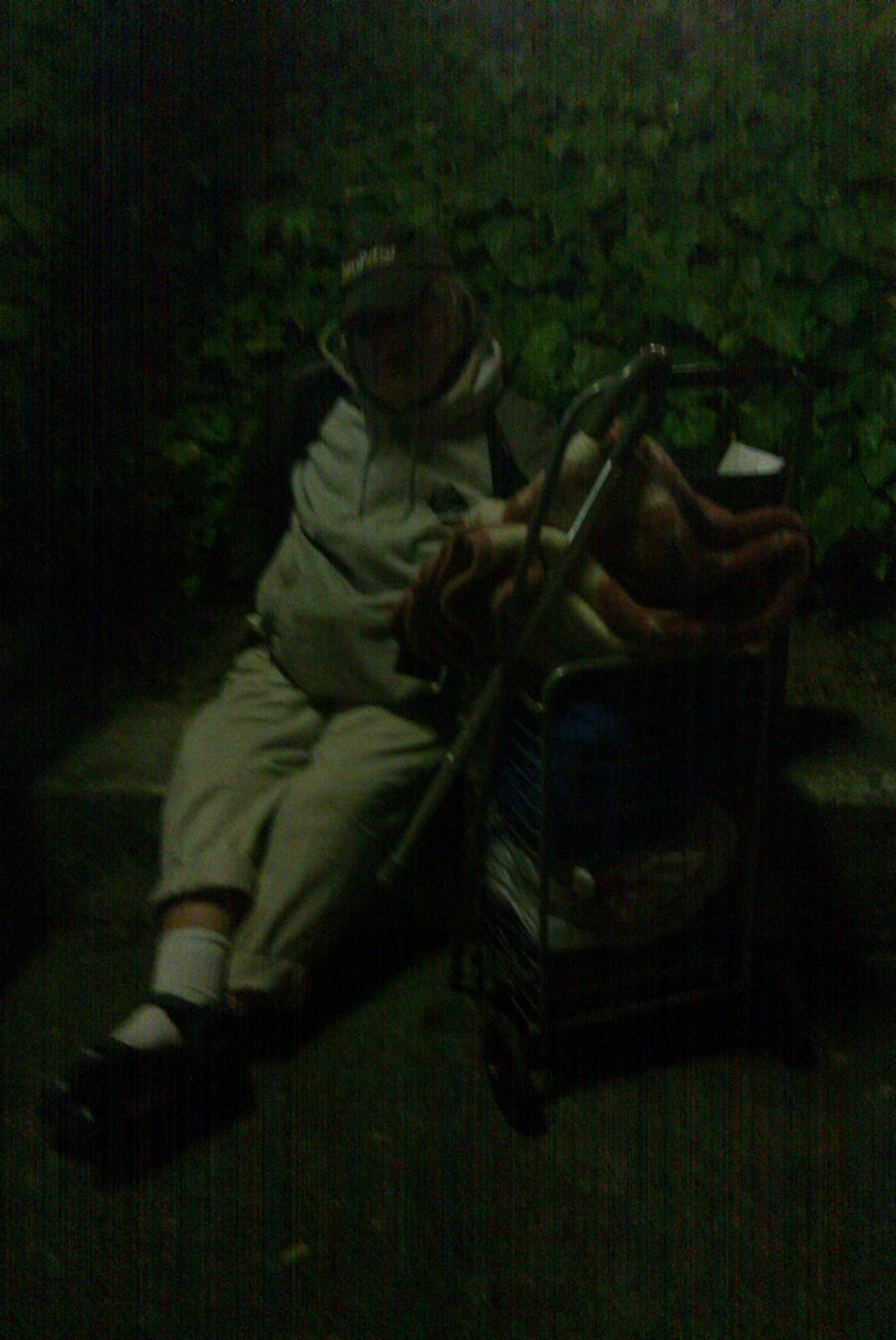
On the night of August 10th, as Linda Lemaster was cited for illegal lodging, Sheriff’s moved elderly, Collette Connolly off the steps. Here she collapses in exhaustion on her belongings a scant 50 feet from the courthouse. Why Sheriff’s told us the steps of the courthouse were illegal at 4:30AM but the parking lot was not was only one of the many arbitrary and confusing encounters Peace Camp 2010 had with law enforcement. Photo by Becky Johnson

Oh, THAT’s a convenient definition of the code! When a sheriff hands you an unsigned piece of paper, then, according to Byers, that person “has been educated”that they no longer have the right to carry a sign, to protest, or to seek redress of government grievances.  And if a protester wants to publicly assemble? They must follow “time, place, and manner restrictions” which are not written in the law anywhere.
Christopher Doyon a.k.a. “X” of Peace Camp 2010 pauses on the lower steps at Peace Camp 2010. In the background, Ed Frey’s white, pick-up truck can be seen hitched to the camp porto-pottie. Other than Ed’s privy, homeless people had no access to a bathroom at night other than at Peace Camp 2010. Photo by Becky Johnson July 30, 2010
For ADA Alex Byers, camping = lodging except that “camping” is not illegal in that particular location under County Code.
While camping is , according to Byers, essentially the same thing, “lodging” rates 6 months in jail and/or a $1000 fine. And CAMPING is legal in the location where Linda was cited.   Committing the same crime in the City (and Lemaster WAS in the City when she was cited) rates a $92 citation or 8 hours of community service as a possible consequence. So why did the sheriff’s use the statewide “lodging” code rather than the County’s camping code or the City’s Sleeping and Blanket ban?
According to ADA, Alex Byers, it was due to “tolerance.”
Those at Peace Camp 2010 know better. The plucky little group had discovered that the County’s camping ban does not apply to the grounds around the courthouse and government center. In other words “camping” is legal there. Also, due to jurisdictional agreements, City police do not patrol the grounds at the Government Center. Sheriff’s opted to not enforce City codes against Sleeping and using  blankets. Codes that are all infractions, violations of which do not include jail. These were the twin laws the protest had assembled to challenge.
On July 29th, 2010, Ed Frey received a letter from County Counsel, Dana McCrae. She informed Frey that city ordinances ARE enforceable at the County Center, since it is within the City limits.  The SENTINEL reported that the reason no citations had yet been issued was because government officials, law enforcement officers and legal experts (had to) sort out what rules apply to the property.”

Peace Camp 2010 used public space which is unused at night. This photo taken on July 20th at 8:13PM shows people setting up bedding. At 8:00AM, Ed Frey would drive the porto-pottie off of the property and normal use of the facilities would commence.  Photo by Becky Johnson

Around the end of July,  County Counsel, Dana McCrae dusted off the lawbooks and dug up a code which used language lifted from an 1880 law in California designed to keep freed slaves from moving into the State. Judges Gallagher and in this trial, Connolly further eroded civil rights by creating a definition which lifts language from the 1851 Indiana State Constitution which states:  “No Negro or Mulatto shall come into, or settle in, the State…”

The new definition of lodging which Judge Rebecca Connolly approved: “To occupy a place temporarily or permanently, or temporarily settle or to live in a place, it may, but does not have to include sleeping. It means more than just sleeping and less than moving into a place permanently.”

Byers told jurors of the flyer sheriff’s passed out willy-nilly to anyone who wanted one: The flyer only stated you are illegally lodging without permission. Merely telling Petitioner or anyone else that they are lodging or that they do not have the owner’s permission in no way clarifies what lodging means or how one can avoid it. In this circumstance “to lodge” illegally appears to have meant to the deputies- to further physically occupy space in any manner on the steps of the Santa Cruz County courthouse.

Sheriff’s deputies stopped calling what we were doing as “camping” and started to accuse us of “lodging.” We knew something was coming. About a week later, sheriff’s handed out this flyer which had no letterhead, was unsigned, and unconvincing in its text as part of their “Education phase.”  –Photo by Becky Johnson Aug 7 2010
THE COUNTY’S PLAN
Byers told jurors about a 2-phased Plan to get the protesters to leave the location.
–Education phase followed by an Enforcement phase.
“Lt. Plageman testified that they weren’t’ interfering with the right to protest.
Their goal was to stop people from the intent of the protest which was to violate
the law.” He told jurors that flyers were handed out in the following way:  “If you were lying down, you were sleeping, you were violating the law. At 4:30AM, they were already lodging when the
Sheriffs deputies arrived. They were already breaking the law.”
Sounds like a slam-dunk.
So does the “law” outlaw lying down, or sleeping? No. PC 647( e ) outlaws “lodging”
but that word is not defined anywhere in the code. In 2011, at the Peace Camp Six
trial, Judge John Gallagher made up a definition by looking at old codes and
a dictionary.  Judge Rebecca Connolly has made up a new definition. In neither
case, were any of the defendants allowed access to either definition of lodging
when cited two years ago.
“The dictionary includes 14 different definitions of “lodging,” Defense Attorney Jonathon Gettleman quickly added in.
jurors don’t know that defendants (and their attorneys) have challenged that
Byers showed some really dark and grainy videos which roughly show a mess. John Valley’s voice can be heard and the sound of Linda coughing.  Even worse, he paints the protest as characterized as “junk all over”, none of which has ANYTHING to do with Linda Lemaster. Linda was wide awake at 11PM with no bedding. That, at 4:30AM, sheriff’s came and found her sitting up and looking sleepy, doesn’t mean a crime was committed.
Byers asserted more claims that I doubt are true.
“No one is allowed to lodge on the steps of the courthouse at night.” Huh? Lodging isn’t defined as an activity done at night only. And when Linda Lemaster was there at 4:30AM, she wasn’t trespassing. The courthouse steps were a legal public place to be (at the time. Since this has been changed by County administration to make it a crime to BE THERE between 7PM and 7AM).

Santa Cruz wins Nazi salute case against Robert Norse

J.M. Brown

Santa Cruz Sentinel:   11/07/2012

SAN JOSE — A federal jury on Wednesday found in favor of Santa Cruz city officials who more than a decade ago ejected a longtime critic from a public meeting for making a mock Nazi salute and had him arrested when he refused to leave.

Former Councilman Tim Fitzmaurice said the 8-0 verdict shows “we acted with integrity” when he and then-Mayor Christopher Krohn sought the removal of activist Robert Norse from a March 2002 meeting. Norse was ejected and arrested again nearly two years later after another series of events that council members viewed as disruptive.

“I knew we presented the best case we possibly could,” Fitzmaurice said.

Norse’s attorney, David Beauvais, said he would file a motion for a new trial within two weeks, saying the evidence predominantly proved Norse was well within his First Amendment rights to make the salute. If the judge denies the request for a new trial, Beauvais said he would evaluate the judge’s reasoning before determining whether to appeal further.

Beauvais and co-counsel Kate Wells attempted to convince jurors during the four-day trial that city officials singled Norse out for punishment because they were annoyed by his unrelenting criticism of their policies concerning the homeless.

“The implications of this are that anybody on the council that doesn’t like anything going on can declare they are disturbed,” Beauvais said of the verdict. “It effectively removes the First Amendment right to the content of the message.”

Norse made the salute after Krohn stopped a woman from speaking once a public comment period had ended. Although Krohn didn’t see the gesture, Fitzmaurice brought it to his attention and asked that Norse be made to leave. The mayor agreed and stopped the meeting after Norse refused to go, which prompted his arrest and jailing for five hours.

In January 2004, the late Scott Kennedy, who was then mayor, ejected Norse after he argued with Kennedy’s order to leave. Kennedy warned Norse that participating in a protest parade around the Council Chamber was disruptive and warned him again for whispering to an acquaintance.

The two incidents were consolidated for the proceedings before U.S. District Court Ronald Whyte, who had earlier dismissed Norse’s claims and was initially backed up by the 9th District Court of Appeal. However, another appellate panel ordered the judge to hear evidence — a ruling that stood after the U.S. Supreme Court refused to take up the matter.

The city’s attorney, George Kovacevich said Wednesday the verdict affirms constitutional protections on the proper time, place and manner for First Amendment expression.

“This is not a place for protests,” Kovacevich said Wednesday. “It’s a place to dialogue with the council and discuss issues.”

One juror was from Aptos but the others were from communities over the hill. Beauvais said he learned by talking to a juror that one of them thought the city may have discriminated against Norse’s views and held out for several hours before agreeing with the majority.

The city faced the possibility of paying about $300,000 in legal bills from Norse’s attorneys and about $30,000 in damages, Kovacevich said. If the city is ultimately successful, it may seek reimbursement for some of its costs, which equal at least $150,000.

Santa Cruz library board delays suspension policy changes

J.M. Brown

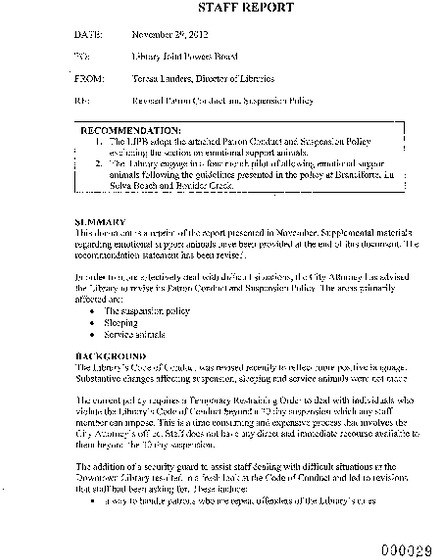
Santa Cruz Sentinel:   11/05/2012SANTA CRUZ — The library board agreed Monday to push two controversial issues to its Dec. 5 meeting to get legal advice on a patron suspension policy and replacing a citizen board member.

The proposed patron policy changes allow for staff to suspend someone for up to a year after a series of warnings.

Current rules allow only for a 30-day suspension, after which the next step was to seek a temporary restraining order. Staff now would be able to suspend a patron up to six months or a year after a fourth violation of conduct rules, and there are ways to appeal.

The changes also ban using the library for sleeping. Landers said the rule is not meant to punish those who doze off while reading, but rather those who come to sleep for long periods of time. The new rules also empower staff to remove unattended items, such as backpacks.

The rules also clarify provisions for animals — dogs or miniature horses — that provide emotional support to patrons. The proposed rules would require staff to ask what kind of service or support the animal provides.

Santa Cruz County Supervisor Ellen Pirie objected to the rule, saying the question could violate personal privacy by forcing a patron to disclose a disability.

“I agree you need to ask, ‘Is this a service animal?’ It’s the next step that I’m not sure is wise,” Pirie said.

Landers said identifying the purpose the animal services reduces the city’s liability if the animal injures someone else.

The library also updated the language used on a flier staff can hand to someone who has a strong odor, a piece of paper that on one side urges the person to leave and on the other provides information about free shower and laundry facilities at the Homeless Services Center. The new language tells the person their odor ‘is a violation of our rules of conduct,” a point Landers said interferes with others’ use of the library.

Landers estimates staff hands out a flier once or twice a week at the downtown branch.

Landers said there has been a major improvement in the atmosphere around the branch since the city hired private security guards to patrol the library and City Hall. People have often congregated outside, sleeping, smoking or being loud. There have been problems inside too, including a man staff caught disrobing in the stacks months ago.

Monday, the board also debated the process for replacing citizen Leigh Poitinger, who has represented Santa Cruz. Pirie objected to specifying that a seat be named specifically for the city, saying the library’s bylaws only state that the board’s three citizen seats be geographically diverse.

The board decided to table the matter to get a ruling from the city attorney about a motion passed in 2005 that some believe required city residency for one of the seats.

Lighthouse Linda Lemaster Trial

Linda Lemaster, chair of the former Homeless Issues Task Force and long-time homeless activist, goes to jury trial on Tuesday, November 6th at 8:30 AM (jury selection begins Monday November 5th at 8:30 AM) in Dept. 1 at 701 Ocean St.  She is charged with PC 647e, an archaic state “anti-lodging” law for sitting on the steps of the courthouse in August 2010 in solidarity with PeaceCamp2010 homeless protesters, peacefully demonstrating against the City’s homeless Sleeping Ban.

Appeals Judge Upholds Anti-Homeless “Lodging” Law Against “Lighthouse” Linda Lemaster – http://www.indybay.org/newsitems/2012/06/11/18715182.php

“Lighthouse” Linda Lemaster’s blog – http://www.hearthbylinda.blogspot.com/

Lemaster Lodging Trial Nears – http://www.indybay.org/newsitems/2012/10/31/18724833.php

Yes, I’m Guilty – http://hearthbylinda.blogspot.com/2012/12/yes-im-guilty-of-unlawful-lodging-647e.html

Sentinal article – Trial date set in case of Santa Cruz Peace Camp protester – http://www.santacruzsentinel.com/localnews/ci_21024661/trial-date-set-case-santa-cruz-peace-camp – HUFF Blog post of article with comments here.

Sentinel article – SC County Woman Convicted – http://www.santacruzsentinel.com/localnews/ci_22141708/no-jail-time-santa-cruz-county-woman-convicted

SC Weekly article – Activist Lemaster Sentenced For Illegal Lodging – http://huffsantacruz.org/wordpress/activist-lemaster-sentenced-for-illegal-lodging/

Former Santa Cruz mayors stand by ouster of advocate over Nazi salute

J.M. Brown

Santa Cruz Sentinel:   11/01/2012SAN JOSE — Two former Santa Cruz mayors who testified Thursday in a free-speech lawsuit stood by their push to eject a City Council critic who made a Nazi salute.

Tim Fitzmaurice and Christopher Krohn told a federal jury the gesture disrupted a March 2002 meeting because activist Robert Norse, who was arrested after refusing to leave, meant to communicate with the council, however quick and quiet, after a public comment period had ended.

“It’s silence was irrelevant to me,” Fitzmaurice said. “It was an attempt at disrupting the meeting, which is Mr. Norse’s usual activity.”

The former city officials portrayed the 65-year-old advocate for the homeless as a chronic agitator who pushed the boundaries of decorum. Norse’s attorneys tried to show city leaders singled him out, violating his First and Fourth Amendment rights to expression and arrest with probable cause, because they resented his persistent derision.

Norse has said his irritation with Fitzmaurice stemmed from a promise to reform the city’s ban on sleeping in public between 11 p.m. and 8:30 a.m. But Fitzmaurice rebutted that Thursday, “I never said ‘I’m running on softening the laws for homeless people,’ explicitly or directly.”

Norse made the salute after then-Mayor Krohn stopped a woman from speaking. Norse was arrested again in January 2004 after participating in a protest parade around the Council Chamber and refusing to leave after questioning then-Mayor Scott Kennedy’s admonition of him for whispering to a friend.

The cases were consolidated for the proceedings that got under way this week after an appellate panel ordered the long-delayed matter to trial. U.S. District Court Judge Ronald Whyte said jurors will hear during closing arguments next week how much financial compensation Norse will seek from Krohn, Fitzmaurice and the city. Kennedy died in 2011.

CURTAILED ACCESS

After Norse began regularly attending meetings, several other witnesses said the city tightened rules on public participation, including ending a provision that allowed citizens to pull items from the council’s consent agenda for discussion — a tool Norse often used to give unrelated speeches. Citizens must now get a council member to pull an item.

“There was less and less opportunity for Robert to speak, and less and less opportunity for the general public to speak,” said Scott Graham, a frequent attendee who, like others, said the council punished Norse for actions others committed without penalty.

Activist Coral Brune testified she also was warned by Kennedy for taking part in the 2004 parade and sat down in the gallery. She said city staff and others, unlike Norse, were not punished for talking to each other during the meeting.

“I’ve never seen that happen before,” she said.

WHAT IS A DISRUPTION?

Norse’s attorneys tried to show it was the council’s own reactions to Norse that created disruptions.

“Other than you complaining, how did this disrupt the meeting?” attorney David Beauvais asked Fitzmaurice about the salute.

“It did disrupt the meeting because Norse was trying to draw attention to himself,” said Fitzmaurice, who brought the salute to Krohn’s attention.

Krohn acknowledged he did not see the gesture and was not personally disrupted by it. But he said it created a disruption because Fitzmaurice deemed it out of order.

Fitzmaurice, who at the time served on the American Civil Liberties Union’s local board, said he would not have seen Norse’s salute as out of order if he had made it during public comment.

But he also acknowledged he would not call someone out of order for applauding the council or giving them a thumbs-up outside of the public comment period. He said those actions would not disrupt a meeting.

“It was a fairly specific kind of message to me that (Norse) assumed, because it was so explosive, it would require a response to it,” Fitzmaurice said.

Robert Norse tells federal jury city suppressed critics

J.M. Brown

Santa Cruz Sentinel:   10/31/2012SAN JOSE — Ten years after filing a First Amendment lawsuit against Santa Cruz officials, Robert Norse finally got his day in court Wednesday, testifying that a mock Nazi salute he made during a public meeting did not cause the disruption that led to his arrest.

The longtime Santa Cruz City Council critic and advocate for the homeless told a federal jury he made the gesture during a March 2002 meeting after then-Mayor Christopher Krohn silenced a speaker and closed a public comment period early. Norse refused Krohn’s order to leave and was taken to jail for more than five hours, later released with no charges filed.

The 65-year-old Norse, who has long sought to overturn a city ban on camping in public overnight, said the council had a history of suppressing critics. By leaving the meeting, Norse said he would have made his supporters lose hope.

“If you begin to surrender your rights in those circumstances, where does it stop?” he asked.

George Kovacevich, the city’s lawyer, tried to paint Norse on cross examination as a chronic agitator, noting he had spoken 271 times at council meetings between 1999 and 2005. Norse acknowledged he often walked around during meetings, talking to other people, and once took a pie to the face during a skit designed to criticize council members.

“This is not really a case about a Nazi salute or a case about protesting,” Kovacevich told the jury of four women and four men. “It’s about who controls the meeting. This is a case that will show Mr. Norse can’t stand that he doesn’t have control.”

U.S. District Court Judge Ronald Whyte, who first dismissed the matter a decade ago, was ordered to hold a trial by a rare 11-member panel of the 9th Circuit Court of Appeal, which overturned an earlier ruling backing Whyte’s original decision. The city appealed to the U.S. Supreme Court in 2011, but the high court declined a review.

The case is consolidated with a 2004 arrest after Norse participated in a parade around the Council Chamber. After re-entering the room and whispering to someone, then-Mayor Scott Kennedy ordered him to leave after he challenged a request to take the conversation outside.

The city has spent an estimated $150,000 fighting Norse and, if it loses, faces the likelihood of paying him unspecified financial damages and covering his attorney’s fees. Norse had offered to settle if the city reforms rules governing meeting decorum and the camping ban, which bars sleeping outside, in a vehicle, or under a structure from 11 p.m. to 8:30 a.m.

Norse’s testimony revealed that his long-running battle with the city over homelessness created the tense backdrop for his appearances at meetings. Even though the 2002 council was one of the most progressive, Norse was unhappy with progress on reversing measures he views as criminalizing homelessness and panhandling.

During the 2002 meeting, after Krohn asked frequent grandstander Mike Tomassi to leave, a woman approached the podium to speak but was told to sit down. After she relented, Norse told the jury, he raised his arm to say, “You’re acting in a very authoritarian manner. You’re acting like fascists.”

Norse said he is Jewish and does not subscribe to Nazi ideals. He acknowledged he made the gesture with his left arm, not his right, as is Nazi custom.

Then-Councilman Tim Fitzmaurice, who Norse said had failed on a promise to reform the camping ban, noticed the salute, brought it to Krohn’s attention and asked that Norse be removed. Norse’s lawyers argue it was Fitzmaurice who caused the disruption by stopping the meeting.

After Krohn ordered Norse to leave, Norse sat down in defiance and was later arrested by a police officer. A court eventually dismissed he officer from the suit.

Video of the 2002 and 2004 incidents were played for jurors Wednesday. In an effort to establish damages, Norse said the arrest made him scared to attend meetings and caused him to lose sleep and work time.

Steve Hartman, a former conservative radio host, and former Community TV cameraman Mark Halfmoon testified they were at the 2002 meeting and did not believe the salute made a disruption.

Hartman, who now resides in Montana, flew in to testify for just a few moments, saying he was opposed to Norse’s politics but believed his actions were within his First Amendment rights. The city’s lawyer did not cross examine either witness.

Fitzmaurice and Krohn are slated to be questioned by Norse’s attorneys Thursday.

Judge Burdick issues sanctions against DA’s office

Becky Johnson: One Woman Talking

October 10, 2012

Original Post

Banner from a rally held by the Brown Berets of Watsonville
in support of the Santa Cruz Eleven. 
Photo by Becky Johnson May 4, 2012

by Becky Johnson
Oct 9 2012

Santa Cruz, Ca. — I went to court this morning. There was much confusion. At my August 20th hearing, I had thought that only Franklin “Angel” Alcantara and Cameron Larendeau were required to be at this hearing. But my lawyer called me yesterday, apologized for not being able to come to the hearing himself, and told me one of the other attorneys had agreed to appear on my behalf.

When I got to court, only Angel and Cameron’s names were on the court docket. Wonderful. Someone screwed up again, I thought. I wonder who.

They call our case “The Occupy Case” which is ironic, considering all the arguments that went back and forth to disassociate the 75 River Street Occupation of a long, empty bank building from Occupy Santa Cruz and its encampment in San Lorenzo Park. In the end, OSC stood up and formed a working group to provide support to the Santa Cruz Eleven as we came to be called.

In my own case, I had a lot to do with the encampment in San Lorenzo Park and very little to do with the 75 River Street building takeover, but this case is not about facts and evidence.

We are now down to seven defendants. Bradley Stuart Allen, Alex Darocy, Grant Wilson, and Ed Rector have all had their charges dismissed due to lack of evidence against them. Judge Burdick had also found the case against Cameron and Angel to be lacking evidence, but ADA Rebekah Young refiled against them.  This hearing had been scheduled by Cameron’s attorney, Briggs, and Angel’s attorney Ruben.  But Ruben wasn’t there. Nor was Briggs. Lisa McCaney, appearing on their behalf asked Young “Where is the additional evidence that you said you had to refile charges against my client?” A photograph referred to in a police report has still not been produced.

Young replied that she had been “confused” as to which motion would be resolved that day. She wasn’t the only one!  Burdick had sharp words for Ms. Young.

“Its my understanding that I’ll be ruling on her motion independent of any discovery violations under discussion. Violations of due process and the procedural morass that has brought us to this point.”
This “point” being ten months into the legal process, eight months after sheriff’s came to my home and arrested me while I was cooking pancakes, and still two more months to go just to get to my preliminary hearing. And I am eager to get to that point too, where I believe I will too be able to dispense with the specious charges against me. You see, the DA has no case against me.

“I apologize. I’m not prepared to argue her motion.” What else is new in this case?

“The people here have a right to a preliminary hearing, not an additional discussion and no new facts,” Burdick told her.

“Your honor, I believed the two sole witnesses at the preliminary hearing to be sufficient.”

“She says she has additional witnesses who can identify Mr. Alcantara and Mr. Larandeau but none have been forthcoming,” McCaney charged.

“Work has been extremely sloppy and we don’t have viable opposition papers.” But then inexplicably he said “I’m going to deny the motion to dismiss.”

Burdick asked if there were any other discovery issues. Attorneys complained about an empty file on one of the disks, but Young insisted that that was how the file came from the SCPD. None of the attorneys mentioned that the videos released many months ago did not have soundtracks, but now, on videos released August 20th, the sound was back but without explanation. Of course this meant the attorneys (and defendants) must now go back and watch over 25 hours of videotape again in order to LISTEN to the dialogue of police engaged in while recording to see if there is more evidence there.

Hackett, appearing on behalf of Norse’s attorney David Beauvais said that Beauvais had repeatedly requested for procedural manuals on instructions for police on crowd control, use of tear gas, and their policy concerning 1st amendment issues.

Young answered that the SCPD “has no first amendment policy.” Burdick seemed puzzled by this. “There must be some manual or procedures for crowd control and the use of chemical agents.”

Should it be achieved by subpoena? one of the defense attorneys quipped.

Burdick ignored this and just instructed Young to “look for those.”

Then Burdick announced that he had contemplated what the appropriate sanctions against the DA’s office should be springing from his statement on August 20th. He ruled that the sanctions would be to bill the DA’s office for additional expenses that out of county attorneys only had when they were required to come to attend additional hearings due to Young’s failures to provide discovery in a timely or forthright manner. There would be no relief for defendants dragged to every hearing on threat of arrest, missing work, school, time with loved ones and incurring costs.  Attorneys are paid, defendants are not.

The remaining defendants face a preliminary hearing on January 7th at 9AM in Dept 6. A readiness hearing is scheduled for January 4th also at 9AM.

LINDA LEMASTER TRIAL TO BEGIN WEDNESDAY

In other cases, Linda Lemaster’s 647 ( e) “lodging” trial launches October 15th at 9AM in Dept 1 before Judge Rebecca Connolly. A pre-trial hearing is scheduled for 8:30AM in Dept 1 Oct 10th. Both cases will be heard at Santa Cruz Superior Court, 701 Ocean St. Santa Cruz, Ca. 95060

City’s War on Musicians has one less tool

Becky Johnson: One Woman Talking

October 7, 2012

Original Post

Robert “Blindbear” Facer, an Amish street minister, is issued a $445 citation for “unreasonably disturbing noise” when he kept a 31-year old nearby resident from napping. Jan 6, 2010 Photo by Becky Johnson

NOTE TO READER:  Can u imagine? The LAW that I was convicted under for singing a few songs in the middle of the afternoon in my unamplified singing voice in the FREE SPEECH ZONE no less!! has been found by a Judge OUTSIDE Santa Cruz County to be “unconstitutional”? Surprise. Surprise. Surprise. What’s next? Will the City seek the courts to expunge my conviction? Will they refund the $250 of community service I performed? An apology? Or will they just find another way to drive activists and musicians off of Pacific Ave.? —Becky Johnson, ed.

Judge tosses out part of Santa Cruz noise rule as too vague to meet ‘constitutional muster’

Posted:   10/01/2012 04:57:23 PM PDT
SANTA CRUZ — A federal judge has thrown out a portion of Santa Cruz’s noise ordinance and ordered the city to stop enforcing it.

U.S. District Court Judge Ronald M. Whyte ruled Friday in favor of an Alameda County man arrested in May 2010 after ignoring requests from a police officer to stop preaching loudly downtown. William Hampsmire was cited under the city’s “unreasonably disturbing noise” rule, though the District Attorney’s Office eventually declined to prosecute.

The judge found the ordinance — which bans noise that is “unreasonably disturbing or physically annoying” or “not necessary” to participate in lawful activities — is vague and “fails to pass constitutional muster.” The judge said determining what level of noise is necessary is subjective.
Hampsmire filed suit in the Northern District of California, San Jose Division, in May.

“I certainly think the city should have a noise ordinance, but the ordinance needs to be clear and measurable,” said Mike Millen, a Los Gatos attorney who brought the claim and said he has represented Hampsmire when officers elsewhere have asked him to quiet down.

The judge denied Hampsmire’s claim that his free-speech rights were violated and found no evidence that the arresting officer acted out of an objection to the man’s religious speech.
The case will go to trial unless the parties settle. Millen said he will seek payment from the city for his legal fees, which he estimated at $40,000.

City Attorney John Barisone said the ordinance has been upheld a number of times in state courts, adding, “This is really the first time a judge has had a problem with the language in our law.” He said he will work with the City Council to amend the ordinance for clarity.

The judge’s order does not affect other parts of the city’s noise ordinance, including barring loud noises from 10 p.m. to 8 a.m. Deputy Police Chief Steve Clark said the ruling also does not affect the ability of officers to cite or arrest people whom they believe are using noise to disturb the peace.

Hampsmire was preaching on the sidewalk on Pacific Avenue at Cooper Street about 6 p.m. on a Sunday when a man in an office about 70 feet away complained to police about the loud noise, saying Hampsmire had been speaking for about an hour, according to a court record. Officer Patrick Bayani responded and determined Hampsmire did not need to be so loud, even to be heard across the street, and asked him to move or reduce the noise.

The officer said Hampsmire refused and told him “You’re going to have to arrest me for preaching … for my freedom of religion,” according to the record. The man began preaching even louder after handing his belongings to a woman who was videotaping the incident.

Hampsmire was booked into jail for disturbing the peace and later released, the record said.

The city used the ordinance in 2010 to prosecute advocates for the homeless who sang in protest outside Bookshop Santa Cruz, which is owned by the family of Councilman Ryan Coonerty, a vocal critic of aggressive panhandling and other social problems downtown. The city attorney said Friday’s ruling can’t be applied to previous cases.

Police have issued 121 citations using the rule since 2011, according to city records.

End of the line for Caltrain encampment

SF Chronicle – Thursday, September 27, 2012

Up to 50 homeless people who live in a makeshift tent encampment on Caltrain station property at Fourth and King streets will be moved in a few weeks, according to homeless advocates and city officials.

But that’s about all they agree on.

To Jennifer Friedenbach, director of the Coalition on Homelessness, Caltrain’s request for bids to erect iron fencing around the property is unnecessary. She said school kids, people with disabilities and others will be needlessly displaced since the camp is working just fine with no reported hygiene or health problems.

The campers have even managed to grow a beautiful garden on the property, Friedenbach said.

“From our perspective, these people have nowhere to go so they’re basically displacing people who are in an emergency situation to the streets and forcing them to experience further crises,” she said.

But Bevan Dufty, the point person on homelessness for Mayor Ed Lee, said the fact that there are juveniles living there is proof the encampment “is concerning.” He said a homeless outreach team will begin visiting campers Tuesday and will make regular visits to convince people to return to their hometowns, accept a shelter bed or move into supportive housing. He said the fence will likely go up in about a month.

“We’re going to say, ‘This change is coming and you need to think about what you want to do and can we help you figure that out,'” Dufty said. “The worst that could happen would be for 50 people to be kicked out onto the streets of SoMa which is what we don’t want.”

He said it’s totally understandable that Caltrain has made this decision and that the agency has kept city officials in the loop.

“It’s their property, and they have every right to do it,” he said. “There have been complaints and concerns about it.”

– Heather Knight

Analyzing Homeless Trash

Becky Johnson: One Woman Talking

September 23, 2012

Original Post

SENTINEL photo by photographer Dan Coyro shows two park rangers approaching a very messy campsite as part of the sweeps which began on July 9th, 2012. Such images are used to villify homeless people and portray the worst case scenario as the norm.

Do Homeless People “trash” the Environment?

What do the number say?
 
 by Becky Johnson
September 23, 2012
Santa Cruz, Ca.  — After a recent beach/inland waterway clean-up by Save Our Shores, the following formula was proffered: Litter Produced = (2.4 oz to 12.9lbs) per volunteer hour x hours worked. Using this standard, we can try to assess how dirty the areas where homeless encampments have been found were/are.
Unifying terms into decimals, we find a range of (0.17 lbs – 12.9 lbs) per volunteer hour collected with an average being 6.4 lbs on Monterey and Santa Cruz County area beaches and inland waterways
SOURCE: Classes of Trash, Monterey County Weekly Sept 20, 2012.
“At the extremes: Carmel River State Beach yielded an average of 2.4 ounces of trash, and Elkhorn Slough produced 12.9 pounds, per volunteer-hour.”  — Laura Kasa, Save Our ShoresSept 20 2012

 A homeless woman is rousted from a large encampment by the Santa Cruz Police Department on December 8, 2011 from San Lorenzo Park. Photo by Chip Scheuer
With this formula in hand, we can work backwards and determine how “trashy” an area was at the time of the clean-up. Since homeless encampments are found primarily in the inland waterway areas, those are the statistics we are most interested in.
Save Our Shoresreports that 550 volunteers picked up 850 lbs of trash (pollution) in 3 hours. So the average person picked up 4.6 lbs of trash at a rate of 1.54 lbs per volunteer hour.

  Photo of Occupy Santa Cruz encampment in San Lorenzo Park Nov 1 2011 Photo courtesy santacruz.com
The San Lorenzo River Clean-up produced 315 lbs of trash by 130 volunteers in 3 hours or 2.4 lbs of trash per person at a rate of 0.8 lbs per volunteer hour. While not as clean as Carmel River State Beach, 0.8lbs per volunteer hour is squeaky clean. Especially compared to the average found throughout the region during the entire beach/waterways cleanup.
Perhaps homeless people are cleaning up more trash than they are leaving?
Or these are areas where Public Works, Caltrans, and Boy Scout groups clean up regularly?
 In any case, groups like Take Back Santa Cruz and editorials by Don Miller in the SENTINEL can’t really claim that the  sweeps are justified because of a clear environmental danger.
City Council candidates Cynthia Mathews, Richelle Noroyan, and Pamela Comstock don’t have any evidence of an “environmental” reason for supporting the homeless sweeps. And Mayor Don Lane‘s silence on the sweeps is deafening.