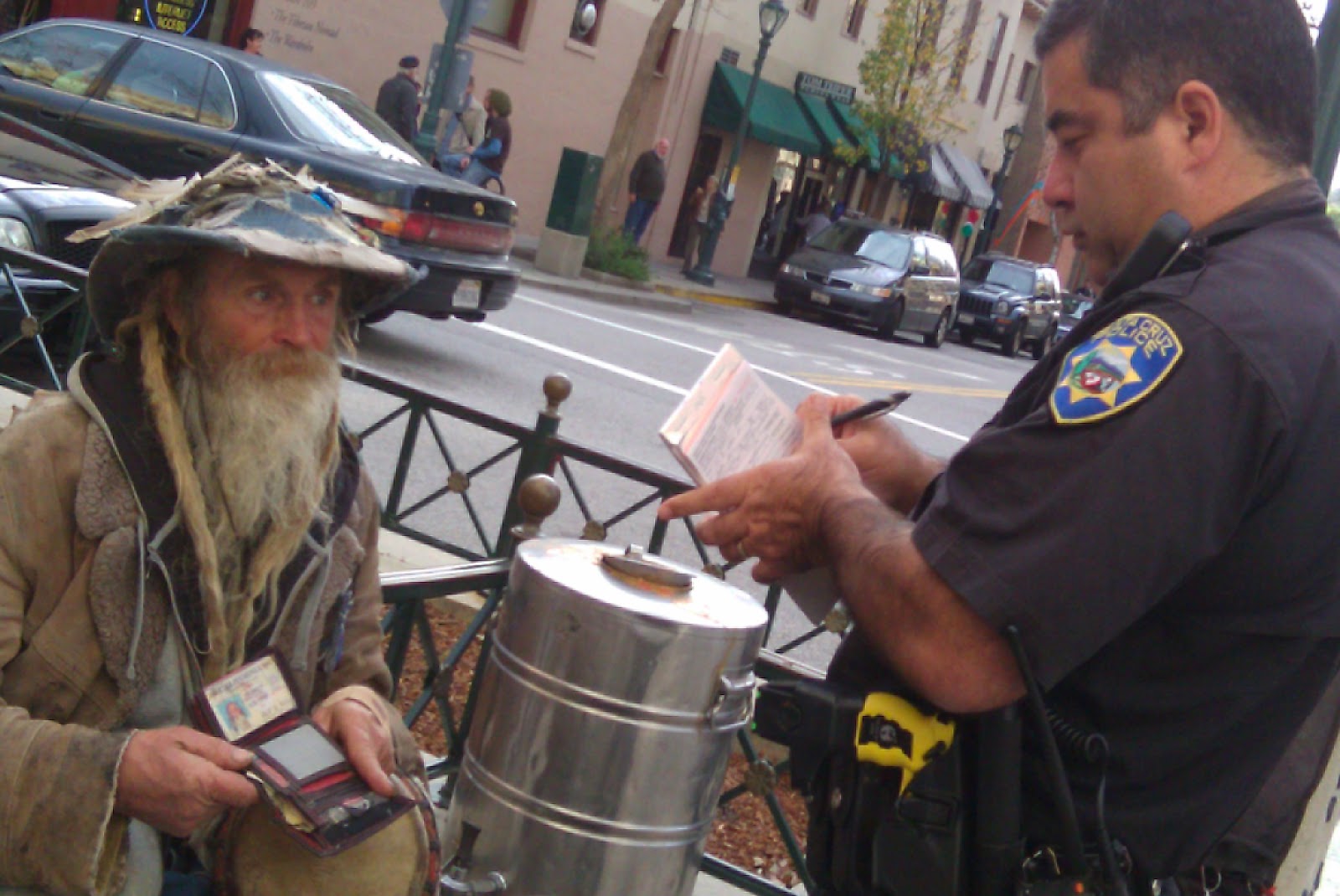
Deputies clear illegal camps near Hwy. 9, Pogonip

By Stephen Baxter – Santa Cruz Sentinel – 09/14/2012


Sheriff’s deputy Damon Hancock posts a notice to vacate in an illegal… (Dan Coyro/Sentinel)

SANTA CRUZ — After a Santa Cruz police project to clear out trash and illegal campsites this summer, sheriff’s deputies have started similar work along Highway 9 and other county areas.

In the past four weeks, deputies have focused on an area next to Highway 9 that includes private property and the edge of the Pogonip. More than a dozen campsites have been identified off its dirt trails. Deputies have worked with Santa Cruz police and park rangers because Pogonip is within Santa Cruz city limits.

After deputies posted notices to vacate the camps and pack their trash, nearly all the campers left. Friday, deputies posted notices at a few remaining active campsites and talked about the problem.

“This is encouraging. These are all people that have been warned and (their sites) are empty. But they’ve abandoned all their stuff,” said Sgt. Mitch Medina.

Some of the transients cleaned up their own mess by piling more than 25 trash bags under a train trestle at Highway 9, deputies said.

At perhaps a dozen other sites, there were strewn fast-food wrappers, dirty clothes, shoes and all kinds of other garbage.

Authorities said they wanted the property owner to pay for some of the trash removal. Deputies also were hammering out an agreement with Roaring Camp Railroads to haul some of it out by train. Train tracks run next to some of the sites near Highway 9.

As did Santa Cruz police, deputies who encountered the homeless have handed out business cards with information about shelters and other services. Also similar to police, deputies acknowledged that dismantling the camps was not a long-term solution to homeless problems in the county. Many of the campers they encountered had been kicked out of Santa Cruz, deputies said.

Still, they said the project was valuable because it protected residents’ property, reduced fire risks and cleaned up the environment.

“If we did nothing, the problem would just grow,” said deputy Daren Kerr, who has been working on the project.

The risk of wildfires is real, added Heather Reiter, chief ranger for the Santa Cruz Parks and Recreation Department.

About a month ago, a transient camped along the train tracks near Highway 9 told authorities that he accidentally started a fire. The blaze destroyed his camp but was contained quickly by firefighters.

“He said it originated in his cooking area,” Reiter said.

A separate fire that started at the base of a tree in the Pogonip in May was traced to a transient, Santa Cruz firefighters reported.

Deputies said they planned to continue the project for at least the next few months.

“We’re hoping with the help of the press, we’ll identify more sites,” said deputy April Skalland.

She asked residents who spot illegal campsites call 454-2440 and leave a message describing the location.

Earlier in the summer, deputies said they cleaned out a creek bed behind Emeline Street and Emeline Avenue. Working with County Jail inmates, authorities collected two Dumpsters worth of garbage, Kerr said.

One man also was arrested for two outstanding warrants and on suspicion of drug paraphernalia possession after he was caught with 30 uncapped syringes, said Kerr.

Friday, deputies did not cite or arrest anyone at the site near Highway 9. But they warned a 42-year-old woman to clear out her campsite near the trestle.

She had a tent pitched and a pit bull tied to a tree. Deputies told her she had 72 hours to leave or she would be ticketed for illegal lodging without the property owner’s permission.

The woman said she probably would stay with her mother, but she could not go to a shelter because she was taking care of the dog — which is not allowed in the Homeless Services Center in Santa Cruz.

Like some of the other transients that deputies encountered, she said she did not want to stay at a shelter.

“You gotta be in by 7, you can’t watch TV. I might as well be out here where I’m free,” she said.

She said she was particularly vulnerable as a homeless woman, and asked not to be named because she feared an ex-boyfriend. Once, while she slept, another man tried to stab her with a heroin-loaded syringe. She now carries a knife for protection.

“I wish I had some money and some food,” she said. “I’m stuck here.”
Letter to the Board of Supervisors on Sweeps of Homeless Encampments

Becky Johnson: One Woman Talking

September 12, 2012

Original Post

Police photo of the destruction of the encampment in San Lorenzo Park on
December 8, 2011 by Santa Cruz Police, Santa Cruz County Sheriffs,  Scotts Valley Police, Capitola Police, UCSC police, Parks & Rec Rangers and First Alarm Security Services. An estimated 160 people were displaced.


From: Homeless United for Friendship & Freedom
309 Cedar St. PMB#14 B — Santa Cruz, Ca. 95060
(831) 423-HUFF or (831) 423-4833
to: Board of Supervisors, County of Santa Cruz
701 Ocean St. Santa Cruz, Ca. 95060
Chair: John Leopold Members: Mark Stone, Neil Coonerty, Ellen Pirie, Greg Caput
cc: Phil Wowak, Sheriff, County of Santa Cruz
cc: Dana McRae, County Counsel, County of Santa Cruz
cc: Susan Mauriello, CAO County of Santa Cruz
re: sweeps of homeless encampments in Santa Cruz
September 12, 2012
Dear Chairman Leopold, and members of the Board of Supervisors for Santa Cruz County,
As you know, the City and County of Santa Cruz have inadequate affordable housing available for poor and homeless people. While many public and private shelter options are available and have openings at any one time, they could, in no way, meet the sheer number of those who have no financial resources to purchase legal shelter. So it is with surprise, concern, and dismay that we read weekly accounts of a joint effort between the Parks and Recreation Department, Public Works, and the Santa Cruz Police Department quantifying efforts to sweep areas commonly used for illegal camping. As these campsites are being “abated,” press releases have been issued announcing the number of camps destroyed, citations issued and arrests made.
A related concern exists in County government with the recent sentencing of Gary Johnson and his attorney, Ed Frey to jail for 2 ½ years in Gary’s case and six months in jail for Ed for the “crime” of lodging. PC 647 (e) draws its origins from a tattered history of Black Codes, Jim Crow, and civil war racism which we had thought had been purged from our justice system during reconstruction. This misdemeanor statute, the statewide anti-lodging code has been mis-interpreted by our courts as outlawing sleeping, when a clear reading of the law says nothing of the kind.
We urge you to use your resources to free both Gary Johnson from captivity and to defer any further punishment of Gary or Ed indefinitely. We ask also, that you review whether it is either legal or advisable to use PC 647 (e) at all.
What these events and policies represent are peoples’ lives being uprooted, their meager possessions seized or destroyed, and the persons involved moved along, cited, or arrested.
Let me remind you, two of the three shelters in Watsonville closed recently. This Saturday, Page Smith Community House closes for 5 months, and will be moving its entire population into the Paul Lee Loft. This will leave only the 30 spaces at the River Street Shelter for emergency housing.
In the City, the current City Council are only willing to fund a bus ticket out of town despite critical needs for legal shelter.
With completely insufficient shelter available, homeless people are left to mill around, unable to sit down, lie down, or sleep whether it is daytime or night. Their overall health suffers, sleep deprivation occurs, and many who tend to self-medicate do so more. Even worse for local merchants, is that when these camps are raided and destroyed, their occupants have nowhere to go but into City parks and downtown business areas where they are not wanted at all.
Police raids, and Sheriff’s citations for illegal “lodging” conducted during an obvious shelter emergency, are unproductive, a waste of public resources, and in light of the lack of legal shelter available to these people, inhumane. HUFF has already called for the SCPD, Parks&Rec, and Public Works to CEASE AND DESIST massive abatement practices when no alternative shelter can be offered.
Now we are asking you, our elected representatives, to act to enact policy whereby PC 647 (e) citations will be suspended until the shelter crisis recedes.
“Housing” homeless people in jail for the “crimes” of “living” “sleeping” “lodging” or “camping” represent institutional abuse of persons whose economic circumstances forbid their ability to purchase legal shelter. Those who knowingly continue such practices will ultimately be held accountable for the human misery they are fomenting.
I thank you for your personal consideration of these issues and invite further dialogue. HUFF holds weekly meetings and I would invite all or any of you to attend our next meeting to explain your policy and practices using civil dialogue and an open process.
Sincerely,
Becky Johnson of HUFF

Aptos Safeway pretends to care

SC Sentinel – As you see it – 9-04-2012

To read of the Aptos Safeway meeting on Aug. 22 where residents voiced opposition to the Safeway developers’ massive plans, I conjured up the image of an idling D9 Dozer impatiently waiting for the token community nonsense to end so it may drop the blade and lay track.

After the meeting concluded, I could see the Safeway reps smiling, shaking their heads and saying, “We gotta seem like we care, don’t we?” This “caring” was so eloquently spoken by Safeway architect Robert Lyman: “I’m trying to capture what Aptos is all about.”

Utter compatibility, no?

Sort of how the out-of-town developers in 1974 wanted to capture what Lighthouse Field was all about with their massive conference center proposal.

THEODORE E. MEYER III, Santa Cruz

SF seeks mandatory treatment for drunks

Phillip Matier and Andrew Ross,
SF Chronicle , Tuesday, September 4, 2012

A city proposal would take chronic drunks off the street and force them into treatment programs they have refused. Photo: Brant Ward, SFC / SF

A city proposal would take chronic drunks off the street and force them into treatment programs they have refused. Photo: Brant Ward, SFC / SF

Chronic drunks in San Francisco could soon be sentenced to locked treatment for as long as six months, under a plan that has the green light from Mayor Ed Lee.

“We’ve done pretty well at getting some of these individuals to a point where they clean up a little bit – but when you leave them alone, they go right back to their old ways,” Lee said of the city’s current policy of releasing drunks when they sober up.

Under a plan being worked out by the city courts, the cops and the Public Health Department, chronic drunks who repeatedly miss their court dates would be held in contempt – five days for each missed appearance.

Contempt citations are handled by a judge – no trial required – although defendants still have the right to an attorney. Considering that some street drunks have missed 20 or more court dates, rolling the citations into one could result in a hefty piece of time.

And that’s the idea – take them off the street and force them into the treatment program they have repeatedly refused.

“If somebody has 20 warrants, you can pretty much guarantee that someone from the health department has offered them some type of help 20 times as well,” said Katherine Feinstein, presiding judge of San Francisco’s Superior Court.

For those sentenced, the first stop would be San Francisco General Hospital.

“These guys may look tough, but they are medically fragile,” said Barbara Garcia, head of the Public Health Department.

After the hospital clears them, the next stop would be a special wing of the city jail for treatment administered by health department workers.

“Thirty days wouldn’t hurt,” Garcia said. “Once people have been sober that long, they look pretty good and can maybe start to get a handle on their lives.”

Garcia said the hope is for a pilot program to be ready to go within 30 days.

Public Defender Jeff Adachi, whose office would represent many of those facing mandatory treatment sentences, questioned whether targeting drunks amounted to “selective enforcement,” and whether criminal proceedings were appropriate for people who suffer from what “I think everyone agrees is a disease.”

Adachi also wonders whether the jail is equipped to handle a rehab program.

Lee, however, says it’s worth a try – the sooner the better.

“This has been a long time coming,” the mayor said. “There are 68 people on the streets that have cost us tens of millions of dollars going in and out of the hospitals, courts and jail.

“I know who they are, too,” Lee said. “I spent six years at the Department of Public Works cleaning up after them.”

Road show: BART directors will hold special board meetings Friday – in Vancouver, Wash., and Clackamas, Ore. – so they can get a close-up look at how the system’s $484 million light-rail connector to Oakland International Airport is being manufactured.

But first they’ll fly into Portland on Thursday – where BART General Manager Grace Crunican last worked – to get a view of that city’s light-rail system.

BART’s delegation is expected to total 15 – five directors, Crunican and nine senior staffers. They’ll stay at the Hotel Monaco downtown, where – with a government discount – rooms run about $200 a night. Officials put the total cost of the trip, including airfare and meals, at about $8,100.

BART District Secretary Ken Duron, who has been with the transit agency for more than two decades, says the out-of-town meeting is a first for the board.

According to a BART agenda notice, Friday morning’s meeting will include a workshop at Thompson Metal Fabricators in Vancouver, where there will be “a discussion and review of (the) welding and finishing process” for the new Oakland tram structure.

Then it’s on to Clackamas, a suburb southeast of Portland, to see how the rail cars are being built.

But apparently there is more to it.

Hiring local workers has been an issue on the project, and “it helps if directors stare down the contractor and say, ‘We’re not going to accept 24 percent of Oakland residents working on the job site when we said 25 percent,’ ” said BART director Robert Raburn, who is among those going on the trip.

Raburn insists this is no junket. In fact, he says, he put his foot down when Oakland officials invited BART directors to go to Las Vegas last month to look at a tram system used by hotels and casinos there.

Oakland City Council President Larry Reid, for his part, says the Vegas trip wasn’t going to be a junket, either – he hoped to drum up support for adding a $15 million hotel stop on Hegenberger Road for the airport line.

A scheduling conflict forced the trip’s cancellation, Reid says, but a meeting was held in its place – at the Alameda County Transportation Commission‘s board room in downtown Oakland.

Effort to reduce Santa Cruz homeless camps sees mixed results

STEPHEN BAXTER – Santa Cruz Sentinel
Posted:   08/29/2012

SANTA CRUZ – Tucked in the bushes near the southbound Highway 17 approach to the Fishhook, 45-year-old Thomas Delfino camped in a tent under a brown tarp on Wednesday.

As cars whooshed by the highway and the sun beat down, Santa Cruz police Sgt. Dan Flippo and three officers confronted Delfino.

A mountain bike lay nearby with its serial numbers and frame painted black – common features of a stolen bike. Two old laptops and four bike wheels were in the tent, surrounded by dirty sheets, empty soda bottles and a stench from a pile of used toilet paper a few steps down the trail.

Delfino, looking sullen, talked to the officers with familiarity. He said he was no longer using heroin, but he still used meth and marijuana.

He said he wanted to stay clean so that he could see his daughter and his girlfriend’s family. “But I got high the other day,” Delfino said, squinting into the sun.

With an outstanding warrant for possession of drug paraphernalia, he was searched, handcuffed and taken to County Jail. Police would later call Caltrans to clear out the camping gear and trash – minus the orange-capped syringe that Flippo found near the tent.

In the nearly seven weeks that Santa Cruz police have cleared out illegal campsites such as Delfino’s around Santa Cruz, Flippo said Wednesday’s find was common.

Most of the people they have contacted had problems with drug and alcohol addiction, yet most of them left after a 72-hour notice.

Police and some residents said the program has made great strides in cleaning up trash in roadside camps, creek beds and other areas. However, police said it might have shifted some illegal campers to areas in Felton and places outside the city.

Some homeless advocates said it was not an overall, long-term solution.

“I think it’s been successful in dealing with the areas that have been heavily impacted” by the homeless, Flippo said. “The emails we’ve been getting have been overwhelmingly positive in terms of sites being cleared. It’s a piece in the puzzle.”

PILOT RESULTS

In early July, Santa Cruz police started the program mainly in response to complaints by residents of trash and safety problems in areas such as the San Lorenzo River levee, Branciforte Creek and Pogonip.

A fire in Pogonip in April also was traced to transients. Environmental concerns grew, police spokesman Zach Friend said at the time.

With help from city public works and Caltrans, police launched a 4-6 week pilot program to clear out the camps and arrest those involved in criminal activity.

As of Aug. 20, police cleared out 54 illegal camps and identified 159 camps. Police typically ticketed people for illegal camping upon first contact, then posted notices that they had to clear everything out in 72 hours.

Authorities found some of the camps were large hangouts for drug users, such as a wooded area near the offramp from Highway 1 to northbound Highway 17, Flippo said.

The train tracks below Bay Street also was a hot spot, where neighbors were annoyed by late-night noise and drug use. At a marsh near Jessie Street and the San Lorenzo River, police said they found a camp with two mattresses that had been used for prostitution.

Camps also were dismantled between Highway 1 and the Santa Cruz Memorial Cemetery at Ocean Street.

“That used to be a go-to spot for a long time,” said officer Ron Inouye, who has been working on the project. “But now, nothing.”

Some police believe the homeless had congregated in wooded areas near Highways 1 and 17 because it’s a convenient spot. They can panhandle for money on Mission, River or Ocean streets, get food from churches and other food pantries, then buy drugs from dealers in the wooded areas.

Their walking or biking radius is only a few miles, Flippo said.

Since the program started, police said the camps have shrunk from large, established campsites such as the one near the Fishhook to smaller, more mobile sites.

Volunteers and city workers also cleared brush along with the campsites at the San Lorenzo River levee, and some say the change in the past month is striking.

However, police said they had heard more reports of homeless in areas in the San Lorenzo Valley. They were starting to work with the Sheriff’s Office on it, Flippo said.

When police approach a camp – often identified by residents’ complaints – they typically ask occupants if they are familiar with shelters such as the Santa Cruz Homeless Services Center on Coral Street.

Flippo said officers carry cards with information about drug and alcohol rehabilitation services, food pantries and other programs.

“We try to explain the services available to them,” Flippo said.

He estimated about one third of the people they’ve contacted in the project used the services, about a third of the people didn’t use them and a third said they didn’t want them. Many of the programs don’t allow drug use, and they are admitted drug users who don’t want to participate, Flippo said.

Others said the shelter is full, which it often is. Or they said they don’t want to go there because of “drama,” Flippo said – often related to the lines and cluster of people.

FUTURE WORK

Although homeless advocates said they appreciated the environmental improvements in the project, some wondered about some unintended consequences.

Similar cleanups have happened recently elsewhere in the state, said Peter Connery, vice president of Watsonville-based Applied Survey Research. The firm conducts a homeless census in Santa Cruz County every two years. There were about 2,770 homeless in the county in 2011.

Really, breaking up encampments has gone on “forever in the history of noiselessness,” he said.

“It’s not a strategy. Folks aren’t going away, they’re just moving them around,” Connery said.

When police force them to leave, many people lose their belongings, identification and paperwork that helps them access services, Connery said. Also, if the camps are pushed into the woods in the San Lorenzo Valley, for instance, that could lead to problems there.

“They get put into unfamiliar and more crowded surroundings that could exacerbate mental health problems,” Connery said.

“It’s just tough, and they just don’t have a lot of alternatives. There’s absolutely insufficient resources in Santa Cruz County to make things better,” Connery said.

Flippo countered that the project essentially was a small solution to a larger, more complex problem.

Standing near Delfino’s campsite off Highway 17 on Wednesday, Flippo noted that Delfino had been to several drug treatment programs.

“How many times do you send people to a treatment program? What’s the next step?” And how many victims’ (items) were in that tent?” Flippo asked.

“It may not be good for him,” he said of the program. “But it’s good for the neighborhood.”

Big SoMa homeless camp cleaned out

Kevin Fagan
SF Chronicle – Tuesday, August 28, 2012

To most people, the giant homeless encampment at Fifth and King streets was invisible. At most, some could catch a glimpse of tents from the Interstate 280 on-ramp, or from a railcar pulling into the nearby Caltrain station.

But nearby residents and shopkeepers knew exactly what was under that I-280 on-ramp – a sprawling mini-city of tents, suitcases and makeshift Conestoga wagon-style trailers, and a 50-strong homeless population that had been there for years. It was the biggest street camp in San Francisco.

Until Tuesday, that is.

At 8 a.m., an army of police officers, city cleaning crews and street counselors descended on the block-long settlement, and by noon tons of clothing, tents, boxes and trash had been cleared out, either to city storage lockers or disposal bins. City workers said that by Wednesday evening they hope to have it cleared down to bare dirt for the first time in at least three years.

The cleanup was a dirty, complex job. Several campers were methamphetamine addicts, forcing crews to use grabbing tools to pick up used needles before it was safe to clear smaller garbage.

“This camp has always been a real mess,” said California Highway Patrol Officer Sarah Wrathall, watching workers with breathing masks sort debris. “There’s a lot of rats, a lot of excrement, a lot of waste.”

City homeless outreach counselors, meanwhile, waded into the crowd. By the end of the day, they had gotten 10 people into temporary housing and on track for permanent supportive residences.

“I can’t believe I get to live inside again,” said Brenda Clark, 48, sitting by her chest-high mound of belongings and waiting for a van to take her to a city-funded residential hotel room. “I got evicted from my last hotel in April, and I didn’t know where to go, so I wound up here.

“I can’t wait to have a real shower,” she said with a toothless smile.

Bevan Dufty, point person on homelessness for Mayor Ed Lee, said the ultimate goal of the joint effort by the various agencies that carried out Tuesday’s clearance was not just to bounce street people down the block to make the area prettier.

“Our objective is to go in and start engaging,” he said. “I have enormous faith in the outreach team, and we will be going back again and again to that spot to help people with housing and services.”

Dufty said he was encouraged that this month, the Board of Supervisors allocated an extra $3 million for homeless shelter, housing and counseling.

The camp has been regularly visited for years by city police, CHP officers including Wrathall, street counselors and officials of the California Department of Transportation – which owns the on-ramp – and partially cleared out every month.

But lately it had grown to include a community garden, a bucketful of dead rats and a fire pit for melting rubber off salvaged or stolen wiring to sell for recycling. The various agencies determined it was time to move in.

Because campers tore out thousands of dollars of cyclone fencing under the on-ramp to set up tents, Caltrans’ plan is now to install a more durable barrier to try to keep them out. That fence will probably cost about $200,000, said Caltrans spokesman Steve Williams – but even then, the agency knows campers will be back.

“You clean it out today, and they’ll back tomorrow,” he said. “We’re just trying to remediate the problem as best we can.”

Jennifer Friedenbach, director of the Coalition on Homelessness, said that until the city has enough housing to readily supply to every homeless person, clearing out camps is just harassment.

“There’s no point to it,” she said. “With nowhere to go, all you’re doing is dispersing people.”

“I’m sleeping here tonight as soon as these guys leave,” said Tasha Ward, 21. “They’ve got too many restrictions inside, and I want to do my meth and mind my own business.”

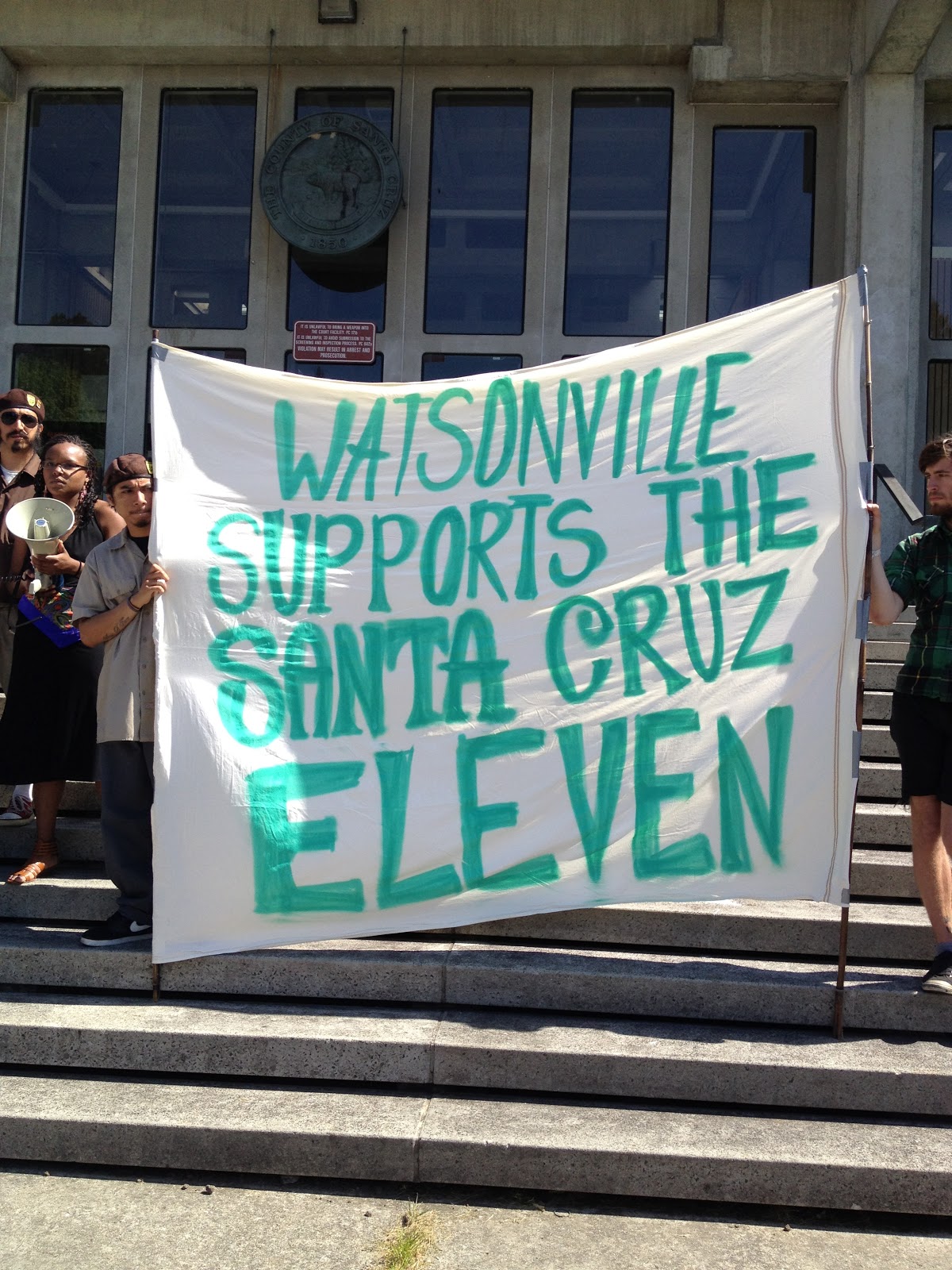
Santa Cruz Eleven brace for a long, dirty fight

Becky Johnson: One Woman Talking

August 20, 2012

Original Post

Santa Cruz, Ca. — Sunday had been upbeat. Defendants and their supporters met on Seabright Beach for a bonfire and cookout. Anyone strolling down the beach would see what looked like a relaxed, peaceful gathering of beach-goers — as all-American as apple pie. Few would guess it was a gathering of eleven people charged with felonies and their supporters fitting in one beach cookout on the eve of what all hoped would be a long-awaited dismissal of specious charges.

However, Monday morning in Judge Burdick’s court that was not to be.

This wasn’t to be the long postponed preliminary hearing. Burdick had cancelled that on Friday. Instead, assistant DA Rebekah Young appeared in court with DA Jeff Roselle and DA David Sherman. Over the weekend, the three had worked to create an evidence list of 13 videos, over 600 photos, a copy of the lease, and the police reports. They purchased 7 hard drives for the seven lawyers representing the seven remaining defendants, including the author. It must be nice to have an unlimited budget.

DAMAGE CLAIMS FROM WELLS FARGO DOCUMENTED

Young was also able to deliver via e-mail the billing sheets for damage alleged to be caused by defendants.

One look at them confirmed why Young had dragged her heels on releasing the documentation for the “vandalism.” Billing sheets had outrageous amounts billed with few details as to what services had been rendered totaling over $25,000. And not a single contractor from Santa Cruz County was hired.

For instance, Wells Fargo manager, Alicia Bucher hired a San Leandro firm to remove furniture damaged beyond repair. The cost? $6,545.41.

Last December, when the SCPD had shut off power and water to the building, protestors had made a make-shift bathroom in a utility closet. The cost to ” remove biohazard” was $6,222.83! The shit heard ’round the world?

Bucher hired a Richmond firm to “detail clean” the property. Protestors report the building was far from pristine when they first entered the building, not having had a tenant for 3 1/2 years, or seen an agent showing it to a potential client in months. The bill? $2,988.00.

She hired a locksmith in Foster City to rekey the building. While protestors used a key to enter the front door, and presumably only had access to the external doors, Bucher opted to have every lock and key replaced in the entire building and at after hours costs totaling $2,430.19.

Despite each and every billing sheet appearing to be padded to the maximum, there was no billing sheet for the graffiti on the air conditioning ducts on the roof of 75 River Street. This is surprising because this was the only damage for which photographic evidence exists. In over 600 police photos turned over to defense attorneys, no other vandalism has been documented.

There are no police photos of any “bio-hazard.” No “broken furniture.” No before and after photos after $2,988.00 worth of cleaning had been completed. No evidence any locks other than those the stolen key fit needed to be replaced. And why did the locksmith ONLY work after midnight?

This is a ridiculously padded account done to foster the claim protestors were out of control vandals rather than concerned activists trying to highlight the waste and blight left in Wells Fargo’s wake for leaving that building empty so long.

Defendants are also being asked to pay for the external fencing which Wells Fargo should have put up before the demonstrators occupied the building.

Why were no local contractors used?Instead Wells Fargo manager, Alicia Bucher contacted and hired contractors from as far away as San Leandro, but not a single Santa Cruz County business benefitted. Bucher herself has an East-bay area code, and no ties to the local community.

Could it be Bucher only used contractors she could manipulate to produce whatever paper-trail she desired? What does that say about Wells Fargo’s integrity generally?

PUNISHMENT PRIOR TO TRIAL

Lawyers, judges, and deputies get paid for what they do. Defendants do not.

“I missed my grandmother’s funeral,” Angel Alcantara revealed. “Her funeral was Friday in Fresno and I had to be here.” How do you put a price on this?

The case grinds on; despite little evidence against those charged and no evidence of vandalism committed by any of the defendants charged,

“It’s a weak case,”David Beauvais, attorney for Robert Norse told Burdick. “It’s time to end this charade.”

But DA Jeff Roselle disagreed.

“Someone broke into…entered private property without permission. Sanction our office but do not dismiss the case. The sanctity of private property has been violated.”

“What about the sanctity of our rights to free speech, to a fair and speedy trial, to dissent?” queried defendant, Gabriella Ripley-Phipps, shortly after the hearing.

Burdick opted to consider what sanctions he might impose but, apparently persuaded by Roselle announced “Serious crimes were committed. My discretion is not appropriately applied by dismissing these cases.”

NEXT COURT DATES:

Jan 4th 9am for prelim set
Jan 7th 9am Preliminary Hearing

Where is the outrage over activist prosecution?

Dennis A. Etler: Opinion

SC Sentinel:   08/19/2012

Over the years Santa Cruz has seen various protest movements ebb and flow through its streets and back alleys. Many local residents are open-minded and supportive of these protests, though the majority seldom participates. When the Occupy Wall Street movement began to spread throughout the country, it resonated with many who were motivated to act by the vast social and economic inequalities and injustices that have come to characterize our country. At its height, Occupy Santa Cruz attracted hundreds of demonstrators from all works of life, all age groups and a diversity of communities.

The encampment at the Benchlands in San Lorenzo Park adjacent to the county building was a dramatic symbol of popular resistance to the fleecing of America by the 1 percent. It was also a dramatic example of community self-help for homeless people who had and still have no shelter.

After some time, in Santa Cruz as throughout the country, local authorities grew apprehensive and angry at Occupy Santa Cruz. The city and county used permit demands, court injunctions, selective arrests, anti-lodging laws and established a new nighttime curfew zone around the courthouse to thwart the protest. Finally, squads of police moved to disperse several hundred homeless people and destroy their property. Elsewhere Occupiers were hit with pepper spray and mass arrests. Here the court system is being used as a club wielded against longtime activists.

Last year at the height of the Occupy protests nationwide, an autonomous group in Santa Cruz occupied a vacant bank building at 75 River St. leased by Wells Fargo. Many local residents, including mainstream and independent media, community leaders and concerned citizens, as well as young, free-spirited revelers, entered the building to support and observe. After 72 hours and a police request that the building be vacated, the protesters left with minimal property damage, no personal injuries, no citations and no arrests.

I was therefore flabbergasted when months later District Attorney Bob Lee initiated criminal proceedings against 11 community activists. He charged then with felony conspiracy to vandalize and trespass. The only evidence as revealed by six preliminary hearings was that they were in the building with dozens if not hundreds of others. A Sentinel reporter, a city councilwoman, and several other more conservative reporters, known to the police with 300 others also in the building were ignored.

Selectively targeting protesters months later for nonviolent protest is a terrifying new tactic. Lee claims he just wants the 11 to pay $25,000 in compensation to Wells Fargo for undocumented graffiti. Yet the cost of courts, bailiffs, deputy DAs, public defenders, etc. runs to many times this amount. This month Lee is asking for more prosecution money.

The Santa Cruz 11 do not deserve to be prosecuted. Local authorities are attempting to bully and intimidate those who have the temerity to challenge a system which dehumanizes and oppresses the dispossessed and most disadvantaged amongst us. Meanwhile the real felons — the banks — continue their abusive foreclosure practices with obscene government handouts. Those who expose them are on a six-month courtroom treadmill and face a possible seven years in prison, while real crimes go unprosecuted.

I ask District Attorney Lee, have you no shame? And I ask the people of Santa Cruz, where is the outrage?

Dennis A. Etler, an instructor in the Cabrillo College anthropology department, lives in Boulder Creek.

Case against Santa Cruz Eleven is crumbling

Becky Johnson: One Woman Talking

August 18, 2012

Original Post

Santa Cruz, Ca. — The case against eleven mostly long-time and well-known activists or alternative media journalists seems to be falling apart.

On Friday, DA Rebekah Young was made to answer for video discovery not delivered, potentially exculpatory evidence not turned over, billing sheets confirming allegations of damages still missing, and promises made not kept.

“She still has not turned over the second videotape mentioned in police reports about my client,” charged defense attorney, Alexa Briggs. “And the first tape is exculpatory as it shows my client, Mr. Laurendau leave the building when warned.”

Judge Burdick cancelled the Preliminary hearing on August 20th and ordered Young to show cause why he should not dismiss all charges.

A 9am hearing is scheduled.

Judge indicates he may dismiss charges in 75 River case due to procedural issues: Judge has strong words for prosecutor

Jessica M. Pasko – Santa Cruz Sentinel
Posted:   08/17/2012

SANTA CRUZ – A judge had strong words Friday for the prosecutor handling the case of the takeover of a vacant bank, telling her he was unhappy with the way the case has been handled, saying he could dismiss it.

Seven people still face charges in connection with the nearly three-day occupation of the former Wells Fargo building located at 75 River St. They’re charged with felony conspiracy, vandalism and misdemeanor trespass. The charges stem from an incident in which a group claiming to be acting “anonymously and autonomously but in solidarity with Occupy Santa Cruz” entered the bank building in late November and remained there for nearly 72 hours.

Friday, defense attorneys told Judge Paul Burdick they haven’t received some of the documents and videos they have requested from the District Attorney’s Office despite numerous attempts.

Alexis Briggs, who represents Cameron Laurendeau, said she has not received specific video she requested from prosecutor Rebekah Young. The video in question refers to footage apparently used by police to confirm who was where and when during the occupation of 75 River St.

Defense attorneys for Becky Johnson, Robert Norse, Gabriella Ripleyphipps, Franklin Alcantara, Desiree Foster and Brent Adams expressed similar frustration.

“If there are videotapes depicting the crimes taken by police and they haven’t been provided (to the defense,) it’s inexcusable,” Burdick said, growing increasingly exasperated. “We’re now eight months into this case. I’m inclined to dismiss it.”

Young said she had duplicated as many of the DVDs as she could but some were unable to be copied due to technological issues. Her office set up a YouTube channel for the raw footage, but some of the defense attorneys argued that the Internet wasn’t an appropriate way to hand over discovery.

Burdick said that at this point, it’s unlikely the court will proceed with a preliminary hearing, which was scheduled for Monday. Instead, he ordered an order to show cause hearing for Monday, in which the prosecution will have to show why all charges shouldn’t be dismissed because of failure to provide discovery.

“I’m really unhappy about this Ms. Young,” Burdick said. “It’s inexcusable.”

He ordered Young to compile an inventory of what evidence – and when – has been provided to the defense attorneys as well as the methodology of doing so.

Late Friday afternoon Young said she was working to upload all of the footage onto external hard drives for the defense attorneys.

Charges against four of the 11 people originally charged in the case – Bradley Allen, Alex Darocy, Grant Wilson and Edward Rector – previously were dismissed by Burdick.