Right2Rest Legislation Update and 2015 R.I.P.


NOTES BY NORSE;  The Right2Rest Law has been laid to rest (for this year at least).   Perhaps pressing for action in a particular city would be a good focus for unhoused activists all over the state, instead encouraging the massed wealthy power all the bigoted city governments to shower legislators with lobbyists.

Contact Councilmember Micah (poo on “poopoo”) Posner, the man whose credo has been “one portapotty-but-let’s-not-disturb-the-staff-by-pressing-to-get-the-already-existing-bathrooms-open-at-night”.  He has scheduled an 11 AM meeting on Friday if anyone wants to come.  But you have to call him at 420-5028 beforehand to schedule it.

Meanwhile in Santa Cruz, crackdowns continue–individually and institutionally.  The Red Church (Calvary Episcopal) has not only withdrawn its lawns from 2-hours-a-week sanctuary to 0-hours-a-week as Pastor Joel Miller, reportedly under pressure from “there goes the neighborhood!” neighbors as well as ecclesiastical superior, called in the police night before last to remove “criminal sleepers” on the property.  Cops and security thugs steadily ignore the right to use public sidewalks around Cafe Pergolesi by giving “obstructing the sidewalk” tickets to at least two people who asked why they didn’t have the right to stand non-obstructively on the sidewalk.   Standing while homeless is apparently the crime involved.  Or questioning the inflated authority of guys in uniforms with badges and guns, perhaps.

Has the Homeless (Lack of) Services Center [HLOSC] okayed the collusion between Harvey West Businesses, the SCPD, and the Public Works Department to create the first-in-Santa-Cruz “no parking at any time without a permit” zone up and down Coral, Fern, and Limekiln streets?   Call them up at 420-5020 and ask them.  I can’t get through.   Or perhaps shoot an e-mail to longtime HLOSC-backer (and Mayor) Don Lane at dlane@cityofsantacruz.com  or 831-420-5022.

We’ll be out there gathering signatures, complaints, and concerns today at 2:30 pm at 115 Coral St. (See “Fighting the Homeless Parking Ban–Day 2” at https://www.indybay.org/newsitems/2015/05/07/18772010.php ).  Hot coffee and heated discussions.  Join us, or contact HUFF at 423-4833 and/or rnorse3@hotmail.com to be alerted for future protests.

Proponents of the Right to Rest bill — including a busload of advocates of homeless people from San Francisco and Oakland — turned out in great numbers. Supporters outnumbered opposition lobbyists from business alliances and city governments by 6 to 1 during legislative hearings in Sacramento.

by TJ Johnston

The Right to Rest Act, California Senate Bill 608, which would decriminalize sleep, rest, the sharing of food and prayer, was pulled from committee without a vote. But the struggle for the bill in California will continue next year.

For now, SB 608 has been delayed after State Sen. Carol Liu (D-La Cañada-Flintridge) asked the Transportation and Housing Committee to hold off a vote on April 7 when it appeared there weren’t enough votes to advance the legislation.
“Today wasn’t a defeat,” said Paul Boden, director of the Western Regional Advocacy Project, one of the homeless advocacy organizations sponsoring the bill. “It was step one in a long process.”

SB 608, known as the Right to Rest Act, will still be active next year, he said. The state legislature still has up to two years to act on proposed legislation.

If passed by both the Senate and Assembly, the bill would ensure all Californians — regardless of housing status — the rights to rest, move freely in public, share food, pray, and sleep in a legally parked vehicle.

In effect, it would make local sit-lie and anti-panhandling ordinances that cities use against their homeless residents unenforceable throughout the state.

At the hearing, proponents of the bill — including a busload of advocates of homeless people from San Francisco and Oakland — turned out in great numbers. Supporters outnumbered opposition lobbyists from business alliances and city governments 6 to 1 during public comment.

Their refrain throughout the session was “stop criminalizing homelessness.” Several wore T-shirts with the words “Homeless Bill of Rights” and an image of a dove and a pair of hands breaking chains. This popular design comes from an image drawn by Ronnie Goodman, a homeless artist who has regularly lent his work to homeless people’s struggles.
Angel McClain, whom Liu invited before the panel, spoke in defense of SB 608. Now a senior advocate at St. Mary’s Center in Oakland, she spent 15 years on the streets, staying in tents, abandoned houses and by freeways — essentially, any place where she could find refuge.

She said that police officers targeted her for arrest simply because of her homeless status. “I was arrested for little or no reason because I was known as a homeless person,” she told the panel. “My cousin told me the police had a schedule to pick me up and put me back in jail.”

McClain also suffered dehumanizing treatment from the police. “I was treated like dirt, no consideration, like a piece of garbage that you discard,” she said.

Opposition to the Right to Rest bill came mainly from the League of California Cities, which argued that the bill would exempt homeless people from so-called “quality of life” laws that in theory apply to all people, but in fact are used almost exclusively against homeless people. The statewide association wrote a letter to Liu that the bill wouldn’t create or expand housing and social services.

But Boden said that is not the focus of the bill. It’s meant to remove legal barriers homeless people face because they have been arrested for the necessary acts of resting, sitting or lying in public.

“It’s not about ending homelessness, just decriminalizing it,” he said. “Everyone sleeps, eats and sits, but only some get tickets or go to jail for it. Criminalization only makes things worse for people living on the streets. And by not having to enforce crimes of status, law enforcement can focus on real public safety issues.”

However, senators on the committee and opponents of the bill said SB 608 would remove a tool from police in enforcing local ordinances (see sidebar).

Appearing before the panel, Matt Gray, a lobbyist for Taxpayers for Improving Public Safety and the California Small Business Association, painted a worst-case scenario of what would happen to communities if the bill passes.

“The answer is simply not to allow the rest of California to be like San Francisco,” he said.

Recently, the city of San Francisco was also used as a model of homeless criminalization in a report from the University of California at Berkeley law school. Of the 58 cities with anti-homeless ordinances it studied, San Francisco tied Los Angeles to lead all others in their overwhelming number of anti-homeless laws — 23 in San Francisco. Homeless people were given about 23,000 citations in a seven-year span for such nonviolent, poverty-related offenses as sitting, resting, camping and panhandling.

In the last five years, San Francisco further restricted homeless people’s activities with prohibitions on sitting and lying on sidewalks at certain times, staying in public parks overnight, and parking large vehicles on most city streets overnight.
Berkeley — which has 10 anti-homeless ordinances of its own — is considering adding many more, including setting one’s belonging by a tree, lying on planter walls, and panhandling within 10 feet of parking pay station.

On March 17, the City Council forwarded these recommendations to the City Manager for recommendation.
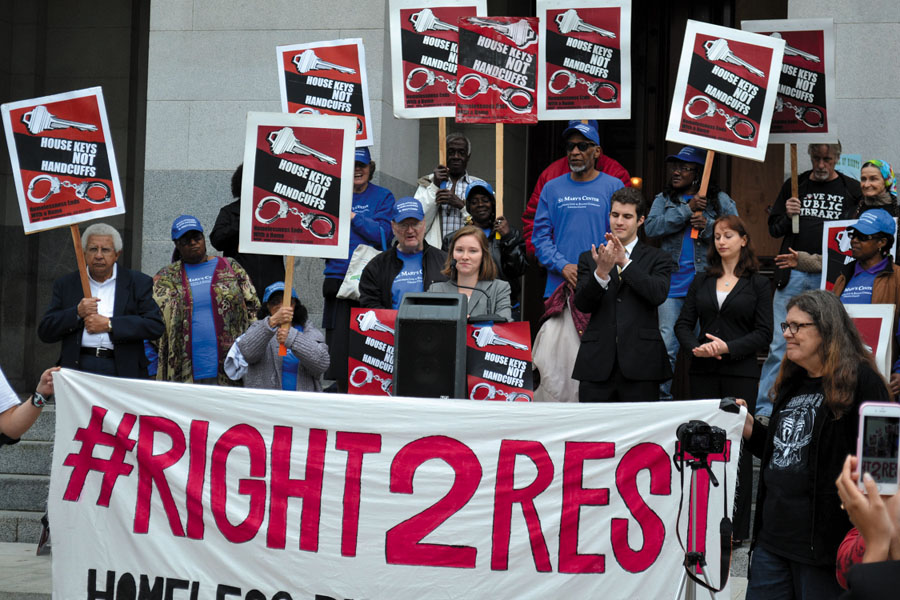
Homeless advocates demonstrate in Sacramento for the Right to Rest Bill which would end the enforcement of many anti-homeless laws.  Janny Castillo photoHomeless advocates demonstrate in Sacramento for the Right to Rest Bill which would end the enforcement of many anti-homeless laws. Janny Castillo photo

Osha Neumann, an attorney with the East Bay Community Law Center, said the proposal would make Berkeley’s tree-lined and metered streets off limits to homeless people if it is enacted.

“Taken together with existing laws, these ordinances would essentially make it illegal for people who are homeless to have a presence on our streets and sidewalks,” he said.

Right to Rest bills are moving through legislatures in Oregon and Colorado.

Two years ago, a more expansive version of the legislation called the Homeless Bill of Rights passed the Assembly Judiciary Committee, but died when the Appropriations Committee declined to bring it up for a vote.

*** *** *** *** *** *** *** *** *** *** *** *** ***

You Can’t Make This Stuff Up

Stupid Things California Lawmakers Say About Homelessness

by TJ Johnston

If there was any doubt that SB 608, the Right to Rest Act, would face any roadblocks in the legislative process, they were surely dispelled when State Sen. Cathleen Galgiani (D-Stockton) weighed in. Before Galgiani’s remarks, a few of the California state senators on the Transportation and Housing committee had already voiced reservations that would lead to a prospective “No” if SB 608 author Carol Liu asked for a vote on the bill on April 7.

Some were concerned about provisions in the bill such as a $1,000 fine to communities upon violation of the act. Others wanted clarifications on how the bill would affect those sleeping on public versus private property. (Liu said it would not apply to private property.)

But Galgiani’s rambling explanation of why she wouldn’t support the bill left some incredulous. While asserting that uneven application of anti-homeless ordinances aren’t a problem in her district, she said cops still need them for other reasons — such as thwarting gang warfare.

“You and I and law enforcement cannot tell who is homeless from someone who belongs to a gang,” she said. “If I dress down, I can blend in as well.”

She then recounted a recent incident that happened in her district.

“This last month,” she said, “we’ve had a drive-by shooting at a market just blocks away from where I used to live a few years ago, where three people were killed. Now it’s a known place where people loiter. How do you define ‘loiter?’ You can’t define it just by looking at someone or seeing that someone is spending time at a place for too long. That’s why we must rely on law enforcement for the judgments on behavior taking place. Law enforcement needs that tool to address the behavior.”

What Galgiani failed to mention is that the U.S. Supreme Court found anti-loitering laws to be unconstitutional in 1999 primarily because of their vagueness.

Galgiani also related another recent tale of an altercation among three motorcycle gangs near a strip club where gunfire was exchanged.

“These are the problems in my district,” she said. “Law enforcement in my district, they’re not bothering people who are homeless. I respect that is occurring throughout the state.” She added that the state should “do a broad blanket for everyone to abide by” if SB 608 becomes law.

Another addition for the file under “you can’t make this up” came from Matt Gray, who lobbied against the bill on behalf of two business organizations.

While he encouraged creating affordable housing and improving social and health services — at the same time, referring to homeless people as “transients, homeless or whatever you want to call them” — he ultimately said the overarching solution wasn’t “allowing the rest of California to be like San Francisco.” No city in California has more anti-homeless laws than San Francisco.

Continue reading →

Homeless Parking Ban–Day Two: 2:30 PM 115 Coral St.


https://www.indybay.org/newsitems/2015/05/07/18772009.php

TEAMING UP WITH THE OPPRESSOR
While they officially call themselves the “Homeless Services Center” [HSC], I have described the HSC as the “Homeless (Lack of) Shelter Center -[HLOSC].

The HLOSC provides shelter for less than 5% of the homeless community, have fenced off the area creating a jail-like atmosphere with ID cards, double layers of uniformed police and security, prioritized office space over vital homeless locker storage space, removed homeless parking on their property, harassed homeless people for “loitering” on the sidewalk, and displayed open hostility to activists advocating for the rights of homeless people.

The HLOSC has also reportedly supported the current “no parking for the poor” program being pushed by the Public Works Department–with the support of the SCPD and some nearby Harvey West Businesses.

THE ANTI-HOMELESS PARKING PLAN
The plan will eliminate ALL parking on Fern, Coral, and Limekiln streets unless you have one of the relatively few permits granted. These few are apparently only available to property owners, businesses, and renters.

This is an unprecedented plan, apparently reserved for the homeless community, nowhere present elsewhere in the City in any of the other permit parking zones.

It is slated to go into effect on May 13th in spite of the letters of objection and petitions filed.

DEMAND PUBLIC PROCESS
Public comment on the issue should send it to at least a hearing for consideration at the Transportation and Public Works Commission.

But yesterday Public Works Parking Program director Marln Granlund decided that such comment would be limited to property owners and renters on the three streets.

CHANGING THE RULES
Initially Granlund advised me that a single letter of complaint would delay the process and at least secure a hearing before the Commission (which recently okayed a more limited anti-homeless Permit Parking program around the Circles Church at Woodrow and California).

I sent him that letter, describing the serious negative impact this would have on disabled folks and other clients of the HSC, which I will attach to this post.

In response, he advised me that may have misspoken and was declining to hold off the deadline, waiting for an opinion from the City Attorney.

STONEWALLING ON PUBLIC DOCUMENTS
In addition, he and City Attorney Bren Lehr have so far declined to release the documents showing who is behind the current attack on visible homeless presence and access to homeless services.

Such documents, though requested a week ago, and readily available in Grandlund’s office, will not be “available” until Monday, two days before the deadline.

ISOLATING THE HOMELESS
Two days ago, HUFF (Homeless United for Friendship & Freedom) set up a small table next to the sidewalk at the HLOSC. An armed and uniformed officer (Bill Azua) with a documented reputation for harassment of homeless people downtown, immediately left his squad car and stood in front of the HLOSC entrance.

He demanded we move off our petitioning table (where we were also serving coffee) onto the narrow 4-6′ wide sidewalk. When I declined, he went in to complain to the management, who sent out a woman to first demand we not pass the locked gates and uniformed guard (there was one there in addition to Azua).

When we agreed to do this, she then insisted we move onto the sidewalk. The unconstitutional “No Loitering” sign was a taste of how homeless people may be treated on a daily basis.

Throughout the next hour and a half, we gathered 30 signatures, in spite of threats and interruptions by Azua, whose presence and verbal comments deterred a number of people who would have signed (though it possibly upset and encouraged others).

RETURN VISIT 2:30 PM TODAY MAY 7TH !
We’ll be back today serving more coffee and gathering more signatures as well as taking complaints and interviewing people for Free Radio (6-8 PM tonight at 101.3 FM and http://www.freakradio.org).

We invite everyone to come on down with video cameras, vid-capable phones, sign-making materials, and friends.

Those concerned with militarization of the community should stop it where it early (though the hour is late)–among the most vulnerable communities. Will we respond to the attempt to deepen the pariah status of homeless people?

Does making disabled people walk several blocks to use services seem anything other than needless cruelty to pander to the prejudice and privilege of a few businesses?

Download the flier at http://www.indybay.org/newsitems/2015/05/04/18771861.php .

HUFF weaves and wanders again Sub Rosa 5-6-15 11 AM

After a heavily surveilled and cramped protest today, HUFF veterans will return from the wars to report their latest on the fight to save Parking spaces on Coral, Fern, and Limekiln streets.  Some tabling may be in the offing at the Farmer’s Market.  We’re still hoping to hear from the Obamaphone Seeker.  And there was a May Day Sit protest in Monterey, rumor has it. Other concerns: Tightening up at the Red Church, Performer reports from Pacific Avenue, and more prospects as I work through the nite….  There will be coffee!

Action Alert: Protest & Signature Gathering at Homeless (Lack of) Services Center 5-5 at 3 PM


“No Parking For Homeless Vehicles”?NO!

Without notice to or input from the Unhoused Community, the Public Works Department is planning to ban all parking on Coral Street, Limekiln Street, and Fern Street.


Currently there are already severe restrictions limiting parking during the day and banning it after midnight on those streets.


This will significantly impact unhoused and disabled individuals using the services of the Paul Lee Loft, the Page Smith Community House, the Rebele Family Shelter, the Homeless Persons Health Project, the River St. Shelter, and the Homeless Services Center.


There has been no documentation provided, nor public hearing held around this issue.


Regular users of these services will be significantly impacted by these changes in their attempts to secure life-sustaining assistance.

Has the management funded to provide for services and security for homeless people spoken up about this or quietly agreed to proceed with a homeless-vehicle-exclusion program?

JOIN US TUESDAY MAY 5th at 3 PM

to find out!

Homeless United for Friendship & Freedom will be serving coffee at Cafe HUFF and gathering signatures opposing the proposed Parking Ban.


We will also be collecting information on the flood of Sleeping, Blanket, and Camping tickets being issued, whether the Homeless (Lack of) Services Center []HLOSC] and River St. Mini-Shelter is issuing documentation for those on its waiting lists so that police and rangers can be encouraged not to harass, cite, and issue stay-away orders.


Under MC 6.36.055, such behavior is already illegal, but police have continued to do so–and the HLOSC have encouraged this practice by declining to regularly issue evidence that those who have signed up are on the waiting list.


In addition we will be investigating concerns that the HLOSCis refusing to put in badly needed storage lockers, created a jail-like atmosphere at the center, and ignored other problems.

Homeless Lives Matter! HUFF meeting 11 AM – 1 PM Sub Rosa

Like to be up for chatter and choices:   Wednesday Info-Gathering and Rights-Asserting Protest at the Metro or Possibly Starbucks…The Baltimore Uprising–Its Implications for Us in Santa Cruz…Permit Parking Around the Homeless (Lack of ) Services Center–Being Pals with the Prejudiced Goes Sour…The Homeless Dumping Issue and Neal Coonerty…Return of the Prodigal Rabbi–Phil Posner Back in Town with “Camp of Last Resort”…and, of course, more.

HUFF charts known and unknown lands 4-22 11 AM Sub Rosa Cafe 703 Pacific

HUFF legions will gather under cloudy skies, perhaps seeking shelter indoors in the catacombs of the Sub Rosa Cafe at 703 Pacific at the usual 11 AM time.

Likely to be on the agenda:  Updates on the Stay-Away Law Suit court hearing on Monday morning, Monday’s Public Safety Committee,  Tuesday’s Supervisor’s “Build a Fence Around the Back of the Jail” vote, Tuesday’s Downtown Accountability Project vote, Prospects for a restored Alliance of activists re: police abuse and militarization, mixing it up with the Metro Security thugs…and whatever comes our way.  Along with the traditional coffee and crunchables.

Step Up to HUFF 11 AM Sub Rosa 4-15

Agenda-likely items:   Next steps in the Small Claims Court Sleep Deprivation Saga; LibraryWatch, ShelterWatch, or CourtWatch–which way to go?; Right 2 Rest Updates and Support Demo; Keeping Up the Pressure on Police Violence Locally; Parks and Rec Stat Gathering and Crunching…with a Copwatch and Homeless Zine meet also slated for 1 PM after the HUFFmeet.   The usual coffee and crunchables are likely to be available.

Bigoted Band Blasts Rights for the Poor in Sacramento & Update on Right to Rest Law


California Cities Band Together To Preserve Their Right To Treat Homeless People As Criminals

by Alan Pyke Posted on April 7, 2015 at 3:43 pm Updated: April 8,

FOLLOW AND POST MORE COMMENTS AT:
http://thinkprogress.org/economy/2015/04/07/3644019/homeless-california-league-of-extraordinarily-strained-logic/

A group of California towns is fighting for their right to criminalize homelessness as state lawmakers weigh new protections for the destitute on Tuesday.
The League of California Cities (LCC) is opposing a new statewide “Right to Rest” bill protecting homeless people’s right to sleep and eat in public. The bill would pre-empt local ordinances that impose fines and jail terms for homeless people over their use of public spaces for non-criminal activity. Such local efforts to make homelessness illegal have cropped up all around the country in recent years, even as homelessness advocates have piled up evidence that it is far cheaper to provide permanent housing to the homeless than it is to lock them up.
The “Right to Rest” law, which gets its first hearing before a Senate committee on Tuesday afternoon, is inspired by a rapid uptick in law enforcement targeting of the unsheltered and a new understanding of how many California towns have laws that criminalize homeless people’s day-to-day activities. Law students from Berkeley found more than 500 separate anti-homeless laws in a review of just 58 cities’ codes, and concluded that California cities are twice as likely as other American towns to ban homeless people from sleeping in their cars.

Their report found that arrests for vagrancy offenses have surged as arrests for disorderly conduct slipped, “suggesting that homeless people are being punished for their status, not their behavior.” That attitude was on full display in San Rafael, CA, earlier this year when Mayor Gary Phillips closed a city park favored by the homeless because “I want to break the cycle so this is not a place for them to hang out.”
     The bill up for a hearing Tuesday is broadly written, but intended to “end the criminalization of the non-criminal activities of life exercised by homeless people” in public spaces. Its author notes federal findings that laws like the ones LCC is working to defend are ineffective at protecting the public interest and even exacerbate homelessness by adding criminal records and institutionalization to an already long list of challenges. The LCC’s legislative letter against the bill argues that it would undermine the basic definition of property rights that “are the foundation of our social order,” and grant special rights to anyone defined as homeless. The group has asked member towns to send letters of opposition to the senator sponsoring the bill.
“Right to Rest” is just one piece of homelessness legislation facing the state this session, and looking at it in connection with the others makes the LCC’s position harder to understand. Assembly Speaker Toni Atkins (D) has proposed a sweeping overhaul of the state’s financing system for affordable housing that would inject hundreds of millions of dollars into construction and upkeep of buildings that could keep the working poor off the streets.
The LCC supports those Atkins bills, and claims that its opposition to “Right to Rest” is consistent with that affordable housing stance. LCC spokeswoman Eva Spiegel told ThinkProgress that the group supports Atkins’ ideas because they correspond with a national consensus “that the key to helping the homeless get back on their feet is through a combination of housing and supportive services.”
But the criminalization law “creates another excuse for not making the commitment to house and serve the homeless,” Spiegel said. Spiegel declined to clarify exactly how decriminalizing homelessness would distract from the holistic efforts that LCC supports.
It isn’t an obvious connection. Criminalizing homeless people’s sleeping habits, minimal property holdings, and access to fresh food doesn’t do anything to facilitate their getting into permanent supportive housing. Cities that have committed to the criminalization path have sometimes found themselves on the wrong end of the courts, as in the case of Fort Lauderdale, FL and Dallas, TX.
If the goal is to devote more resources to housing and counseling solutions that are proven to be effective, criminalizing people’s behavior when they don’t have access to a house may actively get in the way. One study has found that it costs over $30,000 per year in law enforcement and health care expenses to leave a homeless person on the street and criminalize her behavior, but barely $10,000 a year to put him into a permanent housing unit.

California cities fight homeless rights bill

League of California Cities opposition to Right to Rest Act latest in long history of classist edicts, rights groups say

April 7, 20155:00AM ET
An influential league of California cities is opposing a bill that would allow people to rest in public areas — a position that homeless activists argue is consistent with the group’s history of supporting abuses against marginalized groups.
The Right to Rest bill, which moves to a state Senate hearing on April 7, would allow homeless individuals to sit, stand, eat or rest without it being a criminal offense.
Municipal laws in California targeting these behaviors have skyrocketed in past years, a recent report showed, with researchers identifying over 500 restrictions in California municipalities — nearly nine laws per city, on average.
The League of California Cities, an association of California city officials that work to influence policy decisions, drafted a petition last week against the bill, arguing that it doesn’t provide a solution to homelessness and would “undermine the ability of all others to access clean and non-threatening public spaces.”
For rights advocates, that’s tantamount to calling the homeless dirty and threatening.
The League “hides or puts a veil over the race and class issues that are really behind this … but it always seeps through,” said Paul Boden, executive director of the Western Regional Advocacy Project (WRAP).
“Bottom line,” Boden said, the League is saying, “‘We don’t want to see these people, and we want to preserve our authority to pass and enforce these laws, so if too many come around to make us uncomfortable, we can use these laws to get rid of them.’”
The homeless are not the first marginalized group targeted by the League in its over 100-year history, according to documents provided by the Western Center on Law and Poverty (WCLP), an organization that works on the behalf of low-income Californians.
Past League targets for the removal from public space or even entire municipalities include Chinese, Japanese and African Americans, as well as “any person who is diseased, maimed, mutilated, or in any way deformed so as to be an unsightly or disgusting object,” according to the documents.
To counteract the League of California Cities’ opposition to the bill, WRAP, WCLP and other social justice groups sent a letter to Jim Beall, chairman of the California Transportation and Housing Committee, who will oversee this week’s hearing on the bill. In it, the advocacy groups placed the group’s resistance to the Right to Rest bill into a long history of antipathy toward the downtrodden.
“The League of California Cities has an unfortunate history of being on the wrong side of civil and human rights history in some critical times in our past and their opposition to SB 608 continues this historical pattern,” the letter said.
The League has supported sundown towns, Jim Crow laws, Chinese exclusion and Japanese internment, the letter added.
Opposition to the bill by the League “falls on the same kinds of scare tactics used throughout the last century to ban certain ‘undesirables’ who were deemed to be an ‘economic blight’ or danger on the street,” the letter said.
The League rejected allegations that its opposition to the bill was based on an effort to discriminate against a certain group of people. Its communications director, Eva Spiegel, emailed Al Jazeera that the League has a “longstanding commitment to human rights and inclusivity,” that is reflected in its racially and politically diverse board.
“We reject any effort to falsely characterize the league’s opposition to SB 608 as reflective of an organizational philosophy to discriminate against certain groups,” Spiegel said. “This is completely inaccurate and fails to appropriately reflect the comments in our letter.”
Spiegel said the League opposes the bill because it “does nothing to help the homeless get off the streets” and that the solution is to provide affordable housing. She cited California’s 2011 removal of over $1 billion per year in affordable housing. She said that has “had a devastating and well-documented effect of the ability of cities, non-profits, and others to build this much needed housing.”
Homeless advocates agree that cuts to funding for affordable housing are largely to blame for the modern crisis of homelessness, but they disagree that the bill would accomplish “nothing” in getting people of the streets.
Even if there was affordable housing available, having a criminal record makes it more difficult for homeless individuals to find employment and housing. And aggressive policing pushes the homeless out of city centers, farther from the services intended to help them.
Advocates told Al Jazeera that the League’s position on the bill is based on a desire to remove the homeless from public space in the interest of promoting business.
The League’s petition said that a law asserting the rights of people to rest and carry out life-sustaining behaviors in public areas without criminalization would “create social disorder,” adding that the bill “creates a special set of exemptions and privileges for one group of people.”
Advocates said the bill asserts the rights of every Californian to rest, sleep, share food and pray in public.
Boden said that those who argue the bills would create a special exemption for the homeless overlook the discriminatory manner in which those laws are policed.
“This bill says … if you’re forced to sleep outside that doesn’t mean you’re committing a crime — it means we’re having a housing crisis,” Boden added.
As part of the movement for homeless rights that has brought together over 170 social justice groups, similar bills aimed at protecting the right to sit, stand, eat or rest in public have been introduced in state legislatures in Colorado, Oregon and Hawaii.
All of the bills are facing similar opposition by municipalities and business district improvement groups, Boden said.

Thumbnail image for California eyes Right to Rest Act to stem criminalization of homeless

California eyes Right to Rest Act to stem criminalization of homeless

State becomes the fourth to consider legislation enshrining right to basic acts of survival in public places

Thumbnail image for Homeless America: ‘Everyone should be able to pee for free with dignity’

Homeless America: ‘Everyone should be able to pee for free with dignity’

UN says 2.5 billion lack toilets globally, and activists say many homeless in the US struggle to find restrooms

Thumbnail image for Calif. laws increasingly target homeless, sparking calls for Right to Rest

Calif. laws increasingly target homeless, sparking calls for Right to Rest

Study finds 77 percent jump in arrests for vagrancy offenses since 2000; campaigners face deadline to find bill sponsor

Thumbnail image for Critics slam Indianapolis mayor for veto of Homeless Bill of Rights

Critics slam Indianapolis mayor for veto of Homeless Bill of Rights

The proposal would do ‘nothing,’ said the mayor, but others say the homeless need protection from police discrimination

Thumbnail image for Opinion: The growing criminalization of homelessness

Opinion: The growing criminalization of homelessness

How developers and politicians create urban ‘social hygiene’ campaigns


UPDATE ON RIGHT TO REST LAW

 
Date: Wed, 8 Apr 2015 13:18:10 -0700
Subject: Right To Rest Hearing update
From: pboden@wraphome.org
To: pboden@wraphome.org

Hey All
Great turnout, powerful speaking truth to power and 75 or so of some of the best people you’ll ever want to meet!!!
While our bill did not pass out of committee it is definitely not dead.. No vote was taken, so SB 608 will either move by the end of this month or be put on hold till next years session.
Campaign organizers are working with Sen Liu’s office on next steps and we will report back with more clarity as soon as we have all the information we need
In the meantime you can check out the hearing through the links below: Starts at about 13 minutes in and ends at 1:46
For those who weren’t there and/or those who would like to re-live our awesome testimony yesterday, here is the link to the streaming archive:
 
You can also download audio here:
Peace
paul

Continue reading →

Getting HUFFy again at 11 AM 703 PACIFIC April 8 at the Sub Rosa

HUFF toddles on looking over the latest attack on Medical Marijuana and its impact on low-income folks here,  surveys the Right 2 Rest scene in Sacramento after today’s protest and Senate Housing and Transportation Committee vote, scopes out a Thursday Back-to-the-Library Cafe HUFF at 9:30 AM 4-9,  considers Armory closing on or around the 15th, and considers new strategies for an independent campaign against police militarization re: the homeless.  Report on the Monterey sit-lie protests, Berkeley’s Ambassador-Host homeless beating, and more!   All with coffee and crunchables.